Chapter VI · THE PHYSIOLOGICAL THEORY OF FERMENTATION. (continued 2)
Frank Faulkner translation
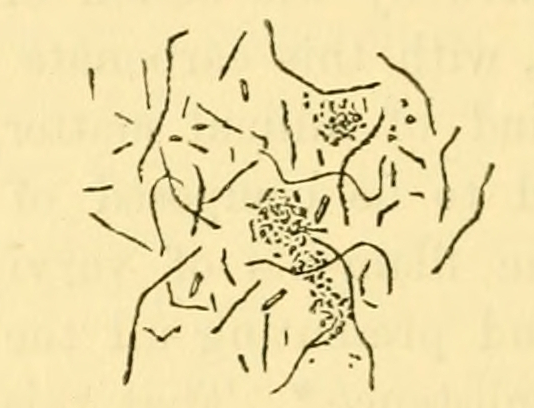
Fig. 68.
After the completion of fermentation there was not a trace of tartrate of lime remaining at the bottom of the vessel: it had disappeared gradually as it got broken up into the different products of fermentation, and its place was taken by some crystallized carbonate of lime—the excess, namely, which had been unable to dissolve by the action of the carbonic acid. Associated, moreover, with this carbonate of lime there was a quantity of some kind of animal matter, which, under the microscope, appeared to be composed of masses of granules mixed with very fine filaments of varying lengths, studded with minute dots, and presenting all the characteristics of a nitrogenous organic substance.[139] That this was really the ferment is evident enough from all that we have already said. To convince ourselves more thoroughly of the fact, and at the same time to enable us to observe the mode of activity of the organism, we instituted the following supplementary observation. Side by side with the experiment just described, we 290conducted a similar one, which we intermitted after the fermentation was somewhat advanced, and about half of the tartrate dissolved. Breaking off, with a file, the exit tube at the point where the neck began to narrow off, we took some of the deposit from the bottom by means of a long, straight piece of tubing, in order to bring it under microscopical examination. We found it to consist of a host of long filaments of extreme tenuity, their diameter being about 1/1000th of a millimetre (0·000039 in.); their length varied, in some cases being as much as 1/20th of a millimetre (0·0019 in.). A crowd of these long vibrios were to be seen creeping slowly along, with a sinuous movement, showing three, four, or even five flexures. The filaments that were at rest had the same aspect as these last, with the exception that they appeared punctate, as though composed of a series of granules arranged in irregular order. No doubt these were vibrios in which vital action had ceased, exhausted specimens which we may compare with the old granular ferment of beer, whilst those in motion may be compared with young and vigorous yeast. The absence of movement in the former seems to prove that this view is correct. Both kinds showed a tendency to form clusters, the compactness of which impeded the movements of those which were in motion. Moreover, it was noticeable that the masses of these latter rested on tartrate not yet dissolved, whilst the granular clusters of the others rested directly on the glass, at the bottom of the flask, as if, having decomposed the tartrate, the only carbonaceous food at their disposal, they had then died at the spot where we 291captured them from inability to escape, precisely in consequence of that state of entanglement which they combined to form, during the period of their active development. Besides these we observed vibrios of the same diameter, but of much smaller length, whirling round with great rapidity, and darting backwards and forwards; these were probably identical with the longer ones, and possessed greater freedom of movement, no doubt in consequence of their greater shortness. Not one of these vibrios could be found throughout the mass of the liquid.
We may remark that as there was a somewhat putrid odour from the deposit in which the vibrios swarmed, the action must have been one of reduction, and no doubt to this fact was due the greyish coloration of the deposit. We suppose that the substances employed, however pure, always contain some trace of iron, which becomes converted into the sulphide, the black colour of which would modify the originally white deposit of insoluble tartrate and phosphate.
But what is the nature of these vibrios? We have already said that we believe that they are nothing but the ordinary vibrios of putrefaction, reduced to a state of extreme tenuity by the special conditions of nutrition involved in the fermentable medium used; in a word, we think that the fermentation in question might be called putrefaction of tartrate of lime. It would be easy enough to determine this point by growing the vibrios of such a fermentation in media adapted to the production of the ordinary forms of vibrio; but this is an experiment which we have not ourselves tried.
One word more on the subject of these curious beings. In a great many of them there appears to be something like a clear spot, a kind of bead, at one of their extremities. This is an illusion arising from the fact that the extremity of these vibrios is curved, hanging downwards, thus causing a greater refraction at that particular point, and leading us to think that the diameter is greater at that extremity. We may easily undeceive ourselves if we watch the movements of the vibrio, when we will readily recognize the bend, especially as it is 292brought into the vertical plane passing over the rest of the filament. In this way we will see the bright spot, the head disappear, and then reappear.
The chief inference that it concerns us to draw from the preceding facts is one which cannot admit of doubt, and which we need not insist on any further—namely, that vibrios, as met with in the fermentation of neutral tartrate of lime, are able to live and multiply when entirely deprived of air.
§ V.—Another Example of Life Without Air—Fermentation of Lactate of Lime.
As another example of life without air, accompanied by fermentation properly so called, we may lastly cite the fermentation of lactate of lime in a mineral medium.
In the experiment described in the last paragraph, it will be remembered that the ferment-liquid and the germs employed in its impregnation came in contact with air, although only for a very brief time. Now, notwithstanding that we possess exact observations which prove that the diffusion of oxygen and nitrogen in a liquid absolutely deprived of air, so far from taking place rapidly, is, on the contrary, a very slow process indeed; yet we were anxious to guard the experiment that we are about to describe from the slightest possible trace of oxygen at the moment of impregnation.
We employed a liquid prepared as follows: Into from 9 to 10 litres (somewhat over 2 gallons) of pure water the following salts[140] were introduced successively, viz:—
293
Pure lactate of lime 225 grammes
Phosphate of ammonia 0·75 grammes
Phosphate of potassium 0·4 grammes
Sulphate of magnesium 0·4 grammes
Sulphate of ammonia 0·2 grammes
[1 gramme=15·43 grains.]
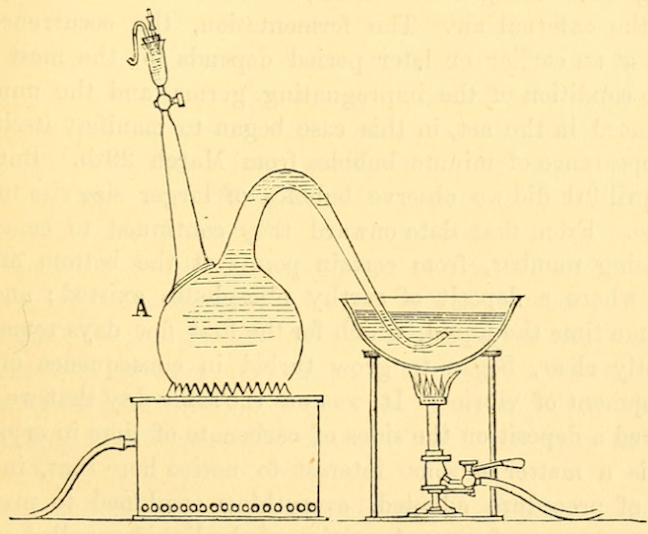
Fig. 69.
On March 23rd, 1875, we filled a 6 litre (about 11 pints) flask, of the shape represented in Fig. 69, and placed it over a heater. Another flame was placed below a vessel containing the same liquid, into which the curved tube of the flask was plunged. The liquids in the flask and in the basin were raised to boiling together, and kept in this condition for more than half-an-hour, so as to expel all the air held in solution. The liquid was several times forced out of the flask by the steam, and sucked back again; but the portion which re-entered the flask was always boiling. On the following day, when the flask had cooled, we transferred the end of the delivery tube to a 294vessel full of mercury and placed the whole apparatus in an oven at a temperature varying between 25° C. and 30° C. (77° F. and 86° F.); then, after having refilled the small cylindrical tap-funnel with carbonic acid, we passed into it with all necessary precautions 10 c.c. (0·35 fl. oz.) of a liquid similar to that described, which had been already in active fermentation for several days out of contact with air and now swarmed with vibrios. We then turned the tap of the funnel, until only a small quantity of liquid was left, just enough to prevent the access of air. In this way the impregnation was accomplished without either the ferment-liquid or the ferment-germs having been brought in contact, even for the shortest space, with the external air. The fermentation, the occurrence of which at an earlier or later period depends for the most part on the condition of the impregnating germs, and the number introduced in the act, in this case began to manifest itself by the appearance of minute bubbles from March 29th. But not till April 9th did we observe bubbles of larger size rise to the surface. From that date onward they continued to come in increasing number, from certain points at the bottom of the flask, where a deposit of earthy phosphates existed; and at the same time the liquid, which for the first few days remained perfectly clear, began to grow turbid in consequence of the development of vibrios. It was on the same day that we first observed a deposit on the sides of carbonate of lime in crystals.
It is a matter of some interest to notice here that, in the mode of procedure adopted, everything combined to prevent the interference of air. A portion of the liquid expelled at the beginning of the experiment, partly because of the increased temperature in the oven and partly also by the force of the gas, as it began to be evolved from the fermentative action, reached the surface of the mercury, where, being the most suitable medium we know for the growth of bacteria, it speedily swarmed with these organisms.[141] In this way any passage of air, if such 295a thing were possible, between the mercury and the sides of the delivery-tube was altogether prevented, since the bacteria would consume every trace of oxygen which might be dissolved in the liquid lying on the surface of the mercury. Hence it is impossible to imagine that the slightest trace of oxygen could have got into the liquid in the flask.
Before passing on we may remark that in this ready absorption of oxygen by bacteria we have a means of depriving fermentable liquids of every trace of that gas with a facility and success equal or even greater than by the method of preliminary boiling. Such a solution as we have described, if kept at summer heat, without any previous boiling, becomes turbid in the course of twenty-four hours from a spontaneous development of bacteria; and it is easy to prove that they absorb all the oxygen held in solution.[142] If we completely fill a flask of a few litres capacity (about a gallon) (Fig. 67) with the liquid described, taking care to have the delivery-tube also filled, and its opening plunged under mercury, and, forty-eight hours afterwards, by means of a chloride of calcium bath, expel from the liquid on the surface of the mercury all the gas which it holds in solution, this gas, when analyzed, will be found to be composed of a mixture of nitrogen and carbonic acid gas, without the least trace of oxygen. Here, then, we have an excellent means of depriving the fermentable liquid of air; we have simply to 296completely fill a flask with the liquid, and place it in the oven, merely avoiding any addition of butyric vibrios before the lapse of two or three days. We may wait even longer; and then, if the liquid does not become impregnated spontaneously with vibrio germs, the liquid, which at first was turbid from the presence of bacteria, will become bright again, since the bacteria when deprived of life, or, at least, of the power of moving, after they have exhausted all the oxygen in solution, will fall inert to the bottom of the vessel. On several occasions, we have determined this interesting fact, which tends to prove that the butyric vibrios cannot be regarded as another form of bacteria, inasmuch as, on the hypothesis of an original relation between the two productions, butyric fermentation ought in every case to follow the growth of bacteria.
We may also call attention to another striking experiment, well suited to show the effect of differences in the composition of the medium upon the propagation of microscopic beings. The fermentation which we last described commenced on March 27th and continued until May 10th; that to which we are now to refer, however, was completed in four days, the liquid employed being similar in composition and quantity to that employed in the former experiment. On April 23rd, 1875, we filled a flask of the same shape as that represented in Fig. 69, and of similar capacity, viz., 6 litres, with a liquid composed as described at page 293. This liquid had been previously left to itself for five days in large open flasks, in consequence of which it had developed an abundant growth of bacteria. On the fifth day a few bubbles, rising from the bottom of the vessels, at long intervals, betokened the commencement of butyric fermentation, a fact, moreover, confirmed by the microscope, in the appearance of the vibrios of this fermentation in specimens of the liquid taken from the bottom of the vessels, the middle of its mass, and even in the layer on the surface that was swarming with bacteria. We transferred the liquid so prepared to the 6-litre flask arranged over the mercury. By evening a tolerably active fermentation had 297begun to manifest itself. On the 24th this fermentation was proceeding with astonishing rapidity, which continued during the 25th and 26th. During the evening of the 26th it slackened, and on the 27th all signs of fermentation had ceased. This was not, as might be supposed, a sudden stoppage, due to some unknown cause; the fermentation was actually completed, for when we examined the fermented liquid on the 28th we could not find the smallest quantity of lactate of lime. If the needs of industry should ever require the production of large quantities of butyric acid, there would, beyond doubt, be found in the preceding fact valuable information in devising an easy method of preparing that product in abundance.[143]
Before we go any further, let us devote some attention to the vibrios of the preceding fermentations.
On May 27th, 1862, we completely filled a flask, capable of holding 2·780 litres (about five pints), with the solution of lactate and phosphates.[144] We refrained from impregnating it with any germs. The liquid became turbid from a development 298of bacteria, and then underwent butyric fermentation. By June 9th the fermentation had become sufficiently active to enable us to collect in the course of twenty-four hours, over mercury, as in all our experiments, about 100 cc. (about 6 cubic inches) of gas. By June 11th, judging from the volume of gas liberated in the course of twenty-four hours, the activity of the fermentation had doubled. We examined a drop of the turbid liquid. Here are the notes accompanying the sketch (Fig. 70) as they stand in our note-book:—“A swarm of vibrios, so active in their movements that the eye has great difficulty in following them. They may be seen in pairs throughout the field, apparently making efforts to separate from each other. The connection would seem to be by some invisible, gelatinous thread, which yields so far to their efforts that they succeed in breaking away from actual contact, but yet are, for a while, so far restrained that the movements of one have a visible effect on those of the other. By and by, however, we see a complete separation effected, and each moves on its separate way with an activity still greater than it had before.”
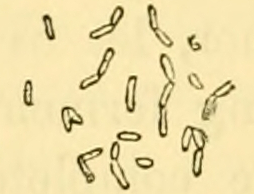
Fig. 70.
One of the best methods that can be employed for the microscopical examination of these vibrios, quite out of contact with air, is the following:—After butyric fermentation has been going on for several days in a flask, A (Fig. 71), we connect this flask by an india-rubber tube with one of the flattened bulbs previously described, page 156 (Fig. 31), which we then place on the stage of the microscope (Fig. 71). When we wish to make an observation we close, under the mercury, at the point b, the end of the drawn-out and bent delivery-tube. The continued evolution of gas soon exerts such a pressure within the flask, that when we open the tap r, the liquid is 299driven into the bulb l l, until it becomes quite full and the liquid flows over into the glass V. In this manner we may bring the vibrios under observation without their coming into contact with the least trace of air, and with as much success as if the bulb, which takes the place of an object glass, had been plunged into the very centre of the flask. The movements and fissiparous multiplication of the vibrios may thus be seen in all their beauty, and it is indeed a most interesting sight. The movements do not immediately cease when the temperature is suddenly lowered, even to a considerable extent, 15° C. (59° F.) for example; they are only slackened. Nevertheless, it is better to observe them at the temperatures most favourable to fermentation, even in the oven where the vessels employed in the experiment are kept at a temperature between 25° C. and 30° C. (77° F. and 86° F.).
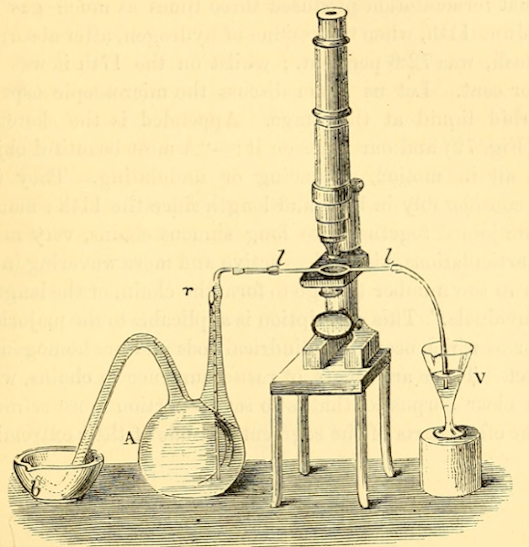
Fig. 71.
300We may now continue our account of the fermentation which we were studying when we made this last digression. On June 17th that fermentation produced three times as much gas as it did on June 11th, when the residue of hydrogen, after absorption by potash, was 72·6 per cent.; whilst on the 17th it was only 49·2 per cent. Let us again discuss the microscopic aspect of the turbid liquid at this stage. Appended is the sketch we made (Fig. 72) and our notes on it:—“A most beautiful object: vibrios all in motion, advancing or undulating. They have grown considerably in bulk and length since the 11th; many of them are joined together into long sinuous chains, very mobile at the articulations, visibly less active and more wavering in proportion to the number that go to form the chain, or the length of the individuals.” This description is applicable to the majority of the vibrios which occur in cylindrical rods and are homogeneous in aspect. There are others, of rare occurrence in chains, which have a clear corpuscle, that is to say, a portion more refractive than the other parts of the segments, at one of their extremities. Sometimes the foremost segment has the corpuscle at one end, sometimes at the other. The long segments of the commoner kind attain a length of from 10 to 30 and even 45 thousandths of a millimetre. Their diameter is from 1-½ to 2, very rarely 3, thousandths of a millimetre.[145]
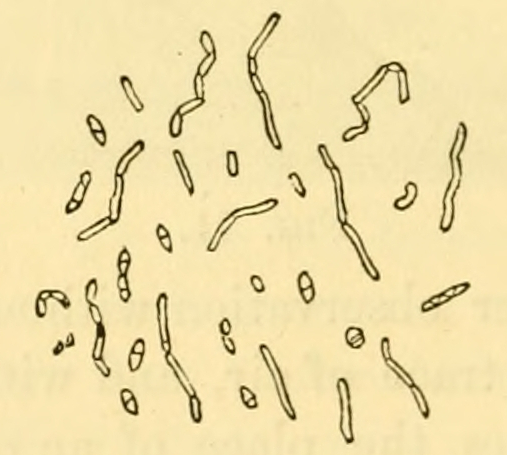
Fig. 72.
301
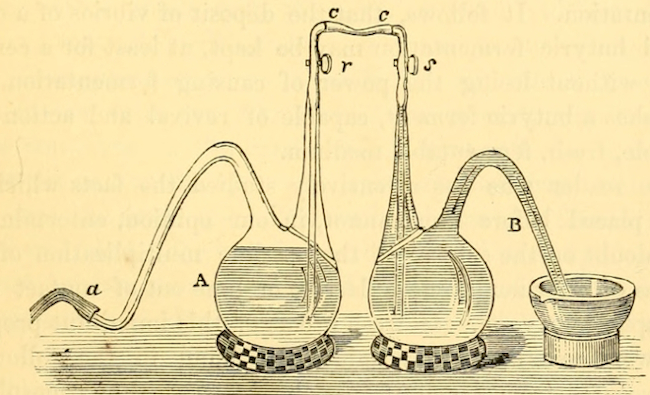
Fig. 73.
On June 28th, fermentation was quite finished; there was no longer any trace of gas, nor any lactate in solution. All the infusoria were lying motionless at the bottom of the flask. The liquid clarified by degrees, and in the course of a few days became quite bright. Here we may inquire, were these motionless infusoria, which from complete exhaustion of the lactate, the source of the carbonaceous part of their food, were now lying inert at the bottom of the fermenting vessel—were they dead beyond power of revival?[146] The following experiment leads us to believe that they were not perfectly lifeless, and that they behave in the same manner as the yeast of beer, which, after it has decomposed all the sugar in a fermentable liquid, is ready to revive and multiply in a fresh saccharine medium. On April 22nd, 1875, we left in the oven, at a temperature of 25° C. (77° F.), a fermentation of lactate of lime that had been completed. The delivery tube of the flask, 302A, (Fig. 73) in which it had taken place had never been withdrawn from under the mercury. We kept the liquid under observation daily, and saw it gradually become brighter; this went on for fifteen days. We then filled a similar flask, B, with the solution of lactate, which we boiled, not only to kill the germs of vibrios which the liquid might contain, but also to expel the air that it held in solution. When the flask, B, had cooled, we connected the two flasks, avoiding the introduction of air[147], after having slightly shaken the flask, A, to stir up the deposit at the bottom. There was then a pressure, due to carbonic acid at the end of the delivery tube of this latter flask, at the point a, so that on opening the taps r and s, the deposit at the bottom of flask A was driven over into flask B, which in consequence was impregnated with the deposit of a fermentation that had been completed fifteen days before. Two days after impregnation, the flask B began to show signs of fermentation. It follows, that the deposit of vibrios of a completed butyric fermentation may be kept, at least for a certain time, without losing the power of causing fermentation. It furnishes a butyric ferment, capable of revival and action in a suitable, fresh, fermentable medium.
The reader who has attentively studied the facts which we have placed before him cannot, in our opinion, entertain the least doubt on the subject of the possible multiplication of the vibrios of a fermentation of lactate of lime out of contact with atmospheric oxygen. If fresh proofs of this important proposition were necessary, they might be found in the following observations, from which it may be inferred that atmospheric oxygen is capable of suddenly checking a fermentation produced by butyric vibrios, and rendering them absolutely motionless, so that it cannot be necessary to enable them to live. On May 7th, 1862, we placed in the oven a flask holding 2·580 litres (4-½ pints), and filled with the solution of 303lactate of lime and phosphates, which we had impregnated on the 9th with two drops of a liquid in butyric fermentation. In the course of a few days fermentation declared itself: on the 16th it was in progress, but feebly; on the 18th it was active; on the 30th it was very active. On June 1st it yielded hourly 35 c.c. (2·3 cubic inches) of gas, containing ten per cent. of hydrogen. On the 2nd we began the study of the action of air on the vibrios of this fermentation. To do this we cut off the delivery-tube on a level with its point of junction to the flask, then with a 50 c.c. pipette we took out that quantity (1-3/4 fl. oz.) of liquid which was, of course, replaced at once by air. We then reversed the flask with the opening under the mercury, and shook it every ten minutes for more than an hour. Wishing to make sure, to begin with, that the oxygen had been absorbed, we connected under the mercury the beak of the flask by means of a thin india-rubber tube filled with water, with a small flask, the neck of which had been drawn out, and was filled with water; we then raised the large flask with the smaller kept above it. A Mohr’s clip, which closed the india-rubber tube, and which we then opened, permitted the water contained in the small flask to pass into the large one, whilst the gas, on the contrary, passed upwards from the large flask into the small one. We analyzed the gas immediately, and found that, allowing for carbonic acid and hydrogen, it did not contain more than 14·2 per cent. of oxygen, which corresponds to an absorption of 6·6 c.c., or of 3·3 c.c. (0·2 cubic inch) of oxygen for the 50 c.c. (3·05 cubic inches) of air employed. Lastly, we again established connection by an india-rubber tube between the flasks, after having seen by microscopical examination that the movements of the vibrios were very languid. Fermentation had become less vigorous without having actually ceased, no doubt because some portions of the liquid had not been brought into contact with the atmospheric oxygen, in spite of the prolonged shaking that the flask had undergone after the introduction of the air. Whatever the cause might have been, the significance of the phenomenon is 304not doubtful. To assure ourselves further of the effect of air on the vibrios, we half filled two test tubes with the fermenting liquid taken from another fermentation which had also attained its maximum of intensity, into one of which we passed a current of air, into the other carbonic acid gas. In the course of half an hour, all the vibrios in the aerated tube were dead, or at least motionless, and fermentation had ceased. In the other tube, after three hours’ exposure to the effects of the carbonic acid gas, the vibrios were still very active, and fermentation was going on.
There is a most simple method of observing the deadly effect of atmospheric air upon vibrios. We have seen in the microscopical examination made by means of the apparatus represented in Fig. 71, how remarkable were the movements of the vibrios when absolutely deprived of air, and how easy it was to discern them. We will repeat this observation, and at the same time make a comparative study of the same liquid, under the microscope, in the ordinary way, that is to say, by placing a drop of the liquid on an object-glass, and covering it with a thin glass slip, a method which must necessarily bring the drop into contact with air, if only for a moment. It is surprising what a remarkable difference is observed immediately between the movements of the vibrios in the bulb and of those under the glass. In the case of the latter we generally see all movement at once cease near the edges of the glass, where the drop of liquid is in direct contact with the air; the movements continue for a longer or shorter time about the centre, in proportion as the air is more or less intercepted by the vibrios at the circumference of the liquid. It does not require much skill in experiments of this kind to enable one to see plainly that immediately after the glass has been placed on the drop, which has been affected all over by atmospheric air, the whole of the vibrios seem to languish and to manifest symptoms of illness—we can think of no better expression to explain what we see taking place—and that they gradually recover their activity about the centre, in proportion as they find themselves in a 305part of the medium that is less affected by the presence of oxygen.
Some most curious facts are to be found in connection with an observation, the correlative and inverse of the foregoing, on the ordinary aërobian bacteria. If we examine below the microscope a drop of liquid full of these organisms under a coverslip, we very soon observe a cessation of motion in all the bacteria which lie in the central portion of the liquid, where the oxygen rapidly disappears to supply the necessities of the bacteria existing there; whilst, on the other hand, near the edges of the cover-glass the movements are very active, in consequence of the constant supply of air. In spite of the speedy death of the bacteria beneath the centre of the glass, we see life prolonged there if by chance a bubble of air has been enclosed. All round this bubble a vast number of bacteria collect in a thick, moving circle, but as soon as all the oxygen of the bubble has been absorbed they fall apparently lifeless, and are scattered by the movement of the liquid.[148]
We may here be permitted to add, as a purely historical matter, that it was these two observations just described, made successively one day in 1861, on vibrios and bacteria, that first suggested to us the idea of the possibility of life without air, and caused us to think that the vibrios which we met so frequently in our lactic fermentations must be the true butyric ferment.
We may pause a moment to consider an interesting question in reference to the two characters under which vibrios appear in butyric fermentations. What is the reason that some vibrios exhibit refractive corpuscles, generally of a lenticular form, 306such as we see in Fig. 72? We are strongly inclined to believe that these corpuscles have to do with a special mode of reproduction in the vibrios, common alike to the anaërobian forms which we are studying, and the ordinary aërobian forms in which also the corpuscles of which we are speaking may occur. The explanation of the phenomenon, from our point of view, would be that, after a certain number of fissiparous generations, and under the influence of variations in the composition of the medium, which is constantly changing through fermentation as well as through the active life of the vibrios themselves, cysts, which are simply the refractive corpuscles, form along them at different points. From these gemmules we have ultimately produced vibrios, ready to reproduce others by the process of transverse division for a certain time, to be themselves encysted later on. Various observations incline us to believe that, in their ordinary form of minute, soft, exuberant rods, the vibrios perish when submitted to desiccation, but when they occur in the corpuscular or encysted form they possess unusual powers of resistance, and may be brought to the state of dry dust and be wafted about by winds. None of the matter which surrounds the corpuscle or cyst seems to take part in the preservation of the germ, when the cyst is formed, for it is all re-absorbed, gradually leaving the cyst bare. The cysts appear as masses of corpuscles, in which the most practised eye cannot detect anything of an organic nature, or anything to remind one of the vibrios which produced them; nevertheless, these minute bodies are endowed with a latent vital action, and only await favourable conditions to develop long rods of vibrios. We are not, it is true, in a position to adduce any very forcible proofs in support of these opinions. They have been suggested to us by experiments, none of which, however, have been absolutely decisive in their favour. We may cite one of our observations on this subject.
In a fermentation of glycerine in a mineral medium—the glycerine was fermenting under the influence of butyric vibrios—after we had determined the, we may say, exclusive presence 307of lenticular vibrios, with refractive corpuscles, we observed the fermentation, which, for some unknown reason, had been very languid, suddenly become extremely active, but now through the influence of ordinary vibrios. The gemmules with brilliant corpuscles had almost disappeared; we could see but very few, and those now consisted of the refractive bodies alone, the bulk of the vibrios accompanying them having undergone some process of re-absorption.
Another observation which still more closely accords with this hypothesis is given in our work on the silkworm disease (vol. i., page 256). We there demonstrate that, when we place in water some of the dust formed of desiccated vibrios, containing a host of these refractive corpuscles, in the course of a very few hours large vibrios appear, well-developed rods fully grown, in which the brilliant points are absent; whilst in the water no process of development from smaller vibrios is to be discerned, a fact which seems to show that the former had issued fully grown from the refractive corpuscles, just as we see colpoda issue with their adult aspect from the dust of their cysts. This observation, we may remark, furnishes one of the best proofs that can be adduced against the spontaneous generation of vibrios or bacteria, since it is probable that the same observation applies to bacteria. It is true that we cannot say of mere points of dust, examined under the microscope, that one particular germ belongs to vibrio, another to bacterium; but how is it possible to doubt that the vibrios issue, as we see them, from an ovum of some kind, a cyst, or germ, of determinate character, when, after having placed some of these indeterminate motes of dust into clean water, we suddenly see, after an interval of not more than one or two hours, an adult vibrio crossing the field of the microscope, without our having been able to detect any intermediate state between its birth and adolescence?
It is a question whether differences in the aspect and nature of vibrios, which depend upon their more or less advanced age, or are occasioned by the influence of certain conditions of the 308medium in which they propagate, do not bring about corresponding changes in the course of the fermentation and the nature of its products. Judging at least from the variations in the proportions of hydrogen and carbonic acid gas produced in butyric fermentations, we are inclined to think that this must be the case; nay, more, we find that hydrogen is not even a constant product in these fermentations. We have met with butyric fermentations of lactate of lime which did not yield the minutest trace of hydrogen, or anything besides carbonic acid. Fig. 74 represents the vibrios which we observed in a fermentation of this kind. They present no special features. Butyl alcohol is, according to our observations, an ordinary product, although it varies and is by no means a necessary concomitant of these fermentations. It might be supposed, since butylic alcohol may be produced, and hydrogen be in deficit, that the proportion of the former of these products would attain its maximum when the latter assumed a minimum. This, however, is by no means the case; even in those few fermentations that we have met with in which hydrogen was absent, there was no formation of butylic alcohol.
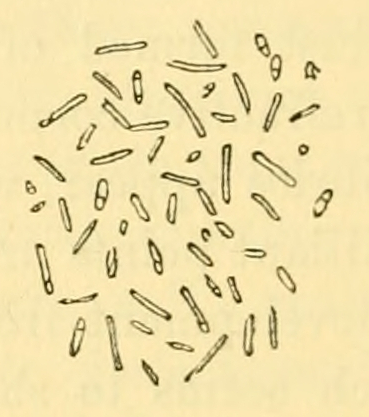
Fig. 74.
From a consideration of all the facts detailed in this paragraph we can have no hesitation in concluding that, on the one hand, in cases of butyric fermentation, the vibrios which abound in them and constitute their ferment, live without air or free oxygen; and that, on the other hand, the presence of gaseous oxygen operates prejudicially against the movements and activity of those vibrios. But now does it follow that the 309presence of minute quantities of air brought into contact with a liquid undergoing butyric fermentation would prevent the continuance of that fermentation, or even exercise any check upon it? We have not made any direct experiments upon this subject; but we should not be surprised to find that, so far from hindering, air may, under such circumstances, facilitate the propagation of the vibrios and accelerate fermentation. This is exactly what happens in the case of yeast. But how could we reconcile this, supposing it were proved to be the case, with the fact just insisted on as to the danger of bringing the butyric vibrios into contact with air? It may be possible that life without air results from habit, whilst death through air may be brought about by a sudden change in the conditions of the existence of the vibrios. The following remarkable experiment is well known: A bird is placed in a glass jar of one or two litres (60 to 120 cubic inches) in capacity, which is then closed. After a time the creature exhibits every sign of intense uneasiness and asphyxia long before it dies; a similar bird of the same size is introduced into the jar; the death of the latter takes place instantaneously, whilst the life of the former may still be prolonged under these conditions for a considerable time, and there is no difficulty even in restoring the bird to perfect health by taking it out of the jar. It seems impossible to deny that we have here a case of the adaptation of an organism to the gradual contamination of the medium; and so it may likewise happen that the anaërobian vibrios of a butyric fermentation, which develop and multiply absolutely without free oxygen, perish immediately when suddenly taken out of their airless medium, and that the result might be different if they had been gradually brought under the action of air in small quantities at a time.
We are compelled here to admit that vibrios frequently abound in liquids exposed to the air, and that they appropriate the atmospheric oxygen, and could not withstand a sudden removal from its influence. Must we, then, believe that such vibrios are absolutely different from those of butyric fermentations? 310It would, perhaps, be more natural to admit that in the one case there is an adaptation to life with air, and in the other case an adaptation to life without air; each of these varieties perishing when suddenly transferred from its habitual condition to that of the other, whilst by a series of progressive changes one might be modified into the other.[149] We know that in the case of alcoholic ferments, although these can actually live without air, propagation is wonderfully assisted by the presence of minute quantities of air; and certain experiments, which we have not yet published, lead us to believe that, after having lived without air, they cannot be suddenly exposed with impunity to the influence of large quantities of oxygen.
We must not forget, however, that aërobian torulæ and anaërobian ferments present an example of organisms apparently identical, in which, however, we have not yet been able to discover any ties of a common origin. Hence we were forced to regard them as distinct species; and so it is possible that there may likewise be aërobian and anaërobian vibrios without any transformation of the one into the other.
The question has been raised whether vibrios, especially those which we have shown to be the ferment of butyric and many other fermentations, are, in their nature, animal or vegetable. M. Ch. Robin attaches great importance to the solution of this question, of which he speaks as follows[150]:—“The determination of the nature, whether animal or vegetable, of organisms, either as a whole or in respect to their anatomical parts, assimilative or reproductive, is a problem which has been capable of solution for a quarter of a century. The method has been brought to a state of remarkable precision, experimentally, as well as in its theoretical aspects, since those who devote their attention to the organic sciences consider it indispensable in every observation and experiment 311to determine accurately, before anything else, whether the object of their study is animal or vegetable in its nature, whether adult or otherwise. To neglect this is as serious an omission for such students, as for chemists would be the neglecting to determine whether it is nitrogen or hydrogen, urea or stearine that has been extracted from a tissue, or which it is whose combinations they are studying in this or that chemical operation. Now, scarcely any one of those who study fermentations, properly so called, and putrefactions, ever pay attention to the preceding data.... Among the observers to whom I allude even M. Pasteur is to be found, who, even in his most recent communications, omits to state definitely what is the nature of many of the ferments which he has studied, with the exception, however, of those which belong to the cryptogamic group called torulaceæ. Various passages in his works seem to show that he considers the cryptogamic organisms called bacteria, as well as those known as vibrios, as belonging to the animal kingdom (see Bulletin de l’Académie de Médecine, Paris, 1875, pp. 249, 251, especially 256, 266, 267, 289, and 290). These would be very different, at least physiologically, the former being aërobian, whilst the vibrios are anaërobian, that is to say, requiring no air to enable them to live, and being killed by oxygen, should it be dissolved in the liquid to any considerable extent.”
We are unable to see the matter in the same light as our learned colleague does; to our thinking, we should be labouring under a great delusion were we to suppose “that it is quite as serious an omission not to determine the animal or vegetable nature of a ferment as it would be to confound nitrogen with hydrogen, or urea with stearine.” The importance of the solutions of disputed questions often depends upon the point of view from which these are regarded. As far as the result of our labours is concerned, we devoted our attention to these two questions exclusively:—1. Is the ferment, in every fermentation properly so called, an organized being? 2. Can this organized being live without air? Now, what bearing can the 312question of the animal or vegetable nature of the ferment, of the organized being, have upon the investigation of these two problems? In studying butyric fermentation, for example, we endeavoured to establish these two fundamental points:—1. The butyric ferment is a vibrio. 2. This vibrio may dispense with air in its life, and, as a matter of fact, does dispense with it in the act of producing butyric fermentation. We did not consider it at all necessary to pronounce any opinion as to the animal or vegetable nature of this organism, and, even up to the present moment, the idea that vibrio is an animal and not a plant is, in our minds, a matter of sentiment rather than of conviction.
M. Robin, however, would have no difficulty in determining the limits of the two kingdoms. According to him, “every variety of cellulose is, we may say, insoluble in ammonia, as also are the reproductive elements of plants, whether male or female. Whatever phase of evolution the elements which reproduce a new individual may have reached, treatment with this reagent, either cold or raised to boiling, leaves them absolutely intact under the eyes of the observer, except that their contents, from being partially dissolved, become more transparent. Every vegetable, whether microscopic or not, every mycelium, and every spore thus preserves in its entirety its special characteristics of form, volume, and structural arrangements; whilst in the case of microscopic animals, or the ova and microscopic embryos of different members of the animal kingdom, the very opposite is the case.”
We should be glad to learn that the employment of a drop of ammonia would enable us to pronounce an opinion, with this degree of confidence, on the nature of the lowest microscopic beings; but is M. Robin absolutely correct in his assumptions? That gentleman himself remarks that spermatozoa, which belong to animal organisms, are insoluble in ammonia, the effect of which is merely to make them paler. If a difference of action in certain reagents, in ammonia, for example, were sufficient to determine the limits of the animal and vegetable kingdoms, might we not argue that there must 313be a very great and natural difference between moulds and bacteria, inasmuch as the presence of a small quantity of acid in the nutritive medium facilitates the growth and propagation of the former, whilst it is able to prevent the life of bacteria and vibrios? Although, as is well known, movement is not an exclusive characteristic of animals, yet we have always been inclined to regard vibrios as animals, on account of the peculiar character of their movements. How greatly they differ in this respect from the diatomacæ, for example! When the vibrio encounters an obstacle it turns, or after having assured itself by some visual effort or other that it cannot overcome it, it retraces its steps. The colpoda—undoubted infusoria—behave in an exactly similar manner. It is true one may argue that the zoospores of certain cryptogamia exhibit similar movements; but do not these zoospores possess as much of an animal nature as do the spermatozoa? As far as bacteria are concerned, when, as already remarked, we see them crowd round a bubble of air in a liquid to prolong their life, oxygen having failed them everywhere else, how can we avoid believing that they are animated by an instinct for life, of the same kind as that which we find in animals. M. Robin seems to us to be wrong in supposing that it is possible to draw any absolute line of separation between the animal and vegetable kingdoms. The settlement of this line, however, we repeat again, no matter what it may be, has no serious bearing upon the questions that have been the subject of our researches.
In like manner the difficulty which M. Robin has raised in objecting to the employment of the word germ, when we cannot specify whether the nature of that germ is animal or vegetable, is in many respects an unnecessary one. In all the questions which we have discussed, whether we were speaking of fermentation or spontaneous generation, the word germ has been used in the sense of origin of living organism. If Liebig, for example, said of an albuminous substance that it gave birth to ferment, could we contradict him more plainly than by replying: “No; ferment is an organized being, the germ of which 314is always present, and the albuminous substance merely serves by its occurrence to nourish the germ and its successive generations.”
In our Memoir of 1862, on so-called spontaneous generations, would it not have been an entire mistake to have attempted to assign specific names to the microscopic organisms which we met with in the course of our observations? Not only would we have met with extreme difficulty in the attempt, arising from the state of extreme confusion which even in the present day exists in the classification and nomenclature of these microscopic organisms, but we should have been forced to sacrifice clearness in our work besides; at all events, we should have wandered from our principal object, which was the determination of the presence or absence of life in general, and had nothing to do with the manifestation of a particular kind of life in this or that species, animal or vegetable. Thus we have systematically employed the vaguest nomenclature, such as mucors, torulæ, bacteria, and vibrios. There was nothing arbitrary in our doing this, whereas there is much that is arbitrary in adopting a definite system of nomenclature, and applying it to organisms but imperfectly known, the differences or resemblances between which are only recognizable through certain characteristics, the true signification of which is obscure. Take, for example, the extensive array of widely different systems that have been invented during the last few years for the species of the genera bacterium and vibrio in the works of Cohn, H. Hoffmann, Hallier, and Billroth. The confusion which prevails here is very great, although we do not of course by any means place these different works on the same footing as regards their respective merits.
M. Robin is, however, right in recognizing the impossibility of maintaining in the present day, as he formerly did, “that fermentation is an exterior phenomenon, going on outside cryptogamic cells, a phenomenon of contact. It is probably,” he adds, “an interior and molecular action at work in the inmost recesses of the substance of each cell.” From the day when we first 315proved that it is possible for all organized ferments, properly so called, to spring up and multiply from their respective germs, sown, whether consciously or by accident, in a mineral medium free from organic and nitrogenous matters other than ammonia, in which medium the fermentable matter alone is adapted to provide the ferment with whatever carbon enters into its composition, from that time forward the theories of Liebig, as well as that of Berzelius, which M. Robin formerly defended, have had to give place to others more in harmony with facts. We trust that the day will come when M. Robin will likewise acknowledge that he has been in error on the subject of the doctrine of spontaneous generation, which he continues to affirm, without adducing any direct proofs in support of it, at the end of the article to which we have been here replying.
We have devoted the greater part of this chapter to the establishing with all possible exactness the extremely important physiological fact of life without air, and its correlation to the phenomena of fermentations properly so called—that is to say, of those which are due to the presence of microscopic cellular organisms. This is the chief basis of the new theory that we propose for the explanation of these phenomena. The details into which we have entered were indispensable on account of the novelty of the subject no less than on account of the necessity we were under of combating the criticisms of the two German naturalists, Drs. Oscar Brefeld and Traube, whose works had cast some doubts on the correctness of the facts upon which we had based the preceding propositions. We have much pleasure in adding that at the very moment when we were revising the proofs of this chapter, we received from M. Brefeld an essay, dated from Berlin, January, 1876, in which, after describing his later experimental researches, he owns with praiseworthy frankness that Dr. Traube and he were both of them mistaken. Life without air is now a proposition which he accepts as perfectly demonstrated. He has witnessed it in the case of mucor racemosus, and has also verified it in the case of yeast. “If,” he says, “after the results of my previous researches, which I 316conducted with all possible exactness, I was inclined to consider Pasteur’s assertions as inaccurate, and to attack them, I have no hesitation now in recognizing them as true, and in proclaiming the service which Pasteur has rendered to science in being the first to indicate the exact relation of things in the phenomenon of fermentation.” In his later researches. Dr. Brefeld has adopted the method which we have long employed for demonstrating the life and multiplication of butyric vibrios in the entire absence of air, as well as the method of conducting growths in mineral media associated with the fermentable substance. We need not pause to consider certain other secondary criticisms of Dr. Brefeld. A perusal of the present work will, we trust, convince him that they are based on no surer foundation than were his former criticisms.
To bring one’s self to believe in a truth that has just dawned upon one is the first step towards progress; to persuade others is the second. There is a third step, less useful perhaps, but highly gratifying nevertheless, which is, to convince one’s opponents.
We, therefore, have experienced great satisfaction in learning that we have won over to our ideas an observer of singular ability, on a subject which is of the utmost importance to the physiology of cells.
§ VI.—Reply to the Critical Observations of Liebig, Published in 1870.[151]
In the Memoir which we published, in 1860, on alcoholic fermentation, and in several subsequent works, we were led to a different conclusion on the causes of this very remarkable phenomenon from that which Liebig had adopted. The opinions of Mitscherlich and Berzelius had ceased to be tenable in the presence of the new facts which we had brought to light. From 317that time we felt sure that the celebrated chemist of Munich had adopted our conclusions, from the fact that he remained silent on this question for a long time, although it had been until then the constant subject of his study, as is shown by all his works. Suddenly there appeared in the Annales de Chimie et de Physique a long essay, reproduced from a lecture delivered by him before the Academy of Bavaria in 1868 and 1869. In this Liebig again maintained, not, however, without certain modifications, the views which he had expressed in his former publications, and disputed the correctness of the principal facts enunciated in our Memoir of 1860, on which were based the arguments against his theory.
“I had admitted,” he says, “that the resolution of fermentable matter into compounds of a simpler kind must be traced to some process of decomposition taking place in the ferment, and that the action of this same ferment on the fermentable matter must continue or cease according to the prolongation or cessation of the alteration produced in the ferment. The molecular change in the sugar would, consequently, be brought about by the destruction or modification of one or more of the component parts of the ferment, and could only take place through the contact of the two substances. M. Pasteur regards fermentation in the following light:—The chemical action of fermentation is essentially a phenomenon correlative with a vital action, beginning and ending with it. He believes that alcoholic fermentation can never occur without the simultaneous occurrence of organization, development, and multiplication of globules, or continuous life, carried on from globules already formed. But the idea that the decomposition of sugar during fermentation is due to the development of the cellules of the ferment, is in contradiction with the fact that the ferment is able to bring about the fermentation of a pure solution of sugar. The greater part of the ferment is composed of a substance that is rich in nitrogen and contains sulphur. It contains, moreover, an appreciable quantity of phosphates, hence it is difficult to conceive how, in the absence of these elements in a pure solution 318of sugar undergoing fermentation, the number of cells is capable of any increase.”
Notwithstanding Liebig’s belief to the contrary, the idea that the decomposition of sugar during fermentation is intimately connected with a development of the cellules of the ferment, or a prolongation of the life of cellules already formed, is in no way opposed to the fact that the ferment is capable of bringing about the fermentation of a pure solution of sugar. It is manifest to any one who has studied such fermentation with the microscope, even in those cases where the sweetened water has been absolutely pure, that ferment-cells do multiply, the reason being that the cells carry with them all the food-supplies necessary for the life of the ferment. They may be observed budding, at least many of them, and there can be no doubt that those which do not bud still continue to live; life has other ways of manifesting itself besides development and cell-proliferation.
If we refer to the figures on page 81 of our Memoir of 1860, Experiments D, E, F, G, H, I, we shall see that the weight of yeast, in the case of the fermentation of a pure solution of sugar, undergoes a considerable increase, even without taking into account the fact that the sugared water gains from the yeast certain soluble parts, since, in the experiments just mentioned, the weights of solid yeast, washed and dried at 100° C. (212° F.), are much greater than those of the raw yeast employed, dried at the same temperature.
In these experiments we employed the following weights of yeast, expressed in grammes (1 gramme = 15·43 grains)—
2·313
2·626
1·198
0·699
0·326
0·476
which became after fermentation, we repeat, without taking 319into account the matters which the sugared water gained from the yeast—
grammes. grains.
2·486 [Increase 0·173 = 2·65
2·963 “ 0·337 = 5·16
1·700 ” 0·502 = 7·7
0·712 “ 0·013 = 0·2
0·335 ” 0·009 = 0·14
0·590 “ 0·114 = 1·75
Have we not in this marked increase in weight a proof of life, or, to adopt an expression which may be preferred, a proof of a profound chemical work of nutrition and assimilation?
We may cite on this subject one of our earlier experiments, which is to be found in the Comptes rendus de l’Académie for the year 1857, and which clearly shows the great influence exerted on fermentation by the soluble portion that the sugared water takes up from the globules of ferment:—
“We take two equal quantities of fresh yeast that have been washed very freely. One of these we cause to ferment in water containing nothing but sugar, and, after removing from the other all its soluble particles—by boiling it in an excess of water and then filtering it to separate the globules—we add to the filtered liquid as much sugar as was used in the first case along with a mere trace of fresh yeast, insufficient, as far as its weight is concerned, to affect the results of our experiment. The globules which we have sown bud, the liquid becomes turbid, a deposit of yeast gradually forms, and, side by side with these appearances, the decomposition of the sugar is effected, and in the course of a few hours manifests itself clearly. These results are such as we might have anticipated. The following fact, however, is of importance. In effecting by these means the organization into globules of the soluble part of the yeast that we used in the second case, we find that a considerable quantity of sugar is decomposed. The following are the results of our experiment: 5 grammes of yeast caused the fermentation of 12·9 320grammes of sugar in six days, at the end of which time it was exhausted. The soluble portion of a like quantity of 5 grammes of the same yeast caused the fermentation of 10 grammes of sugar in nine days, after which the yeast developed by the sowing was likewise exhausted.”
How is it possible to maintain that, in the fermentation of water containing nothing but sugar, the soluble portion of the yeast does not act, either in the production of new globules or the perfection of old ones, when we see, in the preceding experiment, that after this nitrogenous and mineral portion has been removed by boiling, it immediately serves for the production of new globules, which, under the influence of the sowing of a mere trace of globules, causes the fermentation of much sugar?[152]
In short, Liebig is not justified in saying that the solution of pure sugar, caused to ferment by means of yeast, contains none of the elements needed for the growth of yeast, neither nitrogen, sulphur, nor phosphorus, and that, consequently, it should not be possible, by our theory, for the sugar to ferment. On the contrary, the solution does contain all these elements, as a consequence of the introduction and presence of the yeast.
Let us proceed with our examination of Liebig’s criticisms:—
“To this,” he goes on to say, “must be added the decomposing action which yeast exercises on a great number of substances, 321and which resembles that which sugar undergoes. I have shown that malate of lime ferments readily enough through the action of yeast, and that it splits up into three other calcareous salts, namely the acetate, the carbonate, and the succinate. If the action of yeast consists in its increase and multiplication, it is difficult to conceive this action in the case of malate of lime and other calcareous salts of vegetable acids.”
This statement, with all due deference to the opinion of our illustrious critic, is by no means correct. Yeast has no action on malate of lime, or on other calcareous salts formed by vegetable acids. Liebig had previously, much to his own satisfaction, brought forward urea as being capable of transformation into carbonate of ammonia during alcoholic fermentation in contact with yeast. This has been proved by us to be erroneous. It is an error of the same kind that Liebig again brings forward here. In the fermentation of which he speaks (that of malate of lime), certain spontaneous ferments are produced, the germs of which are associated with the yeast, and develop in the mixture of yeast and malate. The yeast merely serves as a source of food for these new ferments without taking any direct part in the fermentations of which we are speaking. Our researches leave no doubt on this point, as is evident from the observations on the fermentations of tartrate of lime previously given.
It is true that there are circumstances under which yeast brings about modifications in different substances. Doebereiner and Mitscherlich, more especially, have shown that yeast imparts to water a soluble material, which liquefies cane-sugar and produces inversion in it by causing it to take up the elements of water, just as diastase behaves to starch or emulsin to amygdalin.
M. Berthelot also has shown that this substance may be isolated by precipitating it with alcohol, in the same way as diastase is precipitated from its solutions.[153] These are remarkable 322facts, which are, however, at present but vaguely connected with the alcoholic fermentation of sugar by means of yeast. The researches in which we have proved the existence of special forms of living ferments in many fermentations, which one might have supposed to have been produced by simple contact action, had established beyond doubt the existence of profound differences between those fermentations, which we have distinguished 323as fermentations proper, and the phenomena connected with soluble substances. The more we advance, the more clearly we are able to detect these differences. M. Dumas has insisted on the fact that the ferments of fermentation proper multiply and reproduce themselves in the process, whilst the others are destroyed.[154] Still more recently M. Müntz has shown that chloroform prevents fermentations proper, but does not interfere with the action of diastase (Comptes rendus, 1875.) M. Bouchardat had already established the fact that “hydrocyanic acid, salts of mercury, ether, alcohol, creosote, and the oils of turpentine, lemon, cloves, and mustard destroy or check alcoholic fermentation, whilst in no way interfering with the glucoside fermentations” (Annales de Chimie et de Physique, 3rd series, t. xiv., 1845.) We may add, in praise of M. Bouchardat’s sagacity, that that skilful observer has always considered these results as a proof that alcoholic fermentation is dependent on the life of the yeast-cell, and that a distinction should be made between the two orders of fermentation.
M. Paul Bert, in his remarkable studies on the influence of 324barometric pressure on the phenomena of life, has recognized the fact that compressed oxygen is fatal to certain ferments, whilst under similar conditions it does not interfere with the action of those substances classed under the name of soluble ferments, such as diastase (the ferment which inverts cane sugar), emulsin, and others. During their stay in compressed air, ferments proper ceased their activity, nor did they resume it, even after exposure to air at ordinary pressures, provided the access of germs was prevented.
We now come to Liebig’s principal objection, with which he concludes his ingenious argument, and to which no less than eight or nine pages of the Annales are devoted.
Our author takes up the question of the possibility of causing yeast to grow in sweetened water, to which a salt of ammonia and some yeast-ash have been added—a fact which is evidently incompatible with his theory that a ferment is always an albuminous substance on its way to decomposition. In this case the albuminous substance does not exist; we have only the mineral substances which will serve to produce it. We know that Liebig regarded yeast, and, generally speaking, any ferment whatever, as being a nitrogenous, albuminous substance which, in the same way as emulsin, for example, possesses the power of bringing about certain chemical decompositions. He connected fermentation with the easy decomposition of that albuminous substance, and imagined that the phenomenon occurred in the following manner:—“The albuminous substance on its way to decomposition possesses the power of communicating to certain other bodies that same state of mobility by which its own atoms are already affected; and through its contact with other bodies it imparts to them the power of decomposing or of entering into other combinations.” Here Liebig failed to perceive that the ferment, in its capacity of a living organism, had anything to do with the fermentation.
This theory dates back as far as 1843. In 1846 Messrs. Boutron and Fremy, in a Memoir on lactic fermentation, published in the Annales de Chimie et de Physique, strained the 325conclusions deducible from it to a most unjustifiable extent. They asserted that one and the same nitrogenous substance might undergo various modifications in contact with air, so as to become successively alcoholic, lactic, butyric, and other ferments. There is nothing more convenient than purely hypothetical theories, theories which are not the necessary consequences of facts; when fresh facts which cannot be reconciled with the original hypothesis are discovered, new hypotheses can be tacked on to the old ones. This is exactly what Liebig and Fremy have done, each in his turn, under the pressure of our studies, commenced in 1857. In 1864 Fremy devised the theory of hemi-organism, which meant nothing more than that he gave up Liebig’s theory of 1843, together with the additions which Boutron and he had made to it in 1846; in other words, he abandoned the idea of albuminous substances being ferments, to take up another idea, that albuminous substances, in contact with air, are peculiarly adapted to undergo organization into new beings—that is, the living ferments which we had discovered—and that the ferments of beer and of the grape have a common origin.
This theory of hemi-organism was word for word the antiquated opinion of Turpin, as may be readily seen by referring to Chapter IV., section III. of the present work. The public, especially a certain section of the public, did not go very deeply into an examination of the subject. It was the period when the doctrine of spontaneous generation was being discussed with much warmth. The new word hemi-organism, which was the only novelty in M. Fremy’s theory, deceived people. It was thought that M. Fremy had really discovered the solution of the question of the day. It is true that it was rather difficult to understand the process by which an albuminous substance could become all at once a living and budding cell. This difficulty was readily solved by M. Fremy, who declared that it was the result of some power that was not yet understood, the power of “organic impulse.”[155]
326Liebig, who, as well as M. Fremy, was compelled to renounce his original opinions concerning the nature of ferments, devised the following obscure theory (Memoir by Liebig, 1870, already cited):—
“There seems to be no doubt as to the part which the vegetable organism plays in the phenomenon of fermentation. It is through it alone that an albuminous substance and sugar are enabled to unite and form this particular combination, this unstable form under which alone, as a component part of the mycoderm, they manifest an action on sugar. Should the mycoderm cease to grow, the bond which unites the constituent parts of the cellular contents is loosened, and it is through the motion produced therein that the cells of yeast bring about a disarrangement or separation of the elements of the sugar into other organic molecules.”
One might easily believe that the translator for the Annales has made some mistake, so great is the obscurity of this passage.
Whether we take this new form of the theory or the old one, neither can be reconciled at all with the development of yeast and fermentation in a saccharine mineral medium, for in the latter experiment fermentation is correlative to the life of the ferment and to its nutrition, a constant change going on between the ferment and its food-matters, since all the carbon assimilated by the ferment is derived from sugar, its nitrogen from ammonia, and phosphorus from the phosphates in solution. And even all said, what purpose can be served by the gratuitous hypothesis of contact-action or communicated motion? The experiment of which we are speaking is thus a fundamental one; indeed, it is its possibility that constitutes the most effective point in the controversy. No doubt Liebig might say, “but it is the motion of life and of nutrition which constitutes your experiment, and this is the communicated motion that my theory requires.” Curiously enough, Liebig does endeavour, as a matter of fact, to say this, but he does so timidly and incidentally: “From a chemical point of view, which point of 327view I would not willingly abandon, a vital action is a phenomenon of motion, and, in this double sense of life M. Pasteur’s theory agrees with my own, and is not in contradiction with it (page 6).” This is true. Elsewhere Liebig says:—
“It is possible that the only correlation between the physiological act and the phenomenon of fermentation is the production, in the living cell, of the substance which, by some special property analogous to that by which emulsin exerts a decomposing action on salicin and amygdalin, may bring about the decomposition of sugar into other organic molecules; the physiological act, in this view, would be necessary for the production of this substance, but would have nothing else to do with the fermentation (page 10).” To this, again, we have no objection to raise.
Liebig, however, does not dwell upon these considerations, which he merely notices in passing, because he is well aware that, as far as the defence of his theory is concerned, they would be mere evasions. If he had insisted on them, or based his opposition solely upon them, our answer would have been simply this: “If you admit with us that fermentation is correlated with the life and nutrition of the ferment, we agree upon the principal point. So agreeing, let us examine, if you will, the actual cause of fermentation;—this is a second question, quite distinct from the first. Science is built up of successive solutions given to questions of ever-increasing subtlety, approaching nearer and nearer towards the very essence of phenomena. If we proceed to discuss together the question of how living, organized beings act in decomposing fermentable substances, we will be found to fall out once more on your hypothesis of communicated motion, since, according to our ideas, the actual cause of fermentation is to be sought, in most cases, in the fact of life without air, which is the characteristic of many ferments.”
Let us briefly see what Liebig thinks of the experiment in which fermentation is produced by the impregnation of a saccharine mineral medium, a result so greatly at variance with 328his mode of viewing the question.[156] After deep consideration he pronounces this experiment to be inexact, and the result ill-founded. Liebig, however, was not one to reject a fact without grave reasons for his doing so, or with the sole object of evading a troublesome discussion. “I have repeated this experiment,” he says, “a great number of times, with the greatest possible care, and have obtained the same results as M. Pasteur, excepting as regards the formation and increase of the ferment.” It was, however, the formation and increase of the ferment that constituted the point of the experiment. Our discussion was, therefore, distinctly limited to this: Liebig denied that the ferment was capable of development in a saccharine mineral medium, whilst we asserted that this development did actually take place, and was comparatively easy to prove. In 1871 we replied to M. Liebig before the Paris Academy of Sciences in a Note, in which we offered to prepare in a mineral medium, in the presence of a commission to be chosen for the purpose, as great a weight of ferment as Liebig could reasonably demand.[157] We were bolder than we should, perhaps, have been in 1860; the reason was that our knowledge of the subject had been strengthened by ten years of renewed research. Liebig did not accept our proposal, nor did he even reply to our Note. Up to the time of his death, which took place on April 18th, 1873, he wrote nothing more on the subject.[158]
329When we published, in 1860, the details of the experiment in question, we pointed out at some length the difficulties of conducting it successfully, and the possible causes of failure. We called attention particularly to the fact that saccharine mineral media are much more suited for the nutrition of bacteria, lactic ferment, and other lowly forms, than they are to that of yeast, and in consequence readily become filled with various organisms from the spontaneous growth of germs derived from the particles of dust floating in the atmosphere. The reason why we do not observe the growth of alcoholic ferments, especially at the commencement of the experiments, is because of the unsuitableness of those media for the life of yeast. The latter may, nevertheless, form in them subsequent to this development of other organized forms, by reason of the modification produced in the original mineral medium by the albuminous matters that they introduce into it. It is interesting to peruse, in our Memoir of 1860, certain facts of the same kind relating to fermentation by means of albumens—that of the blood, for example, from which, we may mention incidentally, we were led to infer the existence of several distinct albumens in the serum, a conclusion which, since then, has been confirmed by various observers, notably by M. Béchamp. Now, in his experiments on fermentation in sweetened water, with yeast-ash and a salt of ammonia, there is no doubt that Liebig had failed to avoid those difficulties which are entailed by the spontaneous growth of other organisms than yeast. Moreover, it is possible that, to have established the certainty of this result, Liebig should have had recourse to a closer microscopical observation than from certain passages in his Memoir he seems to have 330adopted. We have little doubt that his pupils could tell us that Liebig did not even employ that instrument without which any exact study of fermentation is not merely difficult but well-nigh impossible. We ourselves, for the reasons mentioned, did not obtain a simple alcoholic fermentation any more than Liebig did. In that particular experiment, the details of which we gave in our Memoir of 1860, we obtained lactic and alcoholic fermentation together; an appreciable quantity of lactic acid formed and arrested the propagation of the lactic and alcoholic ferments, so that more than half of the sugar remained in the liquid without fermenting. This, however, in no way detracted from the correctness of the conclusion which we deduced from the experiment, and from other similar ones; it might even be said that, from a general and philosophical point of view—which is the only one of interest here—the result was doubly satisfactory, inasmuch as we demonstrated that mineral media were adapted to the simultaneous development of several organized ferments, instead of only one. The fortuitous association of different ferments could not invalidate the conclusion that all the nitrogen of the cells of the alcoholic and lactic ferments was derived from the nitrogen in the ammoniacal salts, and that all the carbon of those ferments was taken from the sugar, since, in the medium employed in our experiment, the sugar was the only substance that contained carbon. Liebig carefully abstained from noticing this fact, which would have been fatal to the very groundwork of his criticisms, and thought that he was keeping up the appearance of a grave contradiction by arguing that we had never obtained a simple alcoholic fermentation. It would be unprofitable to dwell longer upon the subject of the difficulties which the propagation of yeast in a saccharine mineral medium formerly presented. As a matter of fact, the progress of our studies has imparted to the question an aspect very different from that which it formerly wore; it was this circumstance which emboldened us to offer, in our reply to Liebig before the Academy of Sciences in 1871, to prepare, in a saccharine mineral medium, in the presence of a 331commission to be appointed by our opponent, any quantity of ferment that he might require, and to effect the fermentation of any weight of sugar whatsoever.
Our knowledge of the facts detailed in the preceding chapters concerning pure ferments and their manipulation in the presence of pure air, enables us to completely disregard those causes of embarrassment that result from the fortuitous occurrence of the germs of organisms, different in character from the ferments, introduced by the air or from the sides of vessels, or even by the ferment itself.
Let us once more take one of our double-necked flasks (Fig. 22, p. 110), which we will suppose is capable of containing three or four litres (six to eight pints).
Let us put into it the following:—
Pure distilled water.
Sugar candy 200 grammes.
Bitartrate of potassium 1·0 “
” “ ammonia 0·5 ”
Sulphate of ammonia 1·5 “
Ash of yeast 1·5 ”
[1 gramme = 15·43 grains.]
Let us boil the mixture, to destroy all germs of organisms that may exist in the air or liquid or on the sides of the flask, and then permit it to cool, after having placed, by way of extra precaution, a small quantity of asbestos in the end of the fine, curved tube. Let us next introduce a trace of ferment into the liquid, through the other neck, which, as we described, is terminated by a small piece of india-rubber tube closed with a glass stopper.
Here are the details of such an experiment:—
On December 9, 1873, we sowed some pure ferment—saccharomyces pastorianus. From December 11, that is, within so short a time as forty-eight hours after impregnation, we saw a multitude of extremely minute bubbles rising almost continuously from the bottom, indicating that at this point the fermentation had commenced. On the following days, several 332patches of froth appeared on the surface of the liquid. We left the flask undisturbed in the oven, at a temperature of 25° C. (77° F.). On April 24, 1874, we tested some of the liquid, obtained by means of the straight tube, to see if it still contained any sugar. We found that it contained less than two grammes, so that 198 grammes (4·2 oz. Troy) had already disappeared. Some time afterwards the fermentation came to an end; we carried on the experiment, nevertheless, until April 18, 1875.
There was no development of any organism absolutely foreign to the ferment, which was itself abundant, a circumstance that, added to the persistent vitality of the ferment, in spite of the unsuitableness of the medium for its nutrition, permitted the perfect completion of fermentation. There was not the minutest quantity of sugar remaining. The total weight of ferment, after washing and drying at 100° C. (212° F.), was 2·563 grammes (39·5 grains).
In experiments of this kind, in which the ferment has to be weighed, it is better not to use any yeast-ash that cannot be dissolved completely, so as to be capable of easy separation from the ferment formed. Raulin’s liquid, the composition of which we have already given (p. 89, footnote), may be used in such cases with success.
All the alcoholic ferments are not capable to the same extent of development by means of phosphates, ammoniacal salts, and sugar. There are some whose development is arrested a longer or shorter time before the transformation of all the sugar. In a series of comparative experiments, 200 grammes of sugar-candy being used in each case, we found that whilst saccharomyces pastorianus effected a complete fermentation of the sugar, the caseous ferment did not decompose more than two-thirds, and the ferment which we have designated new “high” ferment not more than one-fifth: and keeping the flasks for a longer time in the oven had no effect in increasing the proportions of sugar fermented in these two last cases.
We conducted a great number of fermentations in mineral 333media, in consequence of a circumstance which it may be interesting to mention here. A person who was working in our laboratory asserted that the success of our experiments depended upon the impurity of the sugar-candy which we employed, and that if this sugar had been pure—much purer than was the ordinary, white, commercial sugar-candy, which up to that time we had always used—the ferment could not have multiplied. The persistent objections of our friend, and our desire to convince him, caused us to repeat all our previous experiments on the subject, using sugar of great purity, which had been specially prepared for us, with the utmost care, by a skilful confectioner, Seugnot. The result only confirmed our former conclusions. Even this did not satisfy our obstinate friend, who went to the trouble of preparing some pure sugar for himself, in little crystals, by repeated crystallizations of carefully-selected commercial sugar-candy; he then repeated our experiments himself. This time all his doubts were overcome. It even happened that the fermentations with the perfectly pure sugar instead of being slow were very active, when compared with those which we had conducted with the commercial sugar-candy.
We may here add a few words on the non-transformation of yeast into penicillium glaucum.
If at any time during fermentation we pour off the fermenting liquid, the deposit of yeast remaining in the vessel may continue there, in contact with air, without our ever being able to discover the least formation of penicillium glaucum in it. We may keep a current of pure air constantly passing through the flask; the experiment will give the same result. Nevertheless, this is a medium peculiarly adapted to the development of this mould, inasmuch as if we introduce merely a few spores of penicillium, an abundant vegetation of that growth will afterwards appear on the deposit. The descriptions of Messrs. Turpin, Hoffmann, and Trécul have, therefore, been based on one of these illusions which we meet with so frequently in microscopical observations. 334When we laid these facts before the Academy,[159] M. Trécul professed his inability to comprehend them:[160]
“According to M. Pasteur,” he said, “the yeast of beer is anaërobian, that is to say, it lives in a liquid deprived of free oxygen; and to become mycoderma or penicillium it is above all things necessary that it should be placed in air, since, without this, as the name signifies, an aërobian being cannot exist. To bring about the transformation of the yeast of beer into mycoderma cerevisiæ or into penicillium glaucum, we must accept the conditions under which these two forms are obtained. If M. Pasteur will persist in keeping his yeast in media which are incompatible with the desired modification, it is clear that the results which he obtains must be always negative.”
Contrary to this perfectly gratuitous assertion of M. Trécul’s, we do not keep our yeast in media which are calculated to prevent its transformation into penicillium. As we have just seen, the principal aim and object of our experiment was to bring this minute plant into contact with air, and under conditions that would allow the penicillium to develop with perfect freedom. We conducted our experiments exactly as Turpin and Hoffmann conducted theirs, and exactly as they stipulate that such experiments should be conducted—with the one sole difference, indispensable to the correctness of our observations, that we carefully guarded ourselves against those causes of error which they did not take the least trouble to avoid. It is possible to produce a ready entrance and escape of pure air in the case of the double-necked flasks which we have so often employed in the course of this work, without having recourse to the continuous passage of a current of air. Having made a file-mark on the thin curved neck at a distance of two or three centimetres (an inch) from the flask, we must cut round the neck at this point with a glazier’s diamond, and then remove it, taking care to cover the opening immediately with a sheet of paper 335which has been passed through the flame, and which we must fasten with a thread round the part of the neck still left. In this manner we may increase or prolong the fructification of fungoid growths, or the life of aërobian ferments in our flasks.
What we have said of penicillium glaucum will apply equally to mycoderma cerevisiæ. Notwithstanding what Turpin and Trécul may assert to the contrary, yeast, in contact with air as it was under the conditions of the experiment just described, will not yield mycoderma vini or mycoderma cerevisiæ any more than it will penicillium.
The experiments described in the preceding paragraphs on the increase of organized ferments in mineral media of the composition described, are of great physiological interest. Amongst other results, they show that all the proteic matter of ferments may be produced by the vital activity of the cells, which, apart altogether from the influence of light or free oxygen (unless, indeed, we are dealing with aërobian moulds which require free oxygen), have the power of developing a chemical activity between carbo-hydrates, ammoniacal salts, phosphates and sulphates of potassium and magnesium. It may be admitted with truth that a similar effect obtains in the case of the higher plants, so that in the existing state of science we fail to conceive what serious reason can be urged against our considering this effect as general. It would be perfectly logical to extend the results of which we are speaking to all plants, and to believe that the proteic matter of vegetables, and perhaps of animals also, is formed exclusively by the activity of the cells operating upon the ammoniacal and other mineral salts of the sap or plasma of the blood, and the carbo-hydrates, the formation of which, in the case of the higher plants, requires only the concurrence of the chemical impulse of green light.
Viewed in this manner, the formation of the proteic substances would be independent of the great act of reduction of carbonic acid gas under the influence of light. These substances would not be built up from the elements of water, ammonia, 336and carbonic acid gas, after the decomposition of this last; they would be formed where they are found in the cells themselves, by some process of union between the carbo-hydrates imported by the sap, and the phosphates of potassium and magnesium and salts of ammonia. Lastly, in vegetable growth, by means of a carbo-hydrate and a mineral medium, since the carbo-hydrate is capable of many variations, and it would be difficult to understand how it could be split up into its elements before serving to constitute the proteic substances, we may hope to obtain as many distinct proteic substances, and even cellulose substances, as there are carbo-hydrates. We have commenced certain studies in this direction.
If solar radiation is indispensable to the decomposition of carbonic acid and the building up of the primary substances in the case of higher vegetable life, it is still possible that certain inferior organisms may do without it and nevertheless yield the most complex substances, fatty or carbo-hydrate, such as cellulose, various organic acids, and proteic matter; not, however, by borrowing their carbon from the carbonic acid which is saturated with oxygen, but from other matters still capable of acquiring oxygen, and so of yielding heat in the process, such as alcohol and acetic acid, for example, to cite merely carbon compounds most removed from organization. As these last compounds, and a host of others equally adapted to serve as the carbonaceous food of mycoderms and the mucedines, may be produced synthetically by means of carbon and the vapour of water, after the methods that science owes to Berthelot, it follows that, in the case of certain inferior beings, life would be possible even if it should be that the solar light was extinguished.[161]
337