Chapter V · The Alcoholic Ferments. (continued 2)
Frank Faulkner translation
The ferment of “low” beer.
To these must be added the ordinary ferment of wine, and that called apiculatus, although, indeed, these last are of little practical importance, since, in general, they soon become lost amongst others of greater vitality, in the spontaneous fermentation of fruits. These are not the only alcoholic ferments; a study of the germ-cells diffused over the surface of fruits, grains, and stalks of all vegetables in different countries, would doubtless lead to the discovery of many new ones. We are even inclined to believe that one ferment might give rise to a multitude of others. The investigations which we have undertaken in this direction are as yet not far advanced; we may, however, be allowed merely to state the principle which governs them. A ferment is a combination of cells, the individuals of which must differ more or less from each other. Each of these cells 197has certain generic and specific peculiarities which it shares with the neighbouring cells; but over and above this, certain peculiar characteristics which distinguish it, and which it is capable of transmitting to succeeding generations. If, therefore, we could manage with some species of ferment to isolate the different cells that compose it, and could cultivate each of these separately, we should obtain as many specimens of ferments, which would, probably, be distinct from one another, inasmuch as each of them would inherit the individual peculiarities of the cell from which it originated. Our endeavours are directed to realizing this result practically, by first thoroughly drying a ferment and reducing it to fine powder. We have seen (Chap. III. § 6) that this mode of experiment is practicable, that in a powder composed of yeast and plaster the ferment preserves its faculty of reproduction for a very long time. If we now drop a small quantity of this powder from a sufficient height, and then, at a certain distance below the cloud of dust so formed, open several flasks previously deprived of air and containing a fermentable liquid that has been boiled, immediately closing them all up again, under such circumstances it is conceivable that some of the cells of yeast diffused in the cloud of dust, and separated widely in the act of falling, will enter some of our flasks singly, and there develop an appreciable weight of ferment, all the cells of which will have sprung from the same mother-cell. We have proved that flasks may be easily impregnated under these conditions, and our preliminary observations, although incomplete, seem to favour the idea that numerous varieties of ferment are to be obtained by these means.
Spontaneous ferments, properly so called, of which we have already spoken, are, after all, the result of sowings of this kind. Originating in liquids which have been boiled, and then left to themselves in contact with the air in a place where cells or germs must have existed, these ferments must necessarily often spring from single germs or from a limited few, and this also would probably be a means of developing distinct varieties of ferments.
198Without dwelling longer on the practical consequences likely to result from the ideas which we have just expressed, we shall proceed to describe two new alcoholic ferments, which differ widely from those already mentioned.
New “High” Ferment.—We met with this ferment accidentally, under the following circumstances:—On February 12th, 1873, we had brewed in the laboratory about 2-½ hectolitres (rather over 50 gallons) of wort, 10 litres (about two gallons) of which were set aside to cool in a white-iron trough, and left during the night exposed to free contact with air in the underground part of the laboratory, where we have a small experimental brewery. Next day we put some of this latter into a bottle; the wort soon began to show evidence of change, various productions made their appearance on the surface of the liquid, and a deposit of yeast settled at the bottom. On May 23rd, perceiving bubbles of gas and a steady fermentation set up in the wort, which remained all the time corked up, and fearing that the bottle might burst by the increasing internal pressure, we drew the cork. A considerable liberation of gas at once took place, accompanied by a voluminous foam which half emptied the bottle. A microscopical examination of the deposit from the disturbed liquid led to the discovery of a very homogeneous yeast, associated with various other organisms; it was clearly a yeast which we had not hitherto met with amongst the spontaneous ferments which we had had occasion to study. Thinking that this might be a new species of ferment which would probably produce a beer that was also unknown, we set to work to purify it by cultivation in flasks of pure wort, during the months of May, June, and July. Our last growths, of August 4th, 1873, were preserved, in order that we might assure ourselves of the purity of the beer, and, consequently, of the ferment. On November 15th its purity was established. On that date we made some beer with this ferment, which had now been left to itself for several months in contact with pure air. The beer which we obtained resembled no known variety; consequently the ferment must 199itself have been a distinct one, differing from others, especially those which we have been considering in this chapter.
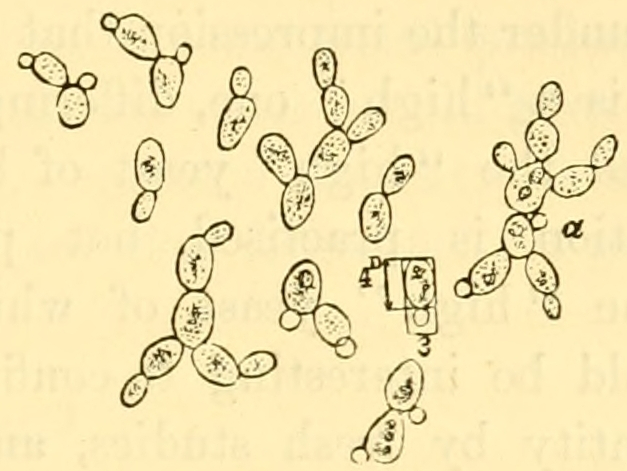
Fig. 43.
Fig. 43 represents the rejuvenescence of this ferment. Comparing this figure with Fig. 42, we see that this ferment presents a considerable resemblance to “low” yeast in dimensions, method of budding, and oval shape; but the feature which distinguishes it essentially from “low” yeast is that it rises to the surface, like “high” yeast. Buoyed up by the gas during fermentation, it forms a layer of yeast on the surface of the fermenting liquid, where it remains after the head has fallen. Some of this head of yeast likewise adheres to the sides of the vessel above the level of the liquid.
In short, by the greater regularity of its forms and the uniform dimensions of its cells, this ferment is to be easily distinguished from saccharomyces pastorianus; its aspect, which is oval instead of spherical, and the ramified form of its chains of cells, which is less marked than in the case of “high” yeast, also prevent our confounding it with the latter ferment; in its rising character it differs absolutely from “low” yeast; lastly, it may be distinguished from all other ferments by the flavour of the beer that it produces.
The ferment which we discovered in this accidental way may be utilized. Indeed, we may ask, is it not to be found already in our beer? We are inclined to believe that it is. After the war of 1870, some Viennese traders established at Maisons-Alfort, near Paris, a manufactory of yeast for bakers. They saccharified by means of malt a mixture of the meals of rye, 200maize, and barley, which they then caused to ferment. One day we had occasion to study the yeast produced in this establishment, and although we did not submit it to a sufficient number of consecutive experiments to enable us to speak positively, we are under the impression that the yeast produced at Maisons-Alfort is a “high” one, differing from what may be properly termed the “high” yeast of breweries in which “high” fermentation is practised, but presenting a great resemblance to the “high” yeast of which we have been speaking. It would be interesting to confirm the opinion of their possible identity by fresh studies, and the best way of doing this would be to compare the qualities of beer which the two yeasts could produce.
Caseous Ferment.—We give the title caseous for a reason that will presently appear, to a ferment which we came across also accidentally. We were trying different methods of purifying yeasts, and for this purpose had composed a liquid formed of:
Ordinary wort 150 c.c.[104]
Water saturated with bi-tartrate of potash 50 c.c.
Alcohol of 90° 25 c.c.
Quantities of this liquid were placed in several of our double-necked flasks, submitted to boiling, then, after cooling, impregnated with different ferments, and kept in a water-bath at 50° C. (122° F.) for one hour.
In operating under these conditions with brewers’ “high” yeast, say, for instance, with what is called Dutch yeast, a kind well known in distilleries, fermentation shows itself in the course of a few days, in spite of the increased temperature to which our liquid, which is hopped and slightly acid and alcoholic, has been subjected. The time required for the resumption of fermentation depends both upon the degree of temperature to which the yeast has been exposed and upon the duration of its exposure. These, however, are not the points 201upon which we now wish to dwell. It is of greater importance to notice that the new yeast has none of the characteristics of “high” ferment, of which Dutch yeast seems to be exclusively composed, if we do not take into account impurities which cannot be avoided in a commercial product of this nature. Other specimens of Dutch yeasts would give the same results.
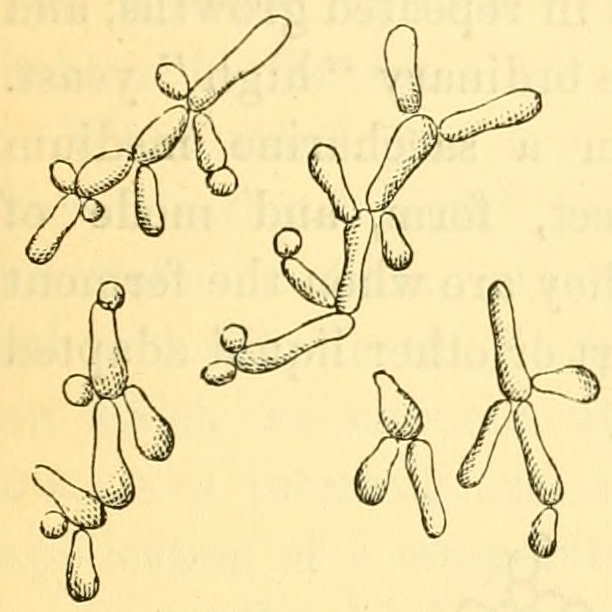
Fig. 44.
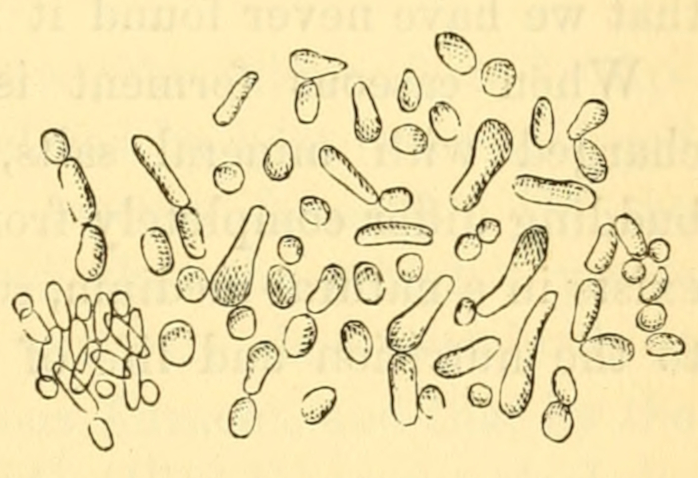
Fig. 45.
Figs. 44 and 45 represent this new ferment magnified to the same extent as the other ferments have generally been, that is 400/1; it will readily be seen how different its form is from that of “high” yeast, how far it is from having the spherical aspect and mode of budding characteristic of that ferment. In Fig. 45 the ferment is represented in a mass; in Fig. 44 we see the ramified groups, the cells and segments of which form, after separation, the yeast of the deposit. It thus appears to be composed of jointed branches of greater or less length, which, at the junctions of the segments, put forth similar cells or segments of a round, oval, pyriform, cylindrical, or other shape; in all its characters recalling the description of dematium. Moreover, the cells and segments exhibit a greater sharpness of outline, as well as a more marked transparency and refractive power than are found in the majority of ferments; but the most curious physical characteristic of this ferment is its plasticity and elasticity, if we may use those terms. It can only be made to diffuse through water with great difficulty; when shaken up in it, it sinks to the bottom quickly 202as a clotted sediment, and the supernatant liquid appears scarcely at all charged with globules in suspension. Again, when placed on a microscope slide and compressed by the cover-glass, it returns to its original form on removal of the pressure. It is from these considerations that we have given to it the name of caseous ferment.[105] Lastly, this ferment produces a beer of a peculiar kind, which cannot be confounded with other kinds of beer known in the present day. We should add that it preserves its characteristics in repeated growths, and that we have never found it reproduce ordinary “high” yeast.
When caseous ferment is sown in a saccharine medium charged with mineral salts, its aspect, form, and mode of budding differ completely from what they are when the ferment exists in a natural medium, such as wort or other liquid adapted to the nutrition and life of ferments.
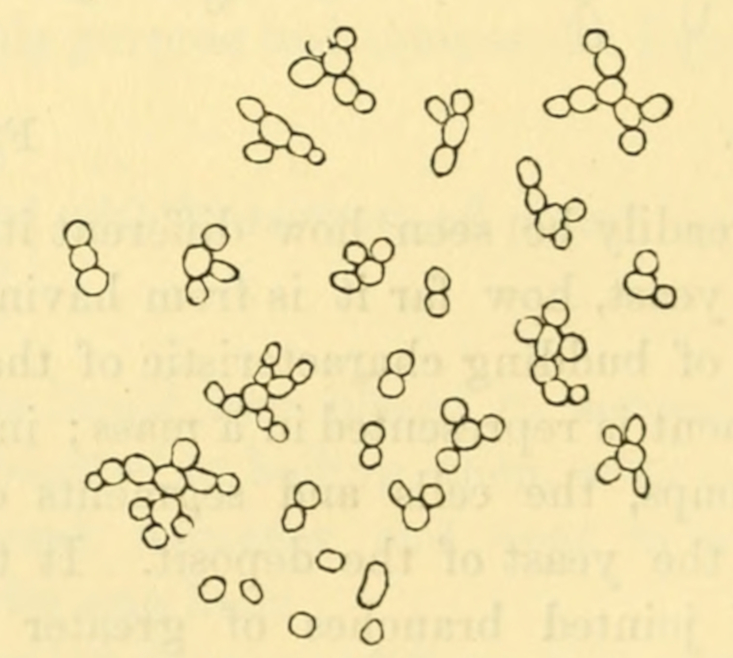
Fig. 46.
Fig. 46 represents this ferment in course of development, forty-eight hours after it had been sown in a saline medium (we employed Raulin’s fluid, substituting bi-tartrate for the 203nitrate of ammonia). It will be seen how different its aspect is from that of the preceding figures; it is still capable, however, of resuming the forms of the latter if cultivated afresh in natural saccharine worts.
“High” yeast from a “high” fermentation brewery in the Ardennes, after having been exposed to heat under the conditions given above, likewise produced caseous ferment, without a trace of “high” ferment, just as happened in the case of the Dutch yeast. All the “high” yeasts used in brewing seem to behave in the same manner.
What conclusion are we to draw from these facts? Apparently that “high” yeast is modified by heat in an acid and alcoholic medium, giving rise to caseous ferment. On the other hand, it might be conceived that the “high” yeasts on which we experimented were not pure, but contained, in a state of intermixture, some caseous ferment, and that by the application of a temperature of 50° C. (122° F.) to our alcoholic medium, the high ferment was all killed and the caseous ferment alone survived. It is a remarkable fact that this latter hypothesis, improbable as it seems, inasmuch as the microscope revealed no intermixture of ferments, seems, nevertheless, to be a true one. As a matter of fact, if we subject to a temperature of 50° C. for one hour in the medium in which it acts, not the “high” yeast of commerce but “high” yeast that is absolutely pure, this will perish utterly, and the wort after cooling may remain for years in an oven without either undergoing fermentation or developing any growth whatever of “high” ferment or “caseous” ferment.
On the other hand, if we impregnate this same alcoholic liquid with some of the caseous ferment and then heat the vessel to 50° C. for one hour, the caseous ferment will go on reproducing itself after the liquid has cooled down.[106]
204It seems, therefore, impossible to admit that caseous ferment results from a modification of “high” ferment, and we are led to believe that in the preceding experiments it must have been the progeny of cells of caseous ferment present in the “high” yeasts of commerce, which cells, probably in consequence of their scarcity, the microscope was unable to reveal, but which, nevertheless, did exist, and went on reproducing themselves alone after the heating.
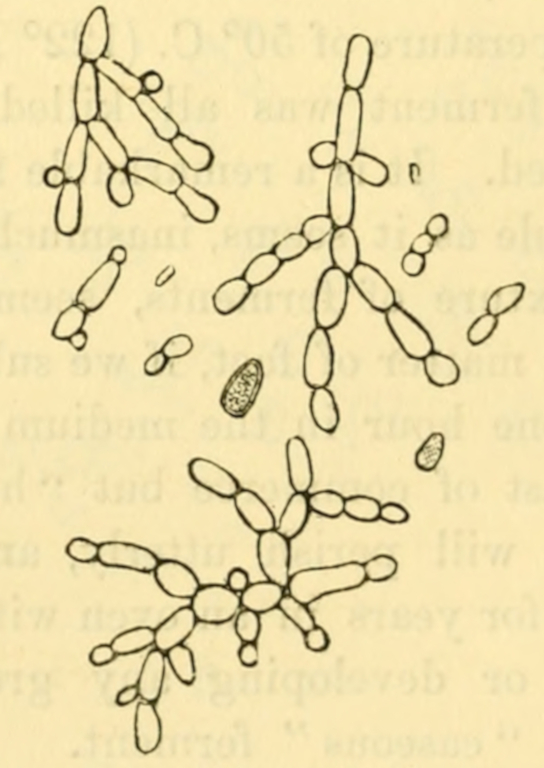
Fig. 47.
This conclusion is supported by the following fact, which also tends to prove that in the case of the “high” English pale ales, caseous ferment plays a most important part. In the medium already described, we sowed the deposit from a bottle of good English pale ale. After having been heated the yeast went on growing, and we obtained the very beautiful specimen of caseous ferment represented in Fig. 47. The two dark globules are dead cells which had been killed. Two minute segments of lactic ferment are also visible in the sketch—the yeast which we sowed was, of course, impure—and their presence 205proves, we may observe, by the way, that lactic ferment also can withstand a temperature of 50° C. (122° F.) in the medium which we here employed. The yeast as sowed is represented in Fig. 48; it reminds us forcibly of certain forms of the caseous ferment. Amongst the globules, which for the most part were transparent and very young, there were some which appeared aged and of a yellowish colour and granular. These latter probably belonged to the yeast of manufacture. Their shape distinguishes them from “high” yeast, properly so called, as on the other hand it causes them to appear more like cells of a recent growth to which, there is no doubt, beer, after it is put in bottle, owes its effervescence and head. These various circumstances incline us to believe that the caseous ferment forms part of certain commercial yeasts, especially those used in the celebrated breweries of Bass and Allsopp, at Burton-on-Trent, in the manufacture of pale ale. Caseous yeast is, moreover, a “high” ferment, that is to say, it rises to the surface.
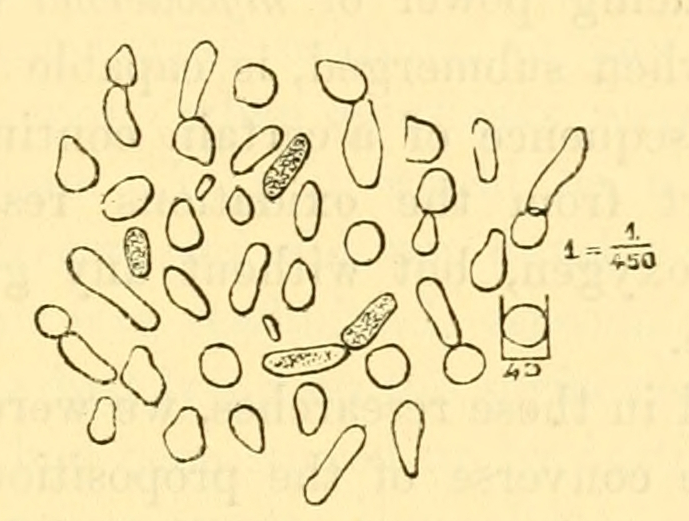
Fig. 48.
§ V.—On a New Race of Alcoholic Ferments: Aërobian Ferments.
Mention has already been made of certain researches which we undertook with the object of ascertaining whether mycoderma vini, or efflorescence of wine, and mycoderma cerevisiæ, or efflorescence of beer, which grow equally well in all fermented 206liquids, have the power of becoming transformed into actual alcoholic ferment. The result of those researches was stated to be that these mycodermata do not become transformed into ferment, properly so called, and that whenever any such transformation has been supposed to have taken place, the ferment produced was derived from germs introduced by the air or by the utensils employed. What we did ascertain of the ferment-producing power of mycoderma vini, was merely that this plant, when submerged, is capable of causing sugar to ferment, in consequence of a certain continuous life possible to its cells, apart from the oxidations resulting from the presence of free oxygen, but without any generation of new cells taking place.
Whilst engaged in these researches, we were pursuing others in relation to the converse of the proposition just discussed, that is to say, respecting the possibility of ferment becoming transformed into mycoderma vini or mycoderma cerevisiae. Our experiments in connection with this subject chiefly consisted in various endeavours by way of exhausting the yeast and subsequent revival of its growth. This exhaustion was effected by growing the yeast in excess of sweetened water, and at other times in unsweetened yeast-water, our efforts being directed to deprive it of all power of fermenting. We afterwards caused it to develop afresh in highly aerated, nutritious liquids, in order that we might see how it reproduced itself, and if its new form were that of a mycoderma. The yeast after having lost its power as a ferment, and being no longer able to act in pure sweetened water, nevertheless reproduced itself when placed in fermentable media, holding in solution materials adapted to its nutrition; yet we never succeeded in obtaining any organism besides the ferment, and, indeed, the identical variety of ferment on which we had operated. In no case was mycoderma vini or cerevisiæ produced, and we concluded that we were justified in stating that whenever the mycoderma vini appeared on the surface of a fermented or fermentable liquid, its germ must have been introduced by the surrounding air, 207or have previously existed in the liquid, and that the reason why this germ multiplied so abundantly was because the liquid in question had been peculiarly adapted to the vitality of the plant.
In a laboratory where alcoholic fermentations are studied, these germs of mycoderma vini exist in great abundance on the surfaces of different objects. This fact admits of easy proof; we have merely to open in such a laboratory some flasks containing yeast-water deprived of air, or yeast-water sweetened, or any natural saccharine medium, or any fermented liquid, which till the moment when our flasks were closed had been kept boiling (Chap. IV.); it would be a very rare thing, indeed, if mycoderma vini did not develop in most of these flasks after the air was readmitted, especially if, shortly before this operation, the dust lying on the surface of the tables or floor of the laboratory had been stirred up by dusting or sweeping.
This series of experiments, the salient points of which we have just given, conducted with a view to ascertain whether yeast could be transformed into mycoderma, has led the way to certain results of special interest, results which concern all alcoholic ferments, and which in all probability will be found in the long run to apply to all aërobian ferments.
It being necessary for the conduct of our experiments to preserve our yeast in a state of purity for an indefinite period, often for a great length of time, in contact with pure air, we discovered that yeast was possessed of extraordinary vitality, and that it rarely perished completely throughout, inasmuch as we could almost invariably cause it to revive by bringing it into contact with fresh, fermentable liquid. This revival of the yeast—and it is to this point that we are most anxious to direct the attention of our readers—is effected from two distinct sources:—
1. By those cells of yeast which have not perished.
2. By cells of new formation.
We may give an example to explain this more clearly. In one of our two-necked flasks we cause some pure wort to ferment by employing yeast also in a state of purity. Fermentation 208completed, we leave the liquid to itself, not touching the flask again. The fermented liquor covers a deposit of yeast, apparently inert, and no trace of mycoderma vini makes its appearance on the surface of the liquid. Let us suppose that we go on daily for a considerable time introducing a little of the yeast from this flask to a different flask of wort: the fresh flasks will begin to ferment. The only appreciable difference which these successive flasks will present, their impregnation having been effected at intervals of twenty-four hours, will be that, ceteris paribus, fermentation in them will be more and more slow in making its appearance. This difference, as we have already explained, will be due to the fact that the yeast in the first flask will, in the course of time, undergo, in each of its cells, a process which we cannot better describe than as a progressive senescence. The cells gradually become filled with amorphous granulations, their interior becomes yellow, and the protoplasm collects, either at the centre or near the borders; in short, the vitality of the yeast becomes feeble. When, however, it is taken out of the liquid in which it has fermented and introduced into a fresh saccharine wort, it gradually resumes its transparency, and then begins to germinate. These effects are the less rapidly brought about the longer the cells remain exhausting themselves in the first fermented liquid. They might be left in that liquid for such a length of time that they would eventually perish, a fact which would manifest itself in their absolute sterility and quiescence when sown in a fresh medium. In general, however, matters are not carried far enough for this to take place, and the yeast, preserved in a state of purity in its fermented liquid, retains the capacity of revival, which may then go on indefinitely. As a matter of observation, the cells of yeast, after causing the liquid to ferment, instead of remaining inactive, and so by living at their own expense gradually passing into a state of exhaustion, begin to bud again; at least this is true of many of them. Multiplying afresh in the fermented medium, under the influence of the air, they form 209a kind of mycodermic film on the liquid surface, or a ring round the sides of the flask, on a level with the liquid. This development might often be mistaken for mycoderma vini or cerevisiæ; in reality there is not a single cell of mycoderma formed. If we sow a trace of the new growth in a saccharine medium it will behave exactly as yeast would, budding and multiplying, and setting up fermentation in the liquid. And thus, in spite of its mycodermic aspect, this growth is nothing but yeast, since it gives rise to true alcoholic fermentation; but it is a kind of yeast which, under the foregoing conditions, lives after the manner of fungoid growths, absorbing the oxygen of the air and emitting carbonic acid gas. It appears on the surface of all fermented liquids, especially those which, like beer, contain carbohydrates, and its quantity is the greater, and its action the more rapid, in proportion as it has more perfect access to the air. We have termed this yeast aërobian ferment or fungoid ferment.
It may easily be understood how this kind of production has escaped notice up to the present time. The conditions of our experiment were, in many respects, novel; a saccharine liquid had never before been caused to ferment by means of pure yeast, absolutely free from foreign germs; a fermented liquid had not previously been exposed to contact with pure air for an indefinite time. On the other hand, all ordinary fermented liquids, when left to themselves in contact with air, are a ready prey to mycoderma vini or aceti at their surface, and then give rise to true fungoid growths. The appearance of these organisms, which always takes place soon, has thus constantly concealed or prevented the development of the true aërobian ferments. In repeating the experiment described any alcoholic ferment may be used, and each one will be found to produce its own peculiar fungoid form of ferment. Another point worthy of notice is that these aërobian ferments, when they put forth buds in the act of fermentation, reproduce the forms of the original ferment, at least apparently so. In this respect they cannot be distinguished, notwithstanding the fact, surprising 210as it seems, that the two kinds of ferments are not identical. If we operate on a “low” yeast its aërobian ferment will differ physiologically from the ferment from which it sprung, presenting various special peculiarities which are not to be found in the original “low” yeast. In most of our experiments we have found the new aërobian ferment to be similar in its action to “high” yeast, rising to the surface, and producing a beer which possesses a greater fragrance than beer brewed with the identical “low” yeast from which it was derived. Lastly, the properties of an aërobious ferment are not peculiar to first growth, but are hereditary; by repeating the growth of the first aërobian ferment we do not cause them to disappear, we find them again in succeeding generations.
Notwithstanding these facts, it would be difficult to discover any very appreciable differences between the forms of the cells of any particular yeast and those of its aërobian ferment in course of development. So true is this, that the aërobian ferment of saccharomyces pastorianus might even be caused to put on the forms of dematium pullulans, which we have had occasion to observe specially characterize this ferment after the cells have been subjected to a prolonged process of senescence.[107] This is evident from the following example, which will once 211again show the remarkable extent to which the forms of a particular organism may be varied by changes in composition of the nutritive medium:—
On August 6th, 1873, we took some of the ferment saccharomyces pastorianus from a flask of wort that had undergone fermentation, and sowed a scarcely perceptible quantity of it in another flask containing a saline medium, composed as follows:—
Water containing about 10 per cent. of sugar-candy 150 c.c. (5-1/4 fl. oz.)
Ash of yeast 0·5 gramme (8 grs.)
Ammonic bitartrate 0·2 “ (3 grs.)
Ammonic sulphate 0·2 ” (3 grs.)
In the course of the following days the ferment began to develop, although with difficulty, the fermentation revealing itself by collections of bubbles appearing here and there on the surface of the liquid. We left the flask undisturbed till the 25th of November following. On that day we found a very white deposit of ferment covering the yeast-ash that had not been taken into solution, and a ring of aërobian ferment on a level with the surface of liquid; all the sugar had disappeared; the liquid contained 5·2 per cent. of alcohol, by volume, at a temperature of 15° C. (59° F.); and, lastly, in consequence of the purity of the materials employed, there was no trace of the formation of fungoid growths, whether of mycoderma vini or of mycoderma cerevisiæ, on the surface of the liquid, or of vibrios or lactic-ferment below the surface.
Thus then we see—and several other examples throughout this work confirm the fact—that saccharine liquids holding mineral salts in solution are as capable of complete fermentation as any media of natural composition. It is true that ferment develops slowly and with difficulty in them, and at times takes on rather curious forms, but, nevertheless, it does develop in the media and carry on a fermentation in which not the 212minutest particle of sugar is left undecomposed. This is true, at least, in the case of saccharomyces pastorianus, but there are other ferments which in such media are checked in their multiplication and in their continued action on sugar. One condition indispensable to the accomplishment of fermentation in such a sweetened mineral medium, by means of saccharomyces pastorianus, is the absolute purity of the materials and of the ferment. It is necessary that the life and physiological action of the latter should be in no way interfered with by the presence of other microscopic organisms. We shall have occasion to revert to this important detail in connection with our growths.
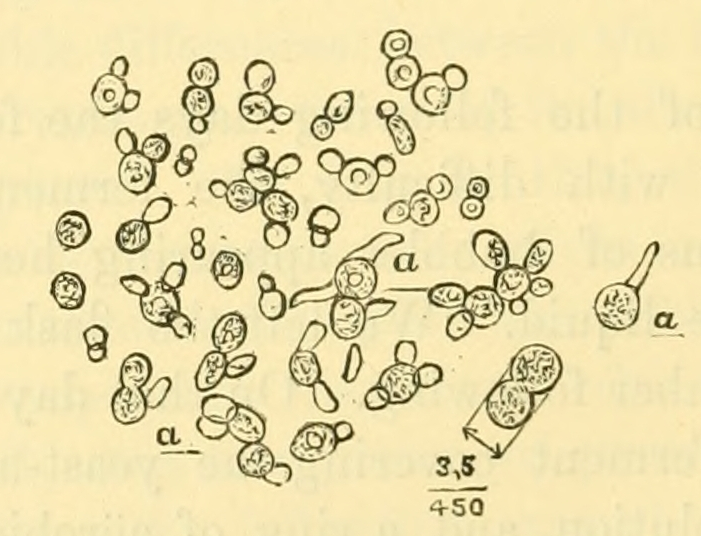
Fig. 49.
Fig. 49 represents the ferment as it appeared when examined on August 11th, 1873. We can no longer recognize in it any saccharomyces pastorianus. The general appearance is spherical, and there are a number of clusters of budding cells which remind one at first sight of the mode of germination of brewers’ “high” yeast. At a, a, a, we see globules from which irregular abortive filaments have sprung, a proof of difficult germination. No such monstrosities could ever have occurred if we had used beer-wort or must as our nutritive medium.
On November 25th we made another examination and sketch of the ferment, the appearance of which did not differ materially from that given above. The general appearance was the same, consisting mostly of globules joined together in clusters of two or three or more. No separation, such as occurs in the case of 213ferment formed in natural worts, had taken place. The ferment, moreover, was very irregular, and comprised cells of all sizes. We sowed some of it in a flask of pure wort. On November 26th there was no apparent development: on November 27th, however, not more than forty-eight hours after impregnation, there was a considerable deposit of white ferment at the bottom of the liquid, and fermentation was so active that the surface of the liquid was covered with an abundant froth. This shows us the wonderful vitality and recuperative power possessed by germs which, left to themselves for about four months, revived so readily. It proves too that the reviving influences took effect on some aërobian ferment. From the mode of life of this latter being similar to that of a surface fungoid growth, it does not become exhausted as the cells of ordinary ferment do. Now the cells which, sown on August 6th, had become exhausted by prolonged stay in the mineral liquid, and were almost inert, would have required several days for their revival; but in the experiment described the revival was rapid, and this rapidity proves, as we have said, that the revival must have taken place in cells of aërobian ferment.
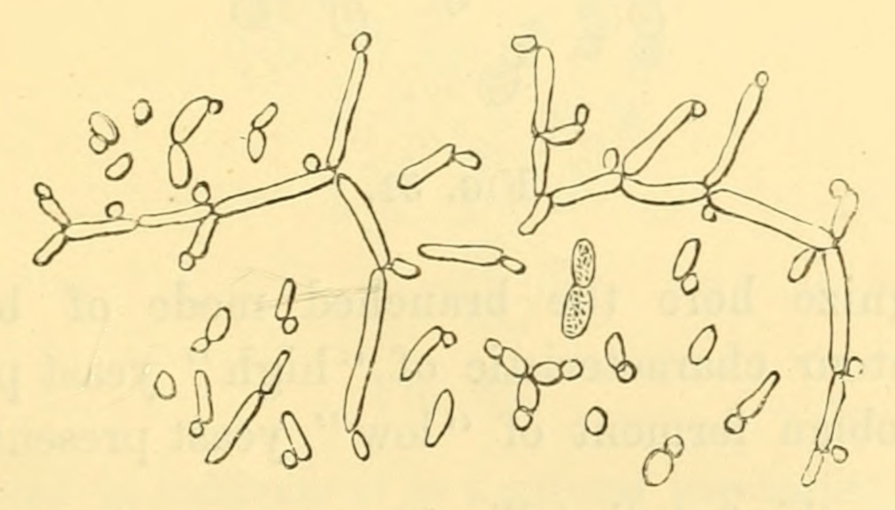
Fig. 50.
Taking some fresh yeast from the bottom of the liquid we examined and made a sketch of it (Fig. 50). The field was filled with round and oval cells, jointed and ramified filaments, budding and multiplying in the most remarkable manner, reminding us of the germination of the cells of yeast exhausted 214in sweetened water, and also of the germination in the form of dematium pullulans of certain germ-cells which are spread over the surface of sweet, domestic fruits. We could never grow tired, as we wrote it in our original notes, of sketching this beautiful plant, which establishes very clearly a transition between one of the best defined cellular ferments, viz., saccharomyces pastorianus, and certain forms of very common fungoid growths, those of dematium, and even of the most common mould, mucor mucedo or racemosus, when it vegetates beneath the surface of a liquid and acts as a ferment.[108] We have here, as in these cases, filamentous chains branching into other similar chains, composed of more or less elongated cells, which at length fall off and germinate exactly as the conidia-bearing hyphae of mucor do.
The aërobian ferment of “high” yeast, in whatever medium we cultivated it, presented no peculiarity, as far as its forms were concerned. It was composed of cells of spherical shape, like ordinary “high” yeast, and germinated in the same way as the latter.
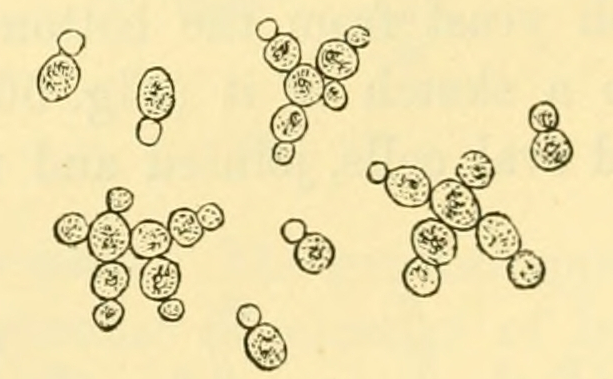
Fig. 51.
Fig. 51 represents the revival of this aërobian ferment. We recognize here the branched mode of budding and spherical contour characteristic of “high” yeast proper. Nor does the aërobian ferment of “low” yeast present any special 215peculiarities, in forms, dimensions, and mode of growth closely resembling the “low” yeast from which it is derived. At the commencement of its restoration, however, if this is performed in sweetened water, the cells in the groups are larger than those which are subsequently developed.
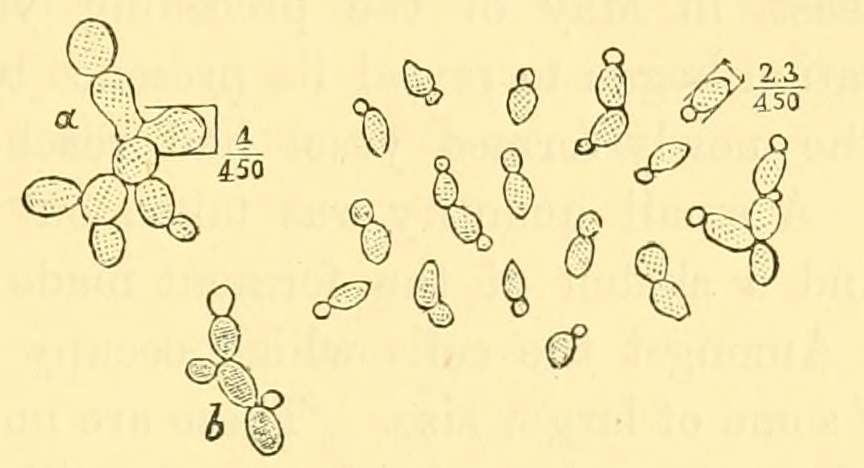
Fig. 52.
Fig. 52 represents the aërobian ferment of yeast used in “low”-fermentation breweries, examined forty-eight hours after pitching. We find that groups resembling that at a are of very rare occurrence. They are to be seen only at the very beginning, generally only for the first few hours of the renewed activity. Very soon, however, they develop cells which are of the size of the oval cells budding at b.
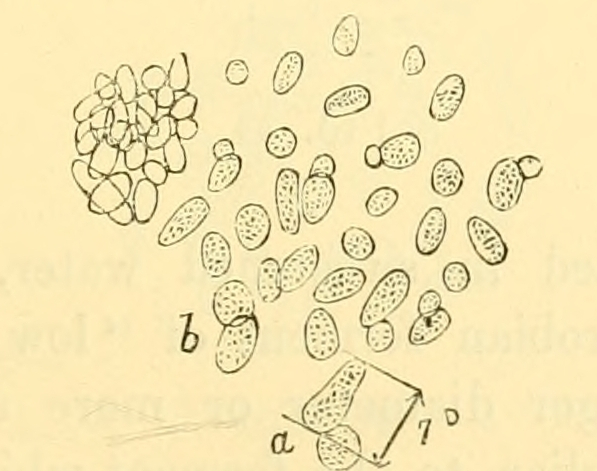
Fig. 53.
Fig. 53 represents the aërobian caseous yeast which forms 216rather rapidly, in thick, greasy-looking pellicles, on the surface of liquids which have been fermented by means of caseous ferment. The larger form of cells, a and b, is not often met with.
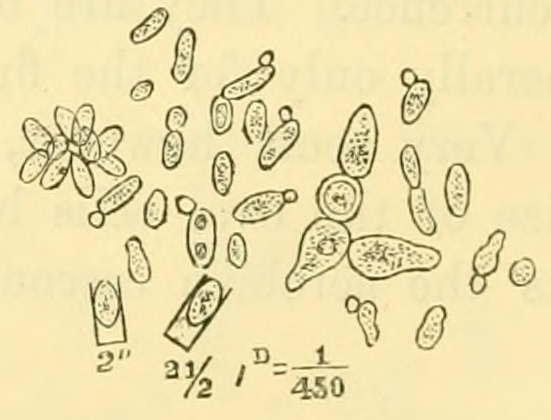
Fig. 54.
On May 27th, 1875, we sowed, in a flask of wort, a trace of a pellicle of this kind, which had formed on the surface of a flask in which fermentation had been set up by means of caseous yeast in May of the preceding year. On May 30th fermentation began to reveal its presence by a voluminous froth, and the newly-formed yeast had reached the bottom of the flask. A small quantity was taken out by a capillary glass tube, and a sketch of the ferment made; this is given in Fig. 54. Amongst the cells which occupy the field there are groups of some of larger size. These are not distinct forms mixed with the others, but simply another illustration of the fact that old cells in course of revival, especially when they have been exhausted in sweetened water, as we have just observed of the aërobian ferment of “low” yeast, commence with forms of larger diameter or more elongated than the ordinary forms peculiar to the ferment which at a later stage are developed from them. We have seen how marked and exaggerated this feature was in the case of saccharomyces pastorianus.
Let us again call attention to the forms of aërobian ferment furnished by the yeast which we have already described under the name of new “high” yeast. Fig. 55 represents this 217aërobian ferment, as taken on November 27th, 1873, from a pellicle of rather greasy and moist appearance, on the surface of a flask of fermented beer-wort which had been impregnated on July 21st, 1872. It might readily be mistaken for ordinary “high” yeast, yet no two ferments can be more distinct.
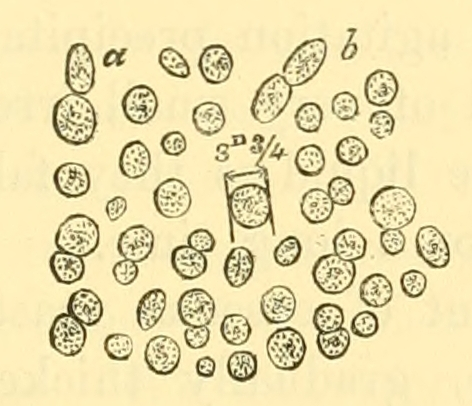
Fig. 55.
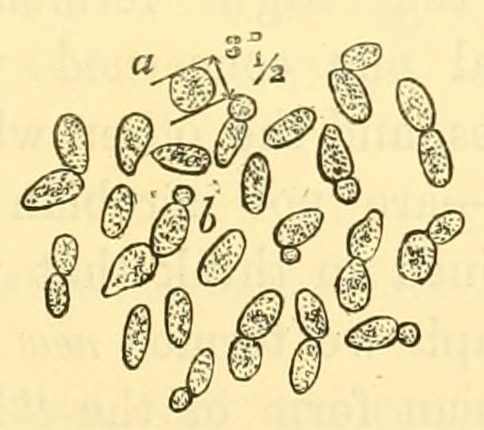
Fig. 56.
On November 27th, 1873, we sowed a trace of this ferment in a flask of wort. From the 29th, with a continuous temperature of 25° C. (77° F.), a considerable deposit of yeast began to form, and the froth of fermentation covered the whole surface of the liquid. We took a little of this deposit for examination; it is represented in Fig. 56. The field is occupied with oval cells of great uniformity. We recognize the aspect of the original yeast (Fig. 43). Here and there, indeed, we come across some cells of larger size, such as those at a and b, which is another illustration of the remark that we have just made respecting the forms which revived exhausted cells take on at the commencement of a new germination.
218The physical aspect of the several aërobian ferments is in general so characteristic that we are often able by simple inspection to distinguish between them as they occur on the surface of liquids. Saccharomyces pastorianus in its aërobian state forms a crown of cells round the sides of the vessel at the surface of the liquid, which crown is broken up by the least agitation of the liquid; its vitality continues for years.
The aërobian ferment of “high” yeast appears in the form of small isolated teats on the surface of the fermented liquid. It develops rather sluggishly, and has no great vitality.
The aërobian form of “low” yeast develops as a somewhat fragile layer, the least agitation precipitating it to the bottom of the vessel in a cloud of very small irregular flocks, that do not diffuse through the liquid as they fall. With free access to air it retains life for a long time.
The aërobian ferment of caseous yeast forms a continuous greasy-looking pellicle, gradually thickening, which breaks up into fragments when shaken. With a supply of air it lives very long, and the pellicle gradually increases in thickness.
In reviewing these ferments we may naturally ask ourselves the question whether the “high” ferments of which we have spoken—the industrial one concerned in the “high” fermentation of breweries, and the other which we have termed new “high” ferment—are not aërobian ferments of “low” yeasts. We are inclined to think that the ferment which in the preceding paragraph we termed new “high” ferment, may, perhaps, be the aërobian form of the “low” yeast employed by Alsatian and German brewers. We have studied this new “high” ferment side by side with the aërobian ferment of “low” yeast, and the result we have arrived at is, that in appearance and mode of germination, as well as in the flavour and quality of the beers which they produce, they greatly resemble one another. In the last respect, however, we cannot say that the identity is quite absolute, and hence it is with some doubt that we suggest the possible identity of the two 219ferments. As regards the ordinary “high” yeast of breweries, it may well be supposed, both from its power of rising to the surface during fermentation and from the peculiar smell and flavour of its beer, that we have in it the aërobian ferment of some “low” yeast, as to the identity of which, however, we can say nothing, having no knowledge as to where it is to be found; or, indeed, any certainty that such a yeast actually exists.
In writing these lines an idea suggests itself which might be profitably made the subject of serious experimental study. What would be the peculiar properties of the aërobious ferment-form of an aërobian yeast? Certain facts incline us to believe that these forms differ from each other just as a “low” yeast differs from its aërobian ferment. If this were actually the case it would be very interesting to compare the peculiar properties of an indefinite series of aërobian ferments, all derived from a common origin. We find recorded in our laboratory notes that a certain aërobian ferment of the second generation produced a beer different from that produced by the same ferment of the first generation, being possessed of a fragrance so marked that, on entering our laboratory, in which only a few litres of this beer were fermenting, we were at once struck by the powerful odour which it emitted.
§ VI.—The Purification of Commercial Yeasts.
We have already stated that the researches detailed in the preceding chapter require for their successful prosecution that the ferments on which we experiment should be absolutely free from germs of other organisms, and we have shown how impossible it would be, if this condition were not complied with, to follow for weeks or months, sometimes even years, the changes which occur in a yeast maintained in contact with air, either in sweetened water or in a liquid which has fermented under its influence. Equally necessary is it that the 220saccharine worts employed should also be exempt from these impurities, as well as the air, which is being constantly renewed at the surface of the liquids. These last conditions may be realized by the adoption of our double-necked flasks, with which a laboratory for research of this kind should be furnished, always ready for use, filled with the different kinds of liquids that may be required.
In general, the inconveniences resulting from the impurity of a yeast employed do not immediately manifest themselves, in consequence of the enormous preponderance of the true yeast, which, in comparison with the foreign germs that contaminate it, may be so great that microscopical examination fails to reveal even the presence of these latter. Again, it is a well-known fact that the abundance of one growth in a limited medium operates to the prejudice of a less abundant one, inasmuch as the first consumes the nutritive materials at the expense of the second, and more particularly the needful amount of oxygen. It follows, that when a saccharine liquid is impregnated with commercial yeast, nothing but yeast may be detected for a time, and one is led to believe in the purity of the subsequent growth. This, however, supposes that the external conditions, as well as those of the medium of growth, are equally adapted to the life of the yeast and that of those organisms present as impurities; for if these conditions rather favoured the nutrition of the latter, we should be sure to find their proper developments appearing at an early stage. For example, when the growth of yeast becomes sluggish, we have invariably the development of such after-growths. The principal germs, having exhausted the saccharine liquid which has fermented under their influence and is no longer adapted for their growth, cease to develop, and have their place taken by ferments of disease, spores of moulds, mycodermata, &c., the growth of which proceeds more or less rapidly, in proportion as the character of the liquid and the surrounding temperature are more or less suited to their growth.
Here, too, we have an explanation of the rapid change that 221occurs in brewers’ yeast when left to itself after fermentation. In such a mass of cells, kept apart from any food-supply, and only with difficulty able to keep themselves in life by consuming their own soluble contents, we have an excellent field for the development of foreign germs. In this way we may have a rapid putrefaction in yeast, to which there will be a correspondingly rapid growth of organisms in the liquid, where they find, as well as in the yeast-cells, appropriate nourishment. Nothing could better confirm this view of the matter than the array of facts, by way of antithesis, already described, in which we have seen a pure yeast remain for an indefinite time in contact with pure air, without undergoing any putrefaction, or manifesting other changes than those which result from the combustions peculiar to living cells when left to support themselves, in a moist state, in contact with oxygen.
In the process of brewing, as soon as fermentation is finished, or rather, as soon as certain physical effects are produced, for instance, when the beer falls bright, or, as the French say technically, when the yeast breaks up,[109] the beer is racked; subsequently the yeast, which is left in a plastic layer at the bottom of the vessels, is collected, washed, and kept under water in a cool place, to be used again in the course of twenty-four or forty-eight hours. Brewers never care to keep their yeast for a longer time before using it, especially in summer. We can understand how this practice prevents the foreign germs which are mixed with the yeast from living and reproducing; but although the conditions of brewing, as far as the treatment of the yeast is concerned, may, in a certain measure, prevent the development of these germs of disease, nevertheless they are there, and from their extreme minuteness, pass into the beer in greater or less number, however bright it may have been rendered by racking. There they only await conditions favourable to their existence to enable them to develop, and to affect more or less injuriously the qualities of that delicate beverage.
222On December 15th, 1872, we bought nine samples of beer in different large cafés in Paris, which had all come from the best breweries of Strasburg, Nancy, Vienna, and Burton. After leaving them for twenty-four hours, we decanted all our samples, and then sowed a drop of the deposit of each in flasks of pure wort. On January 2nd, 1873, we examined the ferments formed in these worts, which had been kept in an oven at a temperature of 20° C. (68° F.), and also tasted the beers produced; they all had an abominable taste, and each contained diseased ferments.
At the same time, by way of comparison, we impregnated other flasks of wort with pure ferments. None of the beers of this series acquired a bad taste or produced foreign ferments; they only became flat.
When we review the operations of the brewer’s art, we are surprised by the comparative perfection to which that art has been brought by the laborious experience of years, and the more so when we consider that, as regards the question of the diseases of beer, the brewer has never been guided by any such rigorous principles as those which we have explained in this work. We have already given proofs of this in our first chapter.
The beer is racked and separated from its yeast before fermentation has entirely ceased. The principal reason for this is that it is necessary that the beer, after being run into cask, should work again and undergo a secondary fermentation, in order that it may not be invaded by the parasites, of which we have already spoken, as would not fail to be the case if the beer were suffered to remain in a state of perfect quiescence. Not only is the beer racked before it has attained its limit of attenuation, but in addition to this, and also with the view of checking the development of parasites, it is placed in cellars sensibly cooler than the temperature of fermentation, low as that is in the case of “low” beers: the temperature of the cellars being not higher than 2° or 3° C. (36° F.).
Unfortunately, the requirements of trade prevent our complying 223with these exigencies to the end. When the beer is sold it is conveyed away, no matter what the season may be, and deposited in the retailer’s cellar, for a longer or shorter time, according to the variations of consumption. On a warm day beer will be in great demand; the next day, if rain or cold have come on, the demand will be very limited, since beer is, in our climate at least, a drink for hot weather. From causes of this nature, the beer may have to remain a long time in the cellars of the retailers or consumers. By way of precaution, indeed, it is put into very small casks, which permit of a frequent renewal of the supply, and is conveyed to distances by express trains, and during the night; it is even sent away in wagons provided with a kind of double case, the outer jacket being filled with ice, which keeps the air surrounding the casks constantly cold. Such are some of the troublesome measures taken to obviate the danger that we have pointed out. They operate very injuriously in restricting the trade and raising the price of beer. It is a matter of extreme importance, then, that our produce should be better removed from the action of those microscopic enemies which beer contains; in other words, that this beverage should have less cause to fear circumstances favourable to the development of the germs of impurity with which it is always contaminated, as a natural consequence of the methods of manufacture at present adopted. The question of alteration in the flavour of beer should be regarded from another point of view which merits equal attention. We have seen that there are different kinds of beer, each of which corresponds to a special ferment from which it derives its flavour and aroma, and, in a word, everything which gives it a value in the eyes of the consumer. It very often happens, especially in badly-managed breweries, and more particularly in those in which several beers are manufactured, that the yeast is a mixture of different ferments. The evil effects of such a mixture are experienced in the course of manufacture, and still more so in the beer after manufacture. Brewers in good “low” fermentation breweries, who brew what is called stock 224beer, during the winter months, for consumption in summer, up to August and September, are very anxious to prevent the development of a vinous flavour in beers of this kind. According to our observations, this vinous flavour seems to be principally due to an intermixture with the pitching yeast of saccharomyces pastorianus or its varieties, one of the peculiarities of which ferment is that in the course of time it imparts a decided vinous flavour to beer. If this ferment were not present amongst the yeast-cells—and here we are speaking of an absolute, so to say, mathematically absolute absence—the beer produced would gradually grow old in the store cellars, without ever acquiring any vinous flavour, properly so called.
This vinous flavour develops more especially in English beers when these are kept. It is an easy matter to show that in English beers, after their manufacture, saccharomyces pastorianus and the ferment which we have termed caseous, which also imparts a peculiar flavour, form almost exclusively, notwithstanding the fact that the yeast used in the manufacture of English beer is a ferment essentially distinct from saccharomyces pastorianus.
The secondary fermentation which takes place in “high” and “low” beers stored in cask after manufacture, is very often due to this same ferment, which may be recognized by elongated jointed cells, at times more or less ramified, as well as by the influence which it exercises upon the flavour of the beer.
We may add that the general result of our researches has convinced us that “high” yeast cannot transform itself, any more than “low” yeast can, into the ferment of which we are speaking, and that whenever a beer produced by means of “high” or “low” yeast develops a foreign ferment, this ferment must have existed in the original yeast in the form of germs, which, from their extreme scarcity, often fail to be detected by means of the microscope. The best proof that we can give of this is the fact that a beer produced by means of “high” or “low” yeast, if left to itself for months 225or years, will never contain in its deposit anything besides the yeast that was used in its manufacture, provided that that was pure to begin with. Now this can never be the case in dealing with actual commercial beers, no matter what they may be or in what brewery they may be produced. In all beers, in the course of time, in addition to diseased ferments, ferments essentially different from those used in their manufacture will appear, and notably saccharomyces pastorianus; this result must be attributed to the general impurity of commercial yeasts.
In certain cases the intermixture of ferments is to be feared almost as much as the presence of diseased ferments, when these latter have not developed to any great extent. We have often seen our fermentations invaded by ferments differing absolutely from those which we originally employed. The repetition of growths, and more particularly changes in the composition of our fermentable media, purposely made with the view of attaining certain results, often produce complications of this kind. For a long time we were unable to realize the true significance of the results of some of our experiments, in consequence of the facts which we have just explained, as well as those detailed in the preceding paragraph, having escaped our notice; indeed, our ignorance of those facts added greatly to the difficulty and length of our researches. Our labours from the commencement of this work to the date of its publication have extended over not less than five years, and no one can know better than ourselves with what advantage we might devote a still longer time to it; but, as Lavoisier says, one would never give anything to the world if he delayed doing so until he fully attained unto his ideal aims, which always seem more distant the more one increases one’s efforts in the attempt.
Our preceding observations show how extremely important it is to employ pure yeasts to obtain, on the one hand, well flavoured beers, whilst adhering to the processes at present existing in breweries, and on the other, beers of good keeping qualities, 226less liable to injury, less dependent on actual commercial requirements, capable, that is, of withstanding conditions favourable to the development of ferments prejudicial to the soundness of the produce, what we have named ferments of disease.
In the case of intermixture of alcoholic ferments, we may sometimes manage to effect their separation by taking advantage of their unequal vitalities in different media of cultivation. On December 17th, 1872, we made a powder of commercial Dutch yeast and plaster, as described in Chapter III. § 6. The Dutch yeast was a “high” ferment.
On July 25th, 1873, we sowed a portion of this dried mixture in a flask of pure wort. From July 27th patches of bubbles from fermentation were visible on the surface.
On August 2nd the fermentation was completed. The yeast, examined under the microscope, was apparently pure, formed of spherical cells of a fine “high” ferment. We poured away the fermented liquid, observing every necessary precaution, and left in the flask almost all the deposit of yeast, and not more than one or two cubic centimetres (about half a tea-spoonful) of beer.
On November 15th following the yeast, examined afresh, still seemed pure and still exhibited the form of round cells of “high” yeast, only that they had taken on a very aged aspect, showing a double contour, and filled with granulations collected irregularly about the centre. Such are the precise characteristics of dead cells; nevertheless it was still possible that some living cells yet remained. To assure ourselves of this we took some of the yeast and placed it in a flask of pure wort. On the 19th a little froth from fermentative action appeared on the surface. We then examined the yeast and discovered that it was no longer “high” yeast, but a small ferment of rather irregular appearance, in which the jointed cells of saccharomyces pastorianus, as it usually appears after a succession of growths, predominated. It must not be imagined here that what we saw was a transformation of one yeast into another. The 227phenomena are to be explained much more simply. The Dutch yeast employed being very impure must have contained traces of foreign ferments, especially of saccharomyces pastorianus. Reduced to a dry powder on December 17th, 1872, the two or more varieties of cells comprising it had preserved their vitality in consequence of the plaster, and this vitality had continued at all events until July 25th, 1873. Subsequently, when cultivated in wort, they had multiplied in that medium. The saccharomyces had revived like the rest, but its quantity, compared with the high Dutch yeast, was so small that the microscopical observations made on August 2nd, when the flask was decanted, failed to discover its presence. Between August 2nd and November 15th the high yeast must have perished entirely: the cells of saccharomyces, on the contrary, still maintained their vitality, and these alone multiplied in the flask of wort impregnated on November 15th. Here we have an example of the separation of alcoholic ferments, through the unequal resistance they sometimes offer to adverse conditions to which they may be subjected. We may also conclude that if we had prepared a quantity of beer with the “high” yeast, which in our experiment of August 2nd, 1873, seemed to have developed in a state of entire purity, this beer when made and stored in cask or bottle could not have failed to undergo a secondary fermentation, in consequence of a development of saccharomyces pastorianus.
Let us take, as another example of purification of the same kind, the case of the different ferments of the vintage. When must begins to ferment the apiculated ferment invariably appears, and becomes afterwards associated, more or less, with the saccharomyces pastorianus, in the presence of which the multiplication of the apiculated ferment soon ceases. Saccharomyces pastorianus, in its turn, is gradually displaced by the ferment which we have termed the ordinary ferment of wine, and which Dr. Rees has named saccharomyces ellipsoïdeus. On the subject of these changes in the proportion of the ferments of wine, the Note which we published in 1862 in the Bulletin 228de la Société chimique may be consulted. Now, these various ferments mutually interfere with each other: whereas if saccharomyces apiculatus were there alone it would multiply to a greater extent, and with greater advantage to the fermentation of the must. This result is obtained by filtering the must, as we have already observed.
It is evident from what we have just said that the principal part of the deposits of yeast in the sediment of fermented grapes, at the time when the wine is first racked, which in the Jura, is called l’entonnaison, is composed of the ordinary ferment of wine, the saccharomyces ellipsoïdeus, and that the cells of apiculated ferment are scarcely discoverable with the microscope, being scattered amongst an infinite multitude of other ferments.[110]
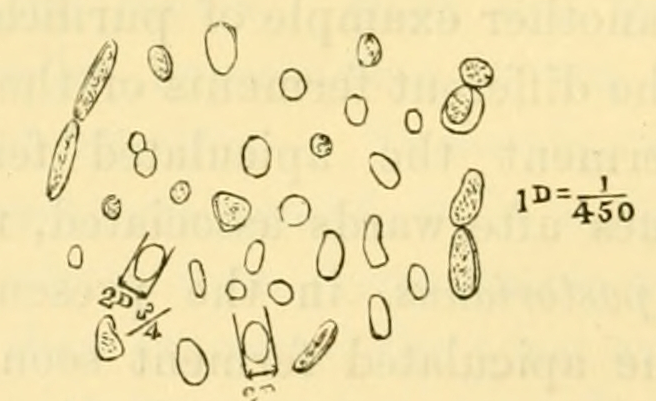
Fig. 57.
We procured from Arbois, on January 20th, 1875, some wine yeast taken from a large barrel of the preceding vintage, racked on January 18th. The ferment was very irregular. Some of its cells were very old, of a yellowish colour, and full of granulations—amongst these a certain number formed jointed segments, rather elongated, and probably belonging to saccharomyces pastorianus. The other cells were transparent, and apparently still young. This mixture of the two ferments is represented in Fig. 57. No doubt if we had searched carefully we should also have found some cells of saccharomyces apiculatus. On January 21st we sowed a small quantity of this 229raw yeast in a flask of sweetened water. On the 24th we poured off the liquid, and supplied the deposit with fresh sweetened water. The exterior temperature was 12° C. (54° F.). On the 27th we took some of the deposit and put it into a flask of wort. The following days there was a development of yeast, accompanied by fermentation. We obtained, however, neither the large forms of the ferments of fruits, nor those of the more minute ferments represented in Plate XI. The saccharomyces pastorianus, represented in the yeast which we sowed by aged, granular, elongated cells, had, therefore, not revived. Fearing that this result might have been attributable to insufficiency of the exhaustion, which had only lasted for a few days, we raised the temperature of the flask of sweetened water to 25° C. (77° F.), at which we kept it until February 20th. On that day we sowed some of this yeast in wort. There was a very perceptible revival the next day, but it was still impossible to detect with the microscope the forms we have just mentioned, nor did saccharomyces pastorianus appear in fresh, succeeding growths.
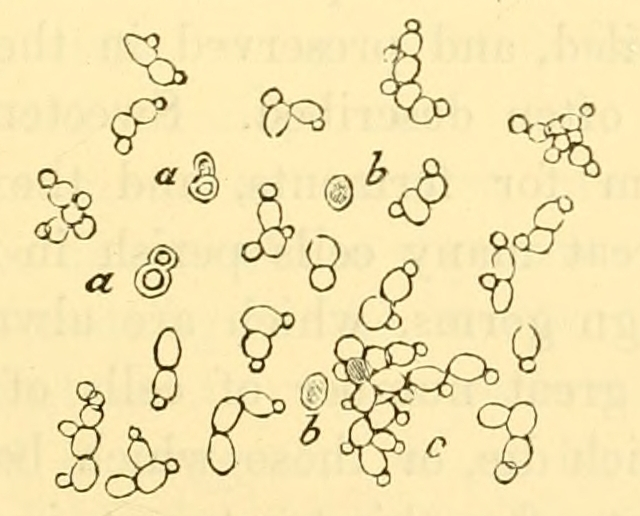
Fig. 58.
Fig. 58 represents the yeast formed, which evidently had sprung from the transparent cells seen in Fig. 57, and doubtless belonging to the ordinary ferment of wine, saccharomyces ellipsoïdeus. Here we have another example of the natural separation of ferments brought about by the death of one or two of them, or by extreme differences in the time of their revival.
230We cultivated this yeast (Fig. 58), to some considerable extent, in beer-wort. It produced a peculiar beer, of vinous character, in fact a true barley wine. This proves, we may here remark, that ordinary wine, in its flavour and quality, depends to a great extent on the specific nature of the ferments which develop during the fermentation of the vintage; and we may fairly assume that if we were to subject the same must to the action of different ferments we should obtain wines of different characters. With a view to the practical application of this idea, it would be well to undertake new studies in this direction; and the methods of cultivating and managing ferments, explained in this work, would be of great value in such researches.
The purification of ferments may be accomplished by various methods, according as we have to deal with an intermixture of ferments, or to regard as our principal object the expulsion of ferments of disease, such as vibrio germs, lactic ferment, the filamentous ferment of turned beer, mycoderma aceti or mycoderma vini.
One method of easy application consists in sowing the yeast in water sweetened with 10 per cent. of sugar. This liquid should be first boiled, and preserved in the two-necked flasks which we have so often described. Sweetened water is a very exhaustive medium for ferments, and the organisms mixed with them. A great many cells perish in it, and the chances are that the foreign germs, which are always scarce in comparison with the great number of cells of ferment, may be amongst those which die, or those which become so exhausted that when the yeast, after this treatment, is sown in wort, they disappear, and allow those cells which have remained vigorous enough to develop alone. The addition of a little tartaric acid to the saccharine solution—say, from 1/1000 to 2/1000 part by weight—often facilitates the destruction of certain germs of impurity. Mycoderma aceti and mycoderma vini do not find suitable life-conditions in the sweetened water; they soon disappear if cultivated alternately in sweetened water and wort.
231In the place of flasks we may make use simply of shallow basins, covered with sheets of glass, such as we have already had occasion to describe, for cultivating yeast in wort after it has been for a longer or shorter time in the sweetened water. The success of these methods of purification is mainly due to the fact that wort is highly aerated, and experience shows that the principal disease-ferments of beer are as much checked in their development by the presence of air as they are favoured by its absence, the inverse of which holds good in the case of alcoholic ferments. So true is this that, working with commercial yeast, which is invariably impure, it would be impossible in our opinion to make beer in closed vessels; and, indeed, as a matter of fact, one has never succeeded in doing this, although the attempt has often been made. To do so requires, much more than in methods actually in use, the employment of pure yeast.
There is, therefore, this advantage in cultivating yeasts in shallow basins, that the multiplication of the alcoholic ferments is promoted, and that of most of the disease-ferments is checked. There is an exception, indeed, in the case of mycodermata; but of all disease-ferments these are the most easily got rid of, by repeating our growths before they make their appearance. Notwithstanding this, our two-necked flasks, which also contain much air at first, are to be preferred to the shallow basins, inasmuch as they are a perfect safeguard against the germs floating in the surrounding air, as well as those of the ferment saccharomyces pastorianus.
Another method is suggested to us by the curious results of which we have already spoken, obtained by sowing yeasts in a wort rendered acid and alcoholic by the addition of bi-tartrate of potash and alcohol. Experience proves that many disease-ferments find great difficulty in withstanding a succession of growths in wort to which 1-½ per cent. of tartaric acid and from 2 to 3 per cent. of alcohol have been added. Such a mixture, however, is equally well adapted to the requirements of saccharomyces pastorianus, and we must always 232assure ourselves that this organism has not taken the place of the yeast we are endeavouring to purify. Growths at a very low temperature are of great help in enabling us to get rid of all ferments that are foreign to “low” yeast, and should be resorted to in all cases where this yeast is to be purified.
Another method of purification, which is perhaps quicker, although inferior in other respects, consists in the employment of carbolic acid—that is to say, in purifying our yeast by successive growths, we may add to every 100 c.c. (3-½ fluid ounces) of wort that we employ from ten to twelve drops of phenol water, containing 10 per cent. of the acid. The action of the phenol, which at first is invariably combined with that of the oxygen of the air, tends to destroy the vitality of many of the cells sown, involving to some extent also the yeast which we are interested in preserving. But amongst the number of cells that are affected those which are less abundant, that is to say, those which are present as impurities, are paralyzed relatively in much greater proportion. If the acid does not destroy them it greatly checks their development, and the cells of yeast, which multiply continuously in vast numbers (for the fermentation goes on in spite of the phenol, if this is added in small quantity), gradually choke the foreign germs in a succession of growths.
By these different means, which are employed separately or combined with one another, we generally manage to obtain the yeast which we wish to purify in a very pure state. We need scarcely add that it is always well, in the case of our purifications, to begin with specimens which are already as pure as it is possible to obtain them. In making our choice the microscope is our best guide, but it is not a sufficient one. We should be strangely deceived if we believed in the purity of a yeast for the sole reason that when examined under the microscope it appeared to contain nothing of a foreign nature. The best means of assuring ourselves of the purity of a yeast consists in making some beer in one of our two-necked flasks, and leaving 233this flask, after fermentation, in an oven at a temperature of 20° or 25° C. (68° to 77° F.). If the beer, in the course of a few weeks, does not thicken, or become covered with efflorescence, if its deposit is microscopically pure, if, in short, it only tastes flat, we may have every confidence in the purity of the yeast which produced it. After we have purified a yeast we are, unfortunately, never sure that it has not undergone some change in the course of the manipulations to which it has been subjected in purification. It is indispensable, therefore, that we should test it, and see if the flavour of the beer produced by it is really the one that we want—viz., that of the beer from which we took the yeast that we submitted to purification.
In the course of a series of practical experiments that we were carrying out in the large brewery of Tourtel, at Tantonville, in 1875, in connection with the new process of brewing, which will be explained in Chap. VII., the following circumstance occurred. We had purified some of the yeast of the brewery, by means of a succession of growths and adding a few drops of phenol, and had obtained a yeast of irreproachable purity. It happened that this yeast, which was repeatedly cultivated in the brewery during the summer of 1875, from six to ten hectolitres (130 to 220 gallons) of wort being used on each occasion, always produced a beer that had a yeast-bitten flavour and defective clarifying powers, notwithstanding that it possessed remarkable keeping properties, which it owed to the pureness of the ferment employed. As a matter of fact, the beer suffered no injury from journeys of more than 300 miles, by slow trains, in ordinary casks, containing from 50 to 100 litres (10 to 20 gallons), during the great heats of June and July, or from being subsequently stored for two months in a cellar, the temperature of which rose during that time from 12° to 18° C. (54° to 65° F.). The temperature of fermentation had been 13° C. (55° F.). Beer from the same brewery, made with the same wort by the ordinary process, did not remain sound for three weeks in this same cellar.
234To what may we attribute the peculiarity of the beer as just described? It is probable that during our processes of purification some ferment had taken the place of the principal yeast. Commercial yeasts, even those with which the brewer is thoroughly satisfied, generally contain various ferments, which are maintained in their relative proportions, or very nearly so, by the uniform conditions under which work is carried on in a brewery; but these proportions, it is obvious, might be very seriously affected by any radical change in the conditions of growth.
235