Chapter IV · The Growth of Different Organisms in a State of Purity: Their Autonomy.[49]
Frank Faulkner translation
CHAPTER IV. The Growth of Different Organisms in a State of Purity: Their Autonomy.[49]
Our observations in the preceding chapter will have shown that organic liquids, natural or artificial—the wort of beer amongst others—if exposed to contact with the air, rapidly develop various forms of life. This is a natural consequence of the mode of impregnation. The fertility of the liquid depends on the various microscopic germs which are deposited 85in it by the common air, and these, again, as regards their nature and number, are dependent upon the situation of the vessel containing them, its height above the ground, the time of year, the disturbance of the atmosphere, and other causes.
The fortuitous association of other forms, in growths which we believe to be uniform and independent, constitutes one of the principal difficulties that occur in the study of the lower organisms, particularly that of fungoid growths. The fact that the germs of many of these little beings exist in the atmosphere in the form of dust, invisible to the naked eye, or, as such, spread over the surface of the different materials and objects used in experiments, exposes the student to constant risk of wrongly interpreting the results which come under his notice. He has sown a plant, and is observing the course of its development. Without his knowledge, spores of another plant have got mixed with his growth, and germinated. In his ignorance, he will attribute all that he sees, all the changes which he describes and which he sketches, and all the conclusions which he draws, to the one plant which engages his attention. If he is dealing with bacteria, vibrios, and, generally speaking, the infinite variety of mobile microscopic organisms, his embarrassment will be greater still. Again, inasmuch as the medium which serves as substratum for growths has a considerable influence on the fertility of the germs in contact with it, as well as on their ulterior development, it often happens that germs deposited fortuitously by the particles of dust which fall from the atmosphere or collect on objects are fertile and multiply with rapidity, whilst those which have been directly sown, no matter in what number, remain sterile, or multiply very slowly. If we place in a young wine some mycoderma aceti, we shall obtain mycoderma vini; by placing some mycoderma vini in an old wine, especially if it is a little acid, we shall obtain mycoderma aceti.[50] It is from facts of 86this kind, wrongly interpreted, that many errors have crept into our knowledge of the lower organisms, and that we are constantly seeing old discussions crop up, both on the subject of so-called spontaneous generation and on that of the theory of fermentation. At every step in the course of this work we shall see the trace of these complications, as well as the influence they have had on the progress of our knowledge.
In opposition to these results, we will study the case of wort sown directly with germs distinctly of one kind, unmixed with any other.
§ I.—Growth of Penicillium Glaucum and Aspergillus Glaucus in a State of Purity—Proofs that these Fungoid Growths do not become Transformed into the Alcoholic Ferments of Beer or Wine.—Preliminary Enquiry into the Cause of Fermentation.
Let us again take one of the flasks furnished with two necks such as we have already described, and let it be supposed that this flask contains a quantity of saccharine wort, brewed some considerable time ago, which has undergone no change whatever, except in colour, the slow process of oxidation having gradually darkened the original colour of the liquid. What we have to do is to drop into this unchanged and fertile liquid some grains or spores of penicillium which are free from the slightest trace of the spores or germs of other microscopic organisms.
One means of effecting this consists in taking up with a pair of metallic forceps, previously heated, a piece of platinum wire, one or two centimetres (about 3/4 in.) in length, which we also pass through the flame of a spirit lamp, and with which, as soon as it is cold, we touch a mass of sporanges of a growth of penicillium. No matter how few spores may be taken up on the end of the platinum wire, we shall have far more than we require for the impregnation of the liquid. At the moment of charging the 87point of the wire we withdraw the glass stopper which closes the india-rubber tube on the right-hand neck of the flask (Fig. 14) and drop the wire through that tube; we then replace the glass stopper, after having, by way of additional precaution, passed it rapidly through the flame of the lamp. There is no doubt that we expose ourselves to error in consequence of having to convey the wire through the surrounding air, and also, in consequence of having previously to open the flask; but, as we have already remarked, this double cause of error has never, we may say, interfered with the exactness of our experiments, the volume of air with which we are concerned being exceedingly limited. Moreover, our flask being in free communication with the exterior air, by means of the opening in the curved, slender tube, there is no inrush of air when we withdraw the stopper. The chance of encountering a spore or fecund germ and introducing it into the flask on the wire that is charged with the others, is so remote that we have considered it unnecessary to adopt a more perfect apparatus, which might easily have been devised had we felt that it was necessary.
A more serious cause of error may occur in the preceding method; resulting from the possible impurity of the spores taken from a field of penicillium which has developed in contact with common air. This field receives, every instant, and has received throughout its growth, particles of dust which have fallen from the atmosphere; thus, it may not be, and, as a matter of fact, is not, free from the germs of other fungoid growths.[51]
88The operator, without knowing it, may frequently sow, besides the penicillium, which is all he can see, spores of mucor mucedo and mycoderma vini, in short, of all the most common fungoid growths.
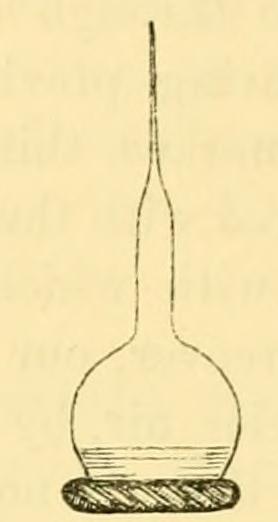
Fig. 17.
This process of impregnation, therefore, does not afford us sufficient safeguards, but by means of the following device we shall render it more satisfactory. Let us take a series of flasks shaped as in Fig. 17, containing an organic liquid suitable to the development of fungoid growths, that is to say, slightly acid—yeast-water, plain or sugared, the wort of beer, or Raulin’s fluid[52] 89will answer our purpose; let us boil the liquid, and having previously drawn out the necks, let us close the ends in the flame of a lamp whilst the steam is escaping, as soon as we judge that the air has been nearly all expelled. Having prepared ten or twenty of these flasks in this manner, when they are cold we may break their points in any place we may be in. The air will rush into the flasks, and we must then seal them up again in the flame of the lamp, and put them aside for future observations. In a certain number of these flasks, as we have already explained in our experiments carried on after this fashion, we shall see some fungoid growths appear, first in the shape of flakes of mycelium floating in the liquid, and afterwards coming to the surface to fructify. Now, it often happens that penicillium glaucum appears alone, so numerous are the spores of this fungus floating in the air. Under such conditions, we shall evidently obtain a field of sporanges quite free from the presence of other organisms. If we now take off the neck of one of the flasks containing the pure penicillium, and take out some of the germs with our platinum wire,[53] we 90shall thus obtain with most certainty spores of penicillium free from impurities.
Our readers will excuse the length of these details and the minutiæ of our precautions, but we shall again and again see that to neglect them, or any part of them, is to expose ourselves to hazard in drawing sure conclusions from facts which come under our observation.
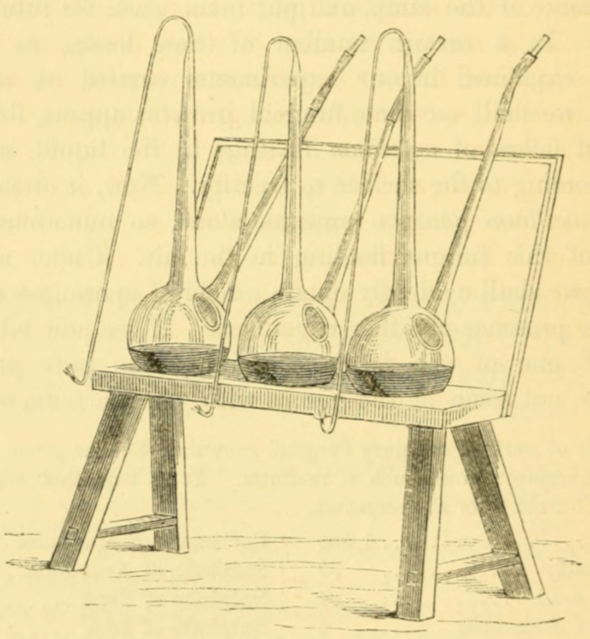
Fig. 18.
On June 17th, 1872, we placed some pure spores of penicillium in a series of three flasks containing wort (Fig. 18), observing all the precautions that we have indicated. We shall designate 91these flasks by the letters A, B, C. On the following day the spores germinated, and the liquid became full of flakes of mycelium, some of which came to the surface to fructify. The temperature varied between 25° C. and 30° C. (77° to 86° F.).
On June 22nd, small patches, with whitish borders and green centres, developed on the liquids. We then shook up the flask A, in order to submerge the plant and the spores.[54] We also shook the flask B, after observing the precaution of sealing up the slender bent tube.[55] The flask C was attached on one side to an aspirator, on the other to a tube filled with cotton, and every day we renewed the air in it.
During the weeks and months over which our observations extended, there was not the least formation of yeast in these flasks; moreover, we have frequently repeated this and other experiments of a similar kind, without ever detecting the appearance of either ordinary yeast or any other true alcoholic ferment. The experiments may be made with saccharine juices that are highly favourable to the development of bacteria and lactic ferment. These latter appear equally incapable of transformation into yeast, which has never been seen to develop in experiments where they were used, if proper precautions have been taken to secure a pure growth. Should we neglect any of the precautions that are necessary to secure the purity of our spores, we may of course obtain different results. If, for instance, we sow spores of penicillium grown in free contact with 92the atmosphere, and consequently exposed to the particles of dust floating therein, we shall frequently observe, mixed with the fruiting hyphæ of the fungoid growth, yeast and mycoderma vini and torulæ, or even bacteria and lactic ferment. Thus we shall be led to believe, in all good faith, that we have under our eyes examples of the changes of spores of fungoid growth into cells of ferment, or proofs of the conversion of bacteria or lactic ferment into the same cells.
Causes of error of this nature have induced some German naturalists to believe that they have succeeded in proving, beyond the possibility of doubt, that a number of fungoid growths may produce alcoholic ferment, and that they have clearly demonstrated that spores of these fungi may become transformed into yeast. In 1856 M. Bail, and, about the same time, Berkeley, and, later on, H. Hoffmann and Hallier, have successively entertained these views, which were introduced into science by M. Turpin. We have combated them since the year 1861.[56] Since that period they have lost rather than gained ground abroad, in spite of the growing favour bestowed on the Darwinian system. One of the mycologists who enjoy the most legitimate authority beyond the Rhine, M. de Bary, has arrived, as we have, at absolutely negative results.
A simple perusal of what has been written in favour of the transformations which we are discussing causes us to entertain the gravest doubts as to the correctness of results which are quoted as decisive. We need only give one example, which we extract from a paper by M. H. Hoffmann.
“In some cases,” this author writes, “and under favourable circumstances, I have been able to see the ferment produce filaments, both small specimens that could be examined immediately under the microscope, and also large specimens, and I have recognized, amongst other varieties, penicillium glaucum, ascophora mucedo, ascophora elegans, and periconia hyalina, sometimes isolated, sometimes intermixed. This result is most easily to be 93obtained by the following method:—Pour a small quantity of water into a test-tube, which should then be placed slantingly: introduce some fresh yeast into the middle part of the tube, and close the tube with a wad of cotton, to prevent the entrance of exterior particles of dust. In this vapour-filled receptacle we shall sometimes see flakes develop. It seems that Messrs. Berkeley and G. H. Hoffmann have also obtained penicillium from ferment, by a similar process.”[57]
Why, however, should it not be admitted that penicillium found under such conditions may be derived from spores of that growth, adhering to the sides of the tube before it is closed with the wad, or mixed with the yeast that is put into the tube?
The facts alleged during the last few years by M. Bail, who persists in his views, in spite of their apparently greater exactness, are also far from being satisfactory.[58]
M. Trécul, who is almost the only one in France, besides Messrs. Ch. Robin and Fremy, to participate in these errors, does not confine himself to affirming the change of the spores of penicillium into yeast, and vice versâ; his system is a far more extensive one. “According to my observations,” he says, “there would be the following series of changes; albuminous matter changed into bacteria, or directly into alcoholic ferment, or into mycoderma; bacteria into lactic ferment, there becoming immoveable; lactic ferment into alcoholic ferment; alcoholic ferment into mycoderma cerevisiæ; finally, mycoderma cerevisiæ into penicillium.[59]”
M. Trécul does not stop here. He goes on to explain the 94principal of these changes, as though his testimony were quite beyond refutation:
“If we use a perfectly filtered wort, containing no granulations, and prepared at a temperature between 60° C. and 70° C. (140° F. and 160° F.), there will first of all appear a multitude of fine granules that will develop into active bacteria, which, losing the faculty of motion, will constitute lactic ferment, as I have repeatedly pointed out. A few days after the appearance of the first granules, we shall perceive others rather larger in size and isolated. These will increase in size, and, in the course of time, assume the form of little globuloid, or elliptic cells; they will not commence to bud before they have attained a comparatively large size, approaching that of ordinary yeast, consequently, there will be a considerable interval of time, during which the young cells will present no buds, especially if we work at a low temperature, as from 20° C. to 35° C. (68° F. to 95° F.)
“As for the transformation of the spores of penicillium into alcoholic ferment, the possibility of which M. Pasteur also denies, I have very often obtained it by using liquids, such as boiled wort and sugared barley water, which had stood for a month or six weeks without setting up an alcoholic fermentation. These liquids, sown with spores of different forms of penicillium, chosen when young and in full growth, fermented after a varying number of days, even at a temperature of 12° C. (54° F.), the condition of fermentation being that the flasks were closed with very elastic corks, which had been boiled for a quarter or half an hour; these corks, as I have already pointed out, it is best to keep for a month after the boiling, to make sure, by drying them thoroughly again, of destroying any mycelia adhering to them. It is necessary to keep the flasks stoppered that the corks may be always moist, and it is also advisable to shake the flasks once or twice a day, to secure the submersion of the spores. If these conditions are carried out, we shall soon see the spores increase in size, gradually lose their green colour and then bud, and often a very active fermentation will manifest itself. All 95the spores will be transformed, if the flasks are perfectly air-tight.”[60]
Such is the manner in which M. Trécul regards these changes. His is entirely a system of spontaneous generation, worked out into minutest detail, from the transformation of the albuminous substances to the formation of cells of the higher organisms, passing from the disintegration of the original substances to the formation of very fine granules, from these to the creation of active bacteria, which last, in their turn, become lactic ferment through the simple cessation of their faculty of moving and so on. We regard all this as purely imaginary. As a matter of fact, M. Trécul’s argument is based on the successive phenomena which manifest themselves in filtered wort “containing no granulations.” As M. Trécul reasons, this condition is a necessity, for he starts with the assertion that the albuminous substances in the wort become changed into granulations “that will develop into active bacteria.” This is another of M. Trécul’s illusions. No doubt we may filter hopped wort to almost perfect clearness, but we can only do this when it is cold. If we filter it warm, it will be bright as long as it remains warm, but as soon as cold it will appear turbid, in consequence of the great number of minute granules floating in it. Again, cold wort, however little it may be or has been in contact with air, undergoes a process of oxidation, and this oxidation, which acts principally on the colouring or resinous matter, causes a deposit of fine granules, the number of which is constantly increasing as oxidation goes on. These granules form an absolutely inert precipitate which, under no possible circumstances, can become 96transformed into active bacteria. Nothing can be easier than to prove this fact, by taking some of our two-necked flasks (Fig. 4) and preparing pure wort in them, by boiling, and then leaving it to cool and undergo the process of oxidation. In wort thus exposed to the air—the air being pure and free from germs—there will be formed a granular deposit, which will never become active or transform itself into any kind of organism whatever.
We may also remark that whilst M. Trécul used wort in his experiments, he does not tell us if it was hopped or not. Had M. Trécul informed us that the facts which he described applied to unhopped wort, we should reply that a temperature of 60° C. or 70° C. (140° F. or 160° F.) is quite insufficient to kill the germs of bacteria existing in such a wort. Hopped wort should be heated to 70° C. or 75° C. (160° F. to 170° F.), that it may remain inert after having cooled down in contact with pure air; unhopped wort must be heated to about 90° C. (194° F.).
In short, whatever may be the case, it must be evident to our readers that the active bacteria observed by M. Trécul existed in the form of germs in the wort that he used, and that what he observed was nothing more than the development of these germs when brought into contact with the air held in solution in the liquid.
As for the success of M. Trécul’s experiments on the penicillium, we have no doubt that that gentleman has sown germs of yeast or torulæ, which bear so striking a resemblance to yeast, at the same time that he sowed spores, since he took his spores from sporangia of penicillium that had been exposed to contact with ordinary air. The conditions under which M. Trécul conducted his experiment rendered it difficult for the spores—although, relatively, much more numerous than the contaminating germs of ferment with which they happened to be associated—to make way against these latter, since the spores were unable to continue their development in a medium that was deprived of oxygen. On the other hand, the cells of 97ferment might easily have multiplied to such an extent as to make the discovery of the spores that had been sown a matter of some difficulty, since those spores would have been lost amongst the great number of cells of ferment. This was, probably, one of the causes which led to the mistaken notion that such spores underwent conversion into cells of ferment. Now although botanists describe several varieties of penicillium glaucum, we do not suppose that the cause of the difference between our results and those obtained by M. Trécul can be attributed to our having operated upon a different variety of penicillium from that which he used. Supposing that there had been a great difference between our two varieties, still M. Trécul declares that he has realized the phenomenon with numerous varieties of this fungus.
M. Trécul expresses himself as follows: “I have used spores of penicillium of several varieties in these experiments: Firstly, thick, green, elliptic spores of a variety of penicillium that grows on lemons; secondly, elliptic spores of a bluish colour and smaller than the preceding, of another variety of penicillium found on lemons; thirdly, spherical spores of the variety termed penicillium crustaceum; fourthly, spores of the penicillium that develops on the yeast of beer.[61]”
This criticism of M. Trécul’s opinions was written on the occasion of a discussion at the Academy, after we had been induced to read over again the remarks which he had published on the subject. We were so impressed by the positive manner in which his conclusions were stated, that we asked ourselves, once more, which of us could be mistaken, and once more, also, we applied ourselves to fresh experiments, which we conducted with every possible precaution, following, as far as we could without falling into the errors of which we accuse the learned botanist, the mode of procedure that he adopted. As his descriptions struck us as being at times insufficient, we resolved to ask him for certain explanations vivâ voce (November 3rd, 1873), which he gave us with the greatest willingness.
98“Every variety of penicillium,” said M. Trécul, “especially when young and vigorous, is amenable to transformation into ferment. This is the way in which I operated; I had some little flasks of 30 c.c. to 40 c.c. (about 1-½ fluid ounces) in capacity, filled quite full with wort, or, at least, containing very little air, closed perfectly air-tight with corks which I had kept for a quarter of an hour in boiling water. These flasks when corked were heated to 60° C. or 70° C. (140° to 158° F.). After they had cooled I uncorked them, and introduced into them the spores which had been prepared as follows: I placed on a piece of glass some spores of the variety of penicillium that I wished to study, taken with a pair of forceps from a mouldy lemon, and I mixed these spores with a drop of wort and observed them under the microscope to assure myself that they contained nothing of a foreign nature; then I poured my drop of wort from the piece of glass into one of the flasks, which I recorked and laid down. The transformation into ferment took place next day.”
Provided with these new data we set to work again and prepared a series of little flasks which were filled quite full with hopped wort, or contained but very little air, as M. Trécul had recommended. These we heated in a hot water bath to 70° C. (158° F.) at least; we then impregnated them, observing the necessary precautions, which we described at the commencement of this paragraph—not working in the evidently defective manner in which M. Trécul had done. Taking his spore-seeds from a field of sporanges exposed to the air, and afterwards manipulating them, in contact with the air, in water on a piece of glass, before he made his microscopical examination, his experiments were conducted under circumstances in every way conducive to the introduction of causes of error. One of the most serious of those causes is that which results from the substratum of the spores as taken from a mouldy lemon. If M. Trécul will examine under the microscope the water in which any lemon has been washed—even a sound lemon, unattacked by any fungoid growth—he will immediately see the cause of error to which his method of working exposes him. Germs of 99microscopic organisms exist abundantly on the surface of all fruits.
Having impregnated the liquids in our flasks with spores from a quantity of pure sporangia grown in a closed vessel, gathered on the point of a platinum wire, which had first been heated and then allowed to cool, we found that in each case, without exception, germination took place, then a mycelium was developed, which soon, however, ceased to grow from want of a proper supply of air; but not in any single case was there the faintest trace of fermentation, formation of yeast, or appearance of bacteria or lactic ferment.
We repeated these experiments, using unhopped wort instead and obtained similar negative results. We had previously determined that it was necessary to heat flasks of hopped wort to 70° C. (158° F.), at least, and those of unhopped wort to 90° C. (194° F.) to secure them from further change.
In short, contrary to the assertions of M. Trécul, M. H. Hoffmann, and other naturalists, it is not true that the spores of penicillium can change into alcoholic ferment.
Regarded from another point of view, growths of pure penicillium will give us some remarkable results, the interpretation of which seems to us to be intimately connected with the physiological theory of fermentation that we shall discuss in a subsequent chapter. It is a question as to the production of alcohol whilst the life of the plant is carried on under certain conditions of growth.
If we distil saccharine liquids on the surface or in the body of which we have grown penicillium, and repeat the distillation in the manner that we have already described for the detection of the minutest quantities of alcohol, we shall readily find that those liquids frequently do contain a little ordinary alcohol. Moreover, if we regard the quantities of alcohol produced, which are always very minute, seldom exceeding 1 or 1·5 thousandth of the total volume of the liquids, we shall find that there is no fixed proportion between this alcohol and the weights of the plants formed. It is possible, for instance, that 100we may obtain more alcohol from one plant than from another weighing a hundred times as much. Often, however, when the vegetation is abundant we cannot make out the occurrence of alcohol in spite of the sensitiveness of the process described (p. 78).
What can be the cause of these varying results relating to the production or non-production of alcohol in the vegetation of the little plant? The numerous experiments that we have made seem to demonstrate positively that they are dependent upon variations in the amount of air or oxygen that is supplied to the fungoid growths, whether, that is, the vegetating mycelium alone be submerged, or the whole plant with its organs of fructification. When the plant has at its disposal an excess of oxygen, as much as its vitality can dispose of, there is no alcohol, or very little, formed. If, on the other hand, the plant vegetates with difficulty, in presence of an insufficiency of oxygen, the proportion of alcohol increases; in other words, the plant shows a certain tendency to behave after the manner of ferments.
Some time ago, wishing to assure ourselves that the spores of penicillium could not become transformed into ferment, we sowed some pure spores in small flasks, holding from 50 c.c. to 100 c.c. (from 2 to 4 fl. oz.), which contained very little air, and which were sealed hermetically after the sowing. Under these conditions, the germination and growth of the spores proceeded with great difficulty, and soon ceased through want of air. The total weight of the little plant was too small to be determined. In cases of this kind, if we distil the whole of the liquid we shall often see the alcohol appear in the second distillation, even though the weight of the plant may have been scarcely appreciable. If, on the other hand, side by side with experiments of this kind, we grow pure penicillium in flasks containing air and having quantities of saccharine liquids equal to the quantities in the small flasks of which we have been speaking, the plant, in consequence of the large volume of air at its disposal, will develop vigorously, and in the course of even 101a few days will have become perceptibly heavier. In distilling the subjacent liquid, however, we shall generally find that it contains no alcohol at all, even though the weight of the plant be half a gramme, or more (6 or 7 grains).
These results apply to all the fungoid growths that we have studied, but they vary considerably with the nature of the organisms. Aspergillus glaucus is, in this respect, one of the most curious.
On June 15th, 1873, we impregnated three flasks of wort, A, B, C, with pure spores of aspergillus glaucus. The development was rapid and the fructification abundant. On June 20th, we shook up the liquid and the supernatant fungoid growths in the three flasks; the flasks A and B were then treated as follows:—
We distilled the Liquid in A to discover the presence of alcohol; but could find none.
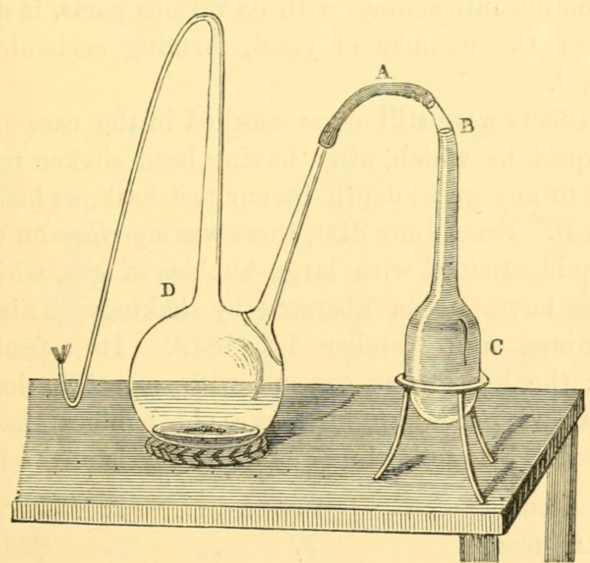
Fig. 19.
The flask B was connected with a test flask (Fig. 19), into which the liquid, together with its fungoid growth, was transferred from B. The next day, June 21st, the mycelium which 102was on the surface of the liquid, in the neck of the flask, was studded with bubbles of gas; these we dispersed by shaking. On June 22nd, many others had formed again, and a large flake of mycelium that had risen from the bottom of the test flask had been stopped at the bottom of the neck, quite distended by gas bubbles. We liberated the gas by shaking, but the bubbles formed again by the next day, and this effect continued for several days; nevertheless the liberation of gas was not continuous, as is the case in an ordinary fermentation.
On July 20th we drew off the liquid and distilled it; it was still very sweet, but though it contained a sensible quantity of alcohol, the microscope failed to detect a single cell of ordinary alcoholic ferment.
These results show that the aspergillus when in full growth, with plenty of air at its disposal, does not yield alcohol, and that if we submerge it, so as to prevent the oxygen of the air from readily coming into contact with its various parts, it decomposes sugar, after the manner of yeast, forming carbonic acid gas and alcohol.
These effects were still more marked in the case of the flask C, the liquid in which, after having been shaken up, was not decanted to any great depth in our test flask, as had been the case with B. From June 21st, there was mycelium on the surface of the liquid, studded with large bubbles of gas, which formed again after having been liberated by shaking. This last flask was examined on November 1st, 1873. Its aspect was unchanged; the liquid was covered with mycelium loaded with sporanges and borne up by large old bubbles that had not disappeared. The following was the analysis of the liquid:—
Alcohol 1·2
Glucose 84·0
Dextrine (?) 32·0
The liquid was very bright, and contained an amorphous granular deposit, formed by the wort after it had been boiled, at the time when we prepared our flasks. We crushed a small 103quantity of mycelium that had risen to the surface of the liquid, and obtained a field such as is represented in Fig. 20. Amongst the ordinary filaments of mycelium belonging to the plant, which are not represented in our engraving, and which were not more 104than 1/300 of a millimetre (nearly 1/7500 in.) in diameter, we perceived much larger ones, swollen and contorted in the most singular manner, and measuring as much as 1/50 of a millimetre across their broadest parts. There was also a multitude of the ordinary spores of aspergillus mixed with others of larger size, and big, inflated cells, with irregular or spherical protuberances, full of granular matter. As there are all the stages between the normal spores of the plant and the big cells, and between these latter and the filaments, it must be admitted that the whole of this strange vegetation results from spores which change their structure under the influence of special conditions to which they are exposed.[62] Beyond all doubt these cells and irregularly shaped segments, in vegetating with difficulty, gave rise to the fermentation, which, although insignificant, was sufficiently marked to produce more than a gramme (15 grains) of alcohol. The oxygen of the air failing, or existing in insufficient quantity for the regular development of the filaments of mycelium belonging to the plant, and for the germination of its submerged spores, filaments and spores vegetated as the yeast of beer might have done if deprived of oxygen.
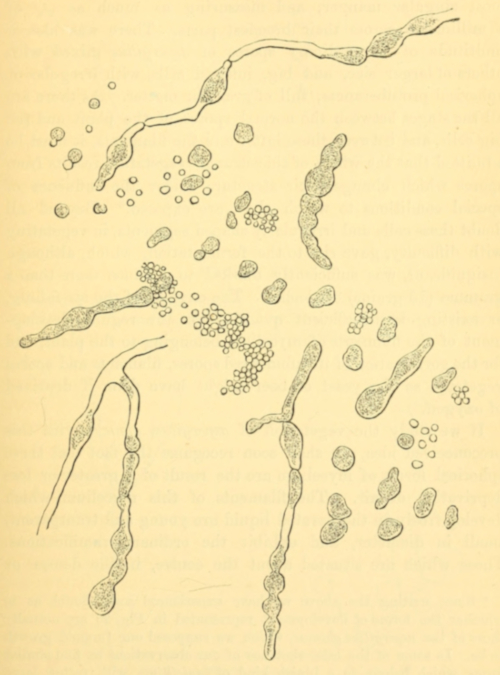
Fig. 20.
If we study the vegetation of aspergillus glaucus with this preconceived idea, we shall soon recognize the fact that these spherical forms of mycelium are the result of a greater or less deprivation of air. The filaments of this mycelium which develop freely in the aerated liquid are young and transparent, small in diameter, and exhibit the ordinary ramifications. Those which are situated about the centre, in the denser or 105more complicated parts, to which the oxygen cannot penetrate in consequence of its absorption by the surrounding parts, are more granular in appearance as well as larger, and inclined to develop swellings. We can observe no conidia[63] on these filaments, but we may say that they are on the point of appearing, for the spherical segments often tend to assume an appearance of close jointing, as when they take the form of those rows of swelling, or cells, which has given rise to the idea of the chaplets of the conidia-cellules. This is represented in the accompanying sketches (Fig. 21), which we have purposely contrasted with two similar ones which relate to the mucor, of which we shall soon speak. The conidia of these latter are very remarkable, and their fermentative character becomes apparent as soon as their growths are deprived of air.
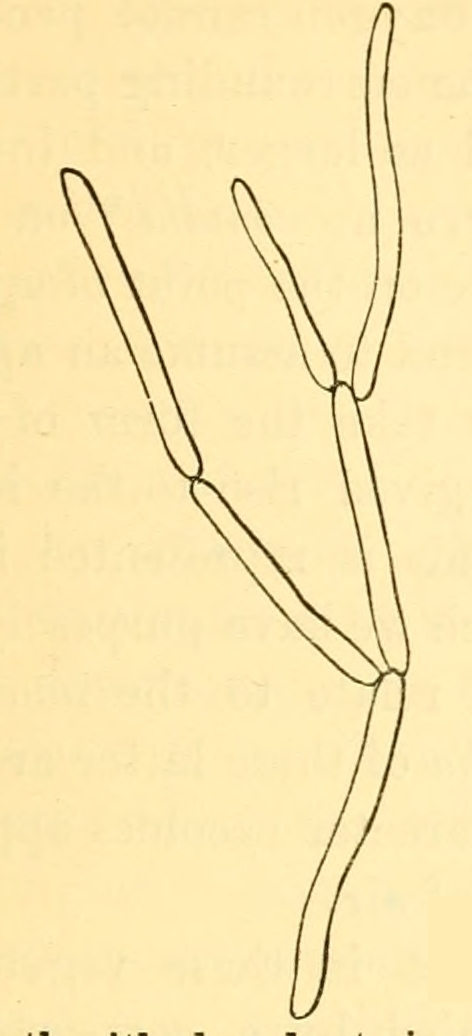
Fig. 21 A. Growth with abundant air-supply at the edge of the mycelium crust.
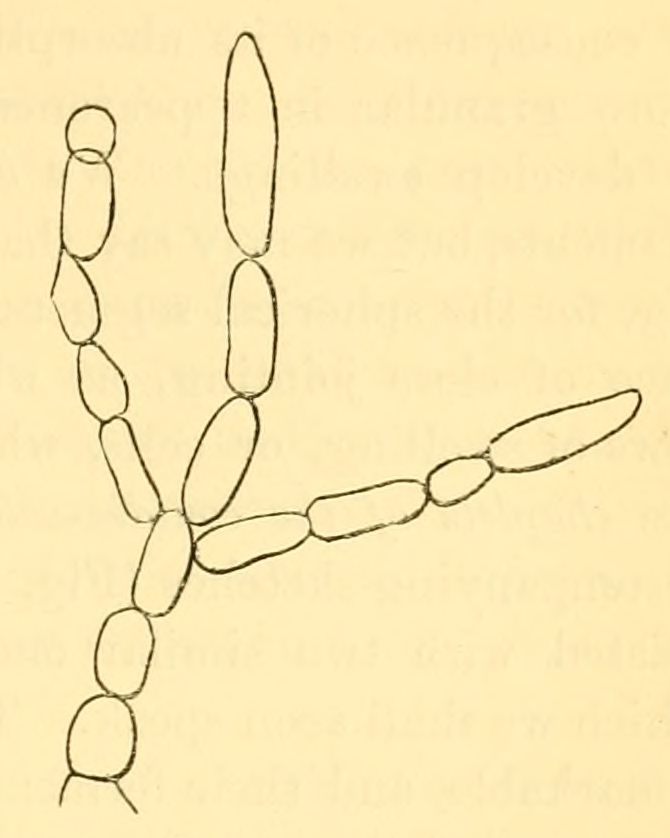
Fig. 21 B. Growth with reduced air-supply in the central and deeper parts of the mycelium.
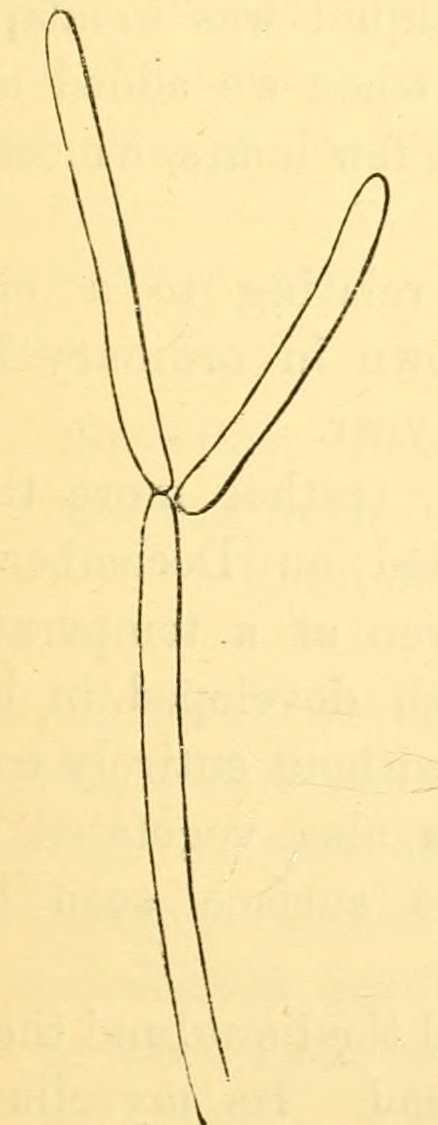
Fig. 21 C. Growth with abundant air-supply at the edge of the mycelium tuft.
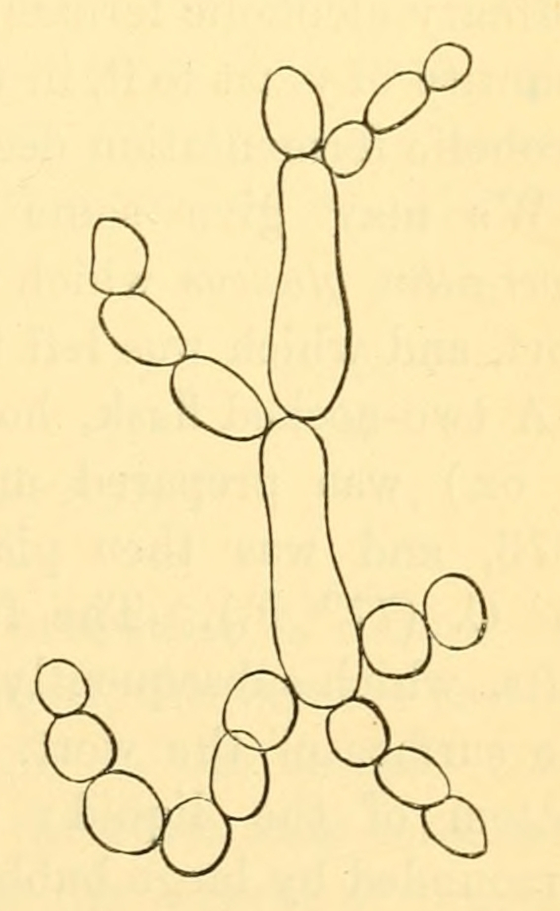
Fig. 21 D. Growth with reduced air-supply in the central and deeper parts.
It is scarcely necessary to add that in these vegetations of aspergillus, which were accompanied by a corresponding alcoholic fermentation, it was impossible to find cells of yeast; and that, notwithstanding this, the liquid was so adapted to ordinary alcoholic fermentation, that, when we added a small quantity of yeast to it, in the course of a few hours, a most active alcoholic fermentation declared itself.
We may give some other facts relating to a crop of aspergillus glaucus which was also grown in ordinary hopped wort, and which was left to itself for a year.
A two-necked flask, holding 300 c.c. (rather more than 10 fl. oz.) was prepared and impregnated on December 21st, 1873, and was then placed in an oven at a temperature of 25° C. (77° F.). The fungoid growth developed in isolated tufts, which subsequently united, but without entirely covering the surface of the wort. A few tufts also vegetated at the bottom of the liquid; those on the surface soon became surrounded by large bubbles of gas.
On December 12th, 1874, we examined the liquid and the plant, which for a long time had appeared dead. Its mycelium was 106formed of aged, granulated filaments, with few swellings. The weight of the dry fungoid growth was 0·50 gramme (about 8 grains) for a total volume of liquid of 122 c.c. (4-1/4 fluid ounces). We obtained 4·4 c.c. of alcohol of 15°, which was about seven times the weight of the plant. Finally, we determined the acidity of the liquid, and found 2·8 grammes, in equivalents of sulphuric acid, a quantity greatly in excess of the total acidity of an equal volume of wort, a fact which shows us that fermentation caused by aspergillus glaucus is accompanied by the formation of an organic acid, the nature of which it would be interesting to determine. M. Gayon has commenced the study of this subject in our laboratory.
In concluding our observations on the aspergillus glaucus, we may give the comparative results of two growths that were obtained under precisely similar conditions, in flasks of exactly the same size, but differing in this respect—that one of them was constantly subjected to a current of pure air that played on the liquid. In the course of a few days, when the fungoid growth in the flask that had been aerated had attained a considerable size, in comparison with the other, we broke the flasks in order that we might take out the two growths and compare their weights. After drying them at 100° C. (212° F.) we found:—
Growth in the aerated flask 0·92
Growth in the closed flask 0·16
Ratio of weights, 92/16 = 5·75.
Again, although we had taken the precaution of condensing in a U tube, over which cold water played, the vapours carried away by the current of air, the liquid in the aerated flask gave no evidence of alcohol. That in the other flask contained a very appreciable quantity, although the weight of fungoid growth in that flask was scarcely a sixth part of what it was in the other.
The preceding facts taken altogether, seem to us to demonstrate once more, in the most conclusive manner:—
107Firstly, That neither penicillium nor aspergillus glaucus can change into yeast, even under conditions that are most favourable to the life of that ferment.
Secondly, That a fungoid growth which vegetates by using the oxygen of the air, and which derives from the oxidating action of that gas, the heat that it requires to enable it to perform the acts necessary to its nutrition, may continue to live, although with difficulty, in the absence of oxygen; that, in such a case, the forms of its mycelian or sporic vegetation undergo a change, the plant, at the same time, evincing a great tendency to act as alcoholic ferment, that is to say, decomposing sugar and forming carbonic acid gas, alcohol, and other substances which we have not determined, and which probably vary with different growths.
Such, at least, is one interpretation of the facts that we have reviewed. The observations in the following paragraphs and chapters may the more incline our readers to accept it as the true one.
§ II.—Growth of Mycoderma Vini in a state of Purity—Confirmation of our original Conjectures as to the cause of Fermentation—Mycoderma Vini does not Change into Yeast, although it may give rise to Fermentation.
The efflorescence of wine, cider, and beer is pretty generally known.[64] Fermented liquors cannot be exposed to the air without soon becoming covered with a white film, which grows thick and becomes wrinkled in a marked manner in proportion as it is deprived of room wherein to spread horizontally, in accord with the extraordinary multiplication of the cellules that compose it. The rapidity of this multiplication is sometimes astounding. During the heat of summer, when the medium is well adapted to the life of the plant, we may count the number of cells which grow in the course of a few hours by millions. The absorption 108of the oxygen necessary to the activity of this growth, and the heat developed in the film, as well as the liberation of carbonic acid gas, that result from it are considerable. A piece of glass covering the mycoderma, at some distance above it, becomes wet with moisture, that soon accumulates to form large drops of water. The quantity of oxygen absorbed is so great that we never see any other fungoid growth on the surface of this film, although the air is constantly depositing on it, as dust, spores of an entirely different character; for, notwithstanding that the warm and moist surface is in contact with an atmosphere that is being continually renewed, yet the mycoderma appropriates to itself all the oxygen contained in the air. When, however, the vegetation begins to languish, we often find, on the other hand, that the plant becomes associated with other species of mycoderma, notably mycoderma aceti, as well as other fungi, amongst which penicillium glaucum generally appears. This is one of the facts which, wrongly interpreted, have led to the belief that mycoderma vini or cerevisiæ may possibly, or even readily, become transformed into penicillium, and vice versâ.[65] As the study of the growth of 109mycoderma vini on the surface of saccharine liquids and in their depths, unaccompanied by any other species, has the most important bearing on the theory of alcoholic fermentation, we may pursue it through a few examples with all the detail that it allows of.
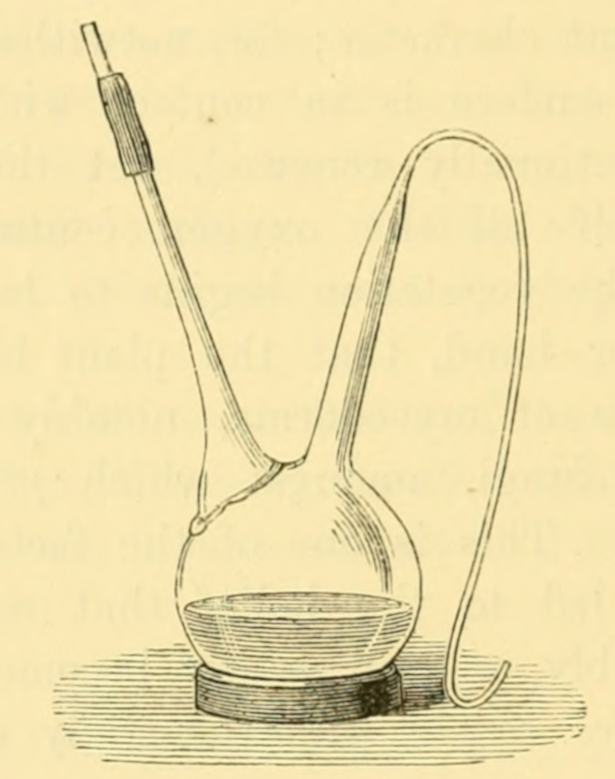
Fig. 22.
On June 21st, 1872, we sowed some mycoderma vini in three flasks, with double necks, A, B, C (Fig. 22), containing some wort. The spores employed for the purpose were obtained from plants growing on sweetened yeast-water in an ordinary closed flask. This had been impregnated with spores from plants grown on wort, which in turn had sprung from spores taken directly from mycoderma vini growing on wine.
The several impregnations were effected by means of a platinum wire, held by forceps, both having been first cleaned by passing through flame, and then smeared with the fungoid films.
By this series of growings in closed vessels, which were but momentarily open at the time when we dropped the spores into them, we secured the separation of the mycoderma from all foreign organisms; and more particularly from germs of mycoderma 110aceti, which is generally found along with it, but which propagates with difficulty in neutral saccharine liquids.
On the following days films of mycoderma vini had spread over the surface of the liquid in the three flasks. To all appearance they were very pure; and the microscope showed the complete absence of any mixture of mycoderma aceti, lactic ferment, or other foreign growths.[66]
On June 26th we decanted and distilled the liquid in A without finding any trace of alcohol. We shook up the liquids in B and C, with all due precautions, so as to submerge their films as much as possible, and then we raised the temperature of the flasks to 26° C. or 28° C. (82° F.). For some days afterwards we saw a constant succession of minute bubbles of carbonic acid gas rising through the liquid, which remained bright under the part of the film that had not fallen in. It had all the appearance of a slow but continuous fermentation.
On June 29th we decanted and distilled the liquid in B, and found in it an appreciable quantity of alcohol, which showed itself in the first distillation. The flask C, which was shaken afresh, continued to give signs of fermentation, but, some days later, the evolution of the bubbles ceased.
On July 15th, 1873, we examined the flask with its film and its deposit of mycoderma vini, without finding a trace of any foreign growths, either in the shape of penicillium glaucum, or mucor mucedo, or rhyzopus nigrans, or mycoderma aceti, or, in short, any of the organisms which could not have failed to appear on the surface of a substratum so peculiarly adapted to their development, had it been in the nature of mycoderma vini 111to transform itself into one or other of those common fungoid growths. The liquid, moreover, still remained sweet, and did not contain any cells of actual yeast. We may conclude then that when one or more of these fungi occur, after an interval of some days, in a growth of mycoderma vini conducted in contact with common air, it does so in consequence of that air having, without the knowledge of the observer, impregnated the liquid spontaneously with germs of these foreign organisms.
There might perhaps be room for some fear that the conditions of growth in our flasks were not favourable to the simultaneous appearance of these common fungoid growths along with the mycoderma vini. On June 24th, 1872, we sowed, in three flasks of sugared yeast-water, prepared as before—in the first, mycoderma vini, together with penicillium glaucum; in the second, mycoderma vini, together with mucor mucedo; in the third, mycoderma vini alone.
We effected this by plunging the platinum wire, which we used for impregnating the liquids, into the pure film of mycoderma vini, and then touching with the wire the sporanges of the other fungus. On June 29th, we saw on the surface of our first flask some green patches of penicillium, along with some spots of mycoderma vini; in the second flask a voluminous mycelium of mucor mucedo, distended by large bubbles, had risen to the surface of the liquid, and was entirely covered by a film of mycoderma vini. As for the liquid in the third flask, there were only a few spots of very pure mycoderma vini. This last flask, after being kept in an oven at 25° C. (77° F.) for several months, still contained nothing but mycoderma vini, unmixed with any other fungoid growth whatever.
We may therefore be sure that mycoderma vini, vegetating on the surface of liquids adapted to its nutrition, in contact with air deprived of its germinating dust, will not present the least sign of a transformation into any of these other common fungi, or into yeast, however long may be the duration of its exposure to contact with that pure air.
We may now return to that feeble and limited production of 112carbonic acid gas and alcohol, the formation of which we have shown experimentally to take place at a high temperature, after submerging the film of mycoderma vini.[67] There can be no doubt that we have here a phenomenon similar in every point to that presented by penicillium and aspergillus, which we studied in the preceding paragraph. When the germs or jointed filaments of mycoderma vini, growing on a saccharine substratum in contact with the air, are in the full activity of life, this activity is carried on at the expense of the sugar and other materials in the liquid, in the same way that animals consume the oxygen of the air and evolve carbonic acid.
The consumption of the different materials is attended with a proportionate formation of new materials, development of structure, and reproduction of organisms.
Under these conditions, not only does the mycoderma vini not form a sufficiency of alcohol for analytical determination, but, if any alcohol exists in the subjacent liquid, the mycoderma consumes it, converting it into water and carbonic acid gas, by 113fixation of the oxygen of the air.[68] If, however, we suddenly submerge the mycoderma, we shall obtain a different result. If, on the one hand, the conditions of life of this fungus are incompatible with the altered circumstances in which it is placed, the plant must perish, just as an animal does when deprived of oxygen. But if, in spite of these changed conditions of nutrition, it can still continue in life, we should expect to see marked changes in its organic structure, or chemical metamorphoses. The result of our observations points to the continuance of life, in a distinct though sluggish and fugacious activity, accompanied by the phenomena of alcoholic fermentation, that is, the evolution of carbonic acid gas, and the production of alcohol.
If we take a drop of liquid charged with disjointed cells of mycoderma, a day or two immediately after the submersion of the film, we shall observe changes, small but appreciable, in the aspect of a great number of these cells; they will show increase in size, their protoplasm will be in process of modification, and many of them will have put forth little buds. It will be quite evident, however, that these acts of interior nutrition and the changes of tissue resulting from them, proceed with difficulty; the buds when they form will soon wither, and there will be no multiplication of new cells. These changes will, nevertheless, be accompanied by the decomposition of sugar into alcohol and carbonic acid.
In comparing these facts with those which we have pointed out in connection with the cultivation of penicillium and aspergillus, we are compelled to admit that the production of alcohol and carbonic acid gas from sugar—in one word, alcoholic fermentation—is a chemical action, connected with the vegetable life of cells which may differ greatly in their nature, and that it takes place at the moment when these cells, ceasing to have the power of freely consuming the materials of their nutrition by respiratory processes—that is, by the absorption of free oxygen—continue 114to live by utilizing oxygenated matters which, like sugar or such unstable substances, produce heat by their decomposition. The character of ferment thus presents itself to us, not as being peculiar to any particular being or to any particular organ, but as a general property of the living cell. This character is always ready to manifest itself, and, in reality, does manifest itself as soon as life ceases to perform its functions under the influence of free oxygen, or without a quantity of that gas sufficient for all the acts of nutrition. Thus we should see it appear and disappear concomitantly with that mode of life; feeble and fugacious in its action when the conditions of this vitality are of a similarly restricted character; intense, on the other hand, and of long duration and productive of large quantities of carbonic acid gas and alcohol, when the conditions are such that the plant or cell can multiply with facility in this novel manner. To this we may attribute all possible degrees of activity in fermentation, as well as the existence of ferments of every variety of form and of very different species. It may readily be imagined that sugar may undergo decomposition in a quite different manner from that of which we have spoken, that instead of alcohol, carbonic acid gas, glycerine, and similar substances, it may yield lactic, butyric, acetic, and other acids. It would be only one definite class of cellular organisms, the members of which resembled each other more or less, that decomposed sugar into alcohol and carbonic acid; others, specifically different, would act in a different manner. In short, we may say that the number of these living organisms is a measure of the number of different ferments.
Plate IV. represents in its two halves the condition of the mycoderma vini at two different and unequal periods after its submersion. In the left-hand semi-circle, it is evident that many of the figures are swollen, that modification of their protoplasm has taken place, and incipient budding is going on in several of them. A budding of this kind would not wither; the buds would grow and, detaching themselves, would form new cells capable of budding in their turn. We should have 115under our eyes all the characteristics of a yeast, which, beyond doubt, would give rise to a very active fermentation, inasmuch as it would belong to the order of phenomena of nutrition and vital energy of which we are speaking. Instead, however, of insisting upon the acceptance of our interpretations, based on a few facts merely, let us go on to accumulate facts, varying the conditions as much as possible. Our examples, taken singly, may seem insufficient to establish the theory that it will be our endeavour to substantiate, but taken together we trust that they will secure our readers’ confidence.
We may now, perhaps with advantage, introduce two new expressions to embody the preceding facts, by the help of which we may often shorten our subsequent explanations. Since life can continue, under certain conditions, away from contact with the oxygen of the air, and since the altered nutrition is accompanied by a phenomenon which is of great scientific as well as industrial importance, we may divide living beings into two classes, aërobian, that is those which cannot live without air, and anaërobian, which, strictly speaking, and for a time, can do without it; these latter would be ferments, properly so called. Again, since we can conceive, in an entire organism, some organ or even a cell capable of existing, at least momentarily, apart from the influence of the air, and endowed at a given moment with the character of a ferment, we may, in like manner, make use of the expression anaërobian cell, in opposition to a cell that is aërobian.
As long ago as 1863, in our work on putrefaction, we proposed to adopt the preceding expressions, and since then we have had the satisfaction of seeing them used by different authors in France and other countries.
One of the principal assertions in this paragraph relates to the non-transformation of mycoderma vini into other moulds or into yeast.[69]
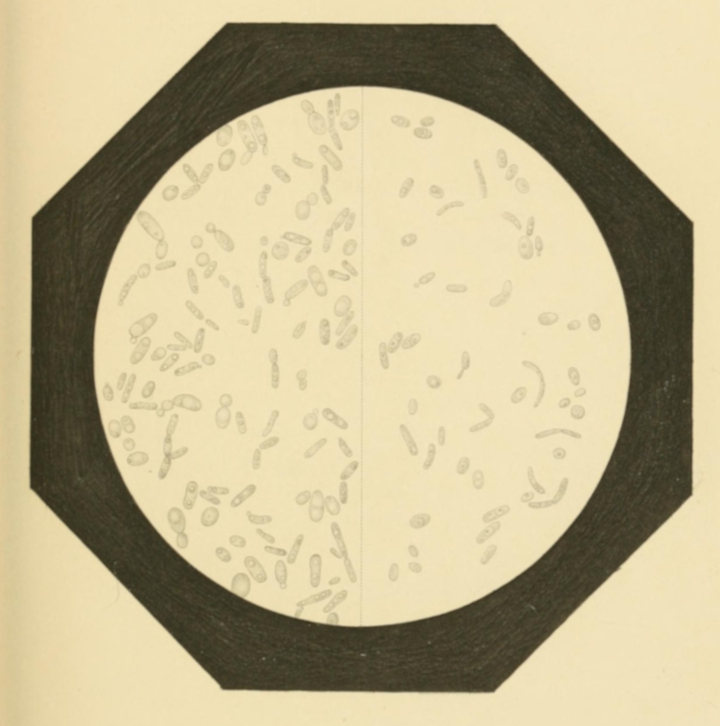
Plate 4. Mycoderma Vini functioning as an Alcoholic Ferment.—Right Half, showing Appearance of Spores just Sown; Left Half, their Appearance after an Interval of Submerged Life.
For a long time, like Turpin and many other observers, although we had no belief in the transformation of mycoderma vini into any 117one of the common moulds, yet we did believe in its transformation into alcoholic ferment. In the course of more elaborate researches, however, we at last discovered that our previous experiments had been vitiated from the same source of error which we have so often had occasion to point out as affecting the observations of our opponents, namely, the fortuitous and spontaneous introduction, unknown to the experimentalist, of germs of the very plant for whose appearance by way of transformation he is seeking.
When we consider that every fermented vinous liquor, when put on draught, is liable to efflorescence, it is difficult to avoid the supposition that this efflorescence is primarily due to cells of the yeast that has caused the liquid to ferment, from which cells the liquid could not be completely freed, no matter how bright it might have been, and which come to the surface of the liquid to live after the manner of fungoid growths. We wished to test this supposition by means of experiments. So great, however, was the resemblance between the forms possible to yeast and mycoderma, of which latter efflorescence is really composed, that we quite despaired of being able to solve the question by microscopical examination, that is, by observing the actual conversion of a cell of yeast into a cell of mycoderma. In order, then, to overcome that difficulty, we endeavoured to produce an inverse transformation—that of mycoderma into yeast. We imagined that we should doubtless obtain this result by submerging some of the efflorescence of wine or beer in a saccharine liquid well adapted to alcoholic fermentation. By submerging the mycoderma we would do away with the ordinary conditions of life in this kind of fungoid growth; for we would thus prevent the supply of oxygen from the air, since that oxygen would always be excluded, in the most effectual manner possible, by the portion of mycoderma that would remain on the surface of the liquid, even after the submersion process; and on the other hand, we would be subjecting our growth to the ordinary conditions of ferment life, which acts at the bottom or in the bulk of liquids fermenting.
118Our experiments were conducted in the following manner:—In some flat porcelain basins, we grew some pure mycoderma vini[70] on fermented liquids, such as wine or beer, or on artificially vinous liquids, such as alcoholized yeast-water, taking care to boil these liquids previously to kill any germs of yeast or other organism that they might contain. The basins themselves, as well as the plates of glass with which they were to be covered, were plunged into boiling water just before they were wanted for use. As soon as the film of mycoderma had become well developed and thick, and even wrinkled—a process requiring not more than two or three days during summer heat—we decanted the subjacent liquid, by means of a siphon, so as to leave the film on the bottom of the basin. We then diffused the whole mass of efflorescence in a saccharine liquid that had been boiled and afterwards cooled down in a closed vessel; generally, we used wort or must preserved by Appert’s process. After that, we emptied the mixture of saccharine liquid and efflorescence into long-necked flasks that had likewise been previously heated, as also had the funnels used in the process of transference.
It seemed to us that experiments conducted with all these precautions must be free from causes of error. It was true that we were working more or less in contact with atmospheric air, but all that we had to fear for the soundness of the conclusions which we might draw was the presence of germs of alcoholic ferment, and we considered how few of these there are amongst floating particles of dust. Consequently, if we succeeded in observing the advent of yeast in each of the long-necked flasks, accompanied by an active alcoholic fermentation, we thought that we might, without danger of error, admit as a fact the transformation of cells of mycoderma into cells of yeast. Again, we thought that we should probably find in the forms of the cells of yeast which were directly derived from the cells of 119mycoderma, a more or less elongated structure, which would be a convincing proof of the transformation that we were seeking, if, indeed, such transformation were possible.
Strange to say, everything happened in a manner that seemed to realize our expectations. The saccharine worts in the flasks in which we had mixed and submerged the mycoderma, fermented in the course of a few days; the yeast first appeared in elongated shapes; lastly, we could see under the microscope that many of the cells or jointed filaments of mycoderma were inflated and presented the appearance of undoubted gradations between their natural state and that of the cells of yeast which soon formed part of the deposit in the vessels. In spite of all this, however, we were the victims of an illusion.
In experiments conducted as we have just described, the yeast which appears, and which soon sets up an active alcoholic fermentation, is introduced in the first place by atmospheric air, from which germs are constantly falling either upon the film of mycoderma or upon the objects that are employed in the successive manipulations. Two peculiarities in these experiments first opened our eyes to the existence of this cause of error. We sometimes found at the bottom of the flasks in which we had submerged the efflorescence, along with the cells of mycoderma, large, spherical cells of mucor mucedo or racemosus, ferment-cells that we shall soon learn to recognize in studying this curious fungoid growth. The existence of mucor mucedo or racemosus, where we had only sown mycoderma vini, was to us a proof that one or more spores of that mucor had been introduced by the surrounding air. If then, we reasoned, the air can introduce spores of mucor into our field of operations, why should it not introduce cells of yeast, especially in our laboratory? Again, it sometimes happened that a negative result was obtained. Harassed by doubts about the reality of this transformation, which accorded so well with, the physiological theory of fermentation we had been led to adopt, we repeated the experiments many times, and in some cases we failed to detect any appearance whatever of a transformation of mycoderma into yeast cells, although the 120conditions under which each of the experiments was conducted had been as similar as could be.
We were at a loss to account for this inactivity in the cells of the mycoderma. Even in the most favourable cases of the supposed fermentation, it was evident that a host of cells of mycoderma vini did not become cells of yeast; but how could it possibly be admitted that amongst the millions of submerged cells, none were adapted for transformation, if that transformation were at all possible?
Thereupon, to find a way out of the difficulty, we resolved to modify completely the conditions of our experiments, and to apply to the research that we had in view a mode of cultivation that might completely, or nearly so, obviate the sole cause of error that we suspected, namely, the possible fall of cells or germs of yeast during the manipulations. We secured this by the use of flasks with two tubes, the right hand one of which was closed by means of a piece of india-rubber tubing with a glass stopper, the other one being drawn out in the shape of a swan’s neck. The use of these flasks, which was then new to us, permitted us to grow mycoderma and to study it under the microscope without fear of disturbance from exterior particles of dust. This time we obtained the results given in the first part of this paragraph. We no longer observed yeast or alcoholic fermentation following the submersion of the efflorescence, either in the flasks themselves, or in the test-flasks attached to them, as represented in Fig. 19. We observed, however, that kind of alcoholic fermentation of which we have already spoken and which is due to the mycoderma itself, a fermentative action that is still more instructive than the one which we thought we had determined, and certainly not less calculated to support the theory of fermentation which we have already briefly sketched.
In an age when ideas involving transformation of species are so readily accepted, perhaps in consequence of their requiring no rigorous experimental work, it is not without interest to consider that, in the course of our researches upon the growths of microscopic plants in a state of purity, we once were 121inclined to believe in the transformation of one organism into another—the transformation of mycoderma vini or cerevisiæ into yeast, and that, on that occasion, we were altogether wrong, through having ourselves fallen a victim to the identical source of error which confidence in our theory of germs had led us so frequently to detect as affecting the observations of others.
§ III.—Growth of Mycoderma Aceti in a State of Purity.
The study of mycoderma aceti has not escaped the numerous causes of error which are apt to attend all observations made on microscopic organisms. This little fungus is still believed by many authors to be one of those polymorphous species capable of great modifications, according to the conditions of their cultivation—it could be, in turns, bacterium, vibrio, yeast, &c. Respecting it, we have seen resuscitated under a modern name, in the course of the last few years, the old hypothesis of Buffon concerning organic molecules, that of Turpin concerning the punctiform globulines of barley, milk, and albumen, and the theory maintained by Dr. Pineau, of Nancy, and by Pouchet concerning proliferous pellicles.[71]
M. Béchamp, Professor in the Faculty of Medicine at Montpellier, disdaining to adopt the expressions which we have just used, has substituted for them that of microzyma, whilst adhering to the opinions and errors represented by the other expressions. This savant designates under the name of microzyma all those punctiform globulines that are met with in most organic liquids when submitted to the microscope; and attributes to them, with Turpin, the faculty of playing the part of ferments, as well as of transforming themselves into yeast 122and various other organisms. They are contained in milk, blood, eggs, the infusion of barley, and such like; nay, we may even find them in chalk, and so we have the fine discovery of Microzyma cretae as a distinct species!
Those who, like ourselves, cannot see in these granulations of organic liquids ought besides things whose nature is still undetermined, term them molecular granules, or, in reference to their Brownian movements, mobile granules. Indefinite expression is the best exponent of imperfect knowledge; when a precise terminology is invented, without any basis of precise ideas derived from a rigid observation of facts, sooner or later the hypothetical facts disappear, but the terminology prematurely created to explain them, hangs about the Science, and, bearing an erroneous interpretation, retards rather than promotes real progress.
We may here introduce a summary of Turpin’s system, as given by himself. It forms a complete biogenesis, which leaves far behind it M. Béchamp’s theory of microzymata, M. Fremy’s descriptions of hemi-organism, and M. Trécul’s account of the genesis of bacteria and lactic ferment:—
“When a mucous substance presents nothing visible through the microscope, as, for example, gelatinous matter, dissolved gum, the white of eggs, or plant-sap, simply thickened on its way to cambium, we call it organic matter or organizable matter. We attribute to it the fecundating power of organic life in the simplest degree; we consider it as material still isolated from organization. We suppose that the invisible molecules, of which this organizable matter is composed, come together, combine and serve through this association in the construction of the different elementary forms of future tissues.
“May we not with greater truth believe that organizable matter is of varied origin, formed of innumerable globulines, too minute and transparent as yet to be observed by our present microscopical means, and that these globulines which are always endowed with motion and a special vital centre, are all capable, although many of them do abort, of separate development 123either into a formative element of tissue or into a mucedinous plant?
“Organizable matter may, according to its successive states of development or age, and according to the different forms it takes in the tissues, be distinguished by special names:—
“1.—We may term matter organizable as long as the globulines composing it are not yet visible to microscopes of existing power.
“2.—We may speak of amorphous or globuline tissue when even the globulines, previously invisible, have increased so as to be seen under the microscope, the term amorphous, or shapeless, being here applied to the association of globulines, and not to the globulines themselves.
“3.—Then we have vesicular tissue, when the globulines, continuing to increase, have developed in such a manner as to present a mass of continuous vesicles, still empty or already containing a new generation of globulines.
“4.—Lastly we have filamentous or tubular tissue, when the globulines, instead of vesiculating, form threads or tubes.”[72]
124Such are the purely hypothetical and exploded ideas which MM. Fremy, Trécul, Béchamp, H. Hoffmann, Hallier, and others would revive in our own day, in opposition to a theory so clear and so well supported by facts as that of germs floating in the air, or spread over the surface of objects, as fruits, dry or green wood, and so on.
M. Béchamp believes that he has discovered that mother of vinegar, introduced into various saccharine liquids, in the presence of carbonate of lime, generates bacteria, which, with the sugar or dregs, produce butyric, lactic, and acetic acids, and that this same mother of vinegar, without the addition of the carbonate of lime, “generates, on the other hand, the fine cells, which produce the normal alcoholic fermentation of cane sugar.” Further, M. Béchamp advances the hypothesis that mother of vinegar is a conglomeration of microzymata, and, as he fails to see in the experiments on which he bases the conclusions which we have just given, that bacteria and ferment cells are the result of spontaneous impregnation, having no connection with the presence of mother of vinegar, on which he experimented, he arrives at this conclusion: “In the experiments which I have just described, things happened as though the microzyma, under some peculiarly favourable conditions, had been the parent both of the bacteria and the cells.”[73] ...
The object of the following experiments was the study of these assumed transformations of the mycoderma aceti in saccharine liquids, in the presence and in the absence of carbonate of lime.
We prepared some two-necked flasks, containing as a growing medium a liquid composed of one-third of Orleans vinegar, and two-thirds of a white wine used by vinegar-makers in Orleans. This liquid is peculiarly adapted to the development of mycoderma aceti.
On December 13th, 1872, we sowed the little plant in a state 125of purity, by means of a piece of platinum wire, in the manner already explained in connection with propagation of other fungoid growths. On December 19th a young and thin film of mycoderma aceti covered the surface of the liquid. We then poured out the liquid through the right-hand tube, at the same time heating the end of the bent tube, to purify the air that passed into the flask. The whole film of mycoderma aceti remained adhering to the interior sides of the flask during this decanting. The question then was how to convey this film of the little plant into a saccharine liquid of a particular kind. We effected this easily by the following means: After having emptied the flask, as just described, instead of re-closing the india-rubber nozzle on the end of the right-hand tube, we attached it to a test-flask containing the saccharine liquid on which we wished to operate. This had been previously boiled in the test-flask, and when we attached the neck of the test-flask, previously slightly drawn out and curved, to the india-rubber tube, the liquid was still very warm. We permitted the liquid in the test-flask to cool down, and, then, taking up the test-flask, we decanted its contents into the other flask, in which, as we have already said, the film of mycoderma aceti had been left. In this way the film became partly submerged, partly spread over the surface of the new liquid. Experiments were made with two saccharine liquids, must and wort. In the case of the latter, from December 22nd the whole surface of the liquid was covered by a film of mycoderma aceti, which even spread up the moist sides of the flask above the level of the liquid. In the case of the must, on the other hand, the plant for some time did not seem to be developing; on December 24th, however, it was visibly spreading over the surface of the must. The following days we frequently shook up the films to separate them, and spread them over the subjacent liquid. There were no signs of alcoholic fermentation.
On December 30th we introduced several grammes (50 or 60 grains) of carbonate of lime into each of the flasks, an operation of little difficulty, which we effected in a manner similar to 126that just described. We substituted for the test-flask another flask—or, better still, a simple glass tube—containing carbonate of lime that had been subjected to great heat in the flask or tube, and there left to cool down. When cold, we poured the powdered carbonate of lime into the liquid in the flask, in this way avoiding the possibility of any error from the introduction with the carbonate of lime of any foreign germ.
In neither case did we obtain alcoholic fermentation, nor was there any appearance of lactic fermentation, or bacteria, or vibrios, properly so called. The flasks remained in the oven, at a temperature of about 25° C. (77° F.), until the end of January, 1873, when we made a microscopical examination of their deposits, exercising greater care and precaution than we had adopted in the case of those examinations which we had made from time to time in the course of the experiment to assure ourselves of the nature of the organisms present.[74] The result was that we never found anything besides the mycoderma aceti, which had developed, although with great difficulty, on the surface of the liquids neutralized with carbonate of lime. The beaded filaments had, under these circumstances, only become a little larger than they had been in the unsweetened acid liquids.
Mycoderma aceti, then, grown on sweetened acid or neutral liquids, grown in the absence or in the presence of carbonate of lime, undergoes no transformation into bacteria or vibrios or yeast, if only we operate with pure germs, free from the dust floating in the air, and from that which, unknown to the operator, may be introduced by means of the vessels and materials employed. It may be asked, do we, therefore, absolutely, reject the theory of the polymorphism of mycoderma aceti? 127On the contrary, we have endeavoured to prove the existence of this polymorphism again and again in a variety of ways. We have been mostly concerned with physiological polymorphism; that is, our efforts have been directed to ascertain if mycoderma aceti might be, for example, the aërobian form of a ferment from which it differed physiologically, as, for instance, lactic ferment, which, in shape, sometimes bears a striking resemblance to mycoderma aceti. We have not succeeded in discovering anything of the kind up to the present time.
What, in view of the positive proofs to the contrary, we do absolutely reject in the matter of this mycoderma, is the theory of polymorphisms, advocated by M. Béchamp and other authors, which, in our judgment, can only be founded on incomplete and erroneous observations.
§ IV.—Growth of Mucor Racemosus in a state of Purity—Example of Life more active and lasting when removed from the influence of Air.
Side by side with the facts explained in the last paragraph, the study of varieties of the genus mucor, grown in natural or artificial saccharine liquids, is of great importance to the establishment of the physiological theory of fermentation, which we shall explain later on. There is a very remarkable work on the subject of this mucedinous fungus by a German botanist, M. Bail, who, in 1857, declared that mucor mucedo caused alcoholic fermentation, and could change into ordinary yeast. The first assertion, relating to the alcoholic fermentation that this fungoid growth which is everywhere so abundant may cause, is quite correct; the second which relates to its faculty of changing into yeast is erroneous.[75]
128On June 13th, 1872, we sowed by the help of a platinum wire in some wort, contained in two-necked flasks, A, B, and C, several of the minute sporange-bearing filaments of mucor along with the heads containing the spores.
On June 14th, there was no mycelium visible to the naked eye in the liquids.
129On June 15th mycelium was very abundant, and was borne up by bubbles of gas. In addition to this there were a few scattered patches of bubbles on the surface of the liquid, showing that fermentation had commenced.
On June 16th fermentation continued to show itself by the frothy state of the crusts of mycelium buoyed up by the bubbles of gas.
On June 17th we attached B and C separately, as indicated in Fig. 19 (p. 101) to test-flasks, into which we transferred nearly all their contents. Some clusters of entangled filaments of mycelium remained on the surface of the liquids in the test-flasks.
On June 18th a very slow fermentation commenced in the test-flasks; it continued for some days without becoming more active. A little bubble would slowly rise from the bottom of the vessel, succeeded after a short interval by another, and so on. The temperature of the oven was 24° C. (75° F.). On June 22nd we raised it to 28° C. (82° F.). The fermentation became more rapid, a constant succession of bubbles rose quickly from the bottom of the test-flasks; still there was none of the vivacity of an alcoholic fermentation produced by yeast.
On June 25th the fermentation was in much the same condition, if anything rather less active.
On June 28th temperature 25° C. (77° F); fermentation had stopped.
On June 29th we raised the temperature to 27° C. (81° F.) again, and some slight revival of fermentation manifested itself.
The increase in temperature, therefore, as might have been expected, exercises a considerable influence on this kind of fermentation.
The vessels were then left to themselves, and during the course of three months they did not show the least sign of fermentation; moreover, we did not observe, either on the interior walls of the empty flasks, or on the surface or throughout the body of the liquid in the test-glasses, any fungoid production or organism whatever different from mucor itself.
The same observations apply to the vessel A; in this case the 130liquid that remained in the flask was covered with a gelatinous and frothy mycelium.
On October 20th, 1872, after a lapse of three months and a half, we poured the liquid from the test-flask attached to flask C back again to that flask. The test-flask connected with flask B we left untouched alongside the other flasks to serve as a means of comparison.
On October 21st, 22nd, 23rd, we observed nothing; on succeeding days, however, some patches of bubbles appeared on the surface of the liquid in flask C, and clusters of mycelium buoyed up by the bubbles of gas which they imprisoned. Life had resumed its course, and with life fermentation had recommenced. What had been the cause of this change in the condition of the liquid, after an absolute quiescence of three months? There can be but one answer to this question: for in the other vessels there was no corresponding movement, or sign of life to be detected. In this vessel, however, an aeration of the plant had evidently taken place, consequent on the decantation and contact with the atmosphere of the flask, which communicated with the exterior air through the curved tube. This aeration had been absent or ineffective before decantation, in consequence of the great depth of liquid in the test-flask, the surface of which, too, was covered by a mass of mycelium filaments, itself effectually opposing any aeration of the liquid. Moreover, the surface of the liquid in the narrow neck of the test-flask had necessarily been covered by a layer of carbonic acid gas. We may investigate more thoroughly the influence of aeration, and its relation to the resumption of life in the mycelium of mucor, by restoring the liquid to its previous condition of depth and so cutting off again contact with the air.
For this purpose, on October 31st we decanted once more the liquid and its deposit from the flask into the test-glass. The same evening a slight but continuous fermentation, with formation of froth, appeared on the surface of the liquid in the neck of the test-glass. Fermentation although never vigorous, continued the following days, and until December 20th.
131Between December 20th and 23rd, it ceased altogether to manifest itself by liberation of gas. As for the flask B, during all this time it had remained quite inactive and in the same state in which it had existed since June 29th, although the oven had on several days been heated to 28° C. (82° F.).
On December 23rd, 1872, wishing to assure ourselves of the state of the plant in flask B, we subjected it to the same operation to which the flask C had been subjected on October 20th: that is to say, we poured the contents of the test-glass back into the connected flask, with the object of supplying the plant with oxygen.
On December 24th, 25th, 26th, 27th, there was no apparent change.
On December 28th bubbles of gas began to be evolved carrying up clusters of mycelium to the surface of the liquid. It was evident, therefore, that the quiescence in the test-glass attached to flask B, was solely due to deprivation of air, as had happened in the case of the test-glass attached to flask C, up to the date of October 31st.
On this day, December 28th, we re-decanted the contents of the flask into the test-glass, and the following day a continuous but feeble fermentation proceeded. This lasted until January 22nd, although very sluggish in character; it is evident that these effects were exactly the same as those which took place in flask C.[76]
We should observe before we proceed further, that we took 132specimens from the flasks A, B, C, at different times between June and January, and that the microscope never revealed the least trace of yeast in them. We may note besides that, during this interval, we impregnated fresh flasks of wort with specimens taken from the deposits in the flasks A, B, C, and that we always obtained reproduction of the mucor and its peculiar fermentation without the least appearance of ordinary ferment.
The inferences from the results that we have just detailed follow readily, and are besides of great interest. In the first place, it is evident that even if the mucor mucedo may be able to produce alcoholic fermentation, it is totally incapable of changing into yeast. The two plants are necessarily and radically distinct, and, if different authors have succeeded in obtaining them mixed one with another in growths of mucor, this intermixture was doubtless the result of a spontaneous sowing of the yeast, the germs of which abound, particularly in the particles of dust existing in the atmosphere of any laboratory in which studies relating to fermentation are pursued.
This, however, is not the most striking inference from the facts which the cultivation of these organisms revealed. The mucor is evidently a plant, at the same time aërobian and anaërobian. If we had sown the spore-bearing filaments of mucor on slices of pear, lemon, or similar fruit, we should have seen the spores germinate, tubes of mycelium ramifying on the surface of the substratum, and reproducing sporiferous aerial hyphae. In this case the plant would have effected all its phenomena of nutrition by absorbing oxygen and emitting carbonic acid, after the manner of animals, as, in our essay on the organic corpuscles which exist in a state of suspension in the atmosphere, we have shown to be the case generally with fungoid growths. Under these circumstances, the only sugar decomposed would have been a quantity equivalent to that assimilated in forming the cellulose of the young tissues of the fungus, or in entering into combination, either with the elements of ammonia or with the sulphur of the sulphates, or 133the phosphorus of the phosphates, to form the albuminous substances of the interior of the cells.[77] In this case the sugar used up would furnish no alcohol, or at least, if alcohol were formed, it would be decomposed immediately. All aerial growths take place in the same manner; and such is the nature of nutrition and life in all the larger forms.
In our flasks, on the other hand, the life of the little plant functions quite differently. Deprived of oxygen, or having at its disposal but an insufficient quantity of that gas, after a life of activity in contact with air, it can, nevertheless, live apart from the direct action of that element, and the combinations to which it gives rise. On the other hand, we see all the signs of alcoholic fermentation appear; that is, a notable proportion of sugar, in comparison with the weight of solid matter assimilated and fixed by the plant, is decomposed into alcohol and carbonic acid gas; and this decomposition continues as long as life itself continues in the cells, and they remain submerged, this last condition being effected by the decantation of the liquid and its deposit into the test-glass. Along with the disappearance of the phenomena of vital activity in the cells, the fermentation ceases absolutely, or at least is no longer visible externally, by reason of its extreme feebleness. The cells then assume an old, shrivelled, worn-out appearance, with irregular outlines and granular markings. Their life is merely suspended, however, not extinct; for if they be supplied once more with oxygen, and suffered to exist under the influence of that gas, they will vegetate again, and become capable of producing fermentation afresh, even after having been excluded from the air for a considerable time.
Oxygen then presents itself to us as being endowed with a certain determining stimulus in the matter of nutritive action enabling this action to be prolonged beyond the point where 134the direct influence of oxygen ceases. In time the energy that has been imparted to the cells will die away, and then also fermentation will cease, to be resumed, however, when the plant is once more submitted to the revivifying action of the gas. It seems as though the vital energy derived from the influence of gaseous oxygen were capable of effecting an assimilation of oxygen, not in the gaseous state, but existing in some state of combination, and hence its power of causing the decomposition of sugar. Looking at the matter in this light, it seems to us that we may discover in it a fact of general occurrence, that this peculiar action of the oxygen and the cells is to be seen in all living beings. For indeed is there any cell which, if suddenly and completely deprived of air, would perish forthwith, and absolutely? Probably there is not a single one that would do so. With certain modifications of greater or less amount the assimilative and excretive acts which have taken place during life must be carried on after the suppression of oxygen, resulting in fermentations ordinarily obscure and feeble, but in the case of the cells of ferments, properly so called, manifesting an activity both greater in amount and more enduring.
Let us now proceed to compare the weight of alcohol formed by the mucor during fermentation with the weight of the plant itself.
First experiment.—One of the double-necked flasks contained at starting 120 c.c. (about 4 fl. oz.) of wort.
On January 2nd, 1873, we attached this flask to a test-glass, containing a deposit of mucor ferment (Fig. 19, p. 101), a few drops of which we poured into the wort in the flask, to impregnate it. On January 3rd we decanted the wort from the flask into the test-glass; under these conditions we have seen that the wort must ferment.
On January 18th the fermentation in the test-glass ceased. On July 31st, 1873, we transferred the liquid from the test-glass back to the flask. On August 4th, 1873, we again decanted this same liquid from the flask into the test-glass. On December 13525th, 1873, we once more removed the liquid from the test-glass to the flask, and allowed it to remain so until December 23rd, 1874, on which day we submitted it to examination. It was found to contain per 100 c.c. (3-½ fl. oz.)
Grains. Grammes.[78]
Total weight of the fungus 5·7 0·37
Absolute alcohol 50·9 3·3
Acidity, estimated in its equivalent of sulphuric acid 1·7 0·11
Sugar, determined by cupric solution 82·2 5·2
Dextrine (?) 24·6 1·6
The total weight of fungoid growth being 0·37 gramme, and the total weight of absolute alcohol for the 120 c.c. of fermented liquid being 4 grammes, we had, consequently, from ten to eleven times by weight more alcohol than fungus.
Second experiment.—On June 13th, 1872, we sowed two or three sporiferous heads of mucor in some wort contained in one of the double-necked flasks. The temperature of our oven varied between 23° C. and 25° C. (73° F. to 77° F.) The total volume of liquid was 120 c.c., as before.
June 15th, mycelium had developed, buoyed up on bubbles of gas.
June 16th, patches of bubbles, due to fermentation, covered the surface of the liquid.
June 17th, we transferred the liquid to the test-glass.
June 28th, fermentation in the test-flask had ceased.
June 28th, fermentation recommenced, the temperature of the oven being raised to 27° C. (80° F.).
October 20th, the liquid was transferred back from the test-glass to the flask.
October 24th, mycelium had developed, supported by big bubbles on the surface of the liquid in the flask.
October 31st, we retransferred the liquid to the test-glass.
136November 1st, a feeble, but continuous fermentation commenced. This was kept up until January 2nd, 1873, on which day we transferred the liquid, with its deposit from the test-glass to the flask, when it now seemed to be quite inert. We left it in this flask until December 24th, 1874, without its manifesting during this long interval any sign of fermentation; nor did the fungus appear to grow at all.
We then submitted the liquid to analysis, and found in it, per 100 c.c.—
Grammes.[79]
Total weight of fungoid growth 0·25
Absolute alcohol 3·4
Acidity, estimated in its equivalent of sulphuric acid 0·12
Sugar, determined by copper solution 6·2
Sugar, determined after treatment by boiling with sulphuric acid, and deduction of amount of sugar already obtained (dextrine)? 1·0
The total weight of absolute alcohol for the 120 c.c. of fermented liquid was 4·1 grammes—that is, the weight of the alcohol was sixteen or seventeen times that of the plant.
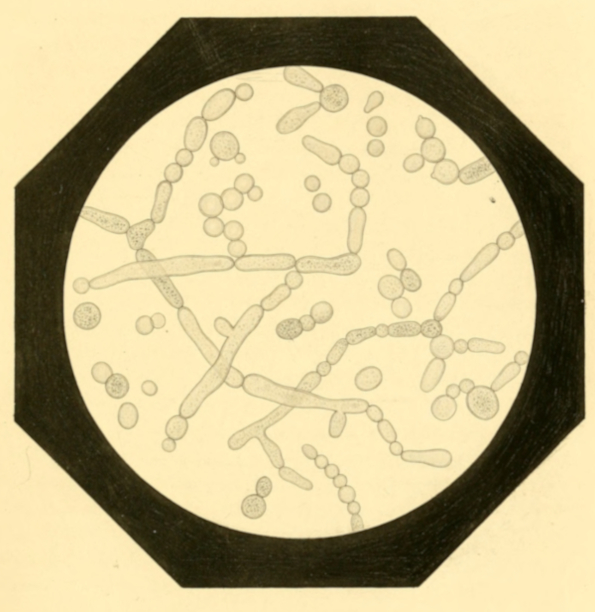
Plate 5. Mucor, Vegetating Submerged, in Deficit of Air.
The structure of the plant differs considerably when it lives surrounded by air, and when it is more or less completely deprived of that fluid. If it has an abundance of air at its disposal, if it vegetates on the surface of a moist substance or in a liquid in which the air held in solution may be renewed without being incessantly displaced by carbonic acid gas, we shall see it develop as an ordinary fungoid growth, with a mycelium consisting of filaments more or less slender, branching, and entangled, sending up from the surface of the liquid aerial organs of fructification. This is the well-known form of vegetation of the common mucor. On the other hand, if we compel the mucor to live in a saccharine liquid with insufficiency of air, at least for some of its parts, the mode of vegetation will change completely, as we have seen in the case of penicillium, aspergillus, 137and mycoderma vini when submerged, but with this difference, that in the case of the mucor the changes in question, and the activity of nutrition under these new conditions, are much more marked than in the case of those other organisms. The spores grow larger and the filaments of mycelium which do develop are much stronger than those in the normal plant. These filaments put forth, here and there, other filaments which detach themselves and vegetate at the side of the others, being terminated or interrupted by chains of large cells, species of spores which can live by budding and reproducing cells similar to themselves or by elongating into filaments.
Plate V. represents the living plant submerged at a little depth, and having, consequently, still at its disposal a certain quantity of air, insufficient, however, to supply the oxygen needed for all the acts of nutrition. In this case the mucor appears very different, morphologically, from what it is when in free contact with air. Here it forms short filaments, having a diameter double or triple that of the filaments of the ordinary mycelium with branches and buds all over, and what is especially characteristic, forming a network of chains of cells, sometimes spherical, sometimes oval or pear-shaped, which are the actual spores. These, as soon as they are detached, bud in their turn, and reproduce either cells or branching tubes; these cells or the chaplets which they form being known under the name mycelian spores or conidia. Our plate gives these different aspects very correctly, and affords us a good idea of the luxuriant state of this remarkable vegetation.
Plate VI. represents the plant living at a greater depth with less air, expending, by means of sugar as source of heat, the energy which it acquired in vegetating under the influence of the oxygen of the air. The filaments are fewer and older in aspect, and the number of cellular forms is proportionately larger than in the former case, the budding giving rise by preference to spherical or oval cells. On a single cell we often see two, three, four, five, six, and even more buds.
138When the buds of the oval or spherical cells detach themselves whilst young, they often resemble in form and size cells of ordinary yeast, nor can even considerable experience in this kind of observation always enable us to distinguish them. Hence we may easily understand how many have come to believe, with so skilful a botanist as Dr. Bail, in the transformation of mucor into yeast.
With the forms represented in Plates V. and VI., the plant is more of a ferment than of a fungoid growth. In such cases the weight of sugar decomposed in comparison with the weight of new cell-globules formed is very considerable, an effect which is more marked the less air the plant has at its disposal. Under the latter conditions, however, vegetation is slow and laborious, and the ferment very soon assumes an aspect of age, and we must constantly rejuvenate the cells by bringing them into contact with oxygen, and subjecting them to the action of limited quantities of that gas, and so promote their vegetation and prolong their fermentative activity. This effect we brought about when we retransferred the liquid and its deposit of mucor from the test-glass to the flask, thus bringing them into contact with fresh air. We saw cells that appeared old, dark, and highly granulated, become inflated, grow more transparent, and fill with a gelatinous protoplasm, the few granulations which they still exhibited assuming a brilliant appearance when we succeeded in distinguishing them; and finally, a very active budding was set up. Under this reviving influence life could continue once more away from the air, although with difficulty, so that fermentation would be most intense if the large filaments and their conidia were constantly being removed from and to the action of air.
The preceding plates show several instances of this rejuvenescence of the old cells of mucor ferment.
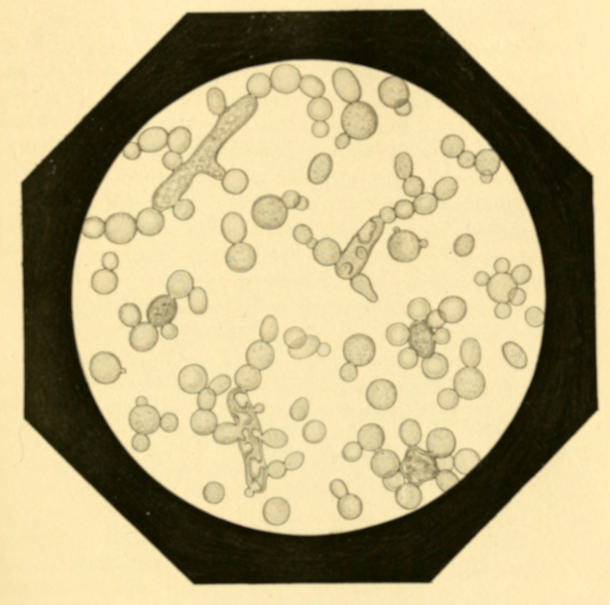
Plate 6. Ferment of Mucor.
We have omitted to represent amongst the old cells some cells which have their granulations collected about the centre, with an empty space between the granulations and the exterior 139borders.[80] In this state, cells are generally dead and incapable of any revival. It is impossible to avoid being impressed by the striking analogies which exist between all these facts and those presented by cells of yeast.
In concluding our study of the vegetation of mucor as a mould and mucor as a ferment, we may again remark that the most striking analogies also exist between the preceding observations and those we have seen in the case of penicillium, aspergillus, and mycoderma vini. These latter plants do not furnish alcohol or carbonic acid gas by direct fermentation of the sugar, as long as we let them vegetate with plenty of air at their disposal. Once submerged, however, their vital aspect changes; on the one hand the cells or filaments of the mycelia evince a tendency to become larger; on the other hand there is a tendency to greater closeness in these latter, and, consequently, a transition to the state of conidia. Lastly, there is a correlative budding of cells, accompanied by a 140formation of alcohol and liberation of carbonic acid gas; in short, all the ordinary signs of alcoholic fermentation.
The principal difference in the case of mucor consists in this, that the vegetation of this latter, under the conditions of insufficient aeration or none at all, is more decided, both as to extent and duration.
It may be thought that all the varieties of mucor are capable of yielding the kind of ferment that we have just mentioned. But this is not the case; and here we have another striking proof of the great physiological differences presented by forms of vegetation so intimately connected with each other that, in botanical classifications, they must be put as closely as possible together. Of this fact we have the most striking example in mycoderma vini and the alcoholic ferments, properly so called, which so closely resemble each other in form and development that they might be supposed to be identical, at least, according to our present knowledge, but which differ so widely in their physiological aspects.