Note 87 — Chapter V · The Alcoholic Ferments.
Frank Faulkner translation
For these observations, we employed small glass cells, which we made out of some St. Gobain glass by punching holes through it, and then cementing on one side one of the little glasses used for covering objects in microscopical examinations. In this manner we made small troughs, in which we placed some wort that had been boiled, and a drop of the water in which grapes had been washed. To prevent evaporation we covered the cells with a sheet of glass. We examined the liquid in these cells by inclining our microscope to the angle required.[88]
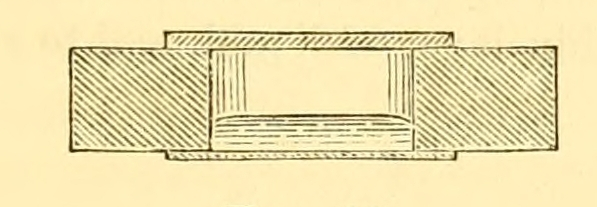
Fig. 29.
We also made use of cells similar to those employed by MM. Van Tieghem and Lemonnier[89] in their researches on mucorines (Fig. 30).

Fig. 30.
An apparatus similar to that employed by M. Duclaux in 1853[90] would do equally well. We should be able to work with even greater facility if we employed bulbs like some which we ordered in Germany, some twelve years ago, of the well-known glass-blower, Geissler. We have heard that these bulbs now sold by that maker are much used by German microscopists. They consist of a tube blown out into a flat bulb, the sides of which, in the centre, come sufficiently close together to enclose but a very thin layer of liquid, and to admit of microscopical examination. We may fill these tube-bulbs completely with liquid, to the exclusion of air or we may surround the central drop with air.
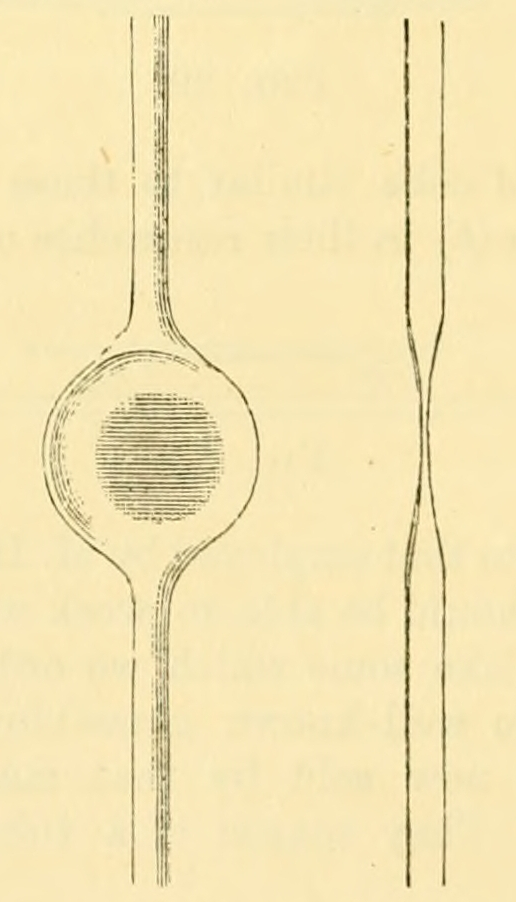
Fig. 31.