SOME IN-DOOR GAMES AT MARBLES.
Reading edition
BY L.D. SNOOK.
One or two of the following games of marbles may be known to the readers of ST. NICHOLAS, but we think they all will be new to a great many boys.
THE ARCHED-BOARD COUNT-GAME.
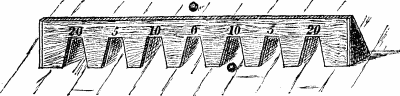
A strip of board, half an inch thick, five inches wide, and twenty-two inches long, has notches cut in one side, two inches wide at the bottom, and tapering as shown. Short bits of board nailed upon each end keep the strip upright. Then it is placed upon the floor within two feet of the wall. Each player is provided with the same number of marbles (from three to five, or as many as the players wish), and from the opposite side of the room he rolls at the board, the object being to roll through the arches, which have numbers immediately above them in the manner shown. The one making the most counts after rolling all the marbles is entitled to one game. Or, if you have but five or six marbles, each party rolls the whole number by himself, and should there be a tie between those who make the highest aggregate number, they must roll again, the one then having the highest tally winning the game.
THREE-ARCH DISCOUNT-GAME.
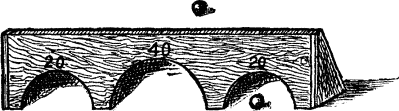
This board is as wide and thick as the other, but is only eighteen inches in length. The center arch is four inches wide, the two small ones three inches each. In playing, each boy rolls from four to ten marbles each, every marble that passes under the center arch counting forty; if the marble goes through either small arch, twenty is deducted from the count, or, as the boys say, is "counted off" each time. So, if you are not a good shot, it is likely you will lose more than you will gain. In this, or the previous game, if you fail to pop your marble through any arch, it is lost.
THE TEN-BLOCK COUNT-GAME.
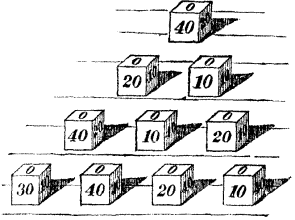
You are to make ten blocks of wood, each about one inch square; upon one side of each you mark the figure 0; on the other sides the numbers 10, 20, 30, 40, and 50, the 50 being upon the side opposite the 0. The blocks are placed upon the floor or carpet in the form of a half diamond, as shown. The in each case being placed upward, each player rolls four marbles singly at the blocks, the object being to hit as many of them as possible. When done, count the numbers on the upper sides of all the blocks, and replace them for the next player. It is a lively game.
SWINGING-BLOCK COUNT-GAME.
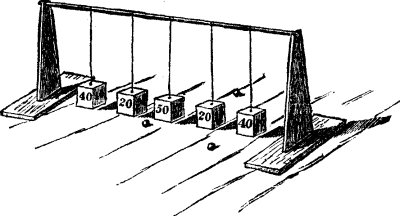
This is but a modification of the block-game just described. A common pin or tack is driven partly into one side of a block, which is connected by a string with a little strip of wood above. Instead of making side-pieces for supports, two chairs can be used, letting the strip rest upon the seat or lower rounds. Each block has the same number upon every side, and is hung so that the bottom is about one-quarter of an inch from the floor. When a marble strikes a block it swings a little and soon is quiet. This saves considerable work in replacing overturned blocks. For each block hit, tally the number upon it.
CIRCLE-GAME.
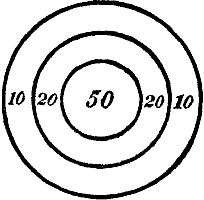
Mark upon a piece of paper three rings, the largest from eight to fifteen inches in diameter, the other two considerably smaller. Within the rings mark the numbers 10, 20, and 50, as shown. Lay this paper upon the carpet or floor, and roll your marbles, the object; being to have them stop upon the paper and as near the center as possible, each person to let his remain where they stop until all of his be rolled. Should a marble rest on a line, tally for it the number in the largest circle adjoining.