Chapter VI
Reading edition
The "silent week" that followed was a solemn time to the mother and the boy.
Every day, whatever time could be spared from the practice with the choir, and from helping in the little house and with his mother's wood-carving, or from playing with Lenichen in the fields, Gottlieb spent in the silent cathedral, draped as it was in funereal black for the sacred life given up to God for man.
"How glad," he thought again and again, "the little children of Jerusalem must have been that they sang when they could to the blessed Jesus! They little knew how soon the kind hands that blessed them would be stretched on the cross, and the kind voice that would not let their singing be stopped would be moaning 'I thirst.'"
But he felt that he, Gottlieb, ought to have known; and if ever he was allowed to sing his hosannas in the choir again, it would feel like the face of the blessed Lord himself smiling on him, and His voice saying, "Suffer this little one to come unto me. I have forgiven him."
He hoped also to see the master-builder again; but nevermore did the slight, aged form appear in the sunshine of the stained windows, or in the shadows of the arches he had planned.
And so the still Passion week wore on.
Until once more, the joy-bells pealed out on the blessed Easter morning.
The city was full of festivals. The rich were in their richest holiday raiment, and few of the poor were so poor as not to have some sign of festivity in their humble dress and on their frugal tables.
Mother Magdalis was surprised by finding at her bedside a new dress such as befitted a good burgher's daughter, sent secretly the night before from Ursula by Hans and Gottlieb, with a pair of enchanting new crimson shoes for little Lenichen, which all but over-balanced the little maiden with the new sense of possessing something which must be a wonder and a delight to all beholders.
The archduke and the beautiful Italian archduchess had arrived the night before, and were to go in stately procession to the cathedral. And Gottlieb was to sing in the choir, and afterward, on the Monday, to sing an Easter greeting for the archduchess at the banquet in the great town-hall.
The mother's heart trembled with some anxiety for the child.
But the boy's was only trembling with the great longing to be allowed to sing once more his hosannas to the blessed Savior, among the children.
It was given him.
At first the eager voice trembled for joy, in the verse he had to sing alone, and the choir-master's brows were knitted with anxiety. But it cleared and steadied in a moment, and soared with a fullness and freedom none had ever heard in it before, filling the arches of the cathedral and the hearts of all.
And the beautiful archduchess bent over to see the child, and her soft, dark eyes were fixed on his face, as he sang, until they filled with tears; and, afterward, she asked who the mother of that little angel was.
But the child's eyes were fixed on nothing earthly, and his heart was listening for another voice—the voice all who listen for shall surely hear.
And it said in the heart of the child, that day: "Suffer the little one to come unto me. Go in peace. Thy sins are forgiven."
A happy, sacred evening they spent that Easter in the hermit's cell, the mother and the two children, the boy singing his best for the little nest, as before for the King of kings.
Still, a little anxiety lingered in the mother's heart about the pomp of the next day.
But she need not have feared.
When the archduchess had asked for the mother of the little chorister with the heavenly voice, the choir-master had told her what touched her much about the widowed Magdalis and her two children; and old Ursula and the master between them contrived that Mother Magdalis should be at the banquet, hidden behind the tapestry.
And when Gottlieb came close to the great lady, robed in white, with blue feathery wings, to represent a little angel, and sang her the Easter greeting, she bent down and folded him in her arms, and kissed him.
And then once more she asked for his mother, and, to Gottlieb's surprise and her own, the mother was led forward, and knelt before the archduchess.
Then the beautiful lady beamed on the mother and the child, and, taking a chain and jewel from her neck, she clasped it round the boy's neck, and said, in musical German with a foreign accent:
"Remember, this is not so much a gift as a token and sign that I will not forget thee and thy mother, and that I look to see thee and hear thee again, and to be thy friend."
And as she smiled on him, the whole banqueting-hall—indeed, the whole world—seemed illuminated to the child.
And he said to his mother as they went home:
"Mother, surely God has sent us an angel at last. But, even for the angels, we will never forget His dear ravens. Wont old Hans be glad?"
And the mother was glad; for she knew that God who giveth grace to the lowly had indeed blessed the lad, because all his gifts and honors were transformed, as always in the lowly heart, not into pride, but into love.
But when the boy ran eagerly to find old Hans, to show him the jewel and tell him of the princely promises, Hans was nowhere to be found; not in the hermit's house, where he was to have met them and shared their little festive meal, nor at his own stall, nor in the hut in which he slept.
Gottlieb's heart began to sink.
Never had his dear old friend failed to share in any joy of theirs before.
At length, as he was lingering about the old man's little hut, wondering, a sad, silent company came bearing slowly and tenderly a heavy burden, which at last they laid on Hans' poor straw pallet.
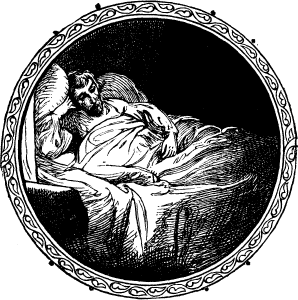
It was poor Hans himself, bruised and crushed and wounded in his struggles to press through the crowd to see his darling, his poor crooked limbs broken and unable to move any more.
But the face was untouched, and when they had laid him on the couch, and the languid eyes opened and rested on the beloved face of the child bending over him bathed in tears, a light came over the poor rugged features, and shone in the dark, hollow eyes, such as nothing on earth can give—a wonderful light of great, unutterable love, as they gazed into the eyes of the child, and then, looking upward, seemed to open on a vision none else could see.
"Jesus! Savior! I can do no more. Take care of him, thou thyself, Jesus, Lord!"
He said no more—no prayer for himself, only for the child.
Then the eyes grew dim, the head sank back, and with one sigh he breathed his soul away to God.
And such an awe came over the boy that he ceased to weep.
He could only follow the happy soul up to God, and say voicelessly in his heart:
"Dear Lord Jesus! I understand at last! The raven was the angel. And Thou hast let me see him for one moment as he is, as he is now with Thee, as he will be evermore!"