SOME FISHING-BIRDS OF FLORIDA.
Reading edition
BY MRS. MARY TREAT.
All along the St. John's River, during the winter, may be seen birds catching fish for a living. They are more numerous here in winter than in summer, because, upon the freezing of the waters at the North, they flock to Florida to carry on their fishing in the St. John's, which, never freezing, contains an abundance of fish.
The belted kingfisher comes close to the house, where I can watch him fishing as I sit at the window. The river is five miles across here, and for several yards from the shore it is quite shallow, so that a wharf two hundred and fifty feet long was necessary to make it easy to launch our small rowboats. A railing extends along the side of the wharf, and upon this railing the kingfisher perches, watching for his prey.
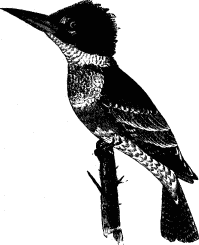
THE BELTED KINGFISHER.
He understands fishing much better than most boys, for he seldom misses his game. He takes his position on the railing, and fixes his eyes upon the finny tribes below, and when a fish that suits him comes within his range, he dives into the water and brings it up with his stout beak, and then beats it upon the railing to make it limp and tender before swallowing.
It is not so very surprising that he is such an expert fisher, for during the winter it is his only occupation; he has no family to look after now, and he is so very selfish and quarrelsome that he will not allow any of his brothers to fish near him. He considers the whole length of the wharf his fishing-post, and his brothers must not trespass upon his grounds; if they do, he chases them away with a rattling, clanging noise, enough to frighten any fisher not stronger than himself.
In the spring he takes a partner in his business, for now it is time to raise a family, and he knows he can never do this alone. He is very good and kind to this partner, and helps her dig a hole in a clayey bank for the nest, and then takes his turn in sitting upon the eggs. After the eggs are hatched, they both catch fish to feed the young until they are old enough to feed themselves.
The American flamingo, with his gorgeous scarlet feathers, is a superb fellow. He is very shy, and peculiarly afraid of man. On account of its fine apparel, it has been more closely pursued than almost any other bird. It does not go north like some of the herons, but Audubon says it has occasionally been seen in South Carolina. Its constant home, however, is in the southern part of Florida and along the Gulf coast.
Like the herons, of which I told you in ST. NICHOLAS for May, 1877, the flamingoes are sociable, and live in flocks. They have webbed feet, which give them an advantage over the herons in enabling them to swim as well as to wade. I have never been able to get near enough to these birds to gain any personal knowledge of their habits.
The nest of the flamingo is a curious affair; usually built in a marshy, muddy place, in the form of a mound. It is made of sticks and grass and mud to the height of two or three feet, with a hollow in the middle to hold the eggs. The male is said to assist in the construction of the nest, but this is probably mere conjecture, for I think no one living at the present time has been able to get near enough to these birds to watch their habits, and their nests can be reached only with great difficulty.
The female lays two white eggs about the size of those of a goose. It is said that she sits astride the nest in an ungainly fashion, and that the young, as soon as they are hatched, take to the water like young ducks.
If a law only could be passed to protect these birds, what a grand sight the waters of Florida would soon present! These great, brilliant, scarlet birds, dallying and playing in the water, or wading near the shore in quest of game, would be a sight never to be forgotten. Can it be possible that Florida does not care for such glorious creatures, and will allow, year after year, these marauders from the North to kill them without a single protest? Unless something is done for the protection of these splendid creatures, they must soon become extinct; for their range is quite limited, and I fear the boy and girl readers of ST. NICHOLAS, by the time they grow to men and women, can only read of these as "gorgeous birds of the past."
Almost every morning, the osprey, or fish-hawk, comes in front of the window and fishes in the shallow water near the house. He does not seem to be as expert as the kingfisher. I have seen him dive a dozen times or more into the water before bringing up his prey. He sails around and around in the air; at last fixing his eyes upon a fish, he swoops down, making the water splash around him. His feet are large and powerful, and he arranges his long toes in the form of a scoop as he plunges into the river; this scoop is his fishing-tackle with which he brings up his finny food.
I think I should not like to be an osprey, for he seems to have such a hard time to get a living, and yet he is an honest, well-disposed laborer. After he has succeeded in catching a fish, a bald eagle often swoops down from some tall tree, where he has been watching him, and by main force compels this honest fisher to give up his hard-won prey. The eagle is considerably larger than his victim, being about three feet in length, while the osprey is only about two feet.
It is quite a grand sight to see these two large birds wheeling through the air—the osprey trying to elude the eagle, diving first one way and then another, until at last, when he sees the unencumbered eagle must overpower him, in a fit of desperation he lets the fish drop, and the eagle catches it before it reaches the water, and carries it to some retired spot where he devours it.
And now the poor defrauded osprey must go to work and catch another fish before he can have his dinner. Here you see the bald eagle with his ill-gotten prey.
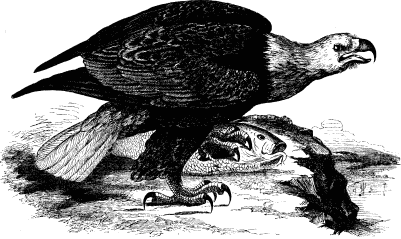
THE BALD EAGLE.
Great flocks of ducks often come to fish in the shallow water close to the shore. I suppose the reason that they come so near is that they find smaller fish here than in the deep water; and another reason, they are never shot at near the shore, for no fire-arms are allowed to be discharged within the town limits, except under the penalty of five dollars for each discharge.
This place, in winter, corresponds to a northern watering-place in summer. There is a warm sulphur-spring here, and people come from all quarters for health and for amusement. At first the great numbers of birds all about attracted many sportsmen, but I am very glad to tell you that the Florida people did not like this reckless shooting of birds in their midst, so they made this beautiful little place—Green Cove Spring—a city, and elected a mayor and a marshal, and other officers, to keep the men straight, and to protect the birds.
So this is why the birds that live about this little city are so tame, and why the ducks come so close to us; they have learned that they are quite safe from guns here.
Several species of ducks may sometimes be seen in one flock, fishing together in perfect harmony. It is quite astonishing how long they can stay under water, and when they come up their feathers are not wet at all.
The most beautiful of these fishing-ducks is the hooded merganser. Its plumage is most elegant, and it has a large thick tuft or crest of feathers covering the whole head, which gives it a sort of military look; and, indeed, it seems to be a commander, for it leads all of its relatives. It sometimes stays so long under the water that I begin to fear something has happened,—that an alligator, or some other huge beast, has got hold of it; but it always makes its appearance after a while, often at quite a long distance from where it went under.