JACK-IN-THE-PULPIT.
Reading edition
"Thirty days has September, April, June and November; all the rest have forty-three, except February, which is leap-year every four months." I may not repeat this correctly, but I heard a little boy saying something of the kind. Perhaps you all know the jingle better than I do, so I'll say no more about it.
NATURE'S PADDLE-BOATS.
A little bird has told me such a strange thing! It's about a kind of jelly-fish which he called a "Globe-Beroe," I think; but you can find out for yourselves, if I caught the name aright or not.
This jelly-fish looks like a tiny ball of the clearest ice. All around it, much after the fashion of the lines of longitude on a geographical globe, are eight bands a little less transparent than the rest of the body. On each of these are thirty or forty small paddles, in shape like the floats upon the paddle-wheels of a steamboat; and it is by means of these that the little creature pushes itself along in the water. The paddles are alive, and move either swiftly or slowly, one at a time or all together.
Not only can this natural paddle-boat send itself along, but it can also cast anchor. It puts forth very fine threads, which gradually lengthen, unfolding from their sides transparent tendrils like those of a vine. These catch hold of and twine around some fixed thing, and moor the craft; and when the Beroe is about to be roving again, they unwind themselves, and all slip quietly back into the little ice-ball out of sight.
There are countless millions of Beroes in the Arctic regions, where the sea is in some parts colored by them for miles and miles. If there were not such immense fleets of these tiny paddle-boats there would be little chance for us to wonder at them, because they choose for their moorings just the places where whales love best to feed and play their rough games, and where, too, their own presence in the sea makes it into a kind of soup of which whales are very fond.
TINY TREES.
Only think of trees, full-grown trees, so small that several of them,—roots, stems, branches and all,—piled one above another, would not be as tall as I am!
What kind of birds would stoop to roost in such little, little trees, I'd like to know?
They tell me that such tree-lings do really grow, away up, on high mountains, near where the snow stays all the year through, and also in very cold countries near the polar circles.
I do hope the words "polar circles" will bring clear ideas to you, my dears. They've quite tangled up my notions. Wont some of you explain the things to me?
BIRDS AND TELEGRAPH-WIRES.
The Little Schoolma'am has been talking about snow-birds, and she says there was a poem about them in ST. NICHOLAS for April, 1875, and also a picture of the dear little fellows comfortably perched on a telegraph-wire, out in Colorado, somewhere. I dare say you'll remember them, my chicks.
Well, she went on to say that telegraph-wires are not always such good friends to birds, for she had heard that, along the great railroads in the West, large numbers of prairie-chickens are killed at certain seasons of the year by flying against the wires. Sometimes this may happen in the dark, but more often in the day-time when the wind is very strong.
Of course, this can't very well be helped; but it does seem dreadful, doesn't it, my dears? However, the section-men, who have charge of the railroad tracks, get some good from it, for they make a regular business of gathering the fallen birds, which are then cooked and eaten.
WALTON'S KITTY AGAIN.
Dear Jack: A while ago I told in ST. NICHOLAS something about "Walton's Kitty," that loves music and climbs upon any one who sings to her, putting her head as close as can be to the lips of the singer. Now, here is another true story about this same cat:
In the summer, Walton's aunt used to set the milk in a cool closet, in a pitcher with a long, narrow neck, but day after day, when teatime came, every drop of that milk was gone. Nobody drank it, nobody used it, nobody spilled it. "Walton's Kitty" and all her descendants were clear of suspicion, because of the long, narrow neck of that pitcher. So everybody watched and waited to find out how the milk went.
And this is what they saw: There sat "Walton's Kitty," dipping her paw deep down into the pitcher, taking it out, and then lapping the milk from it! If she dropped the smallest drop, she stopped and cleaned that up, and then went on. As the milk dwindled to the bottom of the pitcher she shook her paw around; and she never left off until every drop of milk was gone!
Since then, the milk for tea stands in a covered pitcher, but "Walton's Kitty" has hers in a tall, narrow goblet. It is a very affecting sight, and people laugh till they cry as they watch her.—Yours truly,
M.B.C.S.
FLINT ONCE WAS SPONGE.
You never would think it, would you, my dears? But the Little Schoolma'am says that it was; and she always is right.
She says that flint really is nothing more nor less than sponge turned to stone. Once the sponge grew at the bottom of the sea, as other sponges grow now; but that was ages and ages ago, and since then the sponge, turned to flint, has lain covered by rocks and earth of many kinds piled thick above it. Seen with a microscope, flint shows the make of sponge in its fibers; and sometimes you can see, bedded in it, the shells of the tiny creatures on which the sponge had fed. Now and then, inside a flint, will be found bits of the sponge not yet changed.
That last proof settles it; but I must say it's hard to believe;—hard as the flint, almost.
SOME OLD PUZZLES.
Here are two letters, with old puzzles in them, that may amuse you for a while on one of these shivery evenings, my chicks. I'll tell you the answers next month.
Michigan.
DEAR JACK-IN-THE-PULPIT: The other night one of my brothers said he did not believe we could pronounce a certain word after he should have spelled it. I will tell you what it is, though you may have heard about it already:
A cross, a circle complete, An upright where two semi-circles do meet, A triangle standing upon two feet, Two semi-circles, a circle complete.
Yours truly, CORA.
Oswego, N.Y.
DEAR JACK: I send you a riddle which I found. I take ST. NICHOLAS and like it very much. I have all of the volumes from 1874.
I am a word of plural number, A foe to peace and human slumber, Yet, do but add the letter S,— Lo! what a metamorphosis! What plural was, is plural now no more, And sweet's what bitter was before.
Yours truly, KITTIE.
Talking about riddles, reminds me of one that was made by Richard Whately, an archbishop of Dublin, as I've heard. This is it:
"When from the Ark's capacious round The beasts came forth in pairs, Who was the first to hear the sound Of boots upon the stairs?"
I'm told that it never has been guessed right by anybody; yet the archbishop said there was an answer, although he did not say what it was. May be you can solve the riddle, my dears, if you brush up your wits a bit? Let me know as soon as you think you have the right answer.
THE NEWEST FASHION.
The girls of the Red School-house often talk about new fashions, especially when the Little Schoolma'am is about, for she is pretty sure to drop some useful hints. Well, one day she told them, among other things, about the "latest novelty" in ladies' ball-dresses at Upernavik, in Greenland.
As nearly as I can remember, she said that the costume consists of a little jacket, made of bright-colored calico or flannel; long pantaloons of sealskin, trimmed like the jacket and sitting close to the figure; and white, red or blue boots: the whole set off by gay ribbons and all the beads the wearer can get.
A jaunty suit enough, no doubt; but, if she wore only that, the wearer must have been obliged to dance, merely to keep herself warm.
By the way, I wonder what ever possessed them to call that frozen country Green-land?
TO SURPRISE A DOG.
This is the way a man among the Himalaya Mountains once astonished a stranger dog. He put on a pair of huge goggles and walked steadily and quietly toward the dog, without speaking a word. The dog bristled up and stared hard for a moment, and then, all at once, he seemed to wilt, and away he slunk as if ashamed of himself.
I heard about this only the other day, my dears, and I tell it to you merely to warn you not to try the little trick, unless you are sure your dog will not get angry and jump for you.
It would not look well for you to slink off as if you were ashamed of yourself.
THE KINDERGARTEN AT HOME.
DEAR JACK: Will you please tell your older boys and girls that in good systems of Kindergarten teaching they will find a great many means of amusing invalid brothers or sisters without wearying them, and many games and much fun for the younger ones, who will learn at the same time things that they ought to know. To carry out these methods one wants sticks, blocks, slates, slats, colored balls, and other things easy to make and cheap to buy, the use of which is pleasant to teach as well as to learn and practice.
I bought lately a full set of Kindergarten apparatus such as I have named, and sent it to a little niece of mine in California, and the dear little one writes to me that she has had much happiness and enjoyment out of it. I hope some of your young friends will try the experiment and let me know what success they have.—I am, dear Jack, yours affectionately, A LITTLE SCHOOLMA'AM.
KAFFIR IRONING.
You all know how ironing is done here—with flat-irons, I think somebody said. Well, the birds tell me that the Kaffirs of South Africa don't use flat-irons, but have quite another way. They make the clothes into a neat flat package, which they lay on a big stone. Then they just dance on the package until they think the clothes are smooth enough! It must be good fun to them! Luckily, Kaffirs don't wear cuffs and frills.
SLIPPERS FOR HORSES.
Where do horses wear slippers?
Now, my chicks, this is not a conundrum. So you need not be chirping out, "On their feet, of course;" or some foolish answer of that kind. The real answer is, "Japan,"—at least, so I'm told, and there are such numbers of other queer things there, that I don't wonder it is so.
Well, Japanese horses wear straw slippers,—clumsy-looking things, I should say. But, besides that, they stand in their stables with their heads where American horses' tails would be! Perhaps Japanese horses like to see for themselves what is going on?
"Where is the food put?"
Why, in a bucket hung from the roof, of course. Where else, would you suppose?
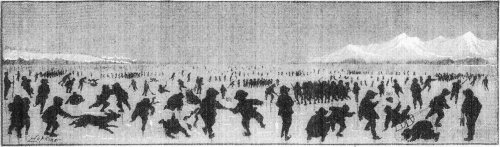
ON THE ICE.