SOLIMIN: A SHIP OF THE DESERT.
Reading edition
BY SUSAN COOLIDGE.
I asked a party of children once the meaning of the word "desert," and all but one shouted out, "rice pudding and oranges!" having in their minds the dinner which we had just eaten. That one, who was older than the rest, said, rather shyly, "A big piece of land, aunty, isn't it?" but even he didn't know how big,—or that there is a difference in spelling between the dessert which people eat and the desert which sometimes eats people, closing its jaws of sand, and swallowing them up as easily as a boy swallows a cherry.
The biggest desert in the world is in Africa, and is called the Sahara. It is almost as large as the Atlantic Ocean, but instead of water it is all sands and rocks. Like the ocean, it is visited with storms; dreadful gales, when the wind scoops up thousands of tons of sand and drives them forward, burying and crushing all they meet. And it has islands, too—small green patches, where springs bubble through the ground, and ferns and acacias and palm-trees grow. When a traveler sees one of these fertile spots afar off, he feels as a tempest-tossed sailor does at sight of land. It is delightful to quit the hot, baking sun, sit in shadow under the trees, and rest the eyes, long wearied with dazzling sands, on the sweet green and the clear spring. Oases, these islands are called. Long distances divide them. It is often a race for life to get across from one to the other. Sometimes people do not get across! In 1805, a caravan of 2,000 persons died miserably of heat and thirst in the great desert, and the sand covered them up. Do you wonder at my saying that the desert eats men?
Now, you will be puzzled to guess what sort of ship it is which swims this dry ocean. It is the camel—an animal made by God to endure these dreadful regions, in which no other beast of burden can live and travel. I dare say many of you have seen camels in menageries. They are ugly animals, but very strong, swift and untiring. With a load of 800 pounds on his back, a camel will travel for days at the rate of eight miles an hour, which is as fast as an ordinary ship can sail. More wonderful still, he will do this without stopping for food or water. Nature has provided him with an extra stomach, in which he keeps a store of drink, and with a hump on his back, made of jelly-like fat, which, in time of need, is absorbed into the system and appropriated as food. Is it not strange to think of a creature with a cistern and a meat-safe inside him? A horse would be useless in the desert, where no oats or grass can be had; but the brave, patient camel goes steadily on without complaint till the oasis is reached: then he champs his thorn bushes, fills himself from the spring, allows the heavy pack to be fastened on his back again, and is ready for further travel.
Now you know what sort of a ship it is that I am going to tell you about. It was a camel, named Solimin. He was of a rare and valuable breed, known as "herie," or coursers, because they are so much swifter than ordinary camels. Solimin's master, Ahmed, was a poor man. He never could have afforded to buy a full-grown camel of this rare breed; and Solimin had become his through a piece of good fortune. When a little foal, Solimin was found in a lonely place in the desert, standing over the dead body of his mother, who had fallen and perished by the way. Led to the brown tent which was Ahmed's home, the orphan baby grew up as a child of the family, lay among the little ones at night, and was their pet and plaything all the day. The boys taught him to kneel, to rise, to carry burdens, to turn this way and that at a signal. The girls hung a necklace of blessed shells around his neck, saved for him the best of the food, sang him songs (which he was supposed to enjoy), and daily kissed and stroked his gentle nose and eyes. As he grew big and strong, the pride of his owners grew with him. Not another family of the tribe possessed a herie. Once and again, Ahmed was offered a large price for him, but he rejected it with disdain.
"Would I sell my son—the son of my heart?" he said. "Neither will I part with Solimin. By the Prophet, I swear it."
Of all the dwellers in the brown tent Solimin loved best Ahmed himself, and his eldest son, Mustapha. With them he was docile as a lamb; but if strangers drew near, or persons he did not like, he became restive and fierce, screamed, laid back his ears, and kicked with his strong hind legs. A kick from a camel is no joke, I can tell you. All the desert guides knew Solimin, and, for his sake, Ahmed was often hired to accompany caravans. Nay, once, at Cairo, Solimin was chosen to carry the sacred person of the Khedive on a day's excursion up the Nile bank, which event served the tribe as a boast for months afterward.
It was the year after this journey to Cairo that Ahmed met with a terrible adventure. He and Mustapha, making their way home after a long journey, had lain down to sleep away the noontide hours, according to the custom of desert travelers. Their camels were tethered beside them, all seemed secure and peaceful, when, sudden as the lowering of a cloud, a party of Arabs, belonging to a wild tribe at enmity with all men, pounced upon them. Ahmed and his son defended themselves manfully, but what could two men, surprised in sleep, do against a dozen? In five minutes all was over. The assailants vanished in a cloud of dust, and Ahmed, who had been struck down in the rush, recovered his senses, to find camels, baggage, belt, money, everything gone, and Mustapha wounded and motionless on the earth beside him.
Ahmed thought him dead. They were alone in the desert, a hundred miles from home, without food or water, and with a groan of despair he sat down beside his son's body, bowed his head, and waited until death should come to him also. An Arab believes in fate, and gives up once for all when misfortune occurs.
But Mustapha stirred, and Ahmed at once sprang up. There was nothing he could do for the poor boy, except to chafe and rub his hands; but this was something, for presently Mustapha revived enough to speak.
"Are they gone?" he asked.
"Yes, the accursed ones, they are gone, with all our goods and with Solimin! The Prophet's curse light upon them!" And passing from despair to fury, Ahmed threw sand upon his head, and flung himself on the ground in helpless rage. Mustapha joined in with groans and lamentations.
When the father and son grew calmer, they began to discuss their situation. Ahmed knew of a small unfrequented oasis, about twenty miles away. It was their only chance of safety, but could they reach it?
"I think I can walk," declared Mustapha, tying up his wounded leg in a fold torn from his turban. But he limped sadly, and his tightly pressed lips showed pain as he moved. He was faint with hunger beside. Neither of the men had eaten since sunrise.
Suddenly Mustapha uttered a joyful cry, and lifted something from the earth.
"The Prophet be praised!" he cried. "My father, here is food. The robbers have dropped a bag of dates."
Sure enough, there it lay, a heavy bag of dates, shaken off from some camel's pack during the struggle. Heavy as it was, and hard to carry, Ahmed would fain have had it larger. It was their safety from starvation. A handful of its contents satisfied hunger, and gave them strength to begin their walk. What a walk it was! Poor Mustapha lay down every half-hour from pain and weakness; the sand was heavy, the darkness puzzled them. When morning broke, they had not accomplished more than half the distance. All through the hot day-time they lay panting on the ground, eating now and then a date, tormented with thirst and heat; and when evening came, they dragged themselves to their feet again, and recommenced their painful journey. Step by step, hour by hour, each harder and longer than the last, moment by moment they grew more feeble, less able to bear up, till it seemed as though they could no longer struggle on. At last, the morning broke. Ahmed raised his blood-shot eyes, seized Mustapha's arm, and pointed. There, not a hundred yards away, was the oasis, its trees and bushes outlined against the sky.
Poor Mustapha was so spent that his father had to drag him across the short dividing space. It was a small oasis, and not very fertile; its well was shallow and scanty, but no ice-cooled sherbet ever seemed more delicious than did its brackish waters to the parched tongues of the exhausted men.
All day and all night they lay under the shadow of the cactuses and the acacia-trees, rousing only to drink, and falling asleep again immediately. Shade, and sleep, and water seemed the only things in the world worth having just then.
The second day they slept less, but it was nearly a week before they could be said to be wide-awake again. Such a pair of scare-crows as they looked! Ahmed was almost naked. The robbers had taken part of his clothes, and the desert thorns the rest. Haggard, wild, blackened by the sun, they gazed at each other with horror; each thought, "Do I look like that?" and each tried to hide from the other his own dismay.
They could never tell afterward how long they remained at the oasis. It seemed years, but I suppose it could not have been more than weeks. All day long they looked wistfully toward the horizon, in hopes of a caravan, but the caravan never came. Slowly the dates dwindled in the bag; slowly the precious water diminished in the well; a little longer, and starvation would be upon them. They scarcely spoke to each other those last days, but sat each by himself in a sort of dull despair. At night, when they fell asleep, they dreamed of food, and woke in the morning to feel themselves still hungry. It was horrible!
Then came a morning when they rose to find the hard desert outline, which they knew so well, vanished and gone, and in its stead a smooth, shining lake, fringed with trees and dotted with feathery, fairy islands. So near it seemed, and so real, that it was as though they heard the ripple of the water and the rustling of the wind in the tree-boughs. Mustapha stared as though his eyes would burst from his head; then he gave a wild cry, and was rushing away; but his father held him fast.
"Stay, my son! Stay, Mustapha! It is no lake,—it is a device of Satan. What you behold is the mirage, spread by devils for men's destruction."
"Let me go!" shrieked Mustapha, writhing and struggling.
But even as he strove, the soft water-outlines shifted and trembled; the lake rose in air, melted, and sailed off into curling mists; the trees, the whole fair picture, dissolved, and the well-remembered sands and black rocks took its place. With a cry of horror, Mustapha slid through his father's arms to the earth, hid his face, and cried like a child.
Next morning, only one date was left in the bag. Ahmed put it in his son's hand with a mournful look.
"Eat, my son," he said; "eat, and then we will die. Allah il Allah!"
A long silence followed; there seemed nothing more to say. Suddenly, from afar off, came to their ears the tinkle of a bell.
Mustapha raised his head.
"Is it the mirage again, my father?" he asked. "For it seems to me that I hear the bell from the neck of Solimin, our camel."
Eagerly they listened. Again the bell tinkled, and, looking through the bushes, they saw, floating toward them, as it seemed, the form of a gigantic camel. Soundless and still, it moved rapidly along. Behind, but much farther away, other forms could be seen, still dim and indistinct, veiled by the mist of driving sand.
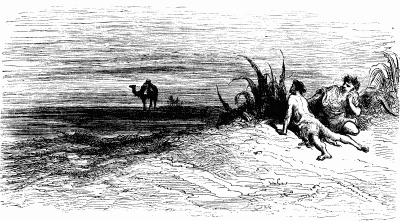
"THEY SAW THE FORM OF A GIGANTIC CAMEL."
Suddenly Mustapha gave a start.
"My father," he cried, in an excited whisper, "it is Solimin! I do not mistake! What other camel ever resembled Solimin? Do you not see his lofty hump,—his arched neck? Does not the bell tinkle as with the voice of home?"
Then, half raising himself, he gave, with all the power of his voice, the well-known call.
Solimin—for it was indeed he—paused as the sound caught his ears, and snuffed the wind. Again came the call; he wheeled, plunged, threw his rider, dashed forward, broke through the bushes, and in a second was on his knees before his old master.
"Up, up, my father! there is no time to lose!" cried Mustapha, grown stronger in a moment. "Up, up! for the robbers are close upon us!"
In fact, wild cries and clouds of dust showed that the foe had taken the alarm, and were hurrying on. But already Ahmed and Mustapha were mounted, and Solimin, like a ship at full sail, was speeding away with them. And where was the camel could overtake him, even when he was loaded double? Fast and swift his long, swinging trot bore them onward, and before two hours were gone, all traces of the pursuers had disappeared behind them, and they were free to turn their course toward the brown tents where rest, and food, and welcome had waited so long for their coming, and where, after a little time, their hardships and sufferings seemed to them only like a bad dream.
As for Solimin, he hardly could be more tenderly treated or beloved than before this adventure; but if the freshest water, the prickliest furze,—if bowls of sour milk;—if a triple necklace of shells,—if brushing and grooming,—if soft pats from childish fingers, and sweet names murmured in his ears by girlish voices can make a camel happy, then is Solimin the happiest of heries. Solimin no longer, however. His name is changed to "The Blessed," in memory of the day when, like a stately ship, he came over the desert sea, and bore his starving masters to home, and life, and liberty.