NAN'S PEACE-OFFERING.
Reading edition
BY KATE W. HAMILTON.
"Just wish I was properer, and everything—so there!" said Nannie, sitting discontentedly down upon the green grass by the road-side, and surveying herself with a pair of very serious brown eyes.
It was a forlorn little self, surely, with wet dress, muddy shoes, inky apron, and crumpled sun-bonnet.
"Aunt S'mantha'll think I'm dreadful. She says I never have any forethought; but I have lots of after-thoughts, and I s'pose folks can't have both kinds. It don't do any good, either. Oh dear!"
There was a whistled tune coming up the road. Tommy Grey was attached to it, but the whistle seemed much the older and more important of the two, and was first to reach the tree where Nannie was sitting. When Tommy caught up with it, he stopped in surprise.
"Hello, Nan Verling! Is that you?"
"I suppose so, but I wish it wasn't," answered Nannie, dolefully.
"What for?" questioned Tommy, in still further astonishment.
"'Cause I wish I was somebody else that wasn't all wrinkled and mussed up. I don't see how folks can keep nice and have good times, anyway," declared Nan, in a burst of confidence. "You see, I just helped sail boats in the brook, and I didn't know my dress was wet a bit till I came away; and then Lizzie Sykes tagged me, and course I had to tag her back again. I don't know what made her run right through the mud, where I couldn't catch her without getting my shoes all muddy. Should think she might have known better! My old ink-stand at school is always upsetting itself, and it had to spill on my clean white apron this afternoon. Then my sun-bonnet—"
"Looks as if you'd hung it up in your pocket," suggested Tommy.
"Well, I didn't; I only rolled it up for a rag-baby when we played keep house at recess. I s'pose it's bad for bonnets, but it made the beautifulest kind of a baby," said Nannie, a little ray of enthusiasm gleaming through her despondency. "But Aunt S'mantha doesn't 'preciate such things," she added, mournfully.
"No," answered Tommy, sympathetically. "She'll scold, may be?"
"P'r'aps so. May be she'll send me to bed without any supper."
"Whew! That a'nt any fun, I tell you!" declared Tommy. "Why, a fellow just tumbles and tumbles, and gets hungrier and hungrier, and wonders what the folks have got for supper, and looks at the stars, and tries to say 'Hickory-dickory-dock' backward, and wishes it was morning. It just feels awful!"
"I didn't ever try it, and I don't s'pose I could stand it," said Nannie, shaking dejectedly the curly head in the flopping sun-bonnet. "I've a good mind not to go home at all, but just run away off somewhere, and be a foundling. Foundlings have pretty good times, 'cause I've read about 'em in books. They get adopted by some great lady in a big house, and grow up rich, and get to be real handsome."
"I don't believe you would," declared Tommy, more honestly than politely.
Nan meditated a minute, and then said, with a sigh:
"Well, I guess I'll have to go home, then."
"Scoldings don't last very long, anyway," urged Tommy, consolingly.
"But if you sort o' think you oughtn't to have done things, and did ought to be more careful—and everything—it makes it seem more worse, you know," remarked Nannie, in a hesitating, half-penitent way. "'Cause I do like Aunt S'mantha."
"Yes," admitted Tommy, knitting his brow over the complications of the case, and searching his own experience for a suggestion of relief. "If you only had something nice to carry home to her—something she wants. Once I got wet as a rat playing round the pond, but I'd caught two fish—reg'lar tip-top trout—and I took 'em home to mother; held 'em up where they'd be seen first thing, you know. And she said, 'What nice fish!' and didn't scold a wink."
"I couldn't catch anything if I tried a week, and Aunt S'mantha wouldn't care, anyway. Why, she's a real grown-up woman, and could have tea-parties and make molasses candy every day if she wanted to! I don't believe she wants anything, unless it's ban—bananas—whatever that is. I heard her say she'd like some, this morning."
"Bandanas?" questioned Tommy, with brightening eyes.
"Y-e-s, I guess so," answered Nannie, rather doubtfully.
"Ho! I know what they are as well as anything. Why, they're silk handkerchiefs—red and yellow, with spots on 'em."
Nannie's hand dived into her small pocket, and re-appeared with two nickels and a copper.
"Do you guess I could buy one at Carney's store for 'leven cents? 'Cause I haven't got any more."
"I s'pose so. Why, yes; handkerchiefs a'nt much 'count, you know. I always lose mine—only they a'nt bandanas. I guess women-folks think more about 'em, though," said Tommy, with the air of one superior to such trifles.
Nannie was convinced, and started from her seat with a little sigh of relief.
"I'll go and buy her one, then. And I think you're a pretty good boy, Tommy Grey," she added, gratefully, as she trudged down the road, leaving Tommy to take up his whistling and his homeward route again.
It was quite a long walk to the store—the store, because the village only boasted one. That did not matter much to the inhabitants generally, as the town was so near. Bentleyville and Bentley were connected by a straggling line of houses that made it hard to tell where the village ended and the town began. Ambitious young villagers took advantage of this to talk about "we city people," while the older ones contentedly spoke of themselves as "plain country-folks."
Nannie did not care in the least which she was, neither did she greatly mind the walk, though the feet that had done so much running began to grow tired. If only she could carry a peace-offering to Aunt Samantha! That would make all right, and her small world bright again, she was sure.
"I can't have any candy or slate-pencils for ever so long; but I don't care, 'cause I do like her, and she'll know it—course she will if I buy her a handkerchief; and she wont think I got all mussed up on purpose," she soliloquized.
It required some heroism to pass by the fresh pop-corn balls at the store door, and to turn away from the boxes of figs without a second glance; but Nannie did both, and, walking straight to the counter, made known her errand.
"Bandanas? Yes, a prime lot of 'em," said bustling little Mr. Carney, bringing out his whole stock.
His small customer, standing on tiptoe to reach the counter, gravely examined them. Would Aunt Samantha like a red one or a yellow one best, she wondered. It was a perplexing question to decide. If only she could take her one of each! And that reminded her to ask the price.
"Seventy-five cents apiece," said the old gentleman briskly.
"Seventy—five—cents!" repeated Nan, faintly.
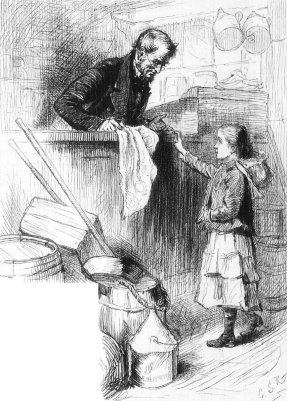
"'SEVENTY-FIVE CENTS APIECE,' SAID THE OLD GENTLEMAN."
"Yes, sissy; cheap at that, too."
"I—thought—I didn't know," stammered Nannie, in a sore disappointment. Then rallying her faltering courage, she asked: "Don't you ever sell any for 'leven cents?"
"Eleven cents? Bless me, child! Why, they cost—Oh! may be you mean cotton ones? Look a little like these."
Nan nodded, glad to think it even probable that she had meant anything.
"Well, I don't keep that kind, you see," explained Mr. Carney, condescendingly.
Discouraged and forlorn, the little woman turned away. She walked until she was quite out of sight of the store, and then paused to meditate. What should she do? It seemed dreadfully hard to give up her plan now when she had thought it all nicely settled. There were plenty of stores in Bentley; some of them might sell handkerchiefs for eleven cents. She glanced dubiously along the road leading to the town, and noticed that the sun was nearly out of sight behind the hills.
"But it stays light ever and ever so long after the sun sets," she murmured, "and it didn't seem a bit far when I rode to town with Aunt S'mantha. I guess this store is most part way. Anyhow, I just must have a bandana!" she added, as she once more caught sight of her soiled apron and muddy shoes.
She straightened her sun-bonnet, and started resolutely forward again. She had grown to feel that the proposed purchase was in some way a reparation due to Aunt Samantha, and she could not give it up. On and on trudged the tired little feet, aching wearily at last, but never hesitating nor turning back. It seemed a long way, though.
"Wonder if I wont ever and ever come to where the houses get thicker," she murmured. "When I keep a store I'll build it on the edge somewhere, so folks wont have to walk so far to get to it."
After a time, the buildings did nestle more closely together, and, somewhat comforted, she stopped a moment to rest. But she started suddenly to her feet as a light flashed upon her from an opposite window. People were really beginning to light their lamps, and the daylight was almost gone.
Weariness was forgotten in the thought that night might fall before she could return, and she ran as fast as her light feet would carry her—so swiftly and so far that she had nearly passed a small store without seeing it.
She checked her steps at this discovery, and entering, asked, breathlessly:
"Oh,—please,—have you any ban-banners?"
"What? any what?" demanded a severe-looking lady, coming forward and eying Nan suspiciously through her spectacles.
"Bandaners,—handkerchiefs," explained Nannie, less confidently.
"Bandanas? No; I don't keep them," responded the lady, very stiffly.
"Should think she might have been more p'lite, if I didn't call it right," commented the young traveler as she hurried along the street once more. "Here's another." This time there was only a boy in attendance. He was head of the establishment when the proprietor went to supper, and he enjoyed his important position.
"Do you keep ban-ban-banners?" asked Nannie, growing confused again.
"Which? I hope you don't mean any disrespect to the flag of your country, ma'am?"
"No sir; I mean handkerchiefs," said Nannie, innocently.
"Ah! yes, I understand. I think we have the article in question."
A number of the red and yellow silks were produced, and while the brown eyes scanned them in some perplexity, the mischievous young clerk surveyed the comical little figure before him, and gravely asked:
"Is that quantity sufficient for the exercise of your predilections? or would you like an additional supply?"
"I would like 'leven cents worth," stammered Nannie.
"Eleven cents worth of silk handkerchiefs? That's a novelty now!" laughed the boy. "Why, you see that wouldn't be a seventh part of one of these bits of magnificence,—not a scrap large enough for a respectable doll. We really couldn't do it, ma'am. The owner of this establishment has a nonsensical way of always selling his handkerchiefs whole."
Then, at sight of the disappointed little face, his fun yielded to an impulse of kindness, and from a far-away corner he produced an old box with the dust of disuse lying thickly upon it. It contained some small cotton handkerchiefs, gayly printed, with border, pictures and verses, in bright colors. Nannie's eyes brightened. They were much prettier than the others, she thought, and they were only ten cents! She wavered uncertainly between a pink and a blue one, and finally appealed to the clerk for advice.
"Which is the nicest? Couldn't really say, ma'am. If you want it for winter use, the blue would probably match best with your nose; but if you keep it specially for fits of weeping, the red might be nearest the proper tint."
Nannie looked at him solemnly, but not understanding him in the least: she decided upon the blue one, and turned away with the precious package in her hand. It was certainly growing late. The rosy glow had all vanished from the west, and one star was peeping out dimly.
"A good deal after supper-time," murmured Nannie, anxiously. Then, glancing down a side street, she caught sight of a baker's sign. It was but a few steps, and she was very hungry, so she determined to invest her remaining cent in a piece of gingerbread. Eager to be on her homeward way she walked rapidly, and this did not suit the fancy of a large dog in a neighboring yard. He bounded toward the fence, barking furiously, and in a moment Nannie discovered that he had pushed open the gate and was upon the street. She fled at full speed away beyond the shop and down another street. At last a corner hid him from view, and he did not follow her. She dared not retrace her steps for fear of meeting him, and she abandoned all hope of a visit to the bakery. There must be other ways back to the road, though, she thought, and she wandered up one street and down another without coming to any building that looked familiar. She had lost her way entirely, and grew more and more bewildered as she wandered. The stars came out thickly in the sky, and it seemed to her that she had been traveling for hours. Finally she found herself in a quiet, unfrequented part of the town, and then the brave little heart failed utterly, and frightened, homesick, and terribly weary, she sank down by the road-side, sobbing bitterly. She did not hear the sound of wheels, nor notice the horses drawn up beside her, until some one called:
"Hello, little one! what's the matter?"
She had heard that neighborly voice too often not to recognize it now, and she sprang up in wild delight. "Oh, Captain Hoyt! Take me home! Oh, please sir, wont you take me home?"
"Home, chick-a-biddy? Why, who—little Nan Verling, I declare! Well, if it isn't lucky that I didn't sell my apples till late to-day, and am just going out! How in the world did you get there?"
"I lost my way," faltered Nannie, trying hard to conquer her tears when she was safely in the wagon. "I came to buy a bandana handkerchief for Aunt S'mantha."
"Bandana? Well, she'll need it, and a few cambric ones thrown in, if she don't know where you are at this time of night," declared the captain, whipping up his horses.
He was quite right; Miss Samantha was nearly frantic. She had sent to every house in the village, and had learned from Tommy how her love of neatness and carelessly expressed desire for bananas had together worked mischief. But as a visit to the store revealed the fact that Nannie had been there and had gone, Miss Samantha could think of nothing but that most improbable resort,—the pond; and she had gathered a party with ropes and lanterns, when Captain Hoyt drove up and deposited the small maiden in their midst.
"I've got the handkerchief, Aunt S'mantha! and I'm so glad; but my clothes are all spoiled, and I'm so sorry," began Nannie.
"Clothes, child! Do you think I care so much more for your clothes than for you that I want to hear about them first?" exclaimed Miss Samantha, with an embrace so long and close that Nannie was quite astonished.
"I didn't know," she answered.
And Miss Samantha said not a word, for she thought if the child really did not know, there must have been something wrong somewhere. She smiled a little grimly when she saw the wonderful handkerchief, but she laid it away as if it were a treasure. Nannie had a nice supper and a good night's sleep, and felt quite bright when Tommy looked in upon her the next morning.
"I had an awful time; but your way is a real good one, Tommy, 'cause she didn't scold a bit," she informed him, confidentially.
"But I guess,—I s'pose,—anyhow, mother says that the best way to please folks is to do as they want you to, instead of buying 'em things," said Tommy, feeling that, as he had led her into trouble, he was in honor bound to give her the benefit of the moral that had been impressed upon him.
"Y-e-s," answered Nannie, rather vaguely.
But, as the weeks went on, and Aunt Samantha grew so much more gentle that she couldn't help being more careful not to trouble her, she thought that handkerchief must be a very precious article.