HOW SIR WILLIAM PHIPS FOUND THE TREASURE IN THE SEA.
Reading edition
BY S.G.W. BENJAMIN.
There is scarcely anything more exciting to the imagination than tales of hidden treasure, especially treasure lost at sea. The mystery, the wonder, the adventure, the tragedy, the seemingly boundless possibilities connected with riches lost by shipwreck or war, and yet not gone beyond the hope of recovery, have given rise to a multitude of romantic stories, some of them pure fictions, but many founded more or less on fact.
I have known several cases in which treasure lost by piracy or shipwreck has been recovered after a century or more. Some years ago a company of men from Boston made two cruises to the shoals of the Silver Key on the Bahama Banks, a spot noted for shipwrecks. They had some clue to a treasure-laden ship which had foundered there long ago. The first trip was unsuccessful, but on the second voyage the wreck was found. Divers, armed with modern apparatus, spent several days in the quest, but in vain, until, finally, just as the last diver was about to give the signal to be drawn up, he leaned against what seemed only the barnacle-encrusted end of a beam; but suddenly it gave way, and numbers of golden doubloons rolled out at his feet. Considerable sums rewarded further search in the sand-filled and decaying carcass of the old ship; but exactly how much was realized is known only to the discoverers, who kept the matter secret, and thus evaded paying a great part of the share due to the British crown, in whose dominion the treasure was found.
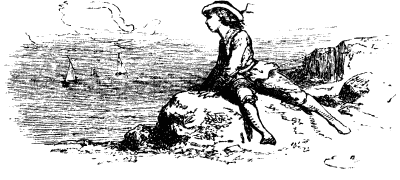
To Boston also belonged, some two centuries ago, the celebrated treasure-hunter, William Phips. He was one of twenty-one sons, and was born at Woolwich, Maine, in 1651. Of a bold, adventurous spirit, his first and last passion was to follow the sea, although until he was eighteen years of age he was forced to tend sheep. He then apprenticed himself to a ship-carpenter for four years, taking a trip down the coast now and then, and watching his chance for the next move. He is said to have been inspired by an idea that celebrity and fortune were to be his destiny; and when his apprenticeship was over, he went to Boston and worked at ship-building for a year, until he had the good luck to win the favor of a rich widow. Her he married, and, with the increase of means thus obtained, Phips launched into various enterprises, which did not always turn out well. But he never lost faith in his guiding star, and often told his good wife that "he should yet become commander of a king's ship, and owner of a fair brick house in the Green Lane of Boston"—at that time the Beacon Street of the plucky little town.
Ten years went by, and Phips seemed but little nearer the realization of his dreams than while tending sheep on the hill-sides of Maine, when the prospect suddenly brightened in an unexpected quarter. This was the time when Spanish and Portuguese galleons were crossing the ocean laden with silver from Potosi and diamonds from Brazil. Pirates and privateers scoured the seas to rob the treasure-ships, and great expeditions were sent out by England in war times for the same purpose. The imaginations of men ran riot during this feverish state of things, and people were ready to believe almost any yarn "spun" in the forecastle.
Phips was just the man to be moved by such tales, and, when he learned of a certain rich wreck on the Bahamas, he at once fitted out a small vessel and went in search of it. He found and recovered the treasure, but the amount was small, being only large enough to whet his appetite for more.
While at the Bahamas, he was told of another Spanish vessel, wrecked off Puerto Plata more than fifty years before, with a much larger treasure. His means not being sufficient for this expedition, Phips sailed for England and made direct application to the Admiralty to aid him in his search. So ably did this true son of the sea represent his cause, that he was given command of the "Rose Algier," a ship mounting eighteen guns and carrying a hundred men. Thus Phips's first dream came to pass; he was now captain of a king's ship, with a roving commission.
The exact position of the wreck was unknown, and the untrustworthy character of the crew added great difficulties to the undertaking. It should be remembered, also, that diving-bells, diving-armor, and the like, were then unknown. But the courage and indomitable perseverance of Phips now came into play, and he had a capital chance to show the stuff of which he was made.
Soon after they had sailed, the crew came aft, armed, and determined to force Phips to yield to their wishes, which probably were that they should all turn pirates. Without giving them time to deliberate, Phips flew at their leader, hurled him to the deck and dispatched him on the spot—a deed so prompt and daring that it awed the mutineers into submission for the time. One who has never seen a mutiny at sea can form but little idea of its desperate character, and the rapidity of action and unflinching nerve required where men are shut up alone on the wide ocean with a quarrel so deadly in its nature that no compromise can be thought of for a moment, and no quarter can be allowed with safety to him who gives it.
But the next plot to seize the ship was even more dangerous. The "Rose Algier," being in need of repairs, was taken to a cove in a small uninhabited island, and careened on one side in order to reach the damaged place. Most of the stores were moved on shore, the ship was hove down, and a bridge was laid between the deck and the land. Under the pretense of pastime, most of the crew now betook themselves to the woods, and there plotted to return at seven in the evening, seize the ship, force Phips and eight faithful men on shore, leave them there to perish, and themselves sail away on a piratical cruise. But the carpenter was one of the few who stood by the captain, and yet they could not risk putting to sea without him. They sent for him, therefore, on some pretext, and, having him in their power, offered him the choice of instant death or of joining his fortunes with theirs. He begged for half an hour to think about it, and said that at any rate he should have to return on board for his tool-chest. They granted his request, and sent two men with him to watch his movements. Soon afterward, he was suddenly taken with a pretended cramp or colic, and in great seeming agony rushed into the cabin for medicine; there he found Phips, and in a few rapid words revealed the plot. In less than two hours the mutineers would be marching on the ship. Not an instant was to be lost. Immediately the guns were loaded and trained to command the shore and all the approaches to the stores; the bridge was taken in, and when the mutineers appeared they found themselves caught. In tones of thunder, Phips bade them not to stir or he would mow them down with his batteries; nor did they dare to disobey. The bridge was again laid down, and the eight loyal men brought back the stores to the ship. When all was safely on board again, the mutineers were told that they were to be left to the fate they had intended for their commander. In despair at so terrible a prospect, the miserable men threw down their arms, and protested their willingness to submit if Phips would but relent and not sail away without them. After a long parley, he agreed to let them come on board, they having first given up their arms. But, with such a crew, further search after the treasure was useless. Phips, therefore, sailed for Jamaica, changed the crew, and again weighed anchor for Hispaniola. There he was lucky enough to find an old Spaniard who told him that the wreck was somewhere about a reef a few leagues north of Puerto de la Plata. Phips immediately went to the spot. But his search for the wreck was long and unavailing, the season was changing, and the "Rose Algier," now but half manned and in unseaworthy condition, was unfit to prowl around a dangerous reef in the hurricane season. So, without having accomplished the object of so much exertion and anxiety, Phips was obliged to return to England, a baffled but not a discouraged man.
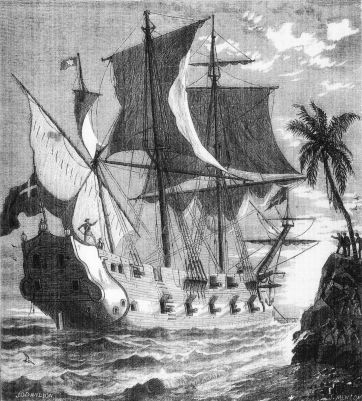
CAPTAIN PHIPS THREATENS TO SAIL AWAY FROM THE MUTINEERS.
Very naturally, it was impossible for our adventurer to obtain another English ship-of-war, although he received much credit for the courage and skill shown in controlling the mutineers, and one would conclude that the treasure of the old Spanish galleon would after this have remained at the bottom of the sea, the exclusive possession of the sharks, the turtles and the barracudas. But with rare pertinacity Phips returned to the charge, and at last persuaded the Duke of Albemarle and several other wealthy noblemen to his views. They formed a company and obtained a patent from King James II., giving them the sole right to all wrecked treasure they might find during a certain number of years. Then they fitted out a ship and tender, the latter to cruise in coves and shoal water, and Phips invented several rude contrivances, for dragging and diving, far inferior to the means now used for such purposes. Thus prepared, he sailed once more for Hispaniola. There a small, stout boat was built, and with it and a crew of Indian divers the tender was despatched to the reef where the wreck was said to be. The tender was anchored in good holding-ground at a safe distance from the reef, and the men then rowed slowly in the boat around it, carefully examining the depths below for signs of the wrecked galleon. The waters in the West Indies are very clear, and during a calm objects can be seen at a considerable depth. The rocks were of singular form, rising nearly to the surface, but with sides so steep that any vessel striking them would be liable to go down many fathoms below the reach of the most expert diver. The only hope was that the wreck might have lodged on some projecting ledge. But the closest observation, long continued, failed to reveal any sign of the object so eagerly sought, although the water was perfectly calm.
At length; a curious sea-plant cropping out of a crevice in the sides of the reef caught the eye of one of the crew, and he sent down an Indian to bring it up. When the diver returned to the surface he reported that he had seen a number of brass cannon lying tangled among the sea-weed on a ledge. That was enough. Inspired with the greatest enthusiasm, diver after diver plunged below to be the first to discover the treasure, and ere long one of them brought up an ingot of silver worth several hundred pounds. Transported with success they left a buoy to mark the spot, and made all sail to carry the glad tidings to Phips. He would not credit the tale until he had seen the ingot, when he exclaimed, "Thanks be to God, we are all made!"
Every man was at once enlisted in the service of fishing for the treasure. The bullion was discovered first; after that, in the bottom of the hold, the sea-miners found the coin in bags, which had been so long under water that they were encrusted with a stony shell, hard as rock. This was broken with crowbars, revealing gold, jewels, and "pieces of eight," in glittering abundance. The last day's work brought to light twenty massive silver ingots, and the whole amount recovered was somewhat over three hundred thousand pounds, a sum equal in the values of our time to five millions of dollars. Nor was this all the riches concealed in the wreck; but Phips was obliged to return to England before completing the business. Provisions had run low, and the presence of so vast a treasure on board had stimulated the cupidity of the crew to a dangerous degree, so that each day of delay in reaching port was full of hazard. Every precaution was taken to guard the treasure, but what probably prevented the crew from rising was the promise Phips gave them, when matters had become most suspicious, that they should each receive a share of the profits in addition to his wages, even if his own portion were thus swallowed up. Phips reached England without mishap, thus bringing to a successful termination one of the most daring exploits of its sort that were ever attempted.
When the profits were divided, Phips received as his share a sum that would now be equal to two hundred and fifty thousand dollars. The Duke of Albemarle presented Mrs. Phips with a magnificent gold cup worth fifteen thousand dollars, and King James expressed great pleasure at the honesty and ability of Phips in the conduct of such a difficult undertaking, and as a reward for bringing such a treasure into England granted him the honor of knighthood, and offered him important employment in the royal service. Fortune had indeed smiled on the shepherd-boy of Maine.
But Phips was never ashamed of his humble origin, nor in all his wanderings did he forget his native land. And now, instead of remaining to enjoy further honors near the throne, he returned to his family, bearing the important commission of High Sheriff of New England. He now built the brick house on Green Lane which he had promised his wife fifteen years before. The name of this Street was eventually changed to Charter Street, in memory of his efforts to have the charter of the Massachusetts colony restored.
Sir William Phips afterward engaged in the wars between the American colonies of France and England, and at the head of an expedition of eight ships captured Port Royal. A subsequent enterprise against Quebec failed from a combination of causes, some of them beyond the control of Phips. After this Sir William went again to England, where he was appointed Captain-General and Governor-in-Chief of the New England colonies; and his return home with these new honors and titles was made the occasion of a day of solemn thanksgiving.
His governorship having ceased, Sir William Phips sailed for England, and was meditating a fresh expedition in search of shipwrecked treasure when he was taken suddenly ill, and died at the age of forty-five. While his adventurous career affords us little hope that any of us will ever, like him, discover shipwrecked wealth, it gives us a fine example of what perseverance combined with intelligence, courage and honesty can accomplish in the face of great difficulties; for it was a union of all these qualities which enabled Sir William Phips to wrest fortune and honors from the ocean depths.