THE STORK AND THE CRANE: A FABLE.
Reading edition
By Howard Pyle.
A Stork and a Crane once frequented the same marsh. The Stork was a quiet, dignified individual, with a philosophical countenance. One would never have thought, from his deeply reflective look, of the number of frogs and pollywogs, eels and small fish, that had disappeared in his meditative mouth. For the Stork was like many another philosopher, and in spite of his supernaturally wise external appearance, inside he was just as selfish, and just as voracious, as all the rest of his kind.
Although he never mentioned the subject, he was secretly very proud to recall the former grandeur of his ancestors, one of whom, in old Greek days, had been a famous king over the frogs, eels, and snakes, in a Spartan marsh.
The Crane was a lively little fellow, and not at all philosophical. He ate his dinner without moralizing over it, and felt thankful when he had enough. He had not a particle of aristocratic blood in his veins, and, in consequence, rather ridiculed the possession of that indescribable material by the Stork. Ridicule as he would, however, he was really secretly proud of his acquaintance with the other, and used to say to his friends and relatives sometimes:
"There is no one in the world that more despises pretentiousness than myself. One only too frequently hears an animal boast of its aristocratic acquaintances. I never do that. Now, there is John Stork, of one of our highest families, and although I am not only on friendly but intimate terms with him, and even have been invited to call upon his estimable family, and make the acquaintance of Miss Stork (I have never had an opportunity to do so yet), one never hears me boast of his friendship and intimacy."
To tell the truth, the conversations he held with the philosophical Stork were frequently so deep, that he found himself floundering beyond his depth. For instance, "Do you always stand upon one leg?" said he, one day.
The Stork reflected so long over this question that the Crane thought he had gone to sleep. Finally, however, the philosopher said:
"No; I do not. I always stand upon the other."
The Crane meditated for a space over this, but as it was completely beyond his comprehension, he gave the matter up and changed the subject. His respect for the Stork's wisdom was vastly increased by such conversations, for one often takes for wisdom what one cannot understand.
These two friends, however, did not always dwell together in perfect amity. The Stork was so proud that he frequently galled his humbler companion, and bitter disputes often arose. It was under the influence of such a feeling that the Crane burst forth one day:
"And what are you that you should boast? You have blue blood in your veins, indeed! Perhaps it is that blue blood that makes you so sluggish and stupid."
The Stork meditated a long while over this speech; finally, he said:
"When you accuse me of sluggishness and stupidity you judge by external appearances, and, consequently, by deductive logic. Beside, you do not take collateral matter into the case from which you draw your inference. You have never seen me when my physical energies have been aroused, consequently, your conclusion is both hollow and baseless—Q. E. D."
The Crane was rather taken aback by this speech, and, not comprehending it, he felt somewhat humbled. At length he said:
"I am no philosopher, but as they say 'the proof of the pudding is in the eating of it,' I am willing at any time to run a foot-race with you, and so prove who is the more agile."
"I do not know," answered the Stork, meditatively, "whether my family would altogether approve of my entering into the lists with such a vulgar creature as yourself." Here he shut one eye, and looked reflectively with the other at a frog that sat on a tussock near by. "Still, I recollect that one of my ancestors proved his valor upon a turbulent duckling once, so I see no logical reason why I should not compete with you."
And so the matter was settled.
All was hubbub and excitement among the birds when the coming race was announced. The racecourse was so constructed that the larger birds stood upon one side, and the smaller birds and animals upon the other. This was so arranged, chiefly at the request of a deputy of frogs, because, at a mass meeting once, an albatross had eaten twenty-seven of these animals in a fit of absent-mindedness, as he said. Still the frogs desired to prevent the recurrence of so painful a scene.
"THE STORK WAS AHEAD!"
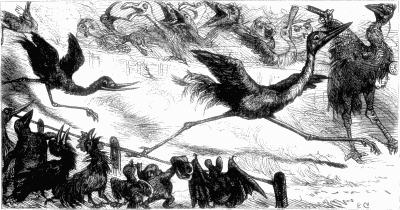
The Cassowary was chosen director of the race, chiefly because he was a famous traveler as well as a pedestrian himself, and so was a judge of such matters. He was the same of whom the Gander, the poet-laureate, had written the poem commencing—
"It was a noble cassowary, On the plains of Timbuctoo, That gobbled up a missionary Body, bones, and hymn-book too."
All were assembled. The champions stood neck to neck, while the spectators looked on, breathless with excitement.
"Go!" cried the Cassowary, and they went.
For a long time they continued neck and neck, and the excitement rose to fever heat. At this juncture a mouse attempted to cross the racecourse, and was instantly devoured by an owl, who acted as police of the course. At length the two racers re-appeared coming toward the grand stand,—that is, the place where the Cassowary stood with the signal-gun or, rather, pistol. The shouts and cries became more agitated and violent; there was no doubt about it,—the Stork was ahead! It was in vain that the gallant little Crane strained every sinew; the Stork came into the stand a good three lengths ahead of his adversary. Bang! went the pistol, and the Stork had won. His adherents crowded around him cheering vociferously, and raising him aloft upon their shoulders above the crowd. Even the Cassowary came forward and shook hands with him.
"Recollect, hereafter," said the successful Stork to the poor Crane, who stood dejectedly to one side, "not to scorn and undervalue qualities in any one, because they are not flaunted in the eyes of the world."
The Crane's adherents maintained that it was a foul start, while the Stork's friends answered that when two birds ran a race, it could not well be anything else.
The frogs, the mice, and most of the small birds, were divided among the successful betters; and, altogether, it was a day of rejoicing, except to the frogs, the mice, and most of the small birds.