SOMETHING IN THE OLD CLOTHES LINE.
Reading edition
By Paul Fort.
When I look at pictures of people of old times, I often think what a curious thing it is that the only apparent difference between them and the people of the present day is to be seen in their clothes.
If we could take a dozen or so of ancient Greeks and Romans; some gentlemen and ladies of the middle ages; a party of our great-grandfathers and mothers, and some nice people who are now living in the next street, and were to dress all the women in calico frocks and sun-bonnets, and all the men in linen coats and trousers and broad straw hats, with their hair cut short; and were then to jumble them all up together, and make them keep their tongues quiet, it would be very difficult, if not impossible, for a committee, unacquainted with any of the party, to pick out the ancients, the middle-agers, or the moderns.
Lady Jane Grey, or Cornelia, the mother of the Gracchi, or Helen of Troy, would not look unlike the other women in sun-bonnets and calico frocks; and while there would be a greater difference in the men, whose nationality might show more strongly, Christopher Columbus, Nero, and Marco Bozzaris would be pretty much the same kind of fellows as the other men of the party.
It is certainly a fact that there are a great many more points of strong resemblance between the people of past ages and ourselves than most of us suppose. It is often very surprising, when reading of the domestic life of the past, to see how precisely similar, in some respects, it was to our own. And, as I have said, the people looked, with the exception of their clothes, very much as we do—meaning by "we" the people of the present day, all over the world.
In 1876, at the Centennial Exposition, I saw a marble bust—life size—which was a portrait of a lady of ancient Rome. There was only the head and neck, the hair was dressed very plainly, and it was astonishing how well that bust would have answered for the portrait of a lady of Thirty-fourth street, New York, or the wife of a gentleman in Springfield, Ohio. The head and face were just such a head and face as I had often seen, and the countenance even seemed familiar to me.
But dress makes all the difference in the world. Had I met that lady attired in her flowing Roman garments, with her golden head-dress and her sandaled feet, I should have had no thought of Thirty-fourth street, or Springfield, Ohio.
And so down the whole line of ages you can tell, pretty nearly, when a man or a woman lived, if you can but get an idea of his or her clothes.
The next thing which strikes most of us when looking at the pictures of old-time people, is a feeling of wonder how they ever could have been willing to make such scarecrows of themselves.
To be sure, we are willing to admire the flowing robes of Greece and Rome, although we feel quite sure that our style of dress is much more sensible, and we have an admiration for a soldier clad in armor, as well as for the noblemen and gentry who figured, some hundreds of years ago, in their splendid velvets and laces, their feathers and cocked hats, and their diamond-hilted swords.
But, as a rule, the garments of our ancestors appear very ridiculous to us. If we did not have good reasons for belief to the contrary, we should be very apt to consider them a set of fools.
It even seems a little wonderful that people should be able to invent such curious fashions of dressing themselves.
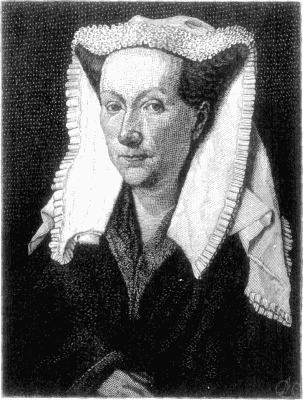
Think, for instance, of the wife of Jean Van Eyck, a celebrated old Dutch painter, who was willing to dress her hair so that she looked like a cat, and, moreover, had her portrait taken in that style, so that future generations might see what a guy she was!
Yes, the picture painted over five hundred years ago hangs to-day in the Academy of Bruges, and the staidest little Belgians laugh when they look at it. You may see it yourselves some day, but, if not, you can at least enjoy this excellent copy, which has been engraved for St. Nicholas from a photograph of the painting. If you look at her face, you will see that in feature she is very much like an ordinary woman of the present day. There is nothing at all distinctive about her countenance. As far as that is concerned, she might just as well have lived now as at any other time.
But if she were to appear in an ordinary evening company dressed in the style in which you see her in the picture, the difference between her and the other ladies would be very striking, to say the least.
THE WOMAN WHO LOOKED LIKE A CAT.
The curious methods of dress in olden times were so many, and were of such infinite variety, that I cannot even allude to them in a little article like this; but you cannot look at very many pictures of the people of by-gone days without seeing some costume which will appear quite funny, if not absolutely absurd.
You need not go very far back either. What could be queerer than the high coat-collars of some of your great-grandfathers, which came up under their ears, while their throats were wrapped in fold after fold of long cravats—or else encircled by a hard, stiff stock,—and the hind-buttons of their coats were away up in the middle of their backs!
But perhaps your great-grandmothers, with the waists of their gowns just under their arms, with their funny long mittens and their great calash bonnets, were just as queer as their husbands.
Now the question comes very naturally to us: Why did these people, as well as the people who came before them, dress in such ridiculous fashions? We know that many of them were very sensible folk, who knew how to do many things as well as we can do them, and some things a great deal better. Mentally and physically the most of them are not surpassed by the people who live now. Then why did not they know enough to dress sensibly and becomingly as we do?
In reply to this I will say that your great-grandfather and your great-grandmother, unless they belonged to some religious sect which regulated the clothes of its members, would have dressed exactly as your father and mother now do, if it had been the fashion in their day.
And if you had seen their portraits, dressed in clothes of the present day (which, had those old people worn them, would have been out of fashion long before you were born), you would have thought they looked perfectly ridiculous.
The truth of the matter is, that with a great many of us the attractive and desirable qualities of clothes depend entirely upon their relations to the current styles or fashions. We think everything unbecoming and ugly excepting those styles; and no matter how absurd the present fashion may be, there are not ten persons out of a thousand who, when they become used to them, do not admire them and follow them to the extent of their ability.
There are few of you who are not old enough to remember fashions of dress, which at one time you and every one else considered very stylish and becoming, and which now would make a perfect fright of any one who would be bold enough to wear them.
Indeed, were a fine lady to make her appearance in the streets of one of our large cities dressed in the hoops and wide skirts in which she was so fashionable and attractive a few years ago, the street boys would hoot her, and she might walk about all day without meeting a single person who would think that there was anything whatever to be said in favor of such a costume.
Of course, some fashions are uglier and more absurd than others, and it is not strange that we wonder how sensible people could have endured them; but if these very styles were to become fashionable again, most of us would adopt them.
If, in a few years, it should become the fashion for ladies to dress their hair like that of the good wife of Jean Van Eyck, I feel quite certain that nearly all the fashionable ladies you know would go about looking very much like cats. This may seem a libelous assertion; but if you will keep a watch on the fashions, I think you will find I am correct, provided the Van Eyck style comes up.