THE LETTER-BOX.
Reading edition
The following is Dr. J. G. Holland's answer to his "Double Riddle," published in our last number:
La, man! I see your little game: 'Tis "la" itself in song or aria That piercing dear Maria's name Transforms it to Malaria. And "la" itself, as all men know, Raises the sol to si and do.
Dear St. Nicholas: I have made up a nice little story, and I want you to know it. It is called "Laziness."
Once upon a time there was a little boy and his name was James. He was very lazy. One day he was going out to play when his mother called him back. "James," said she, "I went up to your room to make your bed, for the maid was too busy, and your room is very disorderly. Unless you promise to keep it in order, and have it in order by next week, I will send you from home. I am very sorry to say this; but it must be said. Now you may go; that is all I wanted you for." Next week came very soon, and the room was still in disorder. The mother went up and looked in; she threw herself on her knees, and prayed that Heaven would not let her send her boy away. James went away, and his mother never saw him again.
Now, children, learn a lesson from this, and don't be driven from home by laziness.
I am eleven years old, and I want you to give my love to Jack-in-the-Pulpit and the School-mistress.
Jennie Moore.
The Blind-clerk's Puzzle.
This is what the "Blind-clerk" made of the puzzling address that M. B. T. gave in a letter to Jack-in-the-Pulpit, published last month:
"Servant Girl, No. 40 Queen's parade, London."
And that turned out to be the right address, too. Another friend says that this same blind-clerk once had referred to him a letter addressed like this:
"To my uncle tom, london."
That was too much. The letter never reached "my uncle tom."
Dear St. Nicholas: I have taken St. Nicholas for several years, and like it better every year. I often read over the old numbers, and find many things that seem almost new to me. One of these was "John Spooner's Human Menagerie," in the number for April, 1875, and I have been trying to get up a "menagerie" like John's. I can make most of the wonderful living curiosities, but I do not know how to make a curtain that will "go up with a flourish." I have made one to draw sideways, but I want one to go up. Please inform me how to construct it.—Yours truly,
Fred R. Martin.
Here is a tolerably easy way to make a stage-curtain that will "go up with a flourish," and come down either quickly or slowly, as may be wished. It is easily kept in order, and readily repaired when damaged.
Above the stage, at the front, set up a stout cross-beam. Let the curtain be of some opaque stuff that will fold well. Fasten its upper edge firmly to the front of the cross-beam. Weight the lower edge of the curtain with a long roller some inches wider than the curtain. Sew to the curtain, on its wrong side, perpendicular rows of rings set at suitable distances apart, and in level lines across. The more rows, the more evenly will the curtain fold. Tie a strong thin cord about the roller in a line with each perpendicular row of rings, and pass each cord through its proper rings. On the bottom of the cross-beam above the several rows of rings, fasten large smooth rings to be used instead of pullies. Pass the cords up through the large rings, and gather them at one end of the beam. Then fasten the ends of the cords to a rope, taking care while doing this that the curtain is down, and hanging properly, and that all the cords are drawn equally tense. There should be a stout pin or hook at the side of the curtain, to which the rope is to be fastened when the curtain is drawn up. Take notice that the cords are of different lengths and must be free from knots. The curtain should not touch the stage, and may be kept in place by fixing the ends of the roller in iron rings or between pegs.
Two Ways of Carrying the Mail.
The frontispiece to this number of St. Nicholas shows how the mails were carried in winter over the Rocky Mountains and the Sierra Nevada before the Union Pacific Railroad was finished (1869), and how they are carried now. In 1867, to the perils of the snow and wind and of mountain travel, were added dangers from desperadoes, white as well as red, so that mail deliveries were few and far between, and very irregular, while too often both the carriers and their packs were lost. Slow as the old way was, however, the snow sometimes makes the new way even slower. In spite of miles and miles of snow-sheds and snow-fences, and ever so many steam snow-plows, the railroad is blocked now and then until a way can be dug through huge heaps of drift. Thus, sometimes, whole days are lost on the steam road, when a man might be speeding and coasting on his queer foot-gear, over the snow-crust like the wind, to reach the destination perhaps a week ahead of the snorting snowed-up monster. However, year by year, as sheds and fences and other preventions are multiplied, railroad delays caused by snow become fewer and fewer.
Georgetown, D. C.
Dear St. Nicholas: I was so much pleased with the little figure of a nun in the November number, that I made eight like it. I have been taking the St. Nicholas ever since it came out, and think it gets nicer every time it is published. I am not quite seven years old, but I composed all of this letter.
John Wm. Mitchell.
My Very Dear St. Nicholas: We really don't know what we should do without you. We took the "Young Folks" for a great many years, and have taken you ever since you were first established.
We went, a short time ago, to see a man who swallowed swords for a profession. Now, can any of our St. Nicholas friends tell us whether he really swallowed them or not, and explain how it is done? —Your loving friends and devoted readers,
Fannie Chandler,
Mary White.
Painesville, Ohio.
Dear St. Nicholas: My children learn the names of English kings and queens, the books of the Old Testament in their order, and other matters of importance to remember, through having found and committed to memory certain rhymes containing them. I have seen several embodying the books of the New Testament, but they all have been too difficult or long for children to learn. I inclose an easy one, written for my own children which may prove useful to your large family of young folks.
W.
BOOKS OF THE NEW TESTAMENT.
In the New Testament we find Matthew and Mark leading, With St. Luke and St. John The books next succeeding. Acts and Romans have place Before Corinthians and Galatians; In them we can trace Good news for all nations. Ephesians and Philippians In order are next; Colossians, Thessalonians, With hard names and good text. Timothy, Titus, and Philemon Fill up some pages, And with Hebrews continue The lessons of ages. James, Peter, and John Finish then the good story With Jude, and Revelations To add to its glory.
Mount Desert.
Dear St. Nicholas: I have seen a good many receipts for candy in the "Letter-Box," but not one for chocolate creams. Here is one I have tried a great many times, and it has always been successful:
Two cups of sugar to half a cup of boiling water. Put on the stove, and let it boil ten minutes. Grate a quarter of a square of Baker's chocolate. Place this on the top of a steaming-kettle; leave it there until soft. Meanwhile, take off the cream and beat it until perfectly white. Roll into little round balls, and dip them in the chocolate. Put the balls into a dish, and set them away to cool.
Hoping you will print this receipt, I remain your devoted admirer,
Caroline G. Blodget.
P. S.—The sugar must be powdered.
Mollie.—We do not know. One always has to make sure, too, that no speck of envy lurks in the wish to have justice done.
A friend sends us the following Kindergarten song:
THE TIME TABLE
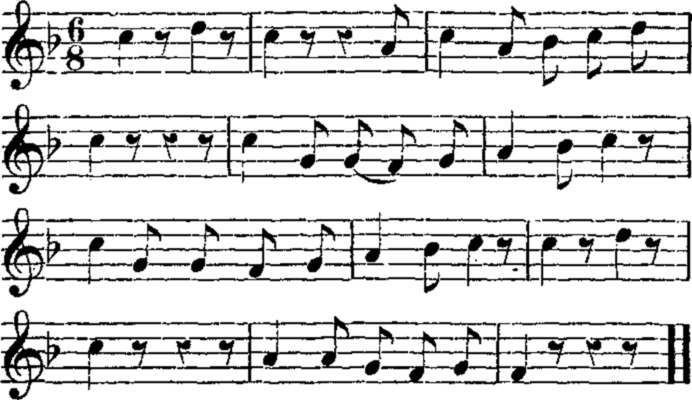
One, two, three! Now please listen to me: A minute is sixty seconds long; Sixty minutes to an hour belong. One, two, three! Learning is easy, you see. Four, five, six! 'Tis easy as picking up sticks. Twenty-four hours make one long day; Seven days in a week we say. One, two, three! Learning is easy, you see. Seven, eight, nine! Never cry or whine. The years are only twelve months long; There is no time for doing wrong. One, two, three! Learning is easy, you see. Tick, tack, tock! Only look at the clock. He works away the whole day long, And every hour he sings a song. Ding, dong, ding! So we'll work and sing.
A. E. L.
Elizabeth, N. J.
My Dear St. Nicholas: Would you please tell me something about the Drawing Classes of the School of Design at the Cooper Institute; and what forms have to be gone through before a pupil can enter; and how old a pupil has to be? Good-by, dear St. Nicholas.—Your faithful reader,
Sarah D. O.
The "Woman's Art School" of the Cooper Union, about which Sarah D. O. makes inquiry, is for pupils between the ages of sixteen and thirty-five.
Applications for admission should be made, personally or in writing, to the Principal, Mrs. Sarah N. Carter, giving a responsible written reference as to character, fitness, etc.
The free school holds session from 9 a.m. to 1 p.m. There is a "paying" class that meets three times a week in the afternoon, under the charge of the first assistant in drawing of the "Woman's Art School" and of the clerk of the school, and the general superintendence of the principal. But the "paying" class is only for those who wish to study art merely as an accomplishment.
Dear St. Nicholas: I thought you would like to hear about a little girl who is very fond of you. She always took St. Nicholas until last autumn, then the times were so hard we were unable to get it for her; so she has read and re-read the old ones. Mamma has been sick a great deal for two years, and Agnes, who is ten years old and the oldest of the family, has learned to do a great many things. She can make bread, biscuit, pies and cake,—but her chief accomplishment is toast-making. Last fall, when berries were ripe, she picked and dried some currants, raspberries and blackberries, and put them carefully away. Ever since, when any one is sick, she puts some of her berries in a cup and cooks them nicely; then she makes such a nice piece of toast, so delicate, never scorched or raw. She has no fruit-closet of delicacies to go to, but the common things she has are so nicely prepared that they become luxurious, and often make mamma think of Bayard Taylor's little rhymes about mush and milk, a couplet of which reads:
"And common things that seem most nigh, Both purse and heart may satisfy."
Her little brother, eighteen months old, claims much of her care, and in return loves her as much as he does mamma. He calls her Tee, and misses her sadly if she is out of sight an hour.
When Agnes was three years old, she said one day:
"Papa, how I love you!"
"What makes you love him? See how homely he is," teasingly answered mamma.
The little one took a good look at papa, and throwing her arms around his neck again, she said:
"Well, he's pretty in his heart."
Mamma thinks the little girl who can be so thoughtful for ever-tired mamma, so kind to the sick, and so tender of little baby brother, must be pretty in her heart.
Agnes's Mother.
Here is an enigma made by a little girl eight years of age:
Cross-word Enigma.
My first is in spin, but not in weave; My second in part, but not in leave; My third is in rain, but not in storm; My fourth in chilly, but not in warm; My fifth in hen, but not in coop; My whole is a country of Europe.
Answer: Spain.
Easton, Md.
Dear St. Nicholas: Will you please tell me from which of Shakspeare's plays the following quotation is taken?
"Sweet are the uses of adversity, Which, like the toad, ugly and venomous, Wears yet a precious jewel in his head."
—Yours truly,
Mary H. Wilson.
The quotation is from "As You Like It," Act II., Scene 1.; and the whole passage reads:
"Sweet are the uses of adversity, Which, like the toad, ugly and venomous, Wears yet a precious jewel in his head; And this our life, exempt from public haunt, Finds tongues in trees, books in the running brooks, Sermons in stones, and good in everything."
The beauty is marred, and the aptness of the illustration is lost sight of, by omitting the second half of this admirable sentence; therefore we quote it entire.
"Fairfax," San Rafael, Cal.
Dear St. Nicholas: I have seen letters from San Francisco, Oakland, and other places in California, but I do not think any one has written to you from San Rafael, a beautiful little town near San Francisco.
"Fairfax" is about three miles from the town. The ride here is very pleasant, especially in winter and spring time, when the hills are green and the wild flowers are in bloom.
The house resembles the old Fairfax house in Virginia, called Greenway Court, except that this is perhaps more rambling and the other lacks our wide-spreading bay-trees. It faces the garden and orchard, and beyond these is the hill, a mine of wonder and beauty.
We all enjoy climbing that hill and looking for ferns. In some parts we hardly dare step, for fear of crushing something beautiful. We look down upon a bank of green moss, and find snowy, shell-like fungi, so delicate that we hold our breath lest they should float away. Farther on are orange-colored ones, and some shaped like callas, translucent, and in color a pale pink carnelian. Wandering on, we enter a grove of pine-trees, in the midst of which a spring is bubbling up, and the ground is covered with a carpet of ferns, mosses, and wild flowers. By the time we are ready to go home, our baskets are well filled; and then, after we get home, we have the delight of arranging the flowers and ferns, examining the fungi with the microscope, and preparing imposing baskets of specimens to send to two delightful members of the Academy of Science in San Francisco, who are making fungi a specialty in their researches.
One day last summer my brother came running into the house, saying, in a very loud whisper, "There's a deer in the creek! There's a deer in the creek!" We all rushed out in time to see Uncle George, up to his waist in water, struggling with an immense buck. The dogs were there, too, barking as loudly as they could. It was very exciting. My sympathies were entirely with the deer, who made a noble fight before he was conquered. Deer are plentiful around here. Often we are awakened by the baying of the deer-hounds, and we can see the hunting parties on their horses galloping over the hill, and the dogs running to and fro.
The boys catch a good many large fish in our creek, and my uncle once caught a ten-pound salmon-trout that was very pretty; it had two delicate pink bands running along its sides.
The hills are crimson, a little before Christmas, with a holly peculiar to California; and we have many merry excursions in a wagon that we children call our "chariot," in which we go to gather holly for our Christmas festivities.
I have written too much, and yet I would like to tell more, our days are so full of pleasant change.—Your affectionate reader,
May D. Bigelow (fifteen years old).
Answers to Puzzles in the November Number were received, previous to November 18, from Annie Longfellow, "Bess," "Isola," "Bessie and her Cousin," "Helen of Troy," W. M. B., Nessie E. Stevens, "Winnie," Florence L. Turrill, James J. Ormsbee, Annie Forbush and Emma Elliott, Grace G. Chandler, Carrie Speiden and Mary F. Speiden, F. A. G. Cameron, Fred M. Pease, Geo. J. Fiske, Geo. Herbert White, "Sidonie," Louise Gilman, Clelia Duel Mosher, Mamie L. Holbrook, Ellie Hewitt, Fannie W., "Croghan, Jr.," Anna E. Mathewson, Eddie Bryan, and Allie Bertram.
BOOKS RECEIVED.
Aunt Jo's Scrap-Bag, Vol. IV. (My Girls, etc.), published by Messrs. Roberts Brothers, Boston, is the fourth book in this deservedly popular series of short stories by Miss Louisa M. Alcott. The tales are full of freshness, humor, and wholesome thought, with inimitable touches of playful fancy and tenderness such as have established Miss Alcott's loving rule over the hearts of her readers. Boys as well as girls will find plenty to enjoy in these twelve delightful scraps from Aunt Jo's bag, and,—but readers of St. Nicholas need no recommendation to them of anything that Miss Alcott has written. There are some pretty illustrations to the book, and the price is one dollar.
From the same publishers we have received also: Tom, a Home-Story, by George L. Chaney, illustrated, $1.25; A Great Emergency, and Other Tales, by Juliana Horatia Ewing, illustrated, $1.25; Jolly Good Times at School—Also Some Times not quite so Jolly, by P. Thorne, illustrated, $1.25.
A new book by the author of "Helen's Babies" is now to be obtained. It is called Budge and Toddie, their Haps and Mishaps, and is an illustrated edition of "Other People's Children." The designs are by Lucy G. Morse.
Boys will be glad to hear of a good book, Every-day Experiences at Eton, by a present Eton boy, published by George R. Lockwood, of New York. It is a hearty and amusing story, giving, with very slight exaggeration, a faithful account of life in the English public-school at Eton.
Spenser for Children, published by Chatto & Windus, of London; Scribner, Armstrong & Co., New York. A beautiful book, illustrated with several fine colored plates, and relating in simple prose the chief incidents of Spenser's great poem.
From Messrs. Baker, Pratt & Co., New York, we have Lilliput Land; or, The Children's Peep-Show. This is a collection of serials, short stories, poems, music, and pictures, adapted to interest and instruct young folks. It is edited by the author of "Lilliput Levee." Price, $1.25.
Messrs. Porter & Coates, Philadelphia, send us Happy Days, a very pleasant book, full of pictures, tales and verses, for boys and girls. Several of the articles are by well-known writers, and the contents, as a whole, are bright, wholesome, and entertaining.
From the American Tract Society, New York, we have received Dolly's New Shoes, and Some of the Places they Went to, price 30 cents, postage 2 cents; Daughters of Armenia, by Mrs. S. A. Wheeler, Missionary in Turkey, price 90 cents, postage 6 cents; Almost a Man, by S. Annie Frost, with illustrations by Arthur Burdett Frost, price $1, postage 8 cents; Grace Ashleigh's Life-Work, illustrated, price $1, postage 8 cents; and Dear Old Stories told Once More, forty Bible stories, in large type, and with illustrations by "Faith Latimer."