HOW KITTY GOT HER NEW HAT.
Reading edition
By E. P. W.
It was all because of Polly, and this was the way of it.
Ma had gone 'cross lots to Aunt Mari's, to stay till milking-time, to see the new things Aunt Mari had brought from Boston, and Polly and I were alone at home. Polly is our hired help, and she is Irish, and has got red hair, but she's as good as gold; and I am Kitty, my Pa's little chatterbox.
Polly was in the buttery, washing the dinner-dishes, and I was on the kitchen floor, playing with Queen Victoria, our old yellow cat, trying to teach her to stand on her hind-legs and beg, like Johnny Dane's dog. But Vic was cross, and wouldn't learn; and when I boxed her ears, she scratched me on my chin, and bounced over my shoulder, and was off to the barn in less than no time.
You needn't suppose I cried, because I didn't, for I shall be ten years old next July. I don't ever cry any more; only when I have the earache, and then I can't help it. Except the other day when Tom stepped on my Rachel Tryphena, and jammed her forehead in, I did. But Tom's going to buy her a new head with the money he gets from selling Jake Lawrence some of his guinea-hen's eggs, so I don't mind about that now. I was just thinking how much better I should feel if I'd had a chance to pull old Vic's tail, when Polly called, "What yer doin', honey!" and said if I would come and wipe the plates for her, that by and by, when she had "set the sponge" for to-morrow's baking, she would take her sewing and sit under the maple-tree, and tell me a story.
I like Polly's stories, and I like wiping dishes, too, sometimes—and I can do them first-rate, if I'm not but nine years old, and never let one drop, neither! So Polly gave me a towel, and we both wiped with all our might and main, and 'most as quick as you can say Jack Robinson, we had them piled in shining rows on the kitchen dresser. Then I did twelve and a half rows on the suspenders I was knitting for Pa's birthday, while Polly finished the rest of her work.
About four o'clock it was all done, and the table set for supper, and everything; so Polly got her needle and thread, and the pink calico she was making into an apron, and we went out through the front entry.
As we were passing the closet door, I saw Pa's new green umbrella, that he had bought when he was in town the day before, hanging inside, and I thought it would be a good thing for us to carry it out with us, because the sun was so piping hot that afternoon; so I asked Polly if we mightn't. She said, "To be shure, darlint," and reached it down for me.
You know our big maple-tree grows close by the front gate, and stretches its branches all around, across the fence and into the road; and it's always cool under it, no matter how hot the sun shines everywhere else. Polly settled herself on the bench at the foot of the tree, and I climbed up and sat on the gate-post, where I could see along the road as far as the turning by Deacon Stiles's, and clear to the five-acre lot, where Tom and Jed were hoeing corn.
Then Polly sewed, and told a story about a beautiful maiden in a lonely tower, and an old banshee that went about nights, howling, and knocking at folks' windows.
And she talked about when she was a little girl in Ireland, and how she and her sisters and Pat Maloney used to wade together in the river, that wasn't so very much bigger than our "crick."
And then she folded her hands on her work, and gazed away into the lower meadow, where we could spy a spot of white moving against the green, that was Pat's shirt, with Pat inside of it, mowing, and began to tell what a fine "b'y" Pat was (Aunt Mari's Pat is the one), and how he had raked and scraped and gone without things ever since he had been in America, so as to save enough money to buy a snug little home over here for his old mother, and get her everything she wants before she dies.
But just as Polly was saying that she was laying by her money, too, and that when the old woman had come she had promised to go and live with them, all at once I heard an awful racket, and looked toward the road, and oh cricky! what do you think I saw? Tearing round Deacon Stiles's corner, lickety-split, was a span of horses and a buggy, with the reins dragging in the dust, and the buggy spinning from one side of the road to the other, and in it was a lady with great wide-open eyes, and a face as white as a sheet, clutching a little girl in her arms like death!
I knew right off that it was the lady who was staying at Judge Gillis's, in the village, because I had seen her and her little girl in meeting, Sunday; but my heart flew into my throat and almost choked me, and at first I couldn't speak a word. Then I screamed, "Polly! Polly!"
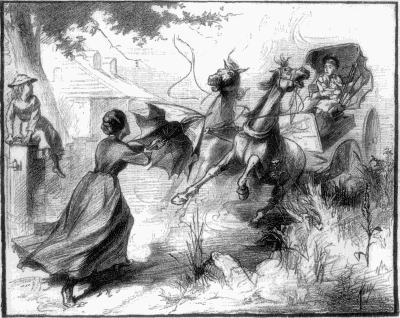
Polly jumped as if she was shot—for, if you will believe it, she had been so busy thinking of Pat that she hadn't heard a sound—and got to the gate in two leaps, scattering her spools and scissors and pieces of pink calico on the grass. When she saw the horses, she stood stock-still for a minute, and stared with all her eyes. Then she gave a screech like a wild Indian, and stooped and grabbed Pa's umbrella from where I had thrown it on the ground, and rushing into the middle of the road, she opened and shut it as fast as she could work her arms, and shouted as loud as she could yell!
At that the horses slacked up a bit. The road is pretty narrow, and they didn't seem to know how to get past the frightful-looking creature that was blocking their way of a sudden, with a big green thing flippety-flopping before her.
Anyhow, they went slower and slower, till they got to the beginning of our fence, when they tried to turn. Then Polly dropped the umbrella, and ran and caught them by the bridles, and brought them to a dead stop.
They were shaking from top to toe, and their glossy black breasts were streaked and spotted with foam. Polly stroked and patted their necks, and said, "Be aisy now, me b'ys—be aisy!" and led them to the hitching-post and made them fast. Then she lifted out the little girl, whose beautiful sky-blue hat was all smashed in at the crown, and taking the poor lady in her arms as tender as though she was a baby, sat her on the bench under the maple. The lady lay back so white and still that I thought she was going to faint, like Miss Clarissa Lovett, that boarded with us last summer, did once, because of Tom's putting a mouse in her work-box.
Polly was dreadfully scart, and fanned her with a breadth of her new apron.
"Run, darlint," said she to me, "run for yer life and fetch a dipper of water!"
"RUSHING INTO THE MIDDLE OF THE ROAD, SHE RAPIDLY OPENED AND SHUT THE UMBRELLA."
But the lady smiled, and said: "No, don't, my dear. I shall be better presently."
And sure enough she was, and in a little while she let Polly help her to the house; and when she had drunk a tumbler of water, and had lain on the sitting-room lounge for a spell, she appeared as smart as ever.
The horses were some new ones of Judge Gillis's, she said, and were very skittish. The judge was going to drive her to Mrs. Colonel Givens's, a mile beyond the village; but as he was stepping into the buggy he noticed there was no whip, so he went to the barn to get one. While he was gone, the horses shied at something and started "two-forty."
"And, you good, noble girl, but for you we certainly should have been killed," she ended, squeezing Polly's hand.
Polly grew as red as fire, and said she "must be afther a-seein' about supper."
At that moment Ma came in the kitchen-way, and, hearing voices in the sitting-room, walked in, very much surprised, because the sitting-room was generally kept shut, on account of the flies and the new window-shades.
She was more surprised on hearing what had been going on, and said the lady must stay to supper, and that afterward Pa would drive her into the village. And she blew the horn for Tom, and told him to saddle Jerry and ride to Judge Gillis's and say to the folks that the lady and little girl were all right, and at our house, and that Pa would bring them home after supper.
Then Ma hurried to the pantry to open some of her best preserve-jars, and Polly to the barn to milk the cows, and I was left to entertain the lady.
I couldn't think how to, exactly, and I thought it wouldn't do for her to talk, being still so pale; so I laid the photograph-album on the corner of the table nearest to her, and asked her little girl if she didn't want to go to the barn and see my four cunning little Maltese kittens.
"Yes, I would, dear," said the lady. "Go with the little girl."
So she put her hand in mine, and we scampered down the hill to the barn as tight as we could go.
We were not very long getting acquainted when we were alone together, and the little girl talked as much as I did.
I asked her what her name was, and she said, "Jessie."
"That's a real pretty name," said I. "Mine's Kitty."
"Why, is it?" said she. "I've got a cousin Kitty. But she isn't near as nice as you are."
And with that we both laughed, and felt as if we had lived next door to each other all our lives.
I showed her the four kittens, and she said they were perfectly lovely, but liked most the one with a white breast and a sweet dot of a white nose. I told her she might have it for hers as quick as it was old enough to leave its mother. But she has never sent for it since. I guess she must have forgotten.
When she had seen the guinea-pigs, and Tom's rabbits, and fed them all they would eat, we clambered into the hay-mow, and had a fine time playing on the hay, till the supper-horn blew.
There was no end of goodies for supper, but Jessie's Ma didn't eat scarcely a thing. But she drank two tumblers of Daisy's milk, and said she hadn't tasted anything so delicious in a year. But Jessie and I could eat, and Tom too,—after he had spilt a cup of tea and a pitcher of water, and knocked a piece of pie under the table. He said, when Jessie and her Ma had gone, that the lady's black eyes "discombobolated" him so that he had more than half a mind to dive under the table himself.
Soon as we were through supper, Pa brought up the horses (which Tom had driven to the barn, and watered and fed), for it was growing late, and the lady wanted to be home before dark. I put on Jessie's hat for her, and tried to straighten the crown, and pin on the long white feather, that was broken in two in the middle.
"It's 'most spoilt," I said. "Isn't it a pity?"
"Poh! I don't care," said Jessie. "I've got three more at home, prettier'n this."
"Why-e-e-e! " said I. "Truly honest?"
"Why, yes!" said Jessie. "How many've you?"
"Just a horrid old Leghorn!" said I. "And it's been pressed over and over, and the trimmings washed, and I can't bear it!"
And I was telling her about the chip jockey hat that Sally Carroll's aunt bought her for a birthday present, when the buggy came to the door.
"Come, say good-bye to the little girl, my love," said the lady, smiling down at me.
Jessie threw her arms around my neck and whispered that I was the best girl she ever knew, and that she should write me a letter when she got to Boston, and hopped in.
The lady shook hands with Ma, and thanked her for being so kind, and then turned to Polly and said, softly:
"You good Polly, I must do something for you. Wont you let me?"—and put her hand in her pocket.
I never saw Polly so mad but once before, and that was when Tom chucked Queen Victoria into the churn, because she wouldn't let him have but a quarter of an apple-pie to take to school. I mean Polly wouldn't. She walked into the buttery, and banged the door behind her as hard as ever she could.
The lady didn't say anything, but her cheeks were rather pink, and she bent and kissed me as if to hide them. Then Pa helped her into the buggy, and they drove away.
The next week, Jed went to the grist-mill, the other end of the village, with some buckwheat to be ground, and, calling at the post-office coming home, he found an express-box from Boston, with "Miss Mary Ann Murphy, Redfield, Massachusetts," printed on it in large black letters. He knew that was Polly's name, he said; and never having heard tell of but one Mary Ann Murphy in these parts, he hoisted it into the wagon.
Polly was washing by the kitchen-door as he rattled in at the gate.
"Hullo, there!" he sang out. "Here's a box that's a-wantin' Miss Mary Ann Murphy!"
"Git along wid yer nonsinse!" Polly said, scrubbing at one of Tom's blue gingham shirts. For Jed is such a fellow for fooling that you never can be sure when to believe him, and Polly thought it was a box of starch, or else of soap, that Ma had ordered from the grocery, and that Jed was only trying to get her to come and lug it into the house for him, so he could drive straight on to the barn.
Ma had set me to picking currants for jelly that morning, and I was getting over the vegetable-garden fence with a heaping pail on each arm when Jed spoke. In a minute, one pail was this side of the fence, and one was rolling along the path the other side, and I was in the wagon, reading the big black letters!
"Oh, Polly, 't is!" I hollered. "True's you live and breathe, a box from Boston! Oh, hurry up!"
Polly stopped short in "The Wearing of the Green," that she had commenced to sing at the top of her voice, and whirled about, her mouth and eyes as round as three pepper-box covers.
"Heh!" said she.
"An express-box for Polly, Jed?" called Ma, sticking her head from the kitchen-window. "You don't say so! Fetch it right in here." And Ma whisked the clothes-basket from before the door.
Jed threw the lines on Jerry's back, and shouldered me and the box, and dumped us both on the kitchen-floor.
"There you be, marm!" he said. "Want I should open it? Them nails appear to be driv' in pretty tight." For Jed was on tenter-hooks to know what was in it.
"No, I guess not," said Ma. "I'm afraid Jerry wont stand. Polly and I can open it."
"Oh, bless your soul and body, marm, he'll stand!" said Jed. "Best hoss I ever see fer that."
But Ma wouldn't hear to his losing the time; so Jed had to make himself scarce, looking mournfuller than when his grandmother died last spring.
"Come, here's the hatchet, Polly! Be a little spry!" Ma said. For Polly stood with her arms akimbo, and didn't budge an inch.
"Shure, an' who sint it?" she asked. And that was the only word she had spoken.
"Why, I don't know," said Ma. "But I can imagine. Can't you?"
Polly marched to her tub, her head high in the air.
"I wont tech the ould thing!" said she.
"Then I will for you," said Ma, and had it open in a jiffey.
Underneath the cover was a piece of paper, with this written on it:
Will Polly please accept these few articles in token that she forgives me for having justly offended her by offering pay for a service which can never be paid for?
Mrs. E. G. Edson.
When she heard that, Polly wasn't quite so riled. She said Jessie's Ma was a rale lady, anyway, and she might as well see what she had sent. So, wiping her hands on her apron, she planted herself in the door-way, while Ma went to work to empty the box.
First, there were six calico dress-patterns,—one purple, sprinkled with little black rings, and another pink, with a criggly vine running through it, and a black-striped white one, and the rest mixed colors.
Then beneath were three more dresses, of some sheeny stuff,—alapaca, Ma called it,—black, purple and brown, that took every inch of dander out of Polly. She wiped her hands extra clean, and came and twisted them this way and that, and crinkled them and smoothed them, and puckered the ends into folds, and laying them across the ironing-table, backed toward the wall with her head cocked sideways, and her eyes squinted together like Mr. Green's, the portrait-painter, when he looks at pictures.
"Shure, the Quane 'u'd be proud to wear thim!" she said; and said she should have the purple for a wedding-gown.
Then, besides, there was a red and black plaid shawl, and a whole piece of white muslin, such as you buy by the yard mostly, and a work-box, with cases of scissors and needles, and spools of thread and sewing-silk. And last was a bandbox tied with string, and that, Ma said, Polly must open.
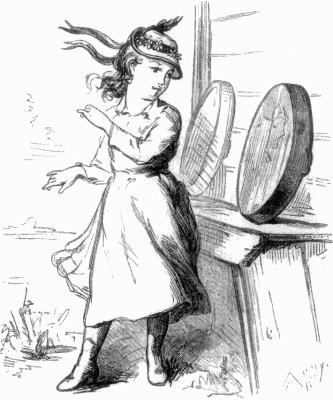
"I LOOKED IN ONE OF POLLY'S BRIGHT MILK-PANS."
So Polly pulled a pin from her belt and puttered at the knot till I 'most had a fit. For Ma wont ever have a string cut; she says it is a sinful waste. I thought it never would untie. Polly's fingers were all thumbs, and twice she dropped the pin. But it did—all knots do if you pick at them long enough—and in the box was a splendiferous bonnet, with green ribbon bows and three pink roses.
"Well, I declare!" said Ma. "What more can you want, Polly?"
Polly put the bandbox on the floor, and the bonnet on her head, and started for the sitting-room looking-glass.
"Sakes alive! Here's another!" Ma said, and held up by one of its bows the sweetest little hat you ever laid eyes on! It was light straw, trimmed with black velvet and blue silk, and had white daisies fastened to the velvet. Pinned to one of the streamers was a slip of paper, and on it was written, "For Kitty."
I just squealed! It was all I could do! To think of that beautiful little hat being for me, Kitty Hazel! Why, I never counted on having anything half so fine, unless I got to be the Grand Mogul, or something of that sort!
"The lady is very kind, I'm sure," said Ma, seeming as pleased as could be. "Try it on, child. You can squeal afterward." And she set it on my head.
I ran and looked in one of Polly's bright milk-pans that were sunning outside the door, and I hardly knew myself!
"Aint you smart!" said I, nodding to the girl in the pan. She smiled and nodded back, and looked so jolly that I came near turning a summer-set, new hat and all!
I wore it to meeting the next Sunday, with my new blue cambric; and I tell you what it is—it's enough sight easier to be good in an old hat than it is in a new one! I tried not to feel stuck-up, and I kept saying to myself: "Kitty Hazel, you're the same girl that sat here last Sunday, with an old Leghorn on. You aint any different!"
But it wasn't much use; for whenever I'd raise my eyes there was Phil Gillis smiling at me from the judge's pew, and opposite were Dave and Aggie Stebbins, staring as though they had never seen the like of me before, and every now and then old Deacon Pettengil, who sits in front of us, would turn and peer at me through his green spectacles so funny that once I nearly giggled.
This all happened last summer, but my hat is as pretty now as it ever was. Ma says she should have supposed the blue would have faded some by this time—blue is such a poor color to wear; but it hasn't a bit. When it does, I shall take it off, and have it for a sash for Rachel Tryphena, and the hat will be 'most as nice as it is now.
Kitty Hazel.
N.B.—I asked Polly how she thought of the umbrella. She said that when she was visiting her sister, that works for a dress-maker in Boston, she saw a picture of an old lady who was chased by a mad bull, and just as the bull was coming at her like sixty, the old lady turned and opened her umbrella square in his face. Polly said she always thought it was so cute of the old lady, and had meant to do the same when a mad bull chased her, if she had an umbrella with her. She said it all popped into her head when she saw the horses.