THE ARMS OF GREAT BRITAIN.
Reading edition
By Susan Archer Weiss.
My young readers have doubtless often observed upon familiar objects, such as books, china and steelware, etc., the device of a lion and a horse (sometimes represented as a unicorn) supporting between them a shield, surmounted by a crown. On the shield are certain divisions called "quarterings," in one of which you will observe two lions and a horse. Attached to the whole is the motto, Dieu et mon droit,—French words, whose meaning is, "God and my right."
If you inquire, you will be told that this device is the "coat-of-arms" of Great Britain,—as the eagle, shield and olive branch is that of the United States,—and that all articles thus marked are of British manufacture.
In old times the national symbol of England was the rose, of Scotland the thistle, of Ireland the shamrock, or clover. When England claimed Ireland and Scotland, these three were united on the British royal shield, as we find them in the time of Queen Elizabeth. On a victory over France, the symbol of France, a unicorn, was also added, the unicorn wearing a chain, to denote the subjection of France to England. This explains the nursery rhyme which you have no doubt often heard—
"The lion and the unicorn fighting for the crown; The lion whipped the unicorn all around the town."
The sovereignty of Great Britain is by law hereditary, but sometimes there are disputes and wars for possession of the crown, and it passes into a new family. Thus some of the kings and queens of Great Britain have belonged to the family of Plantagenet, others to that of Tudor, and still others to the Stuarts. George the First of England was of a family named Guelph, and all the sovereigns of Great Britain succeeding him, down to Queen Victoria, have been of this family and name.
When a new sovereign succeeds to the crown, he has a right to place his own family coat-of-arms on the royal shield of Great Britain. George the First did this. The two lions and the white horse, which you see on one of the quarterings, is the coat-of-arms of the Guelphs, who were dukes of Brunswick and Hanover in Germany. It is therefore called the arms of the House of Brunswick, and it is about this that I now design to tell you.
In order to begin at the beginning, we must go far back into past ages—almost to the time when our Savior was upon earth. At that period the whole northern portion of Europe was inhabited by wild and barbarous tribes who had never heard of Christ, but were Pagans and worshiped imaginary gods, of whom Woden was chief. Among these races were the Saxons, a fair-haired, fair-complexioned people, of great size and strength, who inhabited that portion of country now known as north Germany. They have never been permanently driven out of this country, which is to this day occupied by their descendants, the Germans. This latter name signifies a "war-like people."
Now, according to the pagan belief, the god Woden had a favorite white or light-gray horse, created by magic art, and upon which he bestowed the power of assisting and protecting warriors. This horse was regarded as sacred, and shared in the worship given to Woden. The pagan priests had no temples; the art of building was unknown to them; but, instead, their religious ceremonies were performed in thick groves of oak which were set apart for the purpose. In these gloomy woods the priests reared beautiful white horses, which no man was ever permitted to mount, and which, being from their birth solemnly dedicated to Woden, were believed to be gifted by him with the power of foretelling events by means of certain signs and motions. Before going into battle these sacred steeds were consulted, and occasionally one was sacrificed to Woden or to his white horse, and the bloody head was then mounted upon a pole, and borne aloft in the van of the Saxon army, they believing that it possessed the power of vanquishing the enemy and protecting themselves. We read in history that when the great emperor, Charlemagne, conquered the northern countries, one of the Saxon leaders, named Wittikind, refused to submit to him, and that, in consequence, many bloody battles were fought, wherein the Saxons bore in their van a tall pole surmounted by a wooden horse's head. This was their ensign; and when they afterward became more civilized, they retained the same emblem,—a white horse painted upon a black ground,—which remains to this day the standard or banner of the little kingdom of Saxony.
In the year 861,—just about one thousand years ago,—Bruno, the son of a Saxon king, founded a city in Saxony which he called after himself, Brunonis Vicus, now known as Brunswick. He retained as the standard of Brunswick the white horse of Saxony, and thus it remained until the end of the three succeeding centuries. About that time the reigning prince of Brunswick was a certain Henry Guelph, a leader in the Crusades, noted for his strength and daring, which acquired for him the title of "Henry the Lion." This prince refused to own allegiance to the great Emperor of Germany, Frederic Barbarossa. He declared himself independent, and as a token of defiance set up a great stone lion in Brunswick, and had the same symbol placed upon his standard, two lions supporting a shield beneath the white horse.
Thus you now know the origin of the Brunswick coat-of-arms. But how came the banner of a small German country to be adopted on the arms of Great Britain? This I will now explain.
About the year 1650, the then reigning Duke of Brunswick, afterward also Elector of Hanover, married the granddaughter of King James the First of England. Their eldest son was named George Louis. When, on the death of Queen Anne, the English were in want of a successor, they looked about among those nearest of kin to the royal family, and decided to choose this great-grandson of King James I. Thus it was that George Louis Guelph—a Saxon-German—came to be King George the First of England, and this was how the "lion-and-horse" arms of Brunswick and Hanover came to be also part of the arms of Great Britain. His successors were George the Second, George the Third (against whose rule the American colonies rebelled), George the Fourth, William, and lastly Victoria, the present queen, who is granddaughter to George the Third. Thus you understand how Queen Victoria is descended from the princes of Brunswick,—how she happens to be of German instead of English blood,—and why her name is Guelph.
Now, whenever you look upon "The lion and the unicorn fighting for the crown," you will reflect how strange it is that this great and enlightened Christian nation should bear on its proud standard a symbol of pagan superstition. You will think of the bold Crusader, Henry the Lion; of Wittikind, the brave Saxon duke who, after a twenty years' resistance, was finally conquered and baptized into Christianity; of the wild, half-clad Saxons, with their bloody horse-head ensign; of the Druid priests, who sacrificed human beings as well as white horses; and so, far back to the god Woden himself, who was probably merely some great hero or warrior who lived in a period so remote that we have no record of it in history.
And yet, while you are wondering at England and her relic of Woden-worship, shall I tell you that here, in America, we too possess relics of this very pagan god to which some people accord a superstitious regard? Look on the threshold, or above the door of some cottage or cabin, and you will see nailed there a common horse-shoe as a protection against evil. Examine your grown-up sister's watch-chain, and you will find attached to it a tiny gold horse-shoe, studded with diamond nail-heads, which some friend has given her as a "charm" to secure "good luck." These are simply remnants of the old pagan Woden-worship which we inherit from our English ancestors, who are partly descended from the Saxons, as you have probably learned from your school history. And the word Wednesday is a corruption of Woden's-Day, a name given by our Saxon ancestors to the fourth day of the week in honor of their god.
When I was recently in Germany, I noticed upon the gable-end of every cottage and farm-house in Brunswick and Hanover a curious ornament, consisting of two horses' heads, roughly carved in wood, mounted upon poles, and placed above the entrance-doors, in the form of a cross. This was first done by order of Wittikind, who, upon professing Christianity, changed the pagan symbols above the doors of dwellings to the sign of Christianity—the cross. The ignorant peasants do not know the origin of the custom, but will tell you that the crossed-heads are placed there "to keep out evil spirits, and to bring good luck to the house."
ENTRANCE GATE TO THE OLD CASTLE OF THE DUKES OF BRUNSWICK.
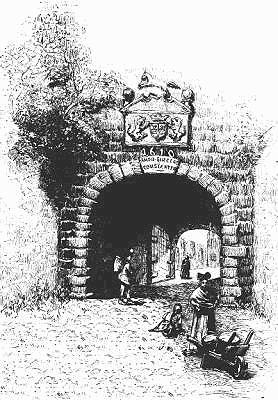
I saw in Brunswick the great stone lion which Henry Guelph placed there seven hundred years ago; and in Hanover, the old palace in which George the First was born, with the lion and the horse above the entrance. Once, too, in the Hartz mountains, I visited a grand-looking ancient castle of the old dukes of Brunswick, in which was born the wife of George the Second of England. It stood on the summit of a lofty precipice, up which we had to climb; then crossing a deep moat by a narrow bridge, we entered through a great arched gate-way, surmounted by the Brunswick coat-of-arms, cut in the stone wall. The moat was dry, and ivy and tall trees growing in it far below, thrust the tips of their branches over the walls. I stopped and took a sketch of the old gate-way, which I here present my young readers.