HOW TO MAKE AN ICE-BOAT.
Reading edition
By J. H. Hubbard.
The sport of sailing on the ice has within a few years attracted considerable attention on our northern rivers and lakes, and seems likely to increase. It is an amusement well adapted to big boys, being exciting, requiring skill, and certainly not more dangerous than skating. It is even more fascinating than yachting, without the danger which always attends the latter pursuit. A small ice-boat that a boy can build will sail ten to twenty miles an hour with a good wind. Some large ones, strange as it may seem, can sail, with a wind on the beam, actually faster than the wind which is blowing. This fact is attested by the highest scientific authorities.
Having seen some unsuccessful attempts at ice-boats by boys in various places, I propose to tell you how to build one, at a small expense, that will sail well, and give you a great deal of sport.
FIG. 1.
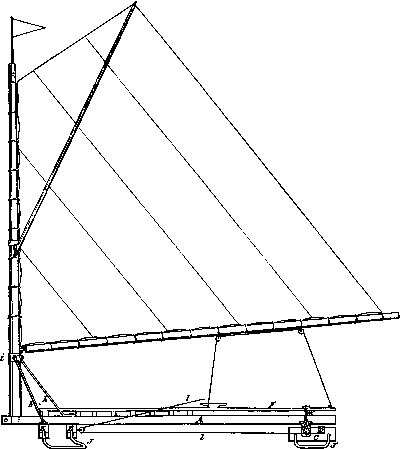
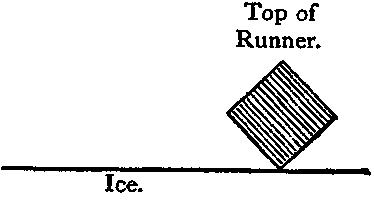
The directions and measurements here given are the result of careful experiments and some failures. Fig. 1 is an elevation, Fig. 2 a ground-plan of the frame, and Fig. 3 a section of a runner. Get a spruce plank, A, 12 feet long, 6 inches wide, 2 inches thick. This is the backbone of the structure. Cut near one end of it a hole two inches square to receive the foot of the mast.
Fig. 2.
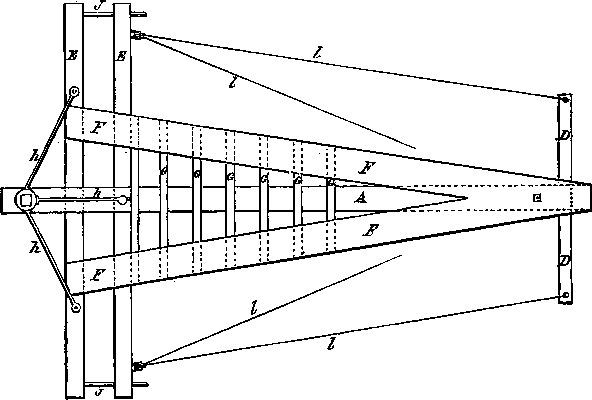
Take two oak cross-bars, E E, 8 feet long, 4 inches deep, 2 inches thick. The cross-bars are bolted to A, one foot apart, the forward one a foot from mast-hole. This distance is best.
Next get one oak plank, C, 16 inches long, 3-1/2 inches deep, 2 inches thick.
The hard-wood piece, D, is for tiller, 4 feet long, 2 inches wide, 1 inch thick. This is to be set into the top of plank C, and fastened there with screws. To each end of it is attached a rope, which runs over a sheave fastened to the cross-bar, C D, and the ropes, l l, constitute the steering apparatus. Two boards, F F, each 11 feet long, 8 inches wide, 7/8-inch thick, are planed, and the edges matched together, at the stern. They are nailed to the plank, A, and the cross-bars, E E, as shown in Fig. 2. Four blocks, each 3 inches thick, must be put under them where they lie over the cross-bars. A board a foot long, 7/8-inch thick, must also be put under F F at the stern.
Six slats, G G, as long as may be needed, 2 inches wide, 7/8-inch thick, are nailed over A, and under F F.
The mast is a natural spruce stick, 13 feet long, shaved down to 3-1/2 inches at butt, 2-1/2 inches at the top.
The boom is 13-1/2 feet long, 2 inches thick at each end, and a little thicker in the middle. It is fastened to the mast by an iron eye, screwed into the mast, and a hook in the end of the boom. The sprit is 10 feet long, 1-1/2 inches diameter, shaved to 3/4-inch for 2 inches at each end.
The iron collar, i, through which the mast is inserted loosely, stands two feet above the top of plank, A. It is supported by three iron braces, h h h, and is bolted to the tops of them. The braces are 3/4-inch round iron, and bolted to the frame as shown.
Fig. 3.
The hind-runner block, C, is fastened to A by a strong iron, m, as shown in Fig. 1. It allows the runner to rock up and down, and to be turned sidewise by the tiller. A must be plated with iron top and bottom where m goes through, that the runner may not "wobble."
The construction of the runners, J J J, must be attended to with the greatest care, as upon these, in a great measure, will depend the success of your boat. Get a square bar of cast steel, 6 feet long, cut off 22 inches for third runner, and divide the rest in halves, across. Shape two forward runners and one hind one as shown in Fig. 1. The bearing surface is a right-angled edge, as shown in Fig. 3. This sharp edge holds the ice firmly without much friction. Holes are bored two inches up into the cross-bars, near their ends, and the runners driven in and fastened with rivets. After the runners are forged, they should be finished with a file and emery paper if not perfectly smooth. The front turn must be long and gradual like a skate, two-thirds the length, however, flat on the ice. The running edges should not be too sharp. They will project 2-1/2 or three inches below the bottom of the wood.
For the sail get twenty yards, three-quarters of a yard wide, of heavy drilling. The dimensions are: Head, 5 feet; foot, 13 feet; foreleach, 10 feet; afterleach, 14-1/2 feet. Make these measurements on a floor, and mark the outlines with a chalk-line. Cut the after-breadth first, and the others to match. Lap the breadths 1 inch. Allow an inch all around for a hem. The breadths should be basted before stitching. Put two rows of stitching where the breadths lap. Look out for puckering. Put a narrow hem clear around the sail. Then stitch a 3/8-inch rope around the hem. Make a loop at the peak to put the end of sprit into. Draw the rope tight along the boom, and fasten it through a hole in the end. Fasten the throat of sail tight to the top of the mast. Cut a number of short pieces of heavy twine, and lace the sail, at intervals of a foot, to the boom and mast. Fasten a becket or loop of rope at a suitable position on the mast, to set the heel of the sprit into. Rig main-sheet over two sheaves, as shown; it brings less strain on the boom, and clears the skipper's head in tacking. Make a good, large wooden cleat to belay it to.
The cost of materials will be about as follows:
Boards, plank and mast $5.00 Iron work 6.00 Twenty yards Drilling 2.75 Four single-sheave galvanized pulley-blocks at 35 c 1.40 (May be omitted by using leather straps.) Ropes, etc. 85 ______ Total $16.00
A boat built as above will sail nearly as close to the wind as a good cat-boat. It is managed much the same. Don't turn too short in coming about. Jibe when you like without fear of capsizing. Your boat will carry three persons in a light wind,—more if it blows fresh. Rig it neatly, and try to make a finished thing all through. Your ice-boat will then be more than a boy's plaything, and will be admired by old and young.

There once was a man with a child Who, the neighbors said, never had smiled; But the father said, "See! Smile in this way, like me, And then folks will know when you've smiled."