DEBBY'S CHRISTMAS.
Reading edition
By Ella A. Drinkwater.
Most young people's Christmas commences the night before; so did Debby's. She had just settled down in Blanket street, and fallen into the sleep of tired, healthy girlhood, when she was aroused by her mother's irritable voice screaming up the stairway.
"Debby! Debby!" she called. "Get up quick and help me pick these turkeys. Your father's made up his mind to sell them dead weight, and we've got to pick them to-night, so he can take them to the hotel early in the morning. Do you hear me, Debby?"
"Yes, ma'am," answered Debby, scrambling out of her warm nest to the square of rag carpet before her bed.
Four minutes later she felt her way down-stairs and opened the kitchen door into a room filled with steam, and the peculiar smell of scalded fowls.
"There's seven to do," her mother said, bending over the brass kettle on the stove to draw from it a dripping turkey. "Yours are all scalded. Go to work."
Debby buttoned on a large apron, seated herself with a tin pan in her lap containing a turkey, and then began quickly to pluck off its feathers, laying them to dry on a religious newspaper spread on the table beside her.
Mrs. Blanchard soon sat down at the other side of the table, and began to pick and talk as fast as fingers and tongue would allow.
What did possess Mr. Blanchard to change his mind, and give them so much extra trouble, she could not conceive; and selling them to Tate, too, when he might have made a quarter of a cent more a pound if he had let Morris have them. And then those hoop-poles! He might have made she didn't know how much if he had taken her advice, and kept them a week longer.
As for the potatoes, they had turned out so small, and the corn was so short in the ear, that the land only knew where the money to get them all something to wear was to come from. Not that she cared for dress, for hadn't she worn the same bonnet and shawl to church until she was ashamed to show her face there? As for the sewing society, she was a master hand at cutting and planning, and she could go as well as not, too, now that Debby was quite old enough to take care of the baby, and get the supper ready for her father and the boys; but not a step was she going to sit next Mrs. Williams with her black silk, and Mrs. White with her handsome alpaca, although their husbands' farms were no larger than Mr. Blanchard's; and for the life of her she could not understand why she should not dress as well when she worked twice as hard as they did.
To all of which Debby listened with a sinking heart and great sobs in her throat, wondering why they should be such an unhappy family when every one around them appeared so glad.
Did it really make people so happy, this Christmas-day that they talked so much about in Sunday-school? That was a beautiful hymn that they sung last Sunday; she repeated one verse softly to herself while the stream of her mother's talk ran on:
"Jesus is our childhood's pattern, Day by day, like us, he grew; He was little, weak and helpless, Tears and smiles, like us, he knew; And he feeleth for our sadness, And he shareth in our gladness."
With a comforted feeling she pushed back her hair with her feathery hand, heartily wishing that all the people who ate their turkeys would be comfortable, and have clothes to wear and go to sewing societies whenever they liked.
The clock ticked loudly, the fire died away while Mrs. Blanchard enlarged upon the trials of her life, and, despite the refrain in her heart—
"And he feeleth for our sadness, And he shareth in our gladness"—
Debby's eyes were as heavy with tears as with sleepiness when the last plump turkey lay on the table plucked of his feathers, just as the clock was striking eleven.
"Go to bed, child, and I'll clear up the mess," her mother said, when Debby sprang up and straightened herself with a long sigh. "I'm sure your father ought to give you something for keeping out of your bed so late, when he is sleeping as innocent as the baby this minute, I'll warrant."
As Debby had a way of only thinking her replies, her answer was to wash her hands at the sink and run upstairs with joyful feet, thinking, "How splendid it will be if he gives me some money; then I can spend it at the Fair to-morrow night."
But even rose-colored visions could not keep the weary child awake; she was not conscious of touching the pillow, and thought of nothing until the clock striking six awoke her to remember, with a thrill, that it was Christmas-day,—the day of the Fair.
But there would be no presents or merry greetings in her home, for she could not remember ever hearing either father or mother wish any of the family "Merry Christmas!" and a little candy on that day was among the dimmest pictures of her childhood.
"I'll make the fire, so that mother can sleep a little longer," she decided, lighting her candle, and beginning to dress with shivering alacrity. "And I'll be as helpful as I can all day, and perhaps father will give me some of the turkey money."
With shaking fingers she kindled the wood fire, and had the kettle boiling and the griddle heated for the cakes, when her mother came out of the bedroom, asking her what had wakened her so early, and telling her to dress the baby while she finished getting the breakfast ready.
Debby willingly brought the screaming baby out to the fire, where she washed and dressed him, soothing him with many motherly little airs. Sam and Jim ran down-stairs to hover over the red-hot stove; the father came in, bringing the pail of milk, stamping his feet, his beard white with his frozen breath; then they all sat down to breakfast by candle-light, and no one would have supposed, from their conversation, that they had ever heard of Christmas-day.
Immediately after breakfast Mr. Blanchard hurried away to dispose of his turkeys, taking the boys with him; Mrs. Blanchard heated the brick oven preparatory to a morning's baking, and Debby flew about as busily as the bee she represented, washing dishes, making beds, peeling vegetables, and tending the baby, lightening her labor with the thought of the money her father might possibly give her.
When it was time for him to return, she determined to keep in sight, as a kind of hint that some of the money should be given to her; not that she would ask him for it,—her askings were only for favors to the boys, made in much fear and inward shrinking; but she would just wait around and remind him by her presence that she had helped pick the turkeys.
But, with no understanding of the feverish anxiety that filled the heart of the little maiden who was moving briskly about the pleasant kitchen dishing up the dinner, Mr. Blanchard threw open the door with a chuckle. "Took every one of them and paid the money down," he announced, coming to the fire. "Got more than I expected, too, for his scales made them weigh more than ours, so I gained just thirty cents."
Debby thought that her heart stopped beating while she stood bewildered in the middle of the floor with a dish of potatoes in her hand, waiting to hear her father say that the extra money should be hers; but he merely asked if dinner were ready, and why she moved so slowly; guessed that sitting up so late made her lazy.
All her castles built of ice-cream, candy, pin-cushions, and fancy needle-books, fell to the ground with a crash as she set the dish on the table, leaving her with no appetite for dinner, not even for the first pumpkin-pie of the season.
She sat at the table absently tasting the savory pork stew, believing that no one else was ever as miserable as she, and that she should never feel like laughing again, when suddenly she remembered that she had twenty-four cents change left from the dollar that her father gave her to buy school-books, and she would—yes—she would give it to him as she was starting for the Fair, and perhaps he would say that she might keep it.
So she was all ready to laugh when Jim asked if the little boys in the big cities wore muzzles like the dog he had seen in town this morning, and when her mother asked if she would take pie, her "yes" was emphatic; for a world of trouble had rolled off her heart, and she was her hopeful self again.
After the dinner-dishes were washed, and the baby trotted away to dream-land, Debby stole up to her room to look over the dress she was to wear in the evening; as the ruffles in neck and wrists were fresh, she found there was nothing for her to do but brush it and lay it out on the bed. Still she lingered with an undefined feeling that it was Christmas-day everywhere else, and if she could only——
All the week, while seeing and hearing about the presents the school-girls were making, she had been full of vague longings to do something for some one; but she had neither money nor material, and was not at all sure how a present from her would be received by her father and mother. "Perhaps I might make a pin-ball," she thought, beginning to search through the old chest of drawers that stood at the foot of her bed.
In the lowest drawer were odds and ends that she had been collecting for years, and from one corner, carefully wrapped up, she drew a square of black cloth in which was worked in wool a bunch of rose-buds, pink, white and yellow, surrounded by their green leaves. A lady who had boarded with them the last summer had begun it for a pair of slippers, but after making two or three mistakes on it, had given it to Debby.
"I wonder if I could make it into a cushion for mother?" soliloquized Debby, turning it around in her red fingers. "Mrs. Williams said old flannel was good to stuff them with, and I can bind it with——" she leaned forward and picked among her bunch of faded ribbons. "There is nothing nice enough," she sighed; "but this green will have to do."
DEBBY AND THE ICE-CREAM [SEE PAGE 227.]
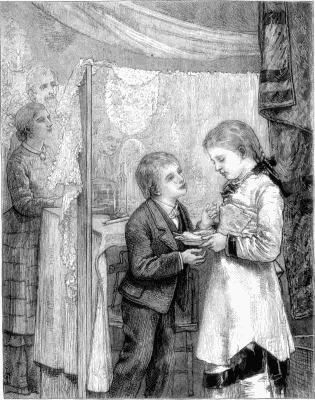
Wrapping herself in a quilt she sat down on the rounded top of a hair-covered trunk, close to the frosty window, and cutting the cloth in the shape of a diamond, she sewed it together like a bag, filled it with flannel, and hurriedly stitched on the faded green ribbon as a binding.
These rosebuds were a wonderful work of art to Debby, and one of her great treasures; it would have been a "perfectly lovely cushion," she thought, if the binding had only been new and the silk with which she stitched it green instead of blue; and it was so delightful to make presents. Next year she would have a present for every one in the house; she wondered why she had never thought of it before.
"And He feeleth for our sadness, And He shareth in our gladness,"
sprang from her heart to her lips, and she hummed it over and over all the three-quarters of an hour that she was at work. When the cushion was finished, she held it out in different positions, trying to decide in which it would look best when she should present it; and then she ran down-stairs, possessed with such a variety of feelings that she could scarcely speak when she opened the kitchen door.
Her mother was ironing, with her back toward her. Debby was glad that no one else was there.
"I've made you a Christmas present, mother," she said, timidly, laying it on the ironing-board.
"So that's what you have been doing in the cold so long," her mother answered, without pausing in her work. "Miss Holmes was a beautiful hand with her needle, and how she did fuss over that! But you might just as well have made it some other day; I was in no hurry for it. Put it in my bureau-drawer, and come and mend these blankets your father has just brought in. He thinks that we have so little to do that we can sew for the horses right in the midst of everything."
So Debby laid the cushion away, glad that it had met with no worse reception, and sat down in a corner near the stove to mend the coarse, dirty horse-blankets. She usually disliked it exceedingly; but her little attempt at making Christmas presents had so warmed her heart, and her head was so full of the Fair, that it did not now seem so uncongenial, and she was really surprised when the last stitch was taken.
"You are almost as handy with your needle as your mother," her father said, throwing the blankets over his shoulder to carry them to the barn.
"Now spring to, child, and set the table," her mother added, "and I'll rest a few minutes, for I feel as if every bone in my body was broken."
While Debby sewed, the bright sunlight on the green field of wheat and the brown, ridged field of corn-stubble visible through the one large window, had faded quickly away; and as she paused a moment to pick some shreds off her dress and glance out at the weather, all she could see was the dim outline of the woods, the dark forms of the hills rising behind them, and the cold, black wind-clouds piled high above them all.
Tea was ready and over at last, and then Mrs. Blanchard said, while she tried to quiet the screaming baby:
"Go and get ready for the Fair, child, and I will wash the dishes. I have a dreadful sideache, and I expect this young one will cry for an hour or two. But 'every dog must have his day,' and yours will be short enough."
With the cloud on her heart that always followed her mother's gloomy sayings, Debby went slowly up to her room to array herself in her last year's blue merino. But it was a pleasant figure to look upon that she tiptoed up to the glass to survey, and a round rosy face, with a little frown over the right eyebrow, that looked out at her with wistful eyes.
Drawing on hood and shawl, she went down-stairs and stood before her father with the money in her hand. He was seated at the table, bending over a large account-book, with Debby's frown deepened at the corner of his bushy eyebrow, and his fingers in his ears to shut out the baby's cries that reached him from the bedroom. As soon as she caught sight of what he was doing, Debby's hopes fell, for reckoning up the yearly expenses always made him cross for a week.
"Where are you off to now?" he asked, glancing up at her.
"To the Fair. The boys are there to come home with me. And here," her voice faltering, "is the change from the school-books."
"Don't stay late," he replied, turning away and dropping the precious money into his vest-pocket.
With a bursting heart, Debby stumbled out into the windy starlight and walked rapidly along the rough road, with her mittened fingers in her mouth to prevent her crying aloud.
How bitterly she wished she had never heard of the Fair! She was ashamed to go back into the house with no reason for returning, yet the thought of attending the Fair with no money to spend was torturing to her.
"There's Debby! Merry Christmas! Ride with us! Jump in, Debby!" called several voices, as a wagon full of boys and girls stopped beside her.
"I don't want to; I'd rather walk," answered Debby, swallowing her sobs.
"Walk, then!" replied Harry Williams, snapping his whip. "I guess you got a switch in your stocking this morning!"
Laughing thoughtlessly, the party rattled past her, leaving her crying harder than before. But a walk full of dread comes to an end some time, and Debby soon found herself at the entrance to the Fair.
Slipping in behind a group of men, she stood confused by the light and noise.
It was a grand and exciting scene to the little country maiden, this long, low room, trimmed with evergreens and flags, and illuminated by all the lamps in the neighborhood.
A table extended across each of three sides of the room. One, used for a supper-table, was filled with people eating and drinking noisily; on another was displayed the handiwork of the sewing society for the past year; and the third, which appeared the most attractive, was laden with cake, confectionery, and ice-cream.
Debby rubbed her swollen eyes, and was gazing about her in admiring astonishment, when her neighbor, Annie Williams, shouted "Merry Christmas" in her ear.
"Oh! Thank you," replied the startled Debby.
"Come and take off your things," suggested Annie. "You may put them with mine behind the apron and necktie end of the table. Mother tends that, you know."
Annie tucked the wraps carefully away, and then drew Debby through the crowd over to the stove, screened off in the corner behind the supper-table, where the good aunties of the village were heating their faces and spotting their Sunday dresses while cooking oysters and making coffee for the benefit of the church. But these ladies looked so annoyed by seeing the girls stand around the stove that Debby hurried away. Possibly they thought that the church would not be benefited by Debby's warming her fingers and toes.
Elbowing their way back, with arms clasped around each other's waist, they encountered and stepped on the toes of a big German boy, who convulsed them by pointing down at them with both forefingers, exclaiming: "See the two craz-z-z-y! See the two craz-z-z-y!" And Debby's laugh was as light-hearted as if she could buy everything in the room, and her mother had nineteen silk dresses.
"Now come and get some ice-cream," urged Annie, as they were pushed toward it. "I have had three saucers, and think it is lovely. I ought to be a judge, don't you think so?"
"Not now," said Debby, hastily. "I want to look at the needle-books your mother made."
"It's pokey over there! But I'll humor you, because it is Christmas," laughed Annie.
So they dodged under elbows, and slipped between young men and their sweethearts, until they reached the other end of the room, where Debby admired pen-holders with spiders and mice on them, cushions representing the old lady who lived in a shoe, and needle-books made like wheelbarrows, wondering if there had been anything at the Centennial more beautiful than these. But when a group of girls claimed Annie's attention, she eagerly seized the opportunity to slip away and sit on the bench behind Mrs. Williams's table.
"Tired so soon?" inquired Mrs. Williams, kindly. "But why didn't your mother come?"
"She didn't have—I don't mean—I mean she didn't speak of coming," stammered Debby, with burning cheeks.
"Never mind," replied Mrs. Williams, "you will have a good time, I know; and you must be sure to ride home with us."
Soothed by her sympathetic words, Debby almost forgot her troubles, and sat watching the moving picture with great amusement, until she espied her brothers helping Mr. Williams pass the saucers of cream.
"Oh, I hope they wont be tempted to take any," she thought, her heart full of a wordless prayer for them. But her anxiety was soon relieved by seeing Sam forcing his way toward her with a plate of cream.
"He gave it to me for helping," he whispered; "but you take it. Jim ate his right up."
"Eat it yourself, Sammy," she said, drawing back the hand she had stretched out for it. "I don't care so very much about it, because I am older, you know."
"Don't you, now, 'truly, truly, black and bluely, lay me down and cut me in twoly?'" he asked, with the air of a magistrate about to "swear" a witness.
"I would very much rather you should eat it," evaded Debby.
"Then I will," he answered, brightly, "for I do want it awfully."
"Eat it, then; but don't be tempted to take any," she cautioned.
"Catch me taking—I'm not a thief!" and he hastened away.
Debby was thirteen years old, but she could have cried for that ice-cream.
"Oh, here you are at last!" cried Annie, running up to her a few minutes afterward. "I couldn't imagine where you had got to. Now, just read my letter," placing a tiny sheet of pink paper in her hand. "That box all trimmed up at the end of the candy-table is the post-office," she explained, "and we give them five cents and ask for a letter. Just read mine."
Debby read, written in a large, clear hand:
"And shouldst thou ask my judgment of that which hath most profit in the world, For answer take thou this: The prudent penning of a letter."
"It's lovely!" was Debby's comment. "If I should have one, I wonder what it would be!"
"I'll run and get you one," volunteered Annie.
"No, no!" cried Debby, in terror. "I have no money to pay for it."
"Have you spent it all so soon?" asked Annie, curiously. "But we must go now and get our ice-cream; for, do you know, Mr. James has promised to treat all our class. So come along, for the more we eat the richer the church will grow."
"No," refused Debby, shaking off Annie's hand, "I wont do any such thing," and she shrank back into her corner.
"How queerly you act! You wont do anything I ask you," pouted Annie, turning away.
"I couldn't take it," Debby excused to herself. "I want it so much that I'd feel like a beggar in taking it from him. Annie can't understand, because she has bought it for herself, and will only eat it now for fun. I wish there was something for me to do."
Her thought was scarcely finished before it was answered by Mrs. White, in the handsome alpaca Debby's mother so admired.
"What am I to do with this child?" she asked, stopping before Mrs. Williams with a sleeping baby in her arms. "Phil wants me to go to supper with him, but what can I do?"
"I'll hold her," said Debby, eagerly. "I have a nice quiet place here."
"Much obliged, I'm sure," answered Mrs. White, placing the baby carefully in her arms.
With something to take care of, Debby grew so comfortable that when Mrs. White returned from supper she begged to keep the baby longer.
"Every one is so busy here that I'd like to have something to do, too," she said, arranging a paper so as to shade the baby's eyes from the light, remembering with a throb of gratitude the oranges Mrs. White sent her when she was sick last fall.
"If you don't really care to run about, it would be a great favor to me," returned Mrs. White, "for there are so many people here that I shall not see again for a year, and I want to speak to them all. But a baby is not the most convenient article to carry in a crowd."
The handsome alpaca disappeared, and Debby kept her guard for an hour, watching the young people who visited the post-office or joked over the neckties and aprons.
"Here's an industrious young lady who has had no supper," declared a bald-headed old gentleman, stopping before her with a large bell in his hand.
"I've had my supper," quickly answered Debby.
"I don't remember counting you at the table," he replied, wiping the perspiration from his forehead as he passed on, loudly ringing the bell.
"I didn't tell a story," sighed Debby, "for I've had my supper; but I'd like people to think I'd had it here. It looks so nice to sit at the table," she added, catching a glimpse of Annie's blue ribbons as she sat at the table next her brother.
"How thoughtless I have been!" cried Mrs. White, returning in a fluster. "I forgot all about you; you must be tired to death."
"Only a little tired," said Debby, "and I am so glad to do anything for you."
"Well, you must come and see me," invited Mrs. White, with her mouth full of pins, as she rolled the baby into a large shawl, "and perhaps I can find something for you to read."
But when Debby stood up she felt more stiff and tired than she had acknowledged, and, fearing that she had stayed too late, she hurried on her wraps, and with much persuasion induced her brothers to go home with her.
"It wouldn't do us any good to stay and see the auction," she reasoned, closing the door upon the noisy scene with a heart lighter than when she had entered it. "Now let us see how fast we can trot home in the moonlight."
Giving a hand to each of the boys, they walked swiftly toward the little red farm-house, where, although their parents had retired, a lamp and a bright fire awaited them.
The kitchen seemed very quiet after the hubbub they had left, with the clock on the stroke of nine and the cat asleep in the wood-box.
There were three pieces of pumpkin-pie on the table, left as a lunch for them, and these they ate, talking in whispers; and then Debby unfastened the boys' neckties, and followed them upstairs, too tired and sleepy to be very glad or very sorry about anything.
But as she snuggled down under the blankets, with the "merry din" still ringing in her ears, she thought:
"I have not made much Christmas for any one to-day, but, when I'm grown-up, wont I make Merry Christmas for little girls!"