THE KING AND THE THREE TRAVELERS.
Reading edition
By Arlo Bates.
Three travelers, who had been found asleep in the royal park, were once brought before King Jollimon. In answer to inquiries, they said that they were story-tellers, who earned their living by relating those tales and legends of which the inhabitants of Jolliland are so extravagantly fond.
"If that be so," said the king, "and if you can tell stories worth hearing, you are indeed welcome. The court story-teller has just been banished for presuming to tell the same story twice, and his place is unfilled. It would be a right royal idea to have three story-tellers instead of one."
So the three travelers, after having been refreshed with food and drink, were bidden to seat themselves at the august feet of King Jollimon, that they might prove their power to please the royal fancy by strange and unheard tales.
They were all old and withered; and the first had a crooked back, the second a crooked nose, and the third a crooked mouth. He of the crooked back began, and told the tale of
The Raven Maiden.
There once lived a young and accomplished prince called Orca. His father was king over all the country and the neighboring provinces, and Orca was his only heir.
The prince was a daring hunter, and went often to the royal forests, sometimes in company with the lords of the court, but oftener alone. For it so happened that the gamekeeper had a young daughter, Sipelie, who was as fair as the morning, and as modest as she was fair; and the prince, having seen her, of course fell over head and ears in love with her, forgetting all differences of wealth and station. As for Sipelie, having no mother to tell her better, although she took good care to wait a modest while before showing it, she gave away her whole heart to him. Nor was this so much to be wondered at, for Orca was every inch a prince, and a fine, manly fellow beside. And so I warrant there was billing and cooing enough at the gamekeeper's lodge, for when the prince came the gamekeeper kept discreetly in the background, and Sipelie had no brothers or sisters to be in the way.
THE CROOKED-BACKED TRAVELER TELLS A STORY TO THE KING.
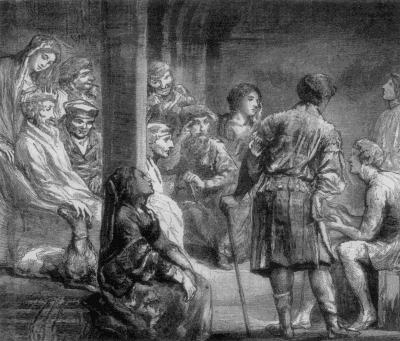
But the course of true love is never without its rapids, and it was not long before Orca's visits to Sipelie began to be talked about among the nobles. So at last the news came to the ears of the Lady Ildea, the prime minister's daughter, who hoped to win Prince Orca herself. The Lady Ildea's temper was certainly none of the best, nor was her beauty at all to be compared with that of the gamekeeper's daughter. She had long laid siege to the heart of the prince, and she was now convinced that it was only on account of the peasant maiden that she made so little progress.
The Lady Ildea was not unskilled in magic, and by consultation with divers not very respectable spirits, she found means to transform the beautiful Sipelie into a raven. Thus it happened that when the prince went as usual to visit his beloved, he found the cottage empty, and no living thing in sight but a raven, which croaked dolorously from a neighboring tree. When the gamekeeper appeared, in answer to Prince Orca's eager questions, he could only say that his daughter was missing. Together, the two men searched the whole night for the lost maiden; but neither then, nor in any after search, could a trace of Sipelie be discovered.
It is needless to speak of the gamekeeper's grief, or the prince's despair. Both refused to be comforted, and the unhappy prince became so pale and thin that it was pitiful to see.
In all his grief and anguish, the Lady Ildea showed a deep sympathy, encouraging him to tell her all his woes, and if she could not comfort him, she at least wept for him, and that was something.
And so it went on until the prince was taken violently ill. The wise men gathered about his bed, and at last concluded, after many long and tedious days of consultation, that his sickness was caused by an evil influence, which they ascribed to a raven that had been noticed fluttering continually about the palace windows. They farther announced that the prince could only be cured by the juice of certain wild herbs, which were exceedingly rare, and which only grew in wild and dangerous places in the mountains. Messengers were dispatched throughout the whole country in search of the precious herbs, but the third day a bundle of the plants was found on the ledge of the prince's window. No one knew whence they came, nor did any one notice that the raven sat on a distant tree, and watched until the herbs were taken in, but then flew silently away, to return no more.
The prince now rapidly recovered, and was soon able to go again into the open air. The lady Ildea had been most attentive throughout his illness, and on the first day on which he went to the hunt, she rode by his side. She was outwardly calm enough, but inwardly she was not at all at ease. Only one day remained of the duration of the magic spell which ensnared Sipelie, and Prince Orca had not yet forgotten the peasant maiden, or bound himself to Ildea. As they followed the hounds through the pleasant forest, the sharp eyes of the lady espied a raven fluttering along from branch to branch, always keeping near the prince.
She pointed it out to her companion, saying, "Do you see the bird of ill omen? It is the same which brought you illness. Now is your time to destroy it."
Prince Orca raised his bow, but lowered it again, for something within stayed his hand, and he said: "Let the poor blackamoor live. I have been too near death myself to feel like harming it."
"If you do not care for yourself," said Lady Ildea, "others do. It might bring you harm again." And with unerring aim she sent an arrow flying through the air. The raven fell, uttering a last mournful cry. But Lady Ildea was not satisfied. Hastily dismounting, she ran through the grass to where the bird lay, and found the body of the maiden Sipelie, pierced to the heart, and covered with blood. Horror-struck, she turned away, but at that instant she trod upon an adder, which suddenly darted its fangs into her foot, inflicting a mortal wound.
"And served her right," quoth King Jollimon, as the crooked-backed man ended. "The prince is left to bury the dead, I suppose. Well, I've heard worse tales, I'm sorry to say; but I generally hear better ones. What have you to tell?" he added, nodding to the man with the crooked nose.
"Mine is a fable, and very instructive," said he; "And the moral——"
"Moral me no morals," interrupted King Jollimon. "Tell your fable, if you please; but I'll draw my own moral as mild as I please."
Thus admonished, he of the crooked nose told the tale of
The Wise Cat.
A certain cat set out to seek his fortune, and traveled through the whole world. At last he came to a country where a cat had never been seen before. The inhabitants were at first frightened by the strange monster, but having observed Puss killing the mice with which the country was overrun, they plucked up courage, and approaching him, requested that he should follow them before the king. Puss complied willingly enough, and the end of the matter was that he was installed rat-catcher to the king, and a large salary bestowed upon him. The faithfulness with which Puss discharged his duties raised him high in the royal regard, and a circumstance soon occurred which advanced him still further. The king took his naps by an open window, and had a plate of cherries placed beside him that he might eat them when he awoke. A crow from the neighboring forest constantly stole the fruit, nor had all the efforts of the king's servants succeeded in destroying the bird. The cat, however, concealed himself in the window-hangings, and pounced upon the unlucky marauder, and broke his neck. The king was full of gratitude, and ordered that Puss's salary be increased. Soon after, a bear came and ravaged the king's flocks. His majesty commanded Puss to kill him. "I can only do what I am able," pleaded the cat; but the king insisted. While Puss was coming, Bruin attacked the store of a swarm of bees, and was stung to death. "You have done as I knew you would, my dear cat," said the king, and would listen to no explanations. The cat received the Order of the Royal Shoe-string.
Next an elephant came and ravaged the crops. The king sent the cat to attack him. "Alas! I can only do what I am able," again pleaded the cat, but there was no moving the king. While the cat was coming, the elephant fell into a pit and was killed.
"You have done as I knew you would," said the king once more; and the cat received the Order of the Royal Penknife, and the care of the Royal Shoe-brush.
A great army marched to subdue the kingdom. The king gave himself no uneasiness. "Have we not the cat here?" he asked. "My dear, go and put these troublesome fellows to flight."
"Alas! your majesty," said the unfortunate cat, "I can but do as I am able, and luck will turn at last;" but the king was stubborn as ever. And while the cat was coming, a band of the enemy fell upon him and destroyed him; and they overthrew all the kingdom. The king was taken prisoner and compelled to feed cats all his life. "That ungrateful cat!" he continually exclaimed.
"And do you call that a fable?" asked King Jollimon. "I should have let you tell the moral, that there might have been some good to it. Come, you fellow," he said to the crooked-mouthed man, "speak quickly. I long to hear another tale, that I may forget this."
And this tale was that of
Hans and Peter.
Hans and Peter met one fine morning on the way to market. Hans was large and stout; the world always went easily with him; he troubled himself as little as possible about the cares of life, and seemed to grow plumper every day.
Peter, on the other hand, was thin and slim. He was continually worrying himself about some trifle, and his face grew more and more care-worn every day.
"Good morrow, friend Peter," said plump Hans, in a hearty tone of cheer.
"Good-day, neighbor!" answered Peter, solemnly.
"Why are you so downcast?" asked Hans.
"Downcast! Have you no troubles," retorted Peter, "that you cannot understand why people look downcast?"
"I?" said jovial Hans. "I've only one trouble in the world, and that does not trouble me. My wife complains because I have become so stout."
"Happy man!" exclaimed Peter. "My friends complain because I am so thin."
"My friends say it makes me move too slowly," said Hans.
"My wife upbraids me," returned Peter, "because I move so very quickly."
"Suppose we change bodies!" said they both in a breath. And they changed.
Again, in a few months, Hans and Peter met one fine morning; and Hans was again large and stout, while Peter had become thin and slim.
"What have you done to my body?" asked Hans.
"What have you done to my body?" asked Peter.
"I was puzzled at first," said Hans, "to know whether I was Hans or Peter; but it soon came right."
"At first," returned Peter, "I knew not whether I was Peter or Hans, but as you say, it soon came right."
"Then the difference," remarked Hans, "is not my body."
"Nor my body," put in Peter.
"But," said they both, "ourselves!"
"Worse and worse," said King Jollimon, at the conclusion of the remarkable legend. "If there were four of you, I shudder to think what a bad story the fourth one would tell!"
"It is because we did not know your majesty's taste," said the man with the crooked back. "If you would hear us once more, we should please you better."
"I have heard enough," said the king; but upon second thought he consented that they should try again.
And first the crooked-backed man told the tale of
The Egg-Shell.
A boy once met a magician, who gave him an egg-shell, telling him to place it in his mouth, but on no account to break it. The boy was as foolish as boys usually are, so he instantly obeyed him, without at all stopping to think what the consequences might be. Immediately his head swelled up like an enormous balloon, so that the wind nearly blew him away. He managed to catch hold of a post and save himself from this fate, and a crowd began to gather around his head. His body was quite out of sight underneath, and only the huge head was to be seen.
As everybody stood staring at the wonderful sight, a fly lit on the boy's cheek. He could not reach it himself, for his arms would not reach a tenth part of the way to his chin; so he asked one of the bystanders to kill the troublesome insect. The boy's voice was so smothered by the egg-shell that it was long before he could make himself understood; but at last the man got an idea of what was wanted, and aimed a severe blow at the fly. The insect flew away unharmed, but the boy started so suddenly that he bit the egg-shell in two, and his head collapsed to its natural size. So there was a little boy in the middle of the place, holding on by a post, and a crowd of people looking at him from a distance.
"What a disappointment!" said the boy's mother. "He was fast becoming remarkable! But then, what a sum his hats would have cost! After all, it is best as it is."
"And besides," added a neighbor, "how could you have got at him to punish him?"
"To be sure!" answered the mother.
"This is better than the first, because it is shorter," said the king; and the man with a crooked nose began the story of
The Crooked-Nosed Philosopher.
"There was once a man," he said, "with a nose so long that it reached half way round his head, and thus the point was continually behind him. This not unnaturally caused him a great deal of trouble, but in the end was the means of his good fortune, as you shall hear. For once, as he sat reading, he felt something on the end of his nose, and turning round his head he saw a fly sitting on the point of it."
"Saw a fly on the point!" interrupted King Jollimon. "What do you take me for, that you thus try to impose such stories on me? Can a man see what is behind him?"
"Certainly, if he turns round," answered the traveler, quite unmoved.
"If he turns round!" repeated the king, in a rage, "can one see the back of his head? I have turned round, but I never could see my back."
"That is because your majesty always looks away from it," replied the other. "If you would turn round and look toward the back of your head, you would undoubtedly see it."
"Do you presume to dispute with me?" screamed his majesty, getting very red in the face. He felt sure he was right, but he could not answer the traveler's argument. "Do you presume to dispute with me?" he repeated. "Get out of my sight, and if one of you three vagabonds, with your trumpery stories, is found in all the kingdom of Jolliland by sunset to-morrow, I'll have every man of you beheaded three times over. A man see his back, indeed!"
And thus it happened that the tale of "The Crooked-Nosed Philosopher" was never concluded, which was the greater pity, since, if the end was like the beginning, it must have been a very marvelous tale.