SYMBOLISM[52]
Reading edition
SYMBOLISM[52]
Symbolism of one kind or another, plays a very important part in the existence of the Pueblo Indian. It is generally agreed that even the minor acts of everyday life have a certain religious symbolic meaning. For example, the gourd spoons, or kajepes, used in moulding pottery, must apparently be consecrated before they may be used. Similarly, a new technique in pottery making must pass through a period of consecration before it becomes completely established. On the other hand, white men often overemphasize the importance of symbolism in studying any civilization whose customs and philosophy differ radically from their own.
In the light of what is known of the mental attitude of the Pueblo Indian, it would not be unreasonable to assume that the designs on their pottery have some symbolical meaning. Whether this symbolism is in any sense religious, or is merely the symbolism of conventionalization of design, is an open question.[53] It is probable that vessels made before the time when pottery became to some extent an article of commerce between the Indian and the tourist, bore designs of symbolical meaning. It may be that the vessels made today for their own use also have such meanings, but there is every reason to believe that much of the ware now turned out by the San Ildefonso potters for sale to tourists bears designs of no special meaning.
It is true that through bitter experience, the Indians have learned to guard carefully their religious and secular philosophy, and it would require many years of study, living with them, to gain an intimate knowledge of their beliefs. If, however, there are definite meanings associated with the designs upon commercial pottery, the inhabitants of San Ildefonso have become past masters of the art of concealment.
An attempt to obtain some idea of the general reason why vessels are decorated and of what was taking place in the mind of the painter while at work, proved wholly fruitless. Inquiries as to the meaning of whole designs, figures, and elements met with three kinds of response. One family, who have enjoyed considerable contact with investigators of Indian customs, were ready and eager with explanations of the meanings of various elements. They could not, however, explain the meaning of the entire design upon any vessel. Other potters met the inquiry with a frank statement of ignorance, such as “I don’t know”, or “Ask the men, the women don’t know”. A third group exhibited great uncertainty. These people would usually translate the questions into Tewa for the benefit of the rest of the Indians present. Then, after much laughter and discussion, the potter would sometimes offer a meaning, at other times say nothing. One old man explained with great gusto that the design which he had just finished upon a small globular olla represented four small clouds sailing across the sky, one behind the other, from west to east. His manner was very similar to that which one of us might adopt in telling an improbable yarn to a particularly guileless listener.
Some potters gave meanings for whole figures. Another potter, however, composed her figures as the work advanced, evidently with no clear idea, when she began it, of the ultimate form of the figures and therefore probably with no idea in regard to their meaning. It has been suggested that minor variation in similar figures on the same vessel have some meaning. The more probable explanation would seem to be that these variations are due to the lack of a visible pattern. At one time a potter was distinctly annoyed because she noticed, after completing a figure, that she had filled the wrong part of a small detail.
It is equally fallacious to lay too great importance upon alternating figures in a panel design. For example, one potter in filling the areas in a four-panel decoration filled the same areas in the first and third panels, and different areas in the second. When she began to fill the areas of the fourth panel in the same way as the first and third, her attention was called to the areas in the second, the order of which she obviously considered a mistake. The result was that the fourth panel was filled as the second had been, thus giving the vessel a panel-design with alternating figures.
The fact that in excavations no two vessels have ever been found with identical designs has been attributed to something in the Indian’s way of thinking. Yet one potter at San Ildefonso placed upon one constricted-mouthed bowl out of a group of vessels a design identical with that on a bowl of the same shape in the previous group made.
Among older pots the “line-break”, a small space left in the horizontal enclosing-line at the lip of the vessel, is a constant element. At San Ildefonso its use has become almost obsolete but one of the informants did employ it. Careful questioning on the subject with another potter as interpreter, brought out the fact that the line-break is called a “door”, through which a spirit may enter or depart. Persistent questioning in regard to the nature of the spirit caused an animated discussion among those present. The potter was clearly puzzled by the questions. Then, after a single sentence by her, the Indians all laughed heartily. Finally, the interpreter stated that the potter had said, in effect, that if the door was going to cause all that trouble she would close it. The matter was finally settled by the interpreter, who pointed out a passage in the advertising pamphlet of a Santa Fe curio-dealer which explained that the line-break was a passage through which the spirits of the dead might pass.
The ready answers given by some potters in response to inquiries as to the meaning of elements of a design, seem to show that the elements are actually conventionalized symbols of definite objects. In one instance the potter, on noticing a dance-costume lying on the bed, pointed out certain parts of it, and then drew the elements representing those parts. Other potters simply deny all knowledge of the meaning of elements. Still others by their hesitancy, seem to grope for a plausible meaning and offer the first which occurs to them. Whether the elements do represent definite objects or not, it nevertheless remains a fact that the meanings given cause apparent contradictions. To elements essentially the same widely different meanings are often given and, conversely, the same idea or object
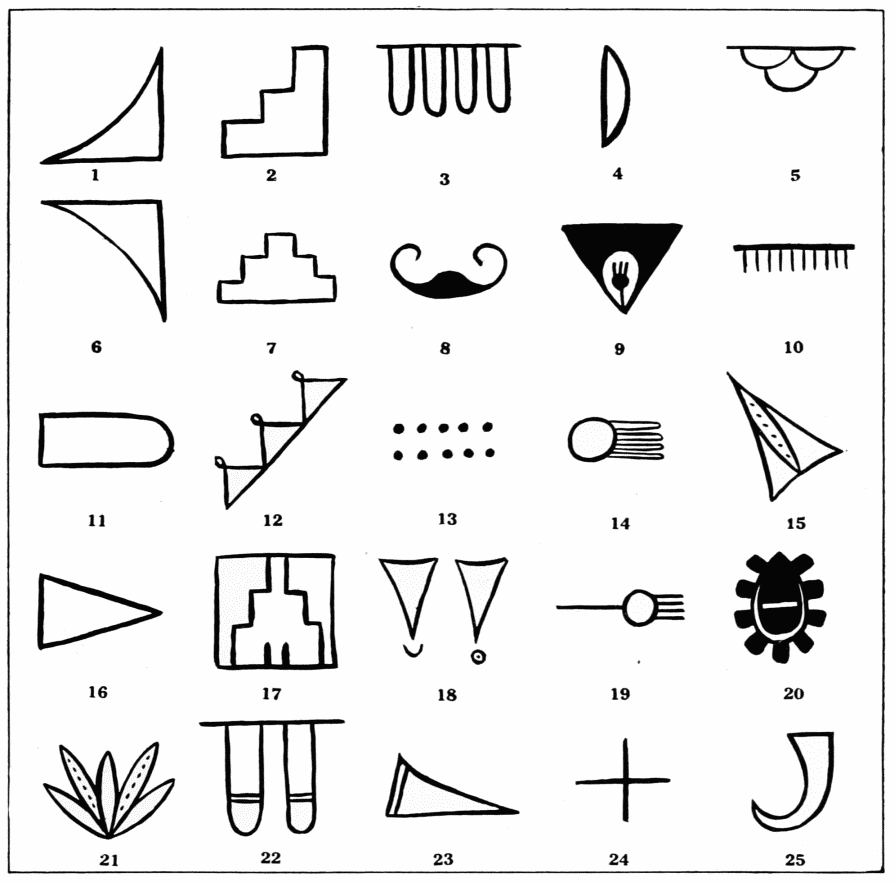
Fig. 11. Elements of design commonly used by the potters of San Ildefonso.
is often represented by entirely different elements. This is also true of more complex figures.
The elements illustrated in figure 11, give examples of the type of idea or object said to be represented, and incidentally illustrate some of the contradictions spoken of above. Numbers 1 and 6 both refer to hills. On the other hand, No. 7 is a mountain, although it bears little resemblance to the “hills”. It resembles more closely No. 2 which one informant described as a pueblo and another as a kiva. The same regular zigzag appears in No. 12, which represents a tablita, or dance mask, with small feathers tied to the points of the zigzags. No. 17, in which the zigzag also appears, represents kiva-steps. Nos. 11 and 16 represent feathers, and No. 21 is a bunch of feathers on the end of a dance-pole. But No. 22 represents the poles of the kiva-ladder, and No. 3 is rain, which is falling a long way off. No. 10 represents fringed woolen armlets, and yet there is as close a resemblance between Nos. 3 and 10, as there is between Nos. 14 and 19, both of which represent the tassels on a man’s dance-belt. No. 8 is called rain-water, but a single spiral, as in No. 25, is a buffalo horn. The dots of No. 13 represent rain-drops in dust, but in No. 21 the dots are markings on feathers, and in No. 15 they represent a procession of bugs on the rib of a leaf. No. 18 represents water dripping through a hole in the roof and making a small cup-like depression in the floor, represented by a semicircle, or a whole circle with a dot in the centre of it; but No. 23, which is also a triangle, is called a leaf, as is also the case with No. 15. And yet No. 4 is also a leaf, although if placed horizontally it more closely resembles the clouds represented in No. 5. But No. 9 is also a cloud, this time a big black cloud with an open space in it through which a small cloud may be seen. Nos. 20 and 24 represent respectively the sun and a star.
In the light of the small amount of material obtained on the subject of symbolism, all that can be said is that the evidence is purely negative. If the elements do represent definite ideas and objects, which seems to the writer improbable, the meanings are so deeply hidden that only an intensive specialized study will result in an acceptable solution.
Meaning of Elements
(M.—Maria. A.—Antonita)
1—“hillside”, M.
2—“pueblo”, M.; “kiva”, A.
3—“rain falling far away”, A.
4—“leaf”, M.
5—“clouds”, M.; A.
6—“hill”, M.
7—“mountain”, M.
8—“rainwater”, A.
9—“black cloud with open space through which one can see a small cloud”, A.
10—“fringed woolen dance armlets”, M.
11—“feather”, M.
12—“tableta (wooden headdress) with feathers on points”, M.
13—“rain-drops on dust”, A.
14—“tassel on man’s dance-belt”, M.
15—“leaf with bugs on it”, M.
16—“feather”, M.
17—“kiva-steps, the two small points fireplaces”, A.
18—“water dripping through holes in roof and making holes in dirt floor”, M.
19—“tassel on man’s dance-belt”, M.
20—“sun”, A.
21—“feathers on dance-pole, spots are markings on feathers”, M.
22—“ladder-poles”, A.
23—“leaf”, M.
24—“star”, A.
25—“buffalo horn”, A.