PAINTING
Reading edition
Three varieties of paint are employed in making the designs—the black, or guaco, which is used on red and polychrome wares, the orange-red (also used as a slip), which serves as a paint in filling certain spaces in the designs upon polychrome ware, and the black ware paint which produces the designs upon polished black ware.[45]
The consistency of the guaco, when dissolved in water and ready for use, varies from that of water to that of thick cream. The solution is sticky and has a characteristic odor. A thin solution when applied to the surface of a vessel is yellowish-green, and has much the same appearance as a fresh coat of the orange-red paint. After drying the two are easily distinguishable. A thick solution of guaco is dark brownish-green when applied to the vessel, and on drying has a noticeable “body”, so that the lines appear slightly raised and glossy. It is not possible to draw as fine a line with the thick solution as with the thin one.
The orange-red is never used in painting lines, but only for filling areas, and is therefore always applied with a medium or heavy brush.
In preparing the black ware paint, a slight amount of guaco is added as an adhesive, and the solution is often stirred with the fingers in order to insure complete dissolving of the coloring matter. When first applied to the vessel, this paint is almost transparent; as it dries it becomes yellowish.
The principal precaution taken when painting is begun is to guard against flies. They eat the moist guaco, causing blank spaces in the lines, and also make fly-specks on the slip which turn black in the firing. The room is therefore cleared of flies as far as possible, and great care then exercised to keep the door shut. The painter watches the pot constantly, and often interrupts her work in order to brush a fly from the design. If it is necessary to do the painting out of doors, the services of an assistant are required to wave a cloth back and forth across the top of the vessel to keep the flies away.[46] When the work has been completed the vessels are immediately covered with a cloth.
The receptacle for paint may be either a small open-mouthed pottery bowl or a china sauce-dish. During the painting it is on the right side of the potter within easy reach, either on the floor or on a low stool. In it is always a stirring-stick.
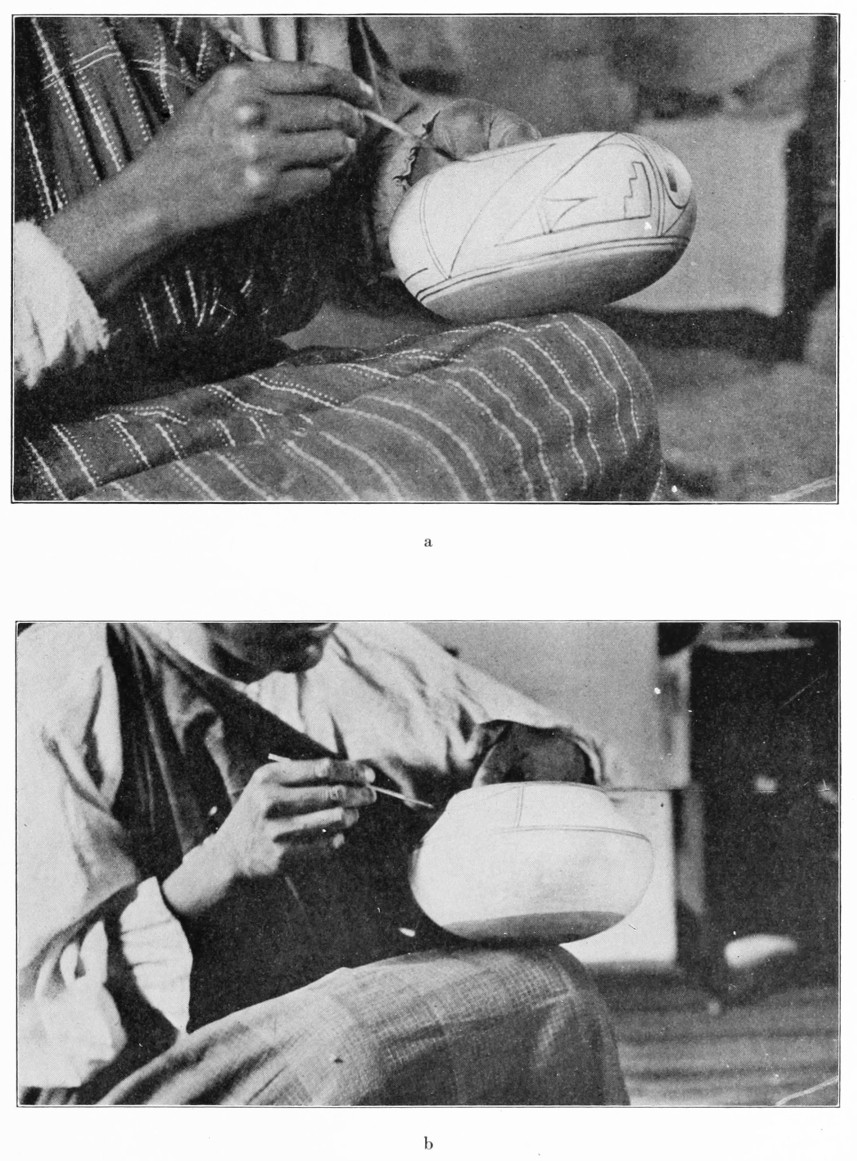
PLATE 22
Painting designs on small vessels. The decorator’s right hand does not come in contact with the pot, and the tip of the brush is trailed rather than stroked across the surface. a. Maria Martinez. b. Maximiliana Martinez.
The brushes are usually kept in the paint, or occasionally beside it, and sometimes a pencil is also near at hand (pl. 23, a).
In decorating the exterior of a constricted-mouthed bowl, the vessel is held upright and inclined very slightly towards the body; it rests on the left knee and is steadied by the pressure of the left hand against the interior of the rim (pl. 22, a). The potter sits in a position which allows the light to come over her right shoulder directly upon the section of the bowl being painted. As the work proceeds the vessel is turned counterclockwise. When the design extends slightly below the shoulder, the bowl is inclined to the left and away from the body. If a considerable portion of the design is below the shoulder, the vessel is inverted and is supported by the fingers of the left hand against the interior base of the bowl.
If the interior of an open-mouthed bowl is being painted, the enclosing lines near the rim are made first. During this process the bowl is held with the mouth vertical and to the right, while the lines are drawn on the lower part of the interior rim. The vessel moves counterclockwise. The bottom of the interior is painted with the bowl standing in its normal position on the left knee, the mouth inclined to the right and toward the body.
When a large vessel, such as an olla, is to be painted, it is placed upon a box or table of the proper height, which has previously been covered with a rug or mat to protect the base (pl. 23). The painter chooses her position so that the light will fall over her shoulder upon the vessel. During the painting of the upper part of the vessel it is touched with the left hand only when it needs to be turned. In working below the shoulder the vessel is tilted slightly to the left, and away from the painter.
The paint-brushes are made of slivers of yucca (fig. 5). They may be roughly grouped into three weights—fine, medium, and heavy.[47] The fine ones are used in making outlines on the smaller vessels; the medium ones either for line work or for the filling of small areas; and the heavy ones for filling only. During the painting there are from three to six brushes in the paint vessel. These brushes are of such durability that the potters have no definite idea of the length of their usefulness. Since the fibres are brittle when dry, brushes are occasionally broken by accident; to prevent such breakage they are soaked in water for a few minutes to soften them before they are used.
The brush is held in the right hand, with the fingers in the position used in holding a pencil or pen. The ends of the fingers are two or three inches from the tip of the brush (pl. 22, a, b.; pl. 23, a). The fingers of the right hand do not rest upon the surface of the vessel and the entire right arm is unsupported (pl. 23), although at times the elbow may be unconsciously steadied against the body. The straightness and evenness of the lines drawn under these conditions are remarkable.
There is a slight personal variation in the method of contact of the brush with the vessel. One potter uses only the tip of the brush; another first places the tip upon the surface, and then makes the line with the body of the brush; a third places the body of the brush upon the vessel at the first contact. In making a line a trailing stroke is invariably used; its direction is usually toward the body, but occasionally away from it. The brush is always moved slowly, and the angle at which it is held varies according to the part of the surface over which the line is being drawn, and upon the part of the stroke which is being made. At the beginning of a stroke the angle is an acute one, varying from forty-five to seventy degrees (fig. 8, a); about the middle it approximates ninety degrees (fig. 8, b); while at the end it is often an obtuse angle of as much as one hundred and twenty degrees (fig. 8, c). On small vessels the strokes seldom exceed four inches in length; on larger pots they are sometimes as much as six inches long. After each stroke the brush is dipped into the paint vessel; it is then always drawn across the stirring stick, which is kept
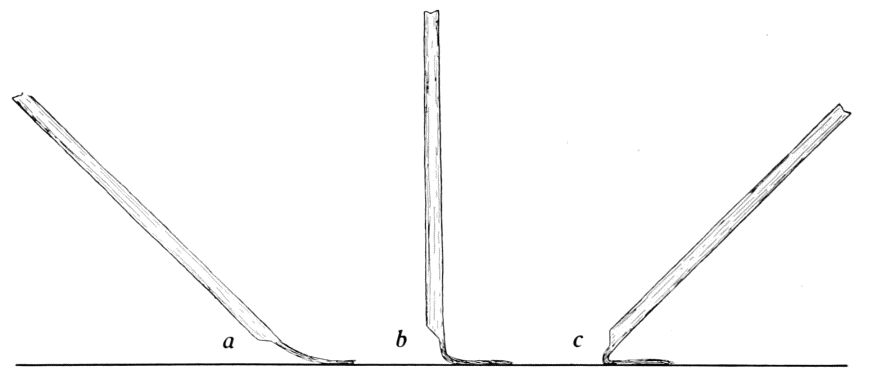
Fig. 8. Angles at which paint-brush is held during a long stroke; a. Beginning. b. Middle of stroke. c. End.
there, in order to remove excess paint before being applied again to the surface. Even after this precaution more paint occasionally remains on the brush than is needed; in such a case the excess is removed by touching with the tip of the brush various larger areas which will later be covered with paint.
The width of the lines drawn is largely dependent upon personal variation, although the type of design also governs their width to some extent. Exceedingly fine lines, for example, would obviously look out of proportion in a bold design upon a large olla. The lines vary in width from one-thirtieth to one-tenth of an inch; the great majority are between one-fifteenth and one-twentieth. Lines one-eighth or one-quarter of an inch wide are in reality double, that is, they actually consist of two lines painted so close together that they touch along their entire length. Still wider lines are made by two parallel lines, with the space between filled up. Some potters simply make the line once, retouching it only in small sections which most plainly require such treatment. Others go over each line at least twice in order to insure a constant width.
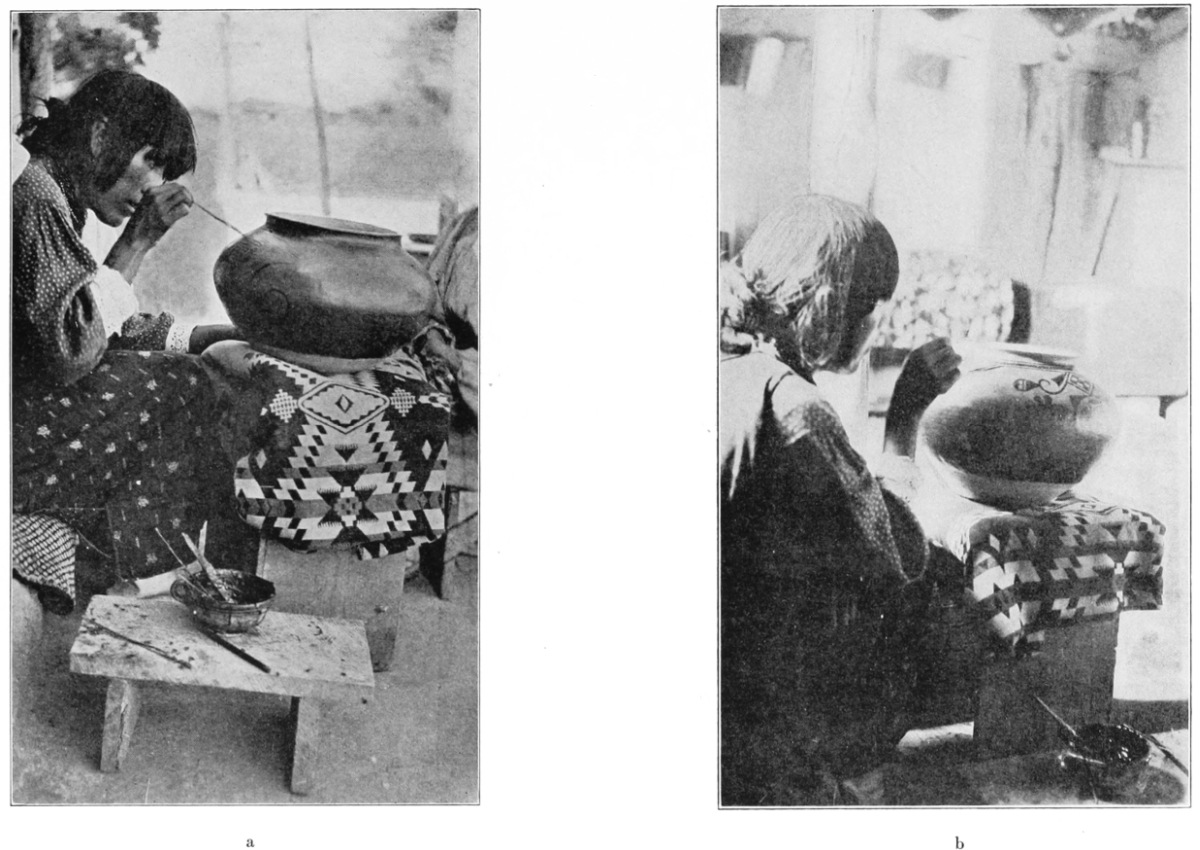
PLATE 23
Decorating large ollas. Note the unsupported arm of the painter and the length of the brush. On the bench in front is the paint-cup with stirring-stick and extra brushes (Antonita Roybal).
From the point of view of technique, the lines upon the exteriors of small vessels, such as constricted-mouthed bowls, may be divided into two groups—the long enclosing lines and those within panels. In forming the enclosing lines, especially the long horizontal ones, the vessel is turned while the brush remains almost stationary. There are two methods of forming such long horizontal lines, which of necessity are made of a series of relatively short strokes. In one case the growth of the line is in the same direction as the strokes, that is, each stroke begins at the point at which the previous stroke ended. In this method the vessel is turned counterclockwise. In the other case the growth of the line is opposite to the direction of the stroke, that is, each stroke is begun a short distance beyond the end of the line and is drawn to meet the beginning of the previous stroke, the vessel being turned clockwise. In either case the fingers of the left hand, which hold the pot by the interior of the lip, are spread far apart in order to insure the constant and regular motion of the vessel. When the lines within a panel are being drawn, the procedure is just the reverse. The bowl remains stationary while the brush is drawn across it. Occasionally lines which are nearly horizontal are drawn first in one direction, then in the other. In some cases, when long diagonal or curved lines are being made, the vessel is turned very slightly counterclockwise.
Large vessels, such as ollas, remain stationary while the brush is being drawn across the surface, and are turned only when a new area is to be worked upon. Lines within panels are usually made with a single stroke of the brush, for it is seldom that a diagonal or curved line within a panel is more than four or five inches long. In large open designs the long lines, both straight and curved, are often drawn in two parts. Crosshatching is made by two sets of parallel lines crossing each other. Dotting is done with the tip of the brush touched lightly to the surface. Spaces are filled with a heavier brush by means of many short strokes. As a rule the strokes begin at the upper right hand corner of the area and proceed downward. In filling spaces, as in drawing lines, some women go over their work only once, others apply two or three coats in order to insure even distribution of the paint.
Some potters exhibit much sureness of touch and confidence in their own ability; their designs are executed without hesitation, but at the same time slowly. Others make hard work of the painting, seem uncertain, and occasionally stop to rest and inspect the symmetry of the pattern.
There are two general points in the painting of vessels which should be emphasized. The first is the remarkable steadiness of the painter’s hand. It seems almost incredible that such straight, unwaving, even lines can be drawn by a hand which is supported only by a completely free arm, and guided merely by the end of the brush. The second is the fact that the men often assist in the painting of designs. They may either execute a complete design upon a vessel, or relieve the painter from time to time during the construction of large patterns. This is the only phase of the actual manufacture of pottery in which the men of the village take part.[48]