SUN-DRYING
Reading edition
The purpose of sun-drying is to allow the vessels to harden, and to remove all moisture before the work on them is completed. During sun-drying, which immediately follows moulding, the ability of the vessels to withstand some heat is also tested. Pieces made of improperly mixed clay are eliminated at this stage of the work, because of the cracks which develop (see under Temper, p. 21). The length of time allowed for sun-drying depends upon the weather and also upon the place where the vessels are exposed.
During the dry months of the year, notably in May and June, vessels placed in the sun will dry completely in less than a day, often in half a day (pl. 18, a). In the fall it requires an entire day under the same conditions. When the sky is cloudy or showers threaten, the drying is done in the house. If time is not pressing, the pots are placed on a table, or in the corner of the room, and allowed to remain there three or more days. At the end of that time they are usually sufficiently dry. Vessels moulded one afternoon and placed on the table for the night are dry enough the following morning to permit lifting them from the pukis, which can then be used again. If, during cloudy weather, the potter desires to dry the vessels quickly, they are placed in the oven of the small wood-stove with which most San Ildefonso houses are nowadays equipped. Sometimes a piece of corrugated cardboard from a carton is placed on the floor of the oven, the door of which is left open to allow the evaporating moisture to escape. Only a low fire is built in the stove, for a hot one would cause the vessels to dry too quickly. Under such treatment a batch of pottery can be dried in two days, more or less. The length of time depends very largely upon the number of pieces to be dried, for the potter tries to keep all the vessels at about the same stage of drying; this of course requires frequent relays in the oven. The most common, and most natural, method, however, is to place the vessels in the sun and, when showers threaten, to carry them hurriedly into the house. In this way pottery is dried in a day or a day and a half. The loss of moisture in the paste changes its color from a dark reddish or greyish brown to a light reddish or whitish grey, and in the early stages the variations in the color of the paste serve as indications of the dryness of the vessel. Later the color-change is very difficult to detect. Various parts of the vessel dry at different rates; the rim always first, then the body, and last the base, both because it is thicker and because it is usually in the shadow of the vessel itself; in spite of this the vessels are never inverted while they are drying.
The occurrence of cracks in the paste is the only form of accident which takes place during drying. There are three sorts of cracks: those in the bottom of the vessel, which usually pass through or very near the centre of the base; rim-cracks; and vertical cracks in the body. All are caused by the contraction of the paste in drying. The part of the vessel which receives the greatest strain is the base, which,
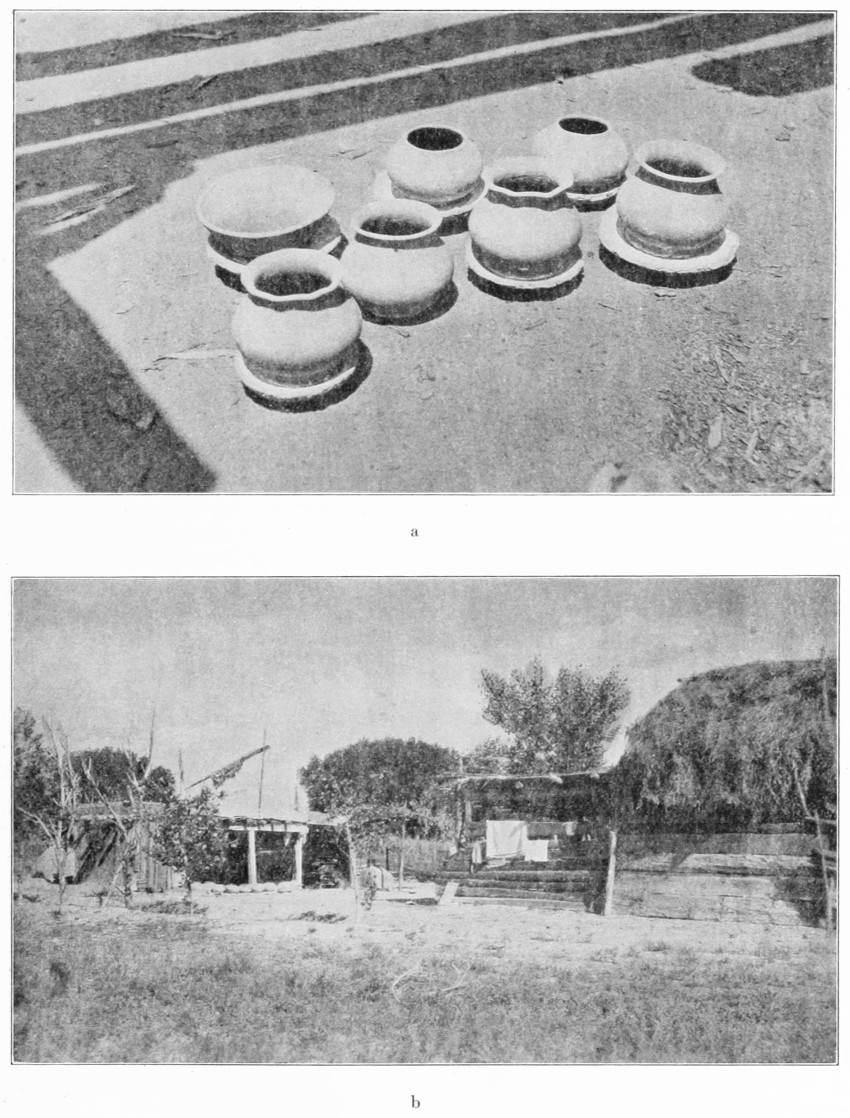
PLATE 18
a. Vessels on their base-moulds drying in the sun; the pottery is always thoroughly sun-dried after it is moulded and before it is decorated.
b. Summer house of Antonita Roybal, a woman who specializes in the manufacture of large red ollas: a row of these may be seen drying before the house.
because of the amount of paste in it, has a tendency to contract more than the bottom of the side. The next greatest strain is at the bottom of the side, where the paste must adjust itself to the contraction in the base as well as to that in the body of the vessel. The body and lip have the least strain, for the contraction may be compensated for by a slight settling of the paste. It is in the base, therefore, that cracks usually occur, and then near the centre of it, since that is the point of greatest strain. The size and quantity of the cracks are an indication of the amount of temper still needed to make the paste of just the right consistency. If there are many small cracks, or a single serious one, the piece may be discarded entirely, to be broken up later, and re-used in moulding. If a crack is not serious, it is filled as follows. With a small sliver of wood, or the end of a case-knife, the paste on the edge of the crack is forced down into it, first on the interior and then on the exterior; little pellets of paste are then added and pressed into the crack until it is filled. Final smoothing with the finger or the kajepe completes the obliteration.
Small vertical cracks near the base of the body probably also indicate faulty mixture of the paste. The potters, however, say that these fine cracks are caused by a vessel’s drying too quickly in the sun, and insist that if it had been allowed to dry slowly in the house, they would not have appeared. Such cracks are too fine and too numerous to warrant the careful filling of each one; so accordingly the surface is merely dampened, some soft paste is added and rubbed in with the fingers or the kajepe.
Cracks running downward from the rim are exceedingly rare. The women of San Ildefonso make no attempt to repair them, but occasionally cut down the vessel to a smaller size. In the single instance noted[37] the crack was first traced downward from the rim until its end was located upon the neck, then the upper part of the neck was cut off below the end of the crack. It was thus possible to use the base of the olla as a large bowl. A line parallel with the rim was marked about the circumference of the neck with a lead-pencil. This line was incised with a penknife, and gone over again in order to deepen it. A second line was incised around the neck about three-sixteenths of an inch nearer the rim. Then the paste between these two lines was dug out with great care, forming a V-shaped groove (pl. 20, a). This groove was cut through about one-half the thickness of the wall all the way around the neck. Then at one point the wall was pierced, and, from there around, the groove was deepened by long and short strokes of a knife pulled toward the body until the wall had been cut through for about three-fifths of the circumference. The remainder broke away easily. The raw surface of the new rim was then softened by the application of water and smoothed with the fingers. The potter said this was the usual method of treating a rim crack.