FIRING
Reading edition
The firing of the vessels is not only the last major step in the making of pottery, but it is also the most critical one. The supreme test of the potter’s work is to subject it to the fire, for many forms of accident occur during the process, some of them due to careless handling of the vessels or of the firing materials, others to defective workmanship or to hidden flaws in the paste. It is only natural that the potters should exhibit considerable excitement and nervousness during the firing. Some women proceed calmly and methodically, and take occasional accidents as part of the day’s work; others are exceedingly nervous, and show exasperation when things go wrong. The latter, as a rule, have more accidents than the former. One potter, in six burnings, lost two large ollas through breakage, and had innumerable smoke-clouds, several of them rather severe ones.
The firing falls naturally into four distinct phases: the preparation, the building of the oven, the burning, and the treatment after burning. Each of these phases will be considered separately.
Preparation
The oven is usually situated behind the potter’s house. All that is required is a level space free from vegetation; no attention is paid, as a rule, to the position of the sun or to the direction of the prevailing wind, and the same spot is used time after time. If on the evening before the firing there are any signs of rain, or if a heavy dew is expected, the area on which the oven is to be built in the morning is covered with a thick layer of dead ashes to protect it from moisture. It would be a fatal mistake to make the oven on ground which would give off steam during the burning.
About six o’clock the next morning a fire is started on the area over which the oven is to be built. While this preliminary fire is thoroughly drying the ground, the accessories are collected (pl. 24, a). Slabs of dung are brought out from the storage places; some of them are placed against the house wall to dry in the sun, others remain in the washtubs in which they have been carried. The material for the grate, and other iron bars, are placed nearby. Pokers of wood and iron, shovels, and sometimes pitchforks, which are to be used later in handling the burning fuel and hot vessels, are placed within reach. When a collection of small tin cans, pail-tops, and small stones saved for this purpose has been added, the workers are ready to begin the burning. Usually a supply of cedar kindling has been split, but sometimes this is done as the wood is needed.
Building the Oven
When the preliminary fire has died down to a mass of coals, these are levelled to form an area of hot ashes about three feet in diameter. On this the oven is built. The surface upon which the vessels are placed must be raised a few inches
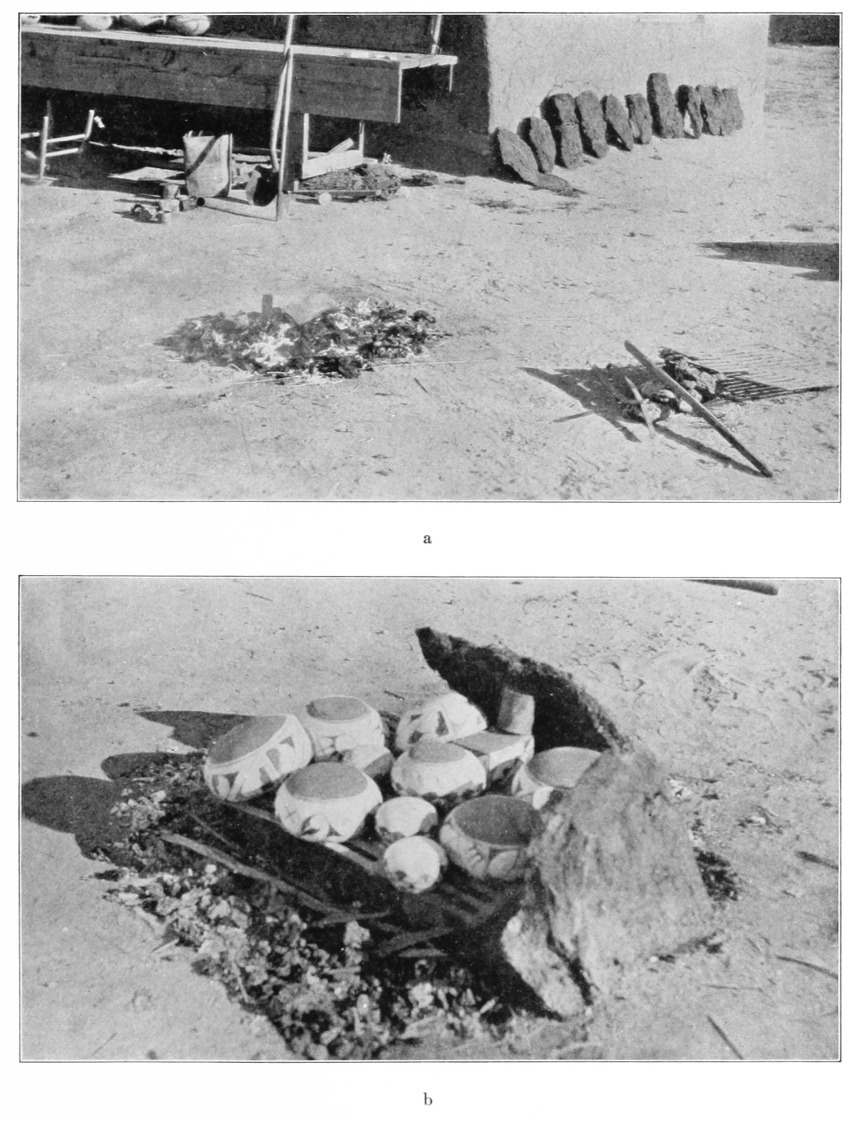
PLATE 24
a. Drying the oven site with a preliminary fire before burning the pottery. At the lower right-hand corner are an old iron grate which will later support the vessels, two iron rods to hold up the roof of the oven, and a wooden poker. Cakes of dung for the oven walls are drying in the sun against the house.
b. The vessels on the grate, and the oven wall of dung cakes begun. Small tin cans support the cakes and keep them from touching the vessels. The grate rests on stones, and split cedar kindling is placed below it on the embers of the preliminary fire.
above the ground to permit the introduction of fuel below the pottery. Such a surface is usually formed of iron rods of one kind or another. One potter built up a grate of a varied assortment of iron junk supported on tin cans and odd-shaped iron fragments. Another potter used a worn-out stove-grate supported on four half-bricks.
The vessels are then placed upon the grate in an inverted position. No attempt is made to keep them from touching one another. In fact, they are crowded together in order that the greatest possible number may be burned at once (pl. 24, b). In firing red ware and polychrome ware only one layer of vessels is placed upon the grate. When polished black ware is to be burned, two layers may be made. The vessels in the second layer are always placed carefully between those of the bottom layer, in order that there may be free circulation of air on both the interior and exterior of all the vessels (pl. 25, a). As a rule the larger bowls are placed in the lower layer.
The number of polychrome vessels burned at one time varies from half-a-dozen to twenty, according to the area of the grate and the size of the vessels. At one burning there were eleven pieces, eight medium-sized and three small; in another there were twenty, eight of which were medium-sized, and the other twelve very small. It is possible to burn as many as thirty-five polished black bowls at once. Some potters burn both polychrome and red pottery in the same oven; others insist that this should not be done, because red ware requires far less time and heat than does polychrome.
After the pots have been placed on the grate, pieces of split cedar six to fifteen inches long are inserted underneath it. Piñon is never used, but the potters could not explain this, saying they had never tried it. A wall-like ring of dung-cakes, placed on edge but not set as snugly together as they might be, is then built around the grate (pl. 25, b). Small tin cans, held in place by the weight of the dung, are used to prevent the cakes from touching the vessels (pi. 24, b, shows one of these cans very clearly). Sometimes small stones and broken bricks are used in place of cans. While the ring is being completed more kindling may be added. The Zuñi oven differs from that of San Ildefonso in being built of smaller pieces of manure which are laid up horizontally instead of on edge (see pl. 31, b, c).
The fire may now be lighted before the oven is finished, but sometimes the potters wait until the roof is nearly complete. Cedar-bark shreds are generally used to start the fire. The lighting is done through the spaces between the dung-cakes, usually at more than one place, sometimes in as many as five. No attention is paid to the wind in this process. If the fire does not start quickly enough, cloths are used to fan the flames.
The roof or vault of the oven is then built. Some potters place iron bars across the top of the dung-ring, keeping them from touching the vessels by inserting tin cans and stones. On these bars flat cakes of dung are laid, and the larger holes are covered with smaller pieces of dung. Other potters dispense with the bars and rest a large circular cake of dung upon cans and stones set in the centre of the pile of pottery. The space between this central cake and the top of the dung-ring is bridged by other cakes which rest on the dung alone. In this manner a low vault of dung-slabs is formed, roughly square in shape, two and a half to three feet on a side, and about a foot and a half high (pl. 25, c). There are still left numerous spaces, both large and small, between the cakes. These are covered with smaller pieces of dung, and with old tin tops of lard-pails or discarded tin plates (pl. 26, a). Even after this, however, there remain enough small spaces to allow free circulation of air, and to prevent the smothering and consequent smoking of the vessels. Through these smaller spaces the flames and pots may be seen. The building of the oven is now complete; by this time the fire has usually been started, and the flames are well under way.
As a rule more than one burning is undertaken during a morning. The building of the oven for the second burning differs slightly in its preliminary stages from that described above. After the previous oven has been destroyed, the ashes are smoothed out, and the grate set straight and carefully dusted so that no ashes remain (pl. 26, b). The bowls are than placed on it as before. Partly burned cakes of dung, which remain from the first burning, are re-used. If, in placing them on the oven, ashes drop on the vessels, care is taken to blow them off.
Some potters stand the vessels which are to be burned on the warm cakes of dung for a few minutes before placing them on the grate (pl. 26, b), a process which is supposed to heat them slightly and thus prevent breakage during firing. Other potters would not think of doing this, for vessels treated in this manner always have discolored bases, where the warm dung has touched them.
Ollas twelve to fourteen inches in diameter are burned in pairs, with a few smaller pieces beside them. The oven is built in the same manner as before. Very large ollas are usually fired one at a time; the oven, except for its greater size, is said to be of the usual type.
Burning
As was said above, the firing of the pottery is done in the morning. The Indians say that they wish to get it over with “before the sun grows hot”. Their own personal comfort probably plays a more important part in this than does the effect of the sun upon the pottery. As a rule the firing is withheld until a sufficient number of finished vessels have accumulated to permit three or four burnings in one morning. The entire forenoon is spent at this work, and sometimes it drags over until early afternoon. The actual burning of the vessels occupies a period of about half-an-hour for each oven; it is said that the length of time has not been appreciably shortened in the past forty or fifty years. The black ware is always saved for the last oven, since the process employed completely precludes the possibility of rebuilding the oven at once.
At the beginning of the burning white smoke is apt to be given off, but too much smoke is regarded as a bad sign, since it signifies that the dung cakes are not sufficiently dried. After fifteen minutes or so, that is when the process is about half finished, the amount of smoke has greatly diminished (pl. 26, a). About this time more kindling is added through openings made by temporarily removing a piece of tin, and new cakes of dung are added where necessary, usually on the top of the oven.
The Indians say that they judge of the condition of the pottery in the oven by its color; the paste and slip must be of just the proper shade before the vessels are
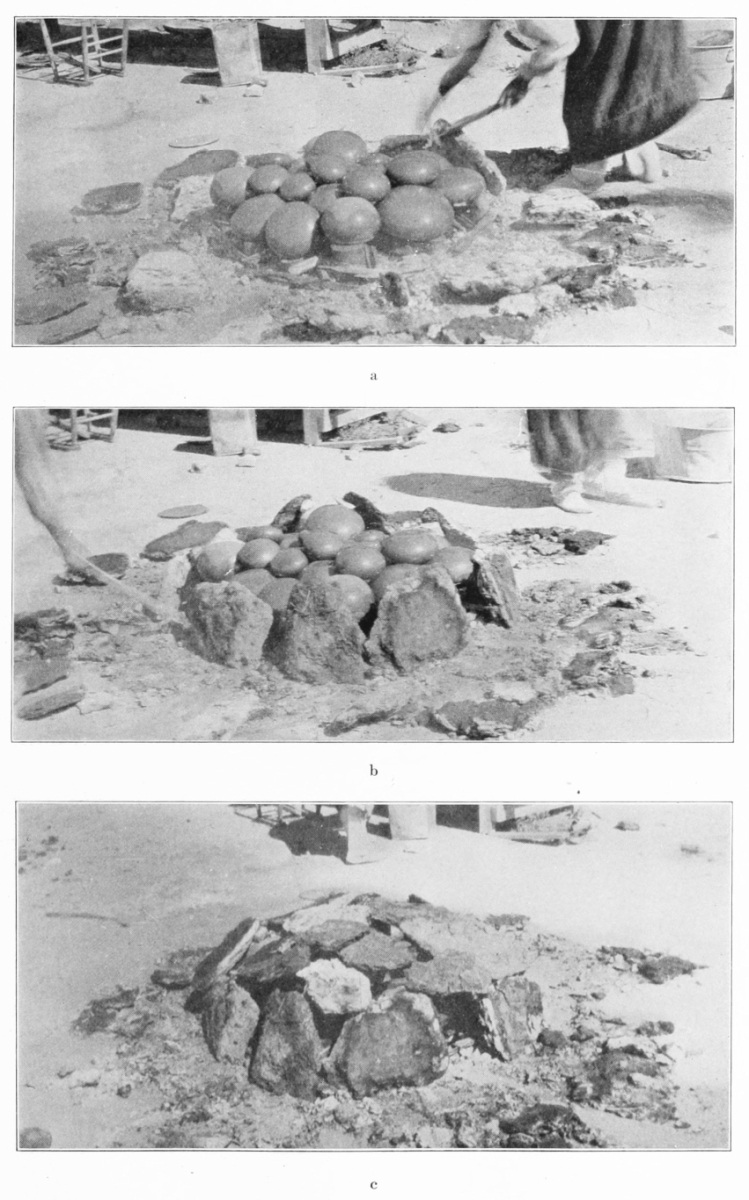
PLATE 25
The building of an oven. a. A double layer of bowls is on the grate; the woman is placing a can between a dung-slab and a bowl. b. The wall of dung-cakes completed. c. The oven finished, but the chinks not yet filled.
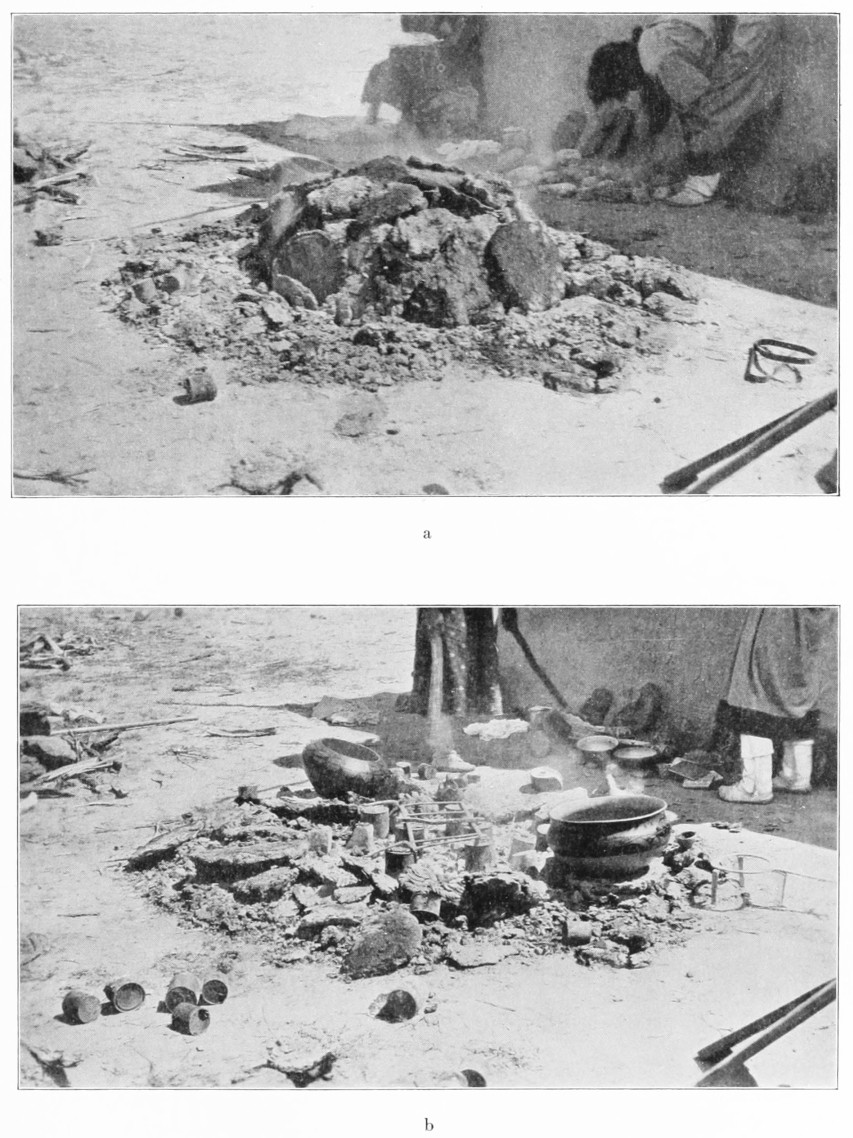
PLATE 26
a. The oven fired. The chinks between the dung-slabs have been partly closed by smaller pieces of dung. b. A firing completed and a grate prepared for a second firing. Two vessels to be burned are warming on hot dung-slabs; the pots that have just been taken from the fire are cooling in the shadow of the house.
thoroughly burned; if they are too dark the burning must continue.[49] Some potters seem to pay little or no attention to the color of the vessels in the oven.
When the potter considers that the burning has been completed, the cakes of dung on the top of the oven are lifted off with a pair of pokers, and those in the ring around the grate are tipped outward. Thus the vessels on the grate are exposed, and their removal is begun at once. Some are tipped on shovels or hay forks; pokers are inserted under and into others. They are then deposited upon tins which have been placed on the ground within six or eight feet of the oven, and are left there from ten to twenty minutes to cool. The women often complain about the heat from the oven during the removal of the vessels. As soon as the grate has been cleared, preparations are begun for the next burning (pl. 26, b).
In one instance a potter decided that a certain vessel which had been removed from the grate was not sufficiently burned. Another fire was already in progress, but when the third was built the vessel was replaced on the grate and burned again. When it came out, however, one side was badly overfired.
The time occupied by various burnings is given in the following table. The first four columns represent burnings by Maria Martinez; the last three by Antonita Roybal. The seventh column records the oven in which the partly fired piece was reburned, and in which a cooking vessel was also placed.
TABLE X
(1)(2)(3)(4)(5)(6)(7)
Minutes
Preparation and building of oven begun 00000000000000
Fire started25150612151509
More kindling and dung added452525 57
Oven broken up52373641724027
Last bowl removed from grate58414247774530
The time required for burning the different wares varies only slightly. Some potters say that red ware takes less fuel, less heat, and less time than polychrome ware; others place both wares in the same oven. The difference in the time required for these two wares is probably no greater than the chance variations in the length of burning as given in Table X. Cooking vessels need to be fired only from one-half to two-thirds as long as the two wares just mentioned (cf. Table X, column 7). The polished black ware will be considered later.
The changes in color before and after firing, and when hot and cool, are very noticeable in some pigments and slips. The orange-red paint is yellow before firing, firing turns it orange-red, almost the color of burnt sienna; cooling produces no noticeable change in this shade. Burning has only a fugitive effect on the red and dark-red slips. While still hot, upon removal from the oven, these are both a dark chocolate shade. As the vessels cool the different reds gradually reappear, until when cold they are the same color as before firing. In some cases, these pigments seem to be just a shade darker after firing than before. The two kinds of white slip are a dead white when applied; after firing they take on a slight pinkish-brown tinge, more cream than white. Cooling produces no further change.
The most interesting change caused by firing is in the black vegetable pigment (guaco). It has already been pointed out (p. 66), that when this paint is laid on thickly, the line made is a little raised and glossy, like a glaze. This “body” to the paint is probably formed by vegetable matter in suspension in the solution. When the vessels with such decorations are removed from the oven after burning, these lines are seen to be white or grey. The material which formed the body of the pigment has been reduced to white ash, which adheres to the surface, but can be rubbed off with the finger or a cloth, while the black color itself has been burned into the clay. Where a thin layer of the pigment was applied, the line, after burning, is light grey, because the black under the thin coat of ash shows through. In those vessels on which a thick solution of pigment was used, the decorations are dead white, and the surface of the ash is often crackled. The thickness of this ash seems to have some effect upon the manner in which the black pigment is burned into the clay, for in decorations covered with a thick layer of ash, the black is of an irregular color with streaks of grey in it. When the thin pigment is used, the resulting black on the finished vessel is of a uniform shade. The glossiness and raised character of the pigment is of course completely destroyed during burning. Guaco lines do not change in shade while the vessel is cooling.
The color of the paste is little affected by burning. In both the red and the white clays, the change is simply one of tone, that is, the clay is lighter after burning than before. The cooking-vessel clay before burning is greyish yellow, but after it has been removed from the oven it is a rich orange-yellow. These cooking vessels eventually become blackened by use over an open fire.
Vessels destined to be polished black ware are treated in quite a different manner during the firing stage, for they are to be subjected to a smothered fire, which will result in the deposition of carbon, thus turning them from red to black. The oven is built in the same way, but greater care is taken to fill gaps, so that more of the heat may be retained. Enough spaces remain, however, to permit free circulation of air. More kindling is used, for a hotter fire is necessary. When the fire has reached the stage at which other wares are removed, it is smothered with new, pulverized, loose manure. Just before the smothering the vessels have the dark chocolate color typical of the red wares while hot. The potter always attempts to smother the entire oven at once by dumping upon it a whole washtubful of fine loose manure. If there is a wind, flames are apt to break out in one or two places. They are, however, hurriedly extinguished. When the loose manure is added, the arch of the oven is, of course, broken, and both cakes and loose manure come in contact with the vessels. For this reason the potter does not exercise particular care in building the oven to keep the cakes from touching the vessels, as they are to be entirely black in the end and a little premature smoking does no harm. After the manure has been added, the mound is continually prodded with a poker to redistribute the loose manure and make certain that all the pieces are equally covered. An extra supply of loose manure is at hand, and this is added in large and small quantities from time to time, as occasion demands. Two washtubsful are generally used, sometimes three. The mound of manure gives off a dense white smoke after the smothering has begun (pl. 27, a). Great care is taken to prevent flames from appearing, since these would remove the carbon from the vessel.
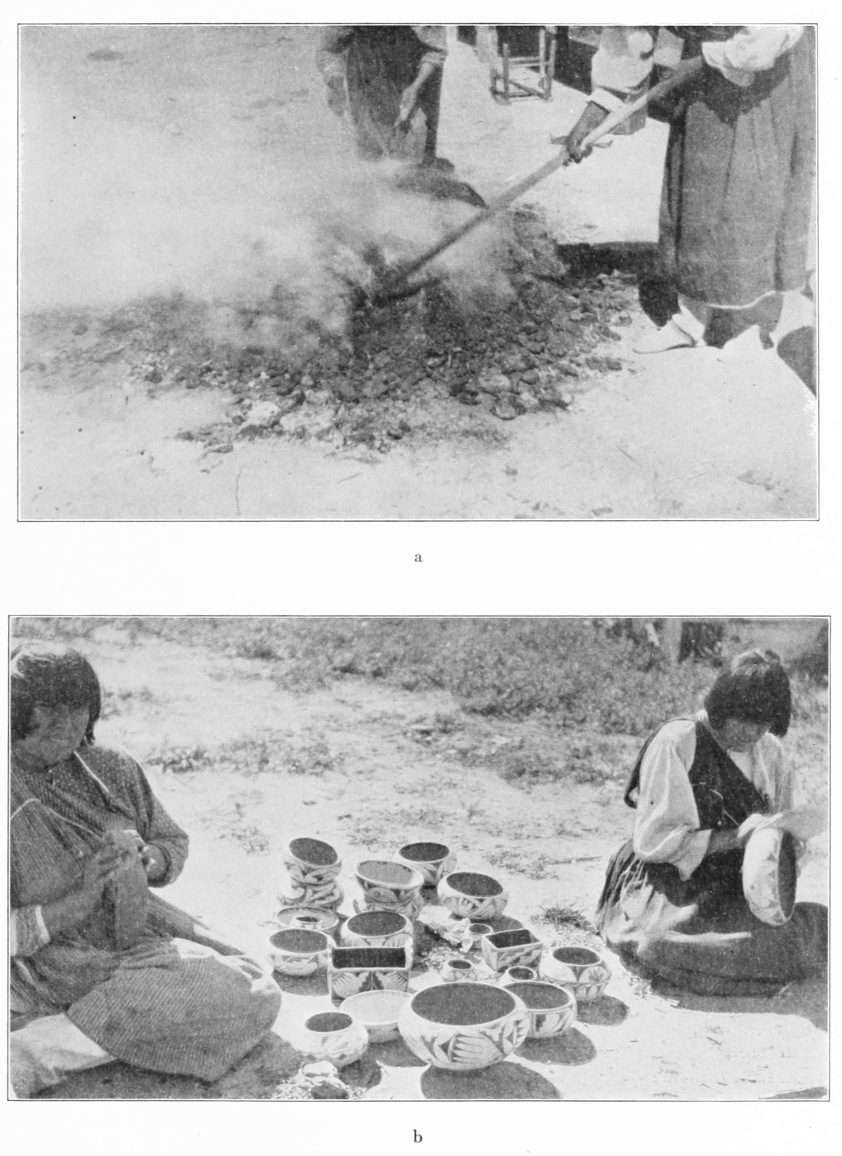
PLATE 27
a. A fire smothered with loose manure to produce polished black ware. b. Wiping vessels that have become cool enough to handle. One woman wipes off the ashes with a dry rag, then passes them to her companion, who goes over them with a slightly greasy cloth.
Ten or fifteen minutes after the smothering the first piece is dug out of the mound with the poker. It is placed a foot or two from the oven and hastily wiped with a dry cloth to remove all manure. The surface of the vessel is a beautiful shiny black color, which does not change at all on cooling. If black ware paint (see p. 24) has been used, it changes from the greenish-yellow color that it had before burning to a dead matte black which contrasts very effectively with the polished surface of the vessel (see pl. 8, a). At first the vessels come from the smoking mound slowly, and all holes left in the pile by the removal of vessels are carefully filled again, but later they are taken out as quickly as possible, and toward the end no attempt is made to keep the pieces still in the pile thoroughly covered. If, when a vessel is removed, its condition does not quite suit the potter, it is replaced in the smoking manure and completely covered.
Certain polished black vessels are further manipulated in such a way as to produce an irregular red blotch upon them.[50] Specimens destined to receive this red blotch, which is usually placed near the rim, are reburied in the hot manure lying round the edge of the pile with that portion which is to have the blotch left uncovered. Against this exposed portion is placed a smoking fragment of a dung-slab. The action of the heat and air results in the removal of the carbon from the surface, so that that part of the vessel which is not covered with manure and ashes regains its former color, the red of the pigment. Since the pot is pushed about a good deal during this process, the line between the red and the black surface is not always very definite, which improves the appearance. The Indians themselves cannot tell beforehand just what shape the blotch is going to take, and must therefore watch the vessel continually. Sometimes burning shreds of cedar bark are placed against the exposed surface to hasten the process, but actual flames are not necessary in order to obtain the desired result. If the red blotch is too large, part of it is simply recovered with hot manure-ashes, and a few minutes later will again become jet black. So far as looks are concerned the success or failure of this red blotch upon black ware depends largely upon the artistic sense of the potter making it. In one group of thirty-three polished black vessels fired together, sixteen were given a red blotch; eight or ten of these were excellent pieces.
The time consumed in burning polished black ware is shown in Table XI. It should be noted that before the loose manure was added, the vessels were subjected to the fire about the same length of time as those of other wares.
TABLE XI
Minutes
Preparation and building of oven begun 00 00
Fire started16 18
More fuel added41 39
Oven smothered with loose manure46 45
First bowl removed59 59
Last bowl removed74 99
Accidents
The accidents which may occur in firing are of two general classes—those which result from faulty treatment during the construction of the vessel itself and those which are due to careless manipulation in burning. The latter are the more frequent.
A vessel may crack or flake badly in the oven; often the entire base breaks off. The fault in this case lies in the original moulding, because small stone fragments or air-bubbles were allowed to remain embedded in the paste. Since the rate of expansion under heat varies for different substances, a great strain develops about such stones or air-bubbles during firing, and the natural result is cracking or flaking of the clay. In some larger vessels the slip flakes away around the shoulder, where the two areas of the surface met when the polishing was done (see p. 64). In the potter’s opinion these flakes, which are exceedingly small, are probably caused by minute air-bubbles that had lodged under the slip while the line about the shoulder was being polished. A third type of accident is merely a blemish; it is due to flies settling on a vessel before burning; the resulting fly-specks are burned into the clay, and the surface of the pot is sprinkled with dots quite as black as guaco decorations.
The most common form of blemish caused by careless manipulation during firing is the “smoke-cloud” or “fire-cloud”, a circular blackened area, the darkest part of which is at the centre. There is no question but that this is caused by contact between the vessel and a dung-cake, and the result is probably due to moisture in the dung which brings about a deposit of carbon on the surface. If, during the burning, a cake of dung falls, it will probably come in contact with the surface of some bowl. If it is removed at once there is little danger of a smoke-cloud, and the potter, when she notices such an accident, immediately tries to secure the fallen cake with two pokers. With much skill she carefully extricates it from within the oven without disturbing the other cakes about the place from which it fell. Fire-clouds may be produced upon the bases of vessels by setting them on hot cakes of dung before firing; or upon damp, or relatively damp, ground immediately after firing. Excessive dampness, such as steam from wet ground under the oven, may in addition to discoloration, produce warping of the vessels. Another sort of blemish is occasionally caused by rust from a tin can resting upon a vessel during firing; such a spot is usually reddish brown in color, and covers a very small area.
If light areas appear on polished black ware, it is safe to assume that they were brought about by lack of proper ventilation within the oven during the preliminary burning, such as would occur if two vessels were so close together as to prohibit the free passage of air. If white slip is touched just before burning, the oil from the fingers is apt to be fired in, thus ruining the uniform appearance of the surface by the potter’s indelible fingerprint. To avoid such an accident, polychrome vessels are usually handled only by the interior of the rim on the day they are burned.
Underfiring and overfiring, with consequent damage to the ware, are usually due to gross carelessness on the part of the potter in the irregular placing of kindling. The wind also has something to do with it. If there is a stiff breeze blowing, the probabilities are that the windward surfaces of vessels within the oven will be underfired, while those in the lee of the vessels will be overfired.
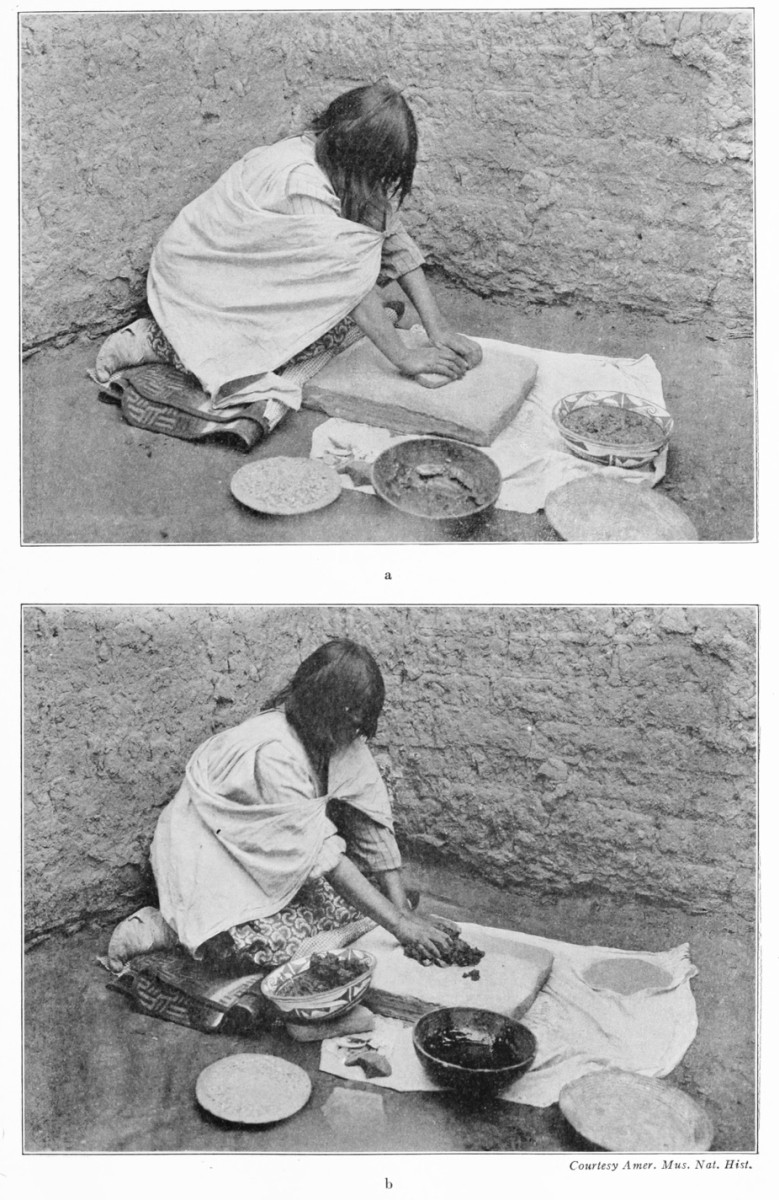
PLATE 28
Courtesy Amer. Mus. Nat. Hist.
ZUÑI. PREPARING CLAY
a. Pulverizing dry ingredients on flat stone slab with a mano or hand stone.
b. Wetting, mixing, and kneading clay; water-container in foreground; prepared clay in bowl.
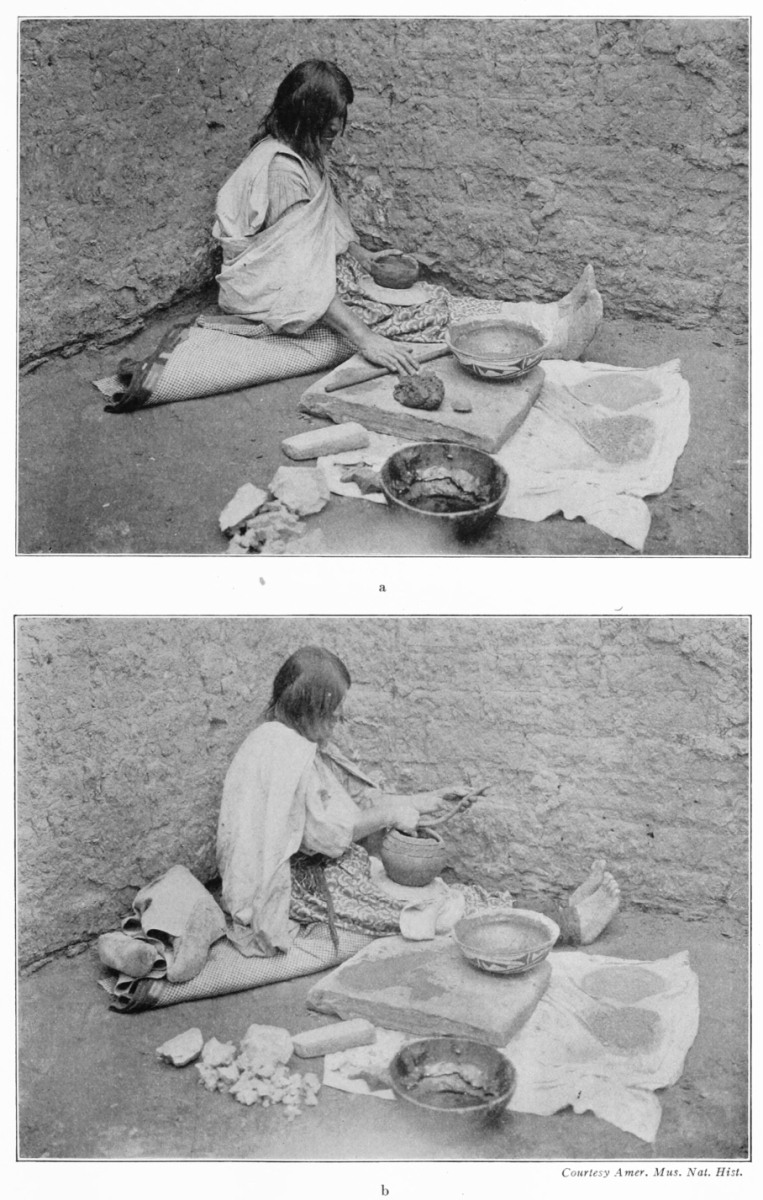
PLATE 29
Courtesy Amer. Mus. Nat. Hist.
ZUÑI. MOULDING
a. Lower part of vessel completed; potter forming roll of clay with which to continue building.
b. Applying roll of clay; left hand guides roll; right hand welds it to side of vessel.
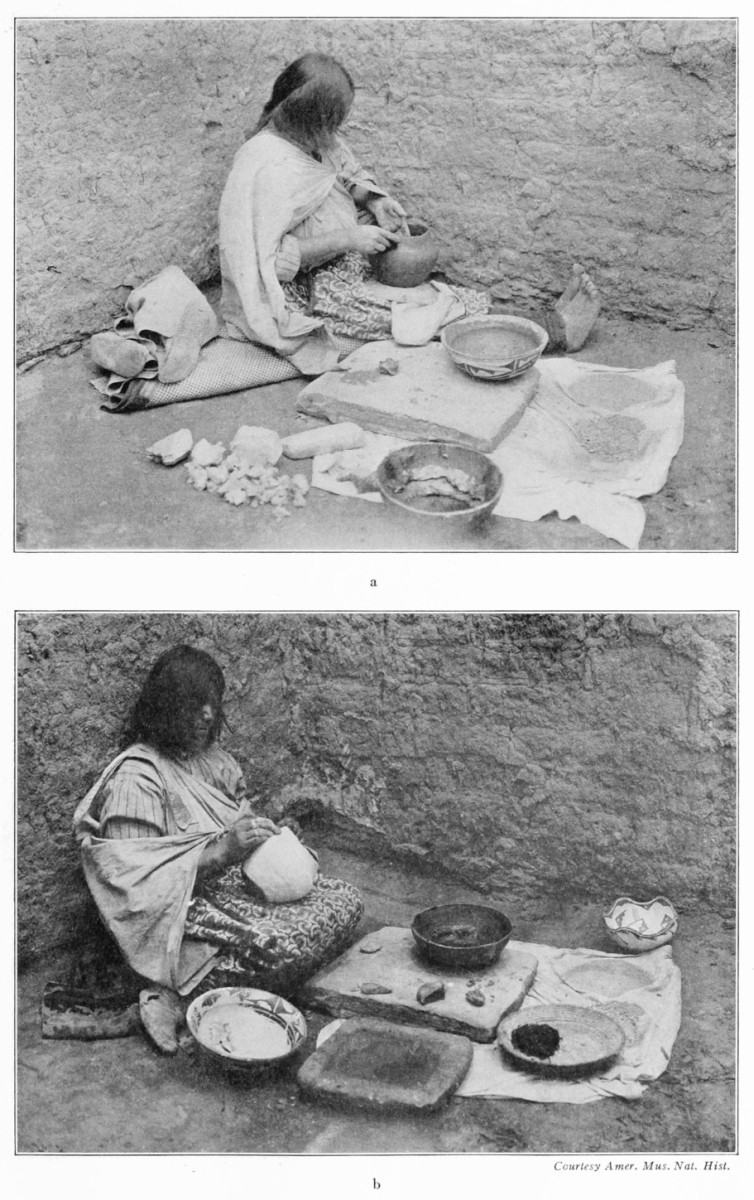
PLATE 30
Courtesy Amer. Mus. Nat. Hist.
ZUÑI. SURFACING
a. Going over outside of vessel with moulding tool to smooth out irregularities.
b. Vessel has been removed from base-mould and covered with white slip from bowl in foreground. Potter now polishing slip with rubbing stone.
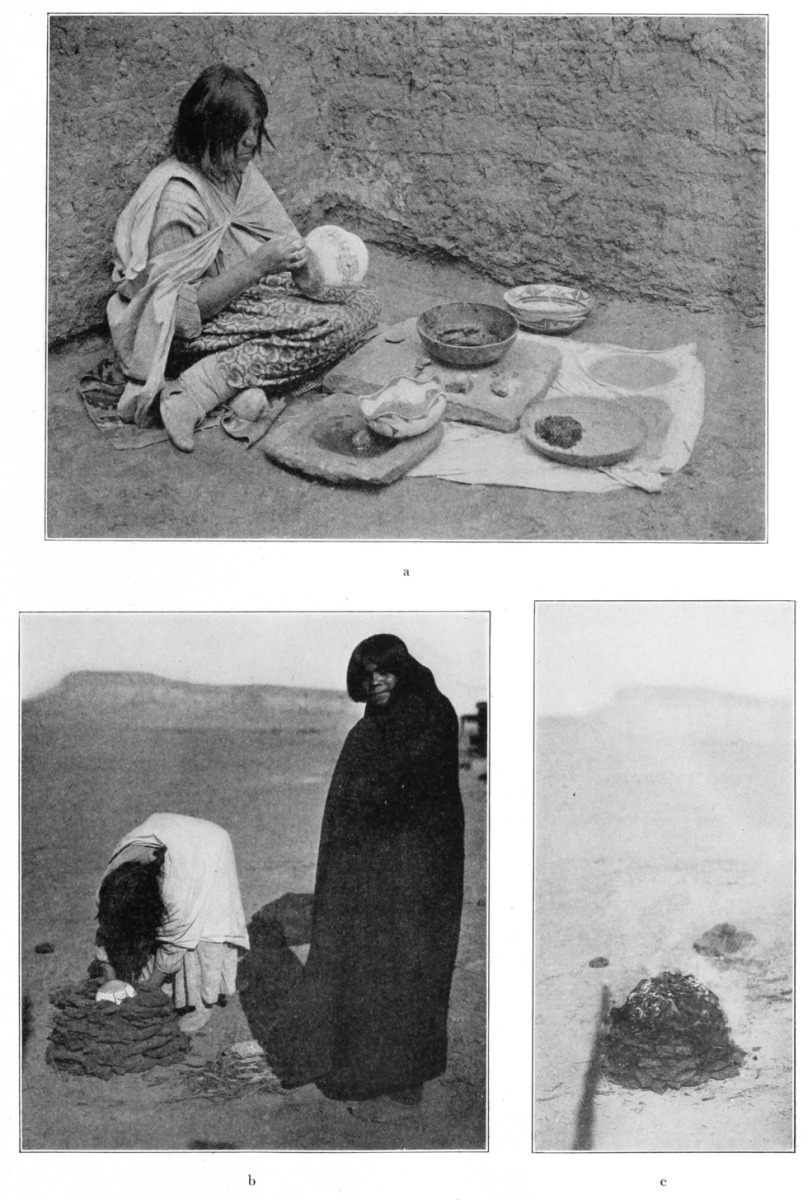
PLATE 31
ZUÑI. PAINTING AND FIRING
a. Applying design with yucca-leaf brush. Black pigment in shallow stone mortar, red in small white bowl. b. Building oven of dung cakes—note kindling at feet of figure at right. c. Oven domed over and set afire.
(Photographs from American Museum of Natural History).
In underfired vessels the color of the pigments is not true, being usually midway between the unfired color and the fired color; as a rule the paste is also dark and friable. Overfiring is more easily detected than underfiring. A slight overfiring may be first noticed in the black guaco paint, which has a tendency to become bluish and light if burned too much. Other bad results follow in quick succession as overfiring is increased: at an early stage the white slip becomes smoky; in severe overfiring it may turn black, as in a smoke-cloud; the paint of the designs is apt to flake off; and finally, in a bad case, the guaco will turn nearly white.
Treatment after Burning
Polished black vessels, when removed from the fire, are set directly upon the ground within a foot or two of the oven. They are at once wiped hastily with a dry cloth to prevent any fragments of the new manure from sticking to the surface. When the vessels are sufficiently cooled they are again wiped with a clean dry cloth and taken into the house for storage. Occasionally the first wiping, while the bowl is still hot, is omitted.
When pieces of polychrome ware or red ware are removed from the oven they are placed on the ground some six or eight feet from the fire, resting on tins in order to prevent possible discoloration from contact with the damp soil, as well as to prevent dust and dirt from sticking to their bases. The vessels are piled on these tins in any manner, often three or four on top of one another. When the pottery first comes from the fire, it is still much too hot to touch, and radiates heat copiously. Ten or fifteen minutes later, when the vessels are cool enough to handle, they are removed from the tins and collected at some convenient place to await wiping.
First the pieces are gone over with a clean dry cloth to take off the guaco ashes and any dust that may remain from the oven (pl. 27, b). Each vessel is then wiped with a slightly greasy cloth, which gives a faint sheen to the surface and removes the blue tinge which is apt to be found in the black guaco-covered areas. Some potters have substituted a chamois skin for this second cloth. It took the two women shown in pl. 27, b, just fifteen minutes to wipe with the two kinds of cloths the twenty-two vessels figured. When the wiping is done, the pottery is carried to the house and stored in one of the rooms. The pieces are placed on the floor, usually with a carpet or rug under them, and covered with a sheet to keep off dust and flies.
The time occupied in each of the individual stages of pottery making has been considered, but the total time, from the beginning of the moulding until the finished vessels are placed in the store room under a sheet, is far in excess of the mere sum of the separate hours and minutes used in each process. Household duties and other tasks are constantly interfering with the work. About nine o’clock on a certain morning one potter began moulding the first of a group of perhaps forty pieces. The scraping was commenced on the morning of the third day, and the polishing on the fourth morning. Nothing was done on the fifth day, but early on the sixth the painting began. A fiesta interrupted the work for two more days, and the burning was done on the morning of the tenth day, although it could have taken place on the seventh. Another potter finished burning several large ollas at noon on the ninth day.