PARAPHERNALIA
Reading edition
Primary Paraphernalia
Earthenware Moulds or “Pukis”
These moulds are usually the bases of broken bowls or ollas. Occasionally pieces of pottery are made especially for moulds; in such cases, although they are fired, they are neither finished carefully nor decorated.
When a mould is to be used, a small amount of temper or wood ashes is placed in it, so that the vessel being moulded will not stick to it.[18]
Gourd Moulding Spoons or “Kajepes”
These spoon-like implements (pl. 11) are made from pieces of gourd-rind, usually from broken rattles or dippers. They vary greatly in size, ranging in diameter from a little over one inch to as much as four, or four and a half, inches. There are also many different shapes: round, several forms of ovals, and a few which have one concave edge. The various shapes are used for the different parts of the vessels. As a general rule the larger kajepes are used on the larger vessels. Each woman has from four to a dozen of these implements, which are distinctly individual, for one potter shows awkwardness in handling the spoons of another. It is said that potsherds were formerly used for the same purpose as these gourd spoons.[19]
Scrapers
Two kinds of scrapers are used at the present time. One is the top of a baking-powder can, which is popular because its shape makes it possible to apply it to any part of a vessel. The other scraper is an ordinary kitchen case-knife. The scraping of the vessels is done after they have been dried in the sun. It is said that potsherds, with edges sharpened on a piece of sandstone, were formerly used.
Polishing Stones
Very smooth, fine-grained pebbles of various colors are used to put the final finish on certain kinds of pottery. They vary considerably in size, from three-quarters of an inch long to three, or even three and a half, inches. It is impossible to classify them by shape, except that the larger ones are usually more flat than spherical. Most of the stones appear to be waterworn pebbles, without any acute angles or sharp edges. Usually two surfaces of the stone are highly polished, most frequently at the ends, where they come in contact with the vessel. Some specimens show signs of great wear.
Each potter has several polishing stones, the number varying from seven to sixteen; they are distinctly the personal property of the potter, and apparently have a semi-sacred significance. For the most part they are heirlooms, handed down from mother to daughter, but additional stones are picked up from ruins which the potters have visited. One informant has four stones which her mother gave her, and three which she found at the ruined pueblo of Puyé. Another informant uses a stone that belonged to her great-grandmother, although her favorite is a small one which she found herself at a nearby ruin. Stones are sometimes lent by one potter to another, but they very seldom find their way outside the family group.[20]
Paint Brushes
These brushes are narrow slivers of the leaves of yucca or soapweed, from five to six inches long, and from an eighth to a quarter of an inch wide. For a distance
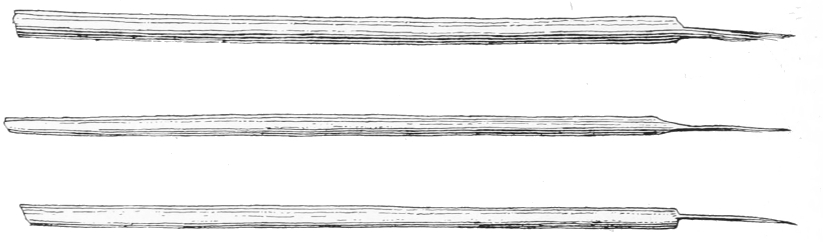
Fig. 5. Slivers of yucca leaf with shredded ends, used as paint brushes for decorating pottery.
of about an inch from one end, the fibres are chewed and thus separated. Most of the chewed fibres are then cut off, and the number remaining determines the fineness of the point (fig. 5). For very thin lines a brush of only one fibre is used. When out of service, the brushes are kept in some receptacle which will protect the shredded ends. When the implement is dry the chewed fibres become stiff and rather brittle, and must be handled with care; before using they are soaked in water for two or three minutes in order to soften them.[21]
SECONDARY PARAPHERNALIA
Carrying and Storing Receptacles
The receptacles used for bringing clays and other ingredients from the pits to the village vary somewhat according to the distance that the material must be carried. If the beds are close at hand, the material is placed in a shawl spread flat on the ground. The shawl is then picked up, the corners are tied, and the bundle is carried on the back. Sometimes gunny-sacks and cement-sacks are used instead. If the beds are at some distance from the pueblo, the material is placed in sacks and brought home in the body of a wagon. As a rule the ingredients brought home in shawls are transferred to sacks or boxes for storage. Paints are kept in ollas, with the exception of the guaco paint, which is allowed to remain in the bowl in which it is dried.
Mixing Surfaces
Whenever ingredients are to be mixed or crushed, the work is done upon some sort of extra surface laid upon the floor. This surface is about a yard square, and may be, apparently, of any suitable material—a bit of old canvas, an opened-out cement-sack, or a small skin such as that of a goat or dog. Similar surfaces also serve for mixing clay and temper, for cleaning temper, for mixing the paste with water and kneading it, and finally for holding the kneaded clay during moulding. Partly finished vessels are placed upon such a surface at various stages of construction. For winnowing clay, the women’s shawls are used.
Boards
No boards are placed beneath the pukis, or moulding trays, while they are being used on the hard floor of the house, but in the courtyard boards are used under them in order that holes may not be worn in the ground during the constant turning necessary in moulding vessels. When small vessels are completed they are placed in rows on a board, where they remain during the early stages of the drying process. Rectangular, flat-bottomed vessels are built directly on boards, or on low footstools made of short boards with legs at each end.
Water Containers
While the potter is at work, she always has beside her a small lard-pail partly filled with water, which serves to keep the kajepes damp, to moisten parts of the vessel, and from time to time to clean her hands. When the kajepes are not in use, they are usually placed in the pail. At San Ildefonso such a pail is now the only form of water-container; formerly pottery bowls were probably used.
Mops for Slips
These mops are the same for all slips. Each consists of a rag, folded and refolded until it is about an inch or an inch and a half wide and from two to two and a half inches long. One end of the rag or mop is held between the thumb and the first two fingers of either hand; the other end serves as a wide paint brush. The potters state that in former times a piece of leather or skin served the same purpose as the cloth mop.[22]
Paint Receptacles
Various receptacles hold the slips and paints that are ready for use. The white slips are usually mixed and kept in enamelled basins and pans, because a large quantity is prepared at one time. The red and orange-red slips may be in small pottery bowls, or in china sauce-dishes. The guaco is invariably in an Indian bowl. Undoubtedly at one time native bowls were used exclusively, and there may even have been bowls of special shapes or designs for this purpose; at present, however, no trace of such a custom remains.
Wiping Rags
Wiping rags or, more simply, the aprons of the potters are used at various stages of the work—after scraping, after polishing, after the slip has dried, and after burning. Apparently any convenient piece of cloth is satisfactory.
Accessories in Firing
When the vessels are to be fired, various accessories must be at hand. Four or more half-bricks or stones are needed upon which to set the grate. The latter may be either a discarded stove-grate, or a collection of strips of iron, metal barrel-hoops, and odds and ends, placed together to form a grill.[23] Small stones and tin cans—such as small condensed milk cans and meat cans—are needed as props to keep the fuel from touching the vessels during the burning. Flat pieces of tin and the covers of large lard-pails serve at times to close spaces between the fuel cakes, and to cover the oven-top, to support which metal rods are often used. Lastly, pokers are needed to handle the fuel and to remove the hot vessels. These may be wooden or iron rods, broomsticks, old shovels, or even pitchforks. Each potter has her own collection of the above materials and implements, stored away ready for use. These collections of apparent refuse vary to a surprising extent.