RAW MATERIALS; COLLECTION, AND PREPARATION
Reading edition
Ingredients
Red Clay[5]
The region most often visited for obtaining this clay is directly south of San Ildefonso, about a quarter of a mile from the village itself, in the arroyos of the low hills.[6] The deposit lies directly under a sandstone ledge and spreads over a considerable area. The clay is in the form of soft earth, easily scooped up with the hand. In gathering it the Indians first scrape off the top half-inch or so, which contains impurities such as small pebbles and twigs. When an area from two to three feet in diameter has been cleared in this way, the clay itself is scooped into a loose pile in the centre of the space, and transferred by the cupped hands into a woman’s shawl or a gunny-sack, and so transported to the house on the back.[7]
One method of cleaning the clay may be used either at the beds or at home. The material is winnowed like wheat to remove small pebbles and fine gravel, either of which will ruin a vessel. The larger impurities are of course picked out by hand. The cloth containing the clay is placed in front of the woman and a second cloth or shawl is spread on the ground to leeward of her. A gusty wind requires several shiftings of the shawl, to the woman’s evident annoyance. A double handful is lifted and allowed to sift through the fingers; the fine particles and dust are blown upon the shawl by the wind, while the heavier pieces fall again upon the pile of uncleaned clay (pl. 9, a). The height to which the hands are lifted, varying from three to five feet, the speed of the movements, and the rapidity with which the material is allowed to sift through the fingers, all depend upon the force of the wind. Sometimes, instead of lifting the clay in the hands, it is allowed to flow over the side of a shallow basket tilted toward the woman at the level of her shoulder; the coarser particles fall straight down in front of her on the pile of uncleaned clay. Another variation is to toss the clay into the air from a shallow basket (pl. 9, b). The movement is repeated quickly and rhythmically; the wind as before blowing the fine stuff on the shawl, while the coarse particles fall back into the basket. After this tossing has been repeated a dozen or more times, the residue, which consists mostly of coarse impurities, is thrown away. The process occupies approximately half an hour, depending somewhat upon the amount of clay handled. The cleaned clay, which is now ready for mixing, is by no means entirely dust; it contains no lumps, but flaky particles fully three-sixteenths of an inch across are often found in it.
If at the time of gathering the wind is not strong enough for winnowing, the uncleaned clay is brought to the house. Here it may be kept for a windy day, or may at once be sifted through an ordinary kitchen sieve of medium large mesh.
The clay, when cleaned, may be stored in a variety of receptacles (pottery vessels, sacks, or boxes), or, if it is the intention of the woman to use it within a few days, it is simply left in the shawl. During the fall the Indians gather great quantities of clay, and pile it on the floor in the corner of a room for use during the winter when the clay beds are frozen.
The preparation of the clay for use consists of two processes, mixing and kneading. The mixing, which as a rule immediately precedes the kneading, consists of the addition of temper (see page 21). This is done while both ingredients are dry. Different varieties of clay are not mixed together. The work is done on a piece of canvas, an opened cement-sack, or the inner side of a skin (usually that of a goat or dog).[8] Either the clay or the temper may be put on the mixing surface first; the other ingredient is then added, and the whole is sifted through the fingers until the mass is uniform in color. The Indians have no definite idea of the necessary proportions. They judge simply by the color of the resulting mixture. The proportions used by three different informants seemed to be about one-third temper and two-thirds clay. Before mixing, the clay is reddish brown; the addition of temper lightens the color several shades.
The scrapings from partly finished vessels (see page 54) and the ground-up fragments of pots which have cracked badly in the course of sun-drying are used a second time. This re-used clay, since it already has temper in it, does not need to be mixed over again. It is mingled with newly mixed clay just before kneading, or is kneaded by itself, as occasion demands.
The kneading is usually done on the same canvas or skin that was used for the mixing. If a large amount of clay is to be treated at one time, a quantity of water is poured into a hollow formed in the centre of the pile. Later, as the worked clay or paste approaches the proper consistency, water is sprinkled over it with one hand, just as clothes are sprinkled, at first copiously, later more sparingly. At the beginning, the entire mass is kneaded until the water has been thoroughly absorbed. When the paste is wet, it becomes of course considerably darker. It is then divided into masses which can easily be handled, about the size of two large loaves of white bread. The woman works the paste to a uniform consistency in exactly the same way that dough is kneaded (pl. 12, a), and piles the masses, now ready for use in moulding, on a board or canvas, covering then with a piece of cloth to keep them damp until they come under the potter’s hands. The consistency is that of putty, just dry enough to crack if pinched. The mixing and kneading can be completed in half an hour.[9]
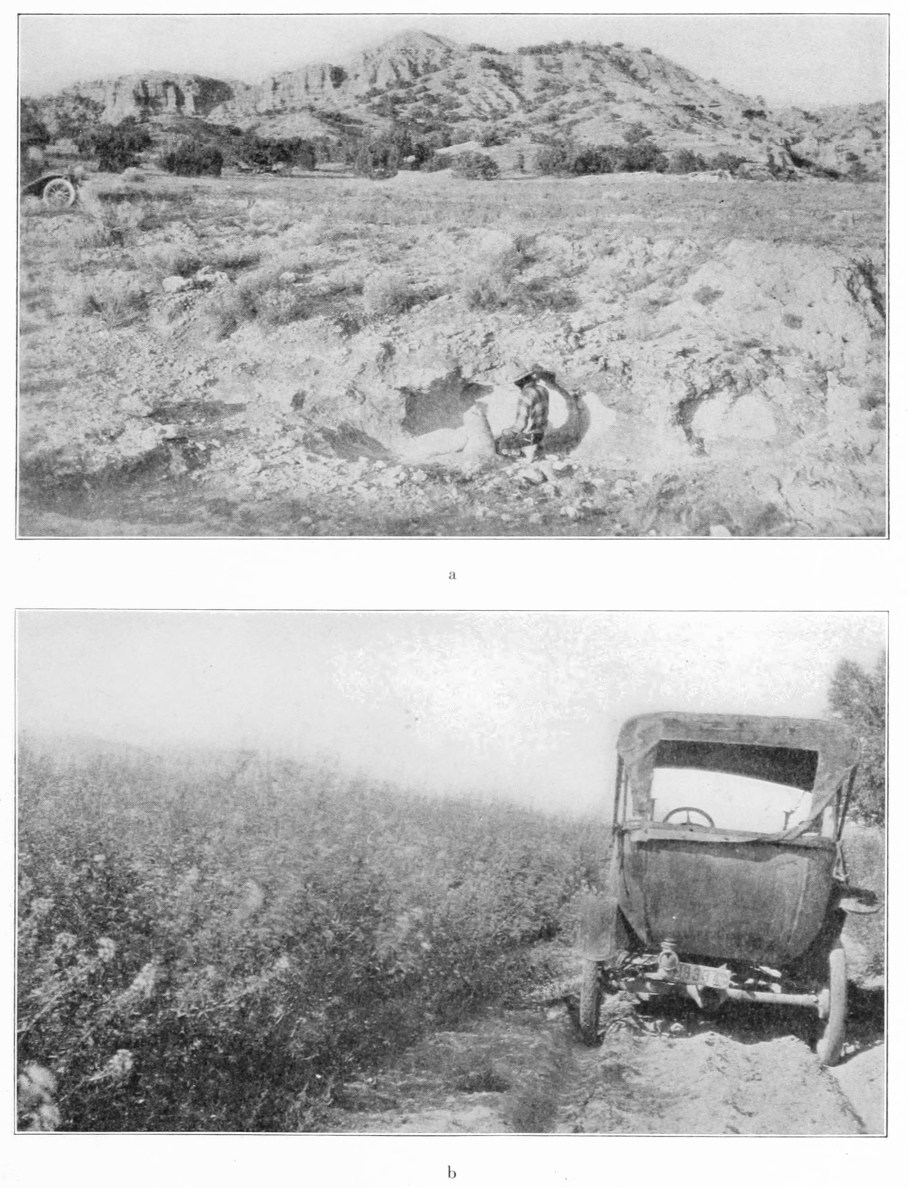
PLATE 10
a. Indian digging material for tempering pottery from an outcrop near the village.
b. Guaco, or Rocky Mountain Bee Plant, from the juice of which is made black paint for decorating pottery.
White Clay
White clay is used interchangeably with red, but the two are never mixed. It is obtained in the bad-lands to the northeast of San Ildefonso, from the side of an arroyo at some distance from the village. The Indians dig it, bring it home, and prepare it in exactly the same manner as the red clay. The color, when dry, is greyish white; when wet, brownish grey.
Temper
The Indians of San Ildefonso obtain their tempering material from outcrops along the Santa Fe-Española road, in the vicinity of the landmark known as Camel Rock. Near the crest of the first high hill crossed by the road north of Camel Rock, just west of the road, in the eastern bank of the cut of the old abandoned road, is a small cave made by the digging of this temper (pl. 10, a). There is another outcrop in the ridge of which Camel Rock is a part. This mineral is a very light grey in color. When freshly exposed to the air it is soft and crumbly—fragments as large as the fist can be crushed in the hand—but after being exposed for some time it hardens. When chopped out with an axe or hatchet it takes the form of small fragments and fine powder. There are veins and nodules of a hard yellow rock in the stratum, which are chopped out and thrown away. The source of the temper is at such a distance from the pueblo that trips to it are made only at long intervals when a large quantity is secured in cement-bags, and carried home in a wagon. Two cement-bags may be filled with from fifteen to twenty minutes’ work at the quarry.
Some of the Indians, while still at the quarry, pound the temper with an axe or hatchet, or a stone, to break the larger pieces and remove the coarser impurities. Others wait to clean it until reaching the house. In the latter case the temper is spread on a cloth or skin; the skin being preferred as offering a smoother, more resistant surface. It is then broken up by trampling it with moccasined feet. Formerly the Indians ground the temper on their metates. The final step in the preparation is to pass the material through a sieve to remove the smaller impurities such as sand and crushed rock. Before the sieve was known, the Indians spread the temper in a very thin layer on a board or skin, and went over it carefully and painstakingly with their fingers, feeling for any slight irregularities or rough places. The temper when cleaned is a fine powder, which looks and feels like dry cement. It is stored in old cement-bags ready to be mixed with the clay.
The purpose of the addition of tempering material is to counteract the tendency of the pure clay to crack during the shrinkage that takes place in sun-drying and in firing. If, however, there is too much temper, the clay becomes “short” and loses its adhesiveness. The Indians understand this fully, for if vessels crack badly during sun-drying, they are ground up, and more temper is added to the paste before it is used again; if, on the other hand, a pot will not retain its shape while being moulded, it is pulled down, more dry clay added to the paste, and the mass rekneaded.[10]
Cooking-Vessel, or Apache, Clay
This is very different from the two other kinds of clays used. It is light brown in color, with a large quantity of fine mica flakes in it[11]; it also has a distinctive odor. When wet it smells cleaner and fresher than the red or white clay, like a newly plowed field after a shower. Some of the San Ildefonso Indians obtain this clay from Las Truchas, a mountain district to the northeast of the village[12]; others get it from Santa Fe Canyon. It is dug either with the hand or with a small stick, and is brought to the pueblo in the form of small lumps. While still in this condition, it is stored in vessels or bags.
The preparation for use is very different from that of the other clays. The lumps are put in a receptacle, such as an enameled washbasin, and sufficient water is added to saturate them. If too much water has been mixed in, the mass is put in the sun to dry out for a while. After the clay has been thoroughly softened by the water, the next step is to remove the pebbles. A small handful is carefully and slowly squeezed and kneaded in the left hand, while the thumb and forefinger of the right are used to pick out the numerous small pebbles as they are encountered. After most of these have been removed, the clay is put on a canvas or skin, and a small part of it at a time is flattened out with the heel of the right hand, pressing away from the body, and against the cloth or skin so as to produce a very thin layer, in which the smaller pebbles are readily felt and from which they can easily be eliminated. Finally when this has been done with all the clay, the whole mass is kneaded together, just as the red and white clays are kneaded. When a uniform consistency has been attained—that of putty—the mass is ready for use. The removal of pebbles and the kneading consume from one-half to three-quarters of an hour. The pebbles which have been removed are placed in a small lard-pail containing water, and when the clay adhering to them has dissolved, they are thrown away and the clayey water is used in the process of moulding the paste.
The most important difference between this clay and the others is that no temper of any kind is mixed with it; the clay, after being cleaned, is used in the vessels just as it came out of the claypit. The fine mica flakes probably act as temper.
Slips and Paints
Native Slip[13]
This is a white, flaky, fairly soft mineral, which is used in solution to give a white outer coating to the bodies of vessels. It is found at some distance from the pueblo, beyond the bad-lands which are visible to the northeast. When the Indians reach the place they pick up small sticks to use as digging tools, but if the deposit happens to be soft enough, the material is merely scooped out with the hand. It is carried home in shawls or bags, and placed in the sun to dry thoroughly; then stored in pottery vessels, usually ollas. It receives no further treatment at this time. When preparing it for use, the Indians simply place it in water as it is, in small lumps. The container is either a small pottery vessel or an enamelled basin. A sufficient amount is mixed with the water to give it the color of milk, but not to thicken it. Occasionally the consistency of thin cream is obtained. Undissolved lumps remain in the solution.
Santo Domingo Slip
This substance, known to the Indians of San Ildefonso either as “Santo Domingo white” or “Cochiti white”, is usually obtained from the Santo Domingo people; it is dug, according to some informants, in the same manner as the native slip. In color and general appearance it is exactly like the latter, but its surface feels more soapy. Santo Domingo slip has largely replaced the native product, because when applied it does not need to be polished with a stone, as does the native slip. It is prepared for use in exactly the same manner as the native slip.
Red Slip
This is a rather loose red earth, which is dug either with the hands or, if conditions demand it, with a small stick. The San Ildefonso Indians obtain it near Santa Fe, but not all of the women know the exact location of the beds. One informant said it was found in Santa Fe Canyon, east of the town, a short distance below the Apache clay beds, at a spot where the convicts from the Penitentiary get material for their bricks. There are three different colors of clay at this place, red, yellow, and white. The red is the clay under discussion. The white is used to color the women’s moccasins.[14]
This slip is handled in much the same manner as the other clays. It is brought home in the usual receptacles—either shawls or bags—and placed in the sun to dry thoroughly. It is then stored, usually in ollas or other earthenware vessels, without further treatment.
There are two ways of preparing red slip for use, according to the kind of vessel for which it is intended. For polished black ware, it is simply mixed to a thin solution with water. For decorated red ware, the process is slightly complicated. At some previous time, equal parts of temper and native slip have been mixed in water and allowed to dry in cakes. When desired for use on a vessel, the cakes are broken and redissolved in water. A sufficient amount is put in to give the water an opaque, milky color, but not to thicken it. To this mixture is added a thin solution of the red slip. There is, apparently, no definite rule in regard to the amount of the red solution to be added. The woman simply puts in enough to give to the slip, when applied to a pot, the proper shade of red. In some cases this mixing of the red and white is done once for all at the beginning of the application of the red slip. In other cases the woman has a bowl of each solution beside her, and from time to time, as she works, adds some of the red to the white. In each bowl lumps of the undissolved substances still remain. Occasionally the slip is stirred to the consistency of cream, but nearly always it has that of water.
Orange-Red Slip
This substance is a yellow clayey earth, in texture somewhat like the two white slips. It occurs in the “Valle” to the west, beyond the first Jemez range, near Ojo Caliente. It is dug with a stick, in the same manner as the native white, and is carried home in shawls and bags. Before being stored it is put out in the sun to dry thoroughly, then placed in ollas and kept until needed. Like the other slips, it is prepared for use by being mixed with water. A saturated solution is made, but the consistency remains that of water.
This material, which in solution is a brilliant yellow, is used for two purposes—as a slip to color the bases of bowls and ollas, and as a paint to supply the red elements of polychrome designs. After being fired it assumes an orange-red or burnt-sienna color.[15]
Black Ware Paint
This is a paint used for making matte designs on polished black ware, a new departure in decorative technique first used by Maria and Julian Martinez of San Ildefonso, in June, 1921. The substance is a hard yellow stone, said to occur in the “Valle”, west of the Jemez range, near Ojo Caliente, in the same district as the orange-red paint.
The first step in preparing the paint for use is to scrape the stone with a knife. The resulting powder is mixed with water, and there is then added about one-fourth as much dissolved “guaco” (see below) as there is paint. It is said that the purpose of the guaco is to make the paint “stick” to the polished surface. This paint, when ready for use, is kept in a small earthenware or china dish. The consistency of the mixture, like the other paints, is that of water.
Black or Guaco Paint
This is the only vegetable paint used by the San Ildefonso Indians for the decoration of their pottery. It is obtained from a very common weed, known as the Rocky Mountain Bee Plant, or Guaco,[16] which grows in the moister flats of this district in great profusion. It flowers late in July and early August, and the seedpods open toward the first of September. The Indians say it grows at a given place only in alternate years. In favorable spots the plants attain a height of five or six feet (pl. 10, b).
The plant is gathered during April and May, when the shoots are only six to ten inches high, and therefore tender. Great quantities of it are carried home in shawls and bags. It is placed with water in Apache-clay cooking-pots, and is boiled over an open fire, never on a stove. As guaco has a bitter taste (“hot like pepper”, the women describe it) when not cooked sufficiently, it is necessary to boil it until this unpleasant flavor has disappeared. Over a hot fire half a day is long enough, but often a whole day is required. Then the liquid is drained into wide-mouthed earthen vessels and placed in the sun to harden into a solid, black, rather sticky, mass. Some women reboil the liquid until it thickens, before placing it in the sun. Metal containers are not used, because they are said to spoil the color. The informants stated that hardened guaco was not eaten. When it has become completely solidified it is set away for future use in painting. It will keep indefinitely.
The residue in the pot, after the liquid has been poured off consists of tender stems and leaves. This is eaten by the Indians, and is not unlike spinach.
The hardened guaco juice is stored at least a year before it is used in painting; the longer it is kept the better black it produces. If it is used during the first year, the resulting color on the vessel is a streaky blue-black.
Guaco is prepared for use in painting in the same manner as the other pigments. A chunk of the hardened mass is broken off and dissolved in water. One informant makes a solution which, although black, has the consistency of water. The others use a syrupy solution almost like thin molasses. The paint has a distinctive, not unpleasant, vegetable odor, and is rather sticky. Any small, wide-mouthed Indian bowl, not too shallow, is used as a paint-cup. In this bowl there is always a stirring-stick, usually a splinter from a board.
Fuel
Manure
Both cow-manure and horse-manure are used for fuel in burning pottery, but sheep-dung, when obtainable, is preferred, because it is thought to make a hotter fire.
The cow-manure is collected from the corrals, and while still soft is patted into large circular cakes, sixteen to twenty inches in diameter. These, after being hardened in the sun, are stored in a dry room until needed. Such circular cakes, with the hand-prints showing, are usually employed for making the top of the oven.
The horse-manure is obtained from the corrals in the early spring, where during the winter it has been trampled down by the horses into a compact layer a foot or more thick. When the corrals are cleaned during April this deposit is cut with an axe into chunks roughly two feet square. After being removed, the squares are split with an axe into slabs several inches thick, which are then stood up against the bases of house or barn walls to dry in the sun, and later stored indoors until needed. Disused bread-ovens sometimes serve as temporary storage places. Further splitting of the slabs may be done at the time of firing. When used in the ovens the slabs are from one to two inches thick.
Sometimes the slabs of manure are placed in the sun for a day or two before being burned, but often they are taken directly from the store-room to the fire, where they are supplemented by dried manure collected from the pastures.
During the burning of polished black ware (see p. 74) the oven is smothered with loose manure, which is brought in galvanized washtubs directly from the stables and corrals, either at the time of burning, or on the preceding day.[17]
Kindling
For starting the fire in the oven no wood but cedar is ever used. This is cut into pieces from six to eighteen inches long and is split into fine kindling at the time of burning.
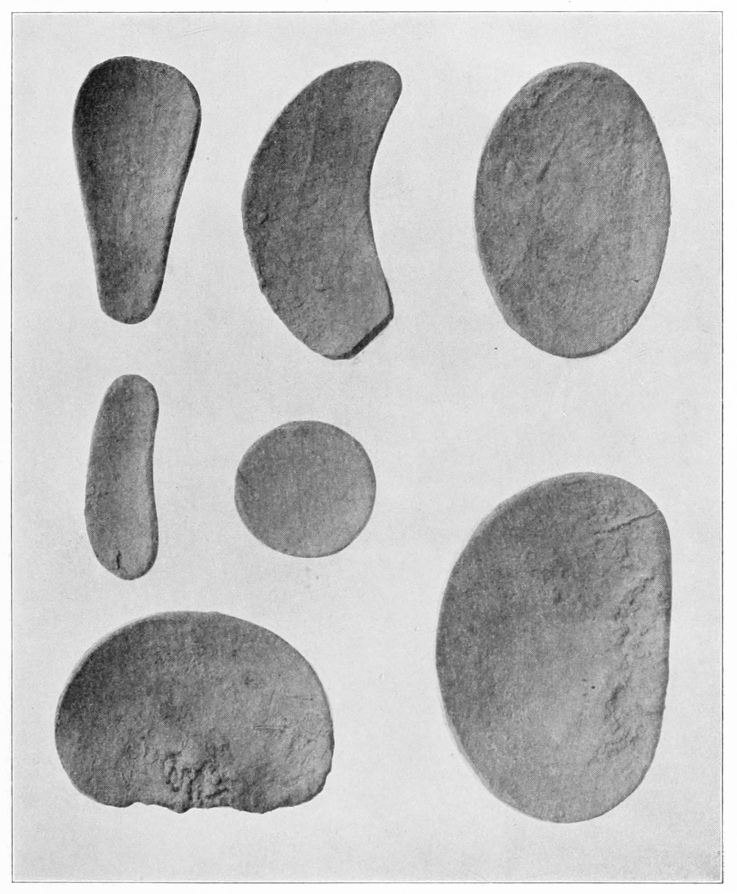
PLATE 11
Gourd spoons, or kajepes, used to shape and smooth the walls of vessels.