Volume 1 / Part 3 — SECTION B. ADDITION, MULTIPLICATION AND EXPONENTIATION.
Reading edition
Summary of Section B.
In the present section, we have to consider the arithmetical operations as applied to cardinals, as well as the relation of greater and less between cardinals. Thus the topics to be dealt with in this section are the first that can properly be said to belong to Arithmetic.
The treatment of addition, multiplication and exponentiation to be given in what follows is guided by the desire to secure the greatest possible generality. In the first place, everything to be said generally about the arithmetical operations must apply equally to finite and infinite classes or cardinals. In the second place, we desire such definitions as shall allow the number of summands in a sum or of factors in a product to be infinite. In the third place, we wish to be able to add or multiply two numbers which are not necessarily of the same type. In the fourth place, we wish our definitions to be such that the sum of the cardinal numbers of two or more classes shall depend only upon the cardinal numbers of those classes, and shall be the same when the classes overlap as when they are mutually exclusive; with similar conditions for the product. The desire to obtain definitions fulfilling all these conditions leads to somewhat more complicated definitions than would otherwise be required; but in the outcome, the result is simpler than if we started with simpler definitions, since we avoid vexatious exceptions.
The above observations will become clearer through their applications. Let us begin with the case of arithmetical addition of two classes.
If and are mutually exclusive classes, the sum of their cardinal numbers will be the cardinal number of . But in order that and may be mutually exclusive, they must have no common members, and this is only significant when they are of the same type. Hence, given two perfectly general classes and , we require to find two classes which are mutually exclusive and are respectively similar to and ; if these two classes are called and , then will be the sum of the cardinal numbers of and . We note that and indicate respectively the 's of the same types as and , and accordingly we take as and the two classes these two classes are always of the same type, always mutually exclusive, and always similar to and respectively. Hence we define
The sum of the cardinal numbers of and will then be the cardinal number of ; hence we may call the arithmetical class-sum of two classes, in contradistinction to , which is the logical sum. It will be noted that , unlike , does not require that and should be of the same type. Also is not identical with , but when , is also , though in a different type. Thus the law of tautology does not hold of the arithmetical class-sum of two classes.
If and are two cardinals of assigned types, we denote their arithmetical sum by . (As many kinds of arithmetical addition occur in our work, and as it is essential to our purpose to distinguish them, we effect the distinction by suffixes to the sign of addition. It is, of course, only in dealing with principles that these different symbols are needed: we do not wish to suggest that they should be adopted in ordinary mathematics.) Now if is to have the properties which we commonly associate with the sum of two cardinals, it must be typically ambiguous, and must be the cardinal number of any class which can be divided into two mutually exclusive parts having terms and terms respectively. Hence we are led to the following definition:
In this definition, various points should be noted. In the first place, it does not require that and should be of the same type; is significant whenever and are classes of classes. Thus it is not necessary for significance that and should be cardinals, though if they are not both cardinals, . If they are both cardinals, we find
Thus in this case .
Hence if neither nor is null, and if has terms and has terms, is a member of . It easily follows that
Hence when and are homogeneous cardinals (i.e. when they are cardinals other than ), their sum is the number of the arithmetical class-sum of any two classes having terms and terms respectively.
A few words are necessary to explain why, in the definition, we put rather than . The reason is this. Suppose either or , say , is . Then, by *102·73, , if is of the appropriate type. Hence if we had put where the ambiguities of type involved in and may be determined as we please, we should have We should also have and so on. Thus would not have a definite value, i.e. it would not merely have typical ambiguity, which it ought to have, but it would not have a definite value even when its type was assigned. Thus such a definition would be unsuitable. For the above reasons, we put in the definition, and obtain the typical ambiguity which we desire by means of the typical ambiguity of the "" in "." It is always essential to right symbolism that the values of typically ambiguous symbols should be unique as soon as their type is assigned. The scope of these definitions and of the corresponding definitions for multiplication and exponentiation (*113·04·05.*116·03·04) is extended by convention of the prefatory statement.
The above definition of is designed for the case in which and are typically definite. But we must be able to speak of "," and this must be a definite cardinal, namely . If we simply write in place of , in the definition of , we find But this will not always have a definite value when the type of is assigned. To take a simple case, write for and for . Then whence we easily obtain If we determine the ambiguity of to be , we find in all types; but if we determine the ambiguity to be , we have and this exists in the type of , if not in lower types. Hence the value of depends upon the determination of the ambiguity of . It is obvious that we want our definition to yield in all types; but in order to insure that this shall hold even when, for some values of , , we must introduce two new definitions, namely This definition is to be applied when "" and "" occur without any determination of type. On the other hand, if we have and , we apply the definition of . We shall find that whenever and both exist, Thus the above definition is only required in order to exclude values of or for which either or is .
The commutative and associative laws of arithmetical addition are easily deduced from the definition of . We shall have because each = . A similar though slightly longer proof shows that
The above definition of enables us to proceed to the sum of any finite number of classes, and allows any one class to recur in the summation. But it does not enable us to define the sum of an infinite number of classes. For this we need a new definition. Since an infinite number of classes cannot be given by enumeration, but only by intension, we shall have to take a class of classes , and define the arithmetical sum of the members of . Thus now the classes which are the summands must all be of the same type (since they are all members of ), and no one class can occur more than once, since each member of only counts once. (In order to deal with repetition, we must advance to multiplication, which will be explained shortly.) Thus in removing the limitation to a finite number of summands, we introduce certain other limitations. This is the reason which makes it worth while to introduce the above definition of in addition to the definition now to be given.
If is a class of classes, the sum of the cardinal numbers of the members of will evidently be obtained by constructing a class of mutually exclusive classes whose members have a one-one relation to the members of corresponding members of . Suppose , are two different members of , and suppose is a member both of and of . Then we wish to count twice over, once as a member of and once as a member of . The simplest way to do this is to form the ordinal couples and , which are not identical except when and are identical. Thus if we take all such ordinal couples, i.e. if we take the class for every which is a member of , we get a class of mutually exclusive classes, namely the classes of the form , where , each of these is similar to the corresponding member of . Hence the logical sum of this class of classes, i.e. has the required number of terms. Now, by *85·601, Hence the class whose logical sum we are taking is . Hence we put may be called the arithmetical sum of , in contradistinction to , which is the logical sum. Thus bears to a relation analogous to that which bears to .
We put further
Thus is the sum of the numbers of members of .
It is to be observed that is not in general a function of . For, if two members of have the same cardinal number, this will only count once in , whereas it counts twice in .
We shall find that, provided , Thus where a finite number of summands are concerned, the two definitions of addition agree, except that the first allows one class to count several times over, while the second does not.
In dealing with multiplication, our procedure is closely analogous to the procedure for addition. We first define the arithmetical class-product of two classes and , which is a certain class whose cardinal number is the product of the cardinal numbers of and . We write for the arithmetical class-product of and , and define it as the class of all ordinal couples of which the referent is a member of and the relatum a member of , i.e. as By *40·7, this class is . Hence we put The class is similar to , and each member of it is similar to ; hence if and , consists of classes having members each. The class is important also in connection with exponentiation.
The product of two cardinals is defined as follows: In regard to types, this definition calls for analogous remarks to those which were made on . Also, as before, we need definitions of and , whence we obtain By means of these definitions, we can define the product of any finite number of cardinals; but in order to define products which have an infinite number of factors, we need a new definition.
If is a class of classes, we take as its arithmetical product. In simple cases, it is easy to see the justification of this decision. E.g. let consist of the three classes , , , and let the members of be , ; those of , , ; those of , , . Then the members of are with four more obtained by substituting for in the above. Thus . In general, however, the existence of is doubtful, owing to the doubt as to the validity of the multiplicative axiom. (We shall return to this point shortly.) Hence there is no proof that the product of an infinite number of factors cannot be zero unless one of the factors is zero.
When is a class of mutually exclusive classes, is similar to . On account of its lower type, is often more convenient than . Hence we put or (what comes to the same thing) For the product of the cardinal numbers of the members of , we put As in the case of , is not in general a function of . We shall have Thus for products of a finite number of different factors, the two definitions of multiplication agree.
It remains to define exponentiation. Since this is not a commutative operation, it essentially involves an order as between the base and the exponent; hence we do not obtain a definition of the exponentiation of a class , analogous to or , but only a definition of , which may be extended to any finite number of exponentiations. We put where has the meaning explained above, resulting from *38·03. It will be observed that, if and , is a class of mutually exclusive classes each of which has terms; hence may suitably be used to define . Hence we put and for the same reasons as before, we put
The above definition of exponentiation gives the same value of as results from Cantor's definition by means of "Belegungen." The class of Cantor's "Belegungen" is and it is easily proved that this is similar to .
The usual formal properties of exponentiation result without much difficulty from the above definitions.
The above definition of exponentiation is so framed as to make propositions on exponentiation independent of the multiplicative axiom, except when exponentiation is to be connected with multiplication, i.e. when it is to be shown that the product of factors, each of which is , is . This proposition cannot be proved generally without the multiplicative axiom. Similarly, in the theory of multiplication, the proposition that the sum of 's is requires the multiplicative axiom (as does also the proposition that a product is zero when and only when one of its factors is zero). Otherwise, the theory of multiplication proceeds without the need for employing the multiplicative axiom.
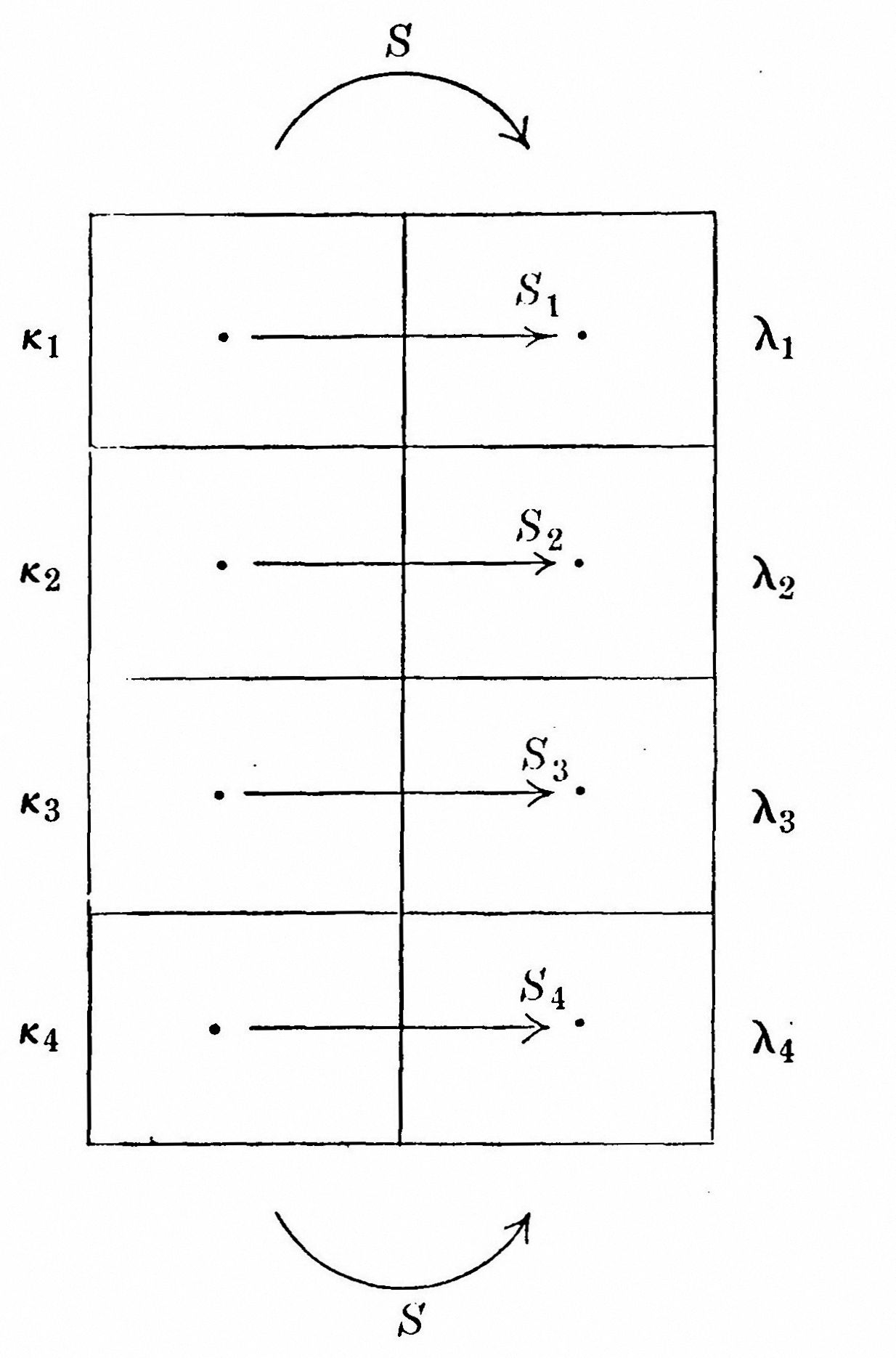
To take first the connection of addition and multiplication: this connection, in the form in which we naturally suppose it to hold, is affirmed in the proposition: We will take the first of these as being simpler. It affirms that the sum of 's is . This can be proved when is finite, whether is finite or not; but when is infinite, it cannot be proved without the multiplicative axiom. This may be seen as follows. We know that Thus (A) above will result if we can prove since we shall put for , and use (B).
Since , , we have . Assume Let , , ... be members of , and let , , ... be the members of which are correlated with , , ... by , i.e. . We have, since , , . Thus , i.e. . If and are finite, we can pick out arbitrarily a correlation for and , another for and , and so on; then ... correlates and , and therefore . But when and are infinite, this method is impracticable. In this case, we proceed as follows.
By *73·01, .
Thus "" will stand for all the permutations of a class into itself; "" stands for all the permutations of into , i.e. all the 's whose domain is and whose converse domain is . It is obvious that In the case of the and above, we know that when ; thus where "" stands for "correspondence." Thus is the class of all correspondences of and ; is the class of all such classes of correspondences. If we extract one member out of each of these classes of correspondences, we get a class of relations whose sum is a correlator of and ; i.e. Thus the desired result follows whenever Now we have .
Consequently whence, by what was said previously,
The consideration of leads similarly to the proposition The proof is closely analogous to that for the connection of addition and multiplication.
It will be seen that, in the above use of the multiplicative axiom, we have two classes of classes and concerning which we assume i.e. we assume that and are similar classes of similar classes. A slightly modified hypothesis concerning and will enable us to obtain many results, without the multiplicative axiom, which otherwise might be expected to require this axiom. This is effected as follows.
Put , where "" is a single symbol representing a relation.
When this relation holds between and , we shall say that and have "double similarity." In this case, correlates and , while correlates and , so that if is a member of , , i.e. , is its correlate in . We shall then have
Also we have Conversely, whence Hence the multiplicative axiom is only required in order to pass from to . It is this fact, and the consequent possibility of diminishing the use of the multiplicative axiom, which has led us to the employment of "" in the present section.
We treat also, in this section, the relation of greater and less between cardinals. We say that when there is a part of which is similar to , but no part of is similar to . The principal proposition in this subject is the Schröder-Bernstein theorem, i.e. This is an immediate consequence of *73·88. It cannot be shown, without assuming the multiplicative axiom, that of any two cardinals one must be the greater, i.e. If we assume the multiplicative axiom, this results from Zermelo's proof that on that assumption, every class can be well-ordered, together with Cantor's proof that of any two well-ordered series which are not similar, one must be similar to a part of the other. But these propositions cannot be proved till a much later stage (*258).