Volume 1 / Part 3 — *121. INTERVALS.
Reading edition
*121. INTERVALS.
Summary of *121.
The present number is concerned with the class of terms between and with respect to some relation , i.e. those terms which lie on a road from to on which any two consecutive terms have the relation . Such a road may be called a -road, and if , the step from to may be called a -step. In order that a -road from to should exist, it is necessary and sufficient that we should have . When this condition is fulfilled, there will in general be many -roads from to . But if , or if ,then at most one road leads from to . This follows from the propositions of *96. In virtue of those propositions, if , is throughout the road from to , and this road forms an open series. The two other possibilities with a are (assuming )
In the first case, there is a cyclic road from to , and there are two roads from to , one consisting of that part of the cycle which is required to reach , the other consisting of this part together with the whole cycle required to travel from back to . Thus the class of terms which can be reached in some journey from to is the whole class of descendants of , i.e. the class , which is the cycle composing the road from to .
In the second case, the descendants of form a , and is in the circular part of the . Here, as before, there are two roads from to , of which the first stops as soon as it reaches , while the second proceeds to travel round the circle until it comes to again. Thus here again, all the descendants of lie on some road between and .
The interval between and is defined as the class of terms lying on some road from to . There will be four kinds of interval, according as we do or do not include the end-points as such. We denote the kind including both end-points by that excluding both by and the other two respectively by
The definitions are
If is either one-many or many-one, it will be one-one throughout the interval , except at most at one exceptional point, namely the junction of the tail and circle of the . If or , the interval between and cannot be -shaped, but must be either open or cyclic; in either case, is throughout , with no exceptions; for if , is throughout the interval because the interval is contained in , and if , because the interval is contained in . Thus throughout this number we shall constantly have the hypothesis ; if , the interval is to be supposed traversed from to , while if , it is to be supposed traversed from to . In either case the interval between and must be an inductive class. This is proved in *121·47. If, however, is serial (cf. *204), and thus neither many-one nor one-many, the interval between and is the stretch of the series between and , with or without end-points according to the definition chosen, and need not be an inductive class.
If the interval between and (both included) has members, we say that . Thus if there is only one road from to , "" means that it requires steps to get from to . Assuming , if we also have (i.e. if none of the families of are cyclic), then if and , we shall have . On this basis an inductive theory of is built up, and it is shown that the class of such relations as for different inductive values of is the same as , the class of powers of including (*121·5). The definition of is
The whole class of such relations as for different inductive values of is called , i.e. we put
If exists, and if , then the descendants of , so long as we do not reach a term for which , may be unambiguously described as the 2nd, 3rd, ... th, ... terms of the posterity of , itself being the 1st term. The correlation thus effected with the inductive cardinals is the logical essence of the process of counting; the last cardinal used in the correlation is the cardinal number of terms counted. We will call these terms , , ... , ..., defining as follows:
This notation does not conflict with as defined in *65.01. There must be a class if is a cardinal, here must be a cardinal and a relation.
Hence whenever exists, the number of terms from the beginning to (both included) is . This is the fact upon which counting relies. If is a many-one and is contained in diversity, and is any inductive cardinal other than 0, then exists when and only when has at least members; i.e. roughly speaking, exists whenever it could possibly be expected to exist. In this case the whole posterity of is contained in the series , , ... , ... (*121·62). If the posterity is an inductive class, this series stops; if not, it forms a progression (cf. *122).
The propositions of the present number are very useful, not only in this section, but in the ordinal theory of finite and infinite and in parts of the book subsequent to that theory.
After some propositions which merely repeat definitions and give immediate consequences, we proceed (*121·3 ff.) to the theory of . We have
*121·302.
*121·305.
*121·31.
When is a transitive serial relation, we shall have .
*121·321.
*121·333.
*121·35·351·352.
A similar result holds for , which = n the same circumstances.
We next proceed to the proof that an interval (under a similar hypothesis) is always an inductive class. This occupies *121·4—·47, being summed up in the proposition
*121·47.
This is an important proposition. It leads to
*121·481.
with a similar proposition if .
The next set of propositions (*121·5—·52) is concerned with . Assuming , we prove that and (*121·5); that if is not null, (*121·501); that (*121·52) and (*121·502); and that etc. (*121·51).
Our next set of propositions is concerned with (*121·6—·638). We have
*121·601.
*121·602.
*121·634.
Finally we have three propositions (*121·7—*121·72) on , of which the most useful is
*121·7.
*121·01.
*121·011.
*121·012.
*121·013.
*121·02.
*121·03.
*121·031.
*121·04.
*121·1.
*121·101.
*121·102.
*121·103.
*121·11.
*121·12.
*121·121.
*121·13.
*121*131.
*121·14.
*121·141.
*121·142.
*121·143.
*121·2.
*121·201.
*121·202.
*121*21.
Dem.
*121·22.
*121·23.
*121·231.
*121·24.
Dem.
*121·241.
*121·242.
*121*25.
*121·251.
*121·252.
*121·253.
*121·254.
*121·254 is frequently used in the theory of series.
*121·26.
Dem.
*121·27.
Dem.
*121·271.
*121·272.
Dem.
*121·273.
Dem.
*121·3.
Dem.
*121·301.
Dem.
*121·302.
*121·303.
Dem.
*121·304.
Dem.
*121·305.
Dem.
*121·306.
Dem.
*121·307.
*121·308.
*121·31.
*121·32.
Dem.
If is not a cardinal, or if , .
*121·321.
Dem.
*121·322.
*121·323.
*121·324.
Dem.
*121·325.
Dem.
*121·326.
*121·327.
Dem.
*121·33·331 are lemmas for *121·332, which is a very useful proposition.
*121·33.
Dem.
From the above proposition it follows that
This does not follow unless , because will always be true if , and therefore (when ) if .
*121·331.
Dem.
*121·332.
*121·333.
*121·34.
Dem.
*121·341.
*121·342.
*121·35.
Dem.
*121·351.
*121·352.
*121·36.
Dem.
*121·361.
*121·37.
Dem.
*121·371.
*121·372.
*121·373.
*121·374.
The proofs of these propositions are analogous to the proof of *121·37.
*121·38.
*121·381.
*121·382.
*121·383.
*121·384.
*121·39.
Dem.
The following series of propositions are concerned with proving *121·47, i.e. The proof for follows from that for by *121·143. Confining ourselves, therefore, to , we proceed as follows.
We prove first that, starting from z and going backwards, each new step adds only one term (which may not be distinct from all its predecessors); i.e. we have From this it follows by induction that if is an inductive class, so is . Thus we only have to prove that is an inductive class. Here we must distinguish two cases, according as or . In the former case, we have whence is an inductive class, and therefore so is .
But in the latter case, when , the matter is more difficult. In this case, is a member of a cycle, the cycle being . We have to prove that this cycle must be an inductive class. Given , will be a member of this cycle if , and may be at the end of the tail of a , if . (Cf. *96.)
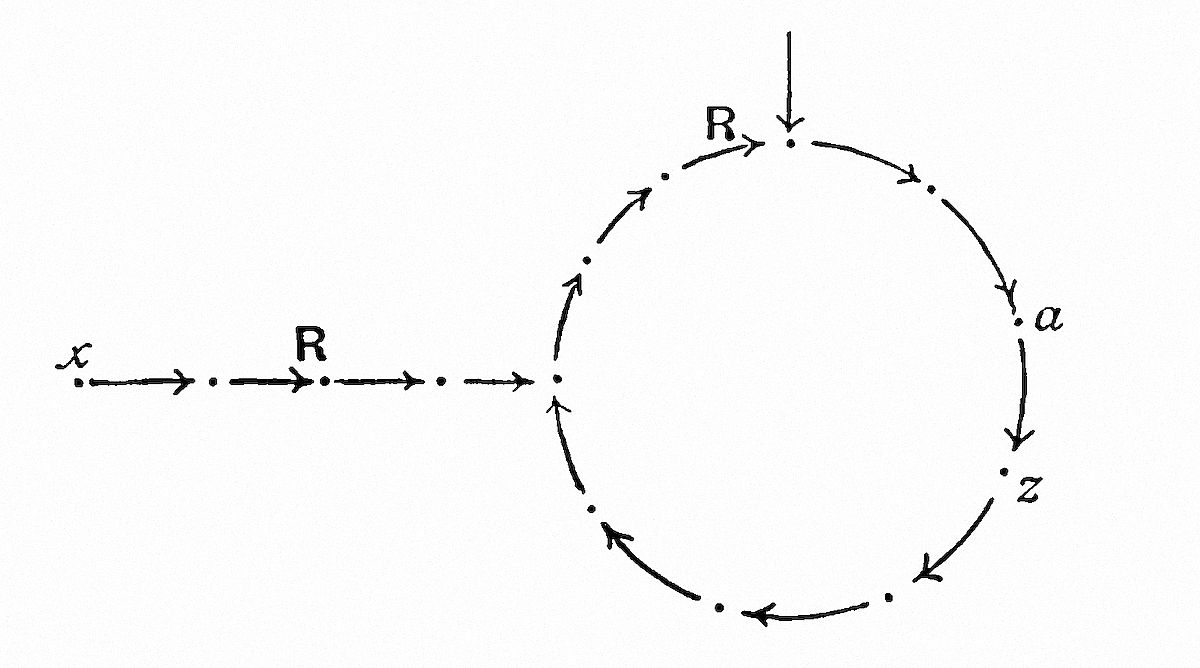
By *96·453, we know that is when confined to . Hence in , has a unique predecessor, say . Assume . We then imagine a barrier placed between and , i.e. we construct a relation which is to hold between any two consecutive members of except and . Putting , we have . Then the relation generates an open series consisting of all the terms of ; i.e. we have Hence, by our previous case, since is an inductive class, so is .
If , then by *96·33 the cycle reduces to the single term , and therefore is still an inductive class.
Hence , and therefore , is always an inductive class when , which was to be proved.
*121·4.
Dem.
*121·41.
Dem.
In virtue of this proposition, we have only to prove . This is obvious when , for then either or . But when , it is more difficult.
*121·42.
Dem.
*121·43.
Dem.
*121·431.
Dem.
*121·432.
Dem.
*121·433.
Dem.
*121·434.
Dem.
*121·44.
Dem.
*121·441.
*121·45.
*121·46.
*121·47.
*121·48.
Dem.
*121·481.
Dem.
The above proposition is used in the proof of *122·35, which is an important proposition in the theory of progressions.
The following propositions are concerned with the identification of such relations as with powers of in the sense of *91.
*121·5.
Dem.
*121·501.
Dem.
*121·502.
Dem.
*121·51.
Dem.
*121·52.
We shall at a later stage (*301) give a general definition of . When this definition has been introduced, we shall be able to prove, with the hypothesis of *121·51, The definition of is postponed on account of various complications which render a general definition of difficult. The chief difficulty arises when . Thus suppose we have ; we shall also have , , etc. Hence if we have , we have Again, suppose this case excluded, but suppose Then we shall have Thus the general definition of has to be complicated, except when .
The following propositions are concerned with the series of relations and the series of terms . The relation holds between two terms (roughly speaking) when it requires steps to get from the first to the second; the term is the th term starting from , which, when it exists, is . In order that should exist, it is necessary that should exist, and that there should be just one term in the field of such that the interval from to (both included) consists of terms. When this is the case for all inductive cardinals from 1 to , we can say that generates a series starting from and having at least terms, each correlated with one of the cardinals in the interval from 1 to , both included; i.e. the series has a th term, whenever . If this holds for all inductive values of , the family of is a progression[9]. (It will be observed that all such terms as belong to the family of , which need not form the whole field of .)
*121·6.
Dem.
*121·601.
Dem.
*121·602.
Dem.
*121·61.
Dem.
*121·62.
Dem.
*121·63.
Dem.
*121·631.
Dem.
*121·632·633 are required for proving *121·634.
*121·632.
Dem.
*121·633.
*121·634.
*121·635.
Dem.
*121·636.
Dem.
*121·637.
Dem.
*121·638.
Dem.
*121*64.
Dem.
*121·641.
*121·65.
Dem.
*121·66.
Dem.
The following proposition is used in *122·38·381.
*121·7.
Dem.
*121·71.
Dem.
*121·72.