Volume 1 / Part 4 — SECTION A. ORDINAL SIMILARITY AND RELATION-NUMBERS.
Reading edition
Summary of Section A.
Two series generated by the relations and respectively are said to be ordinally similar when their terms can be correlated as they stand, without change of order. In the accompanying figure, the relation correlates the members of and in such a way that if , then , and if , then . It is evident that the journey from to (where ) may, in such a case, be taken by going first to , thence to , and thence back to , so that , i.e. . Hence to say that and are ordinally similar is equivalent to saying that there is a one-one relation which has for its converse domain and gives . In this case we call a correlator of and .
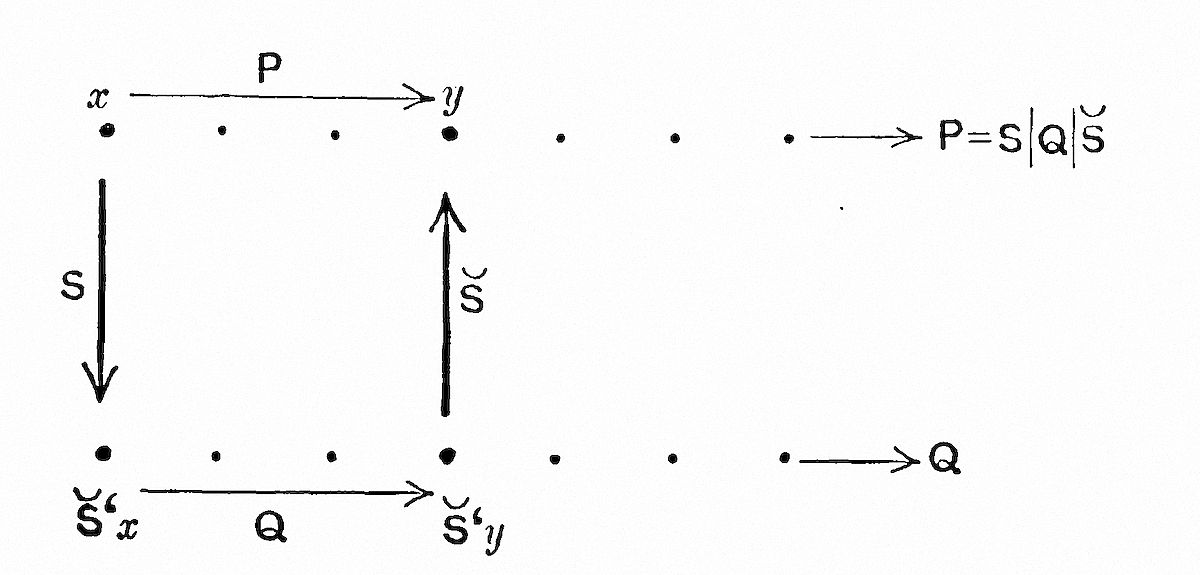
We denote the relation of ordinal similarity by "," which is short for "similar ordinally." Thus
It will be found that the relation plays the same part in relation to in relation-arithmetic as plays in relation to in cardinal arithmetic. It is therefore desirable to have a simpler notation for . We put We shall find that the semi-colon so defined has the same kind of properties in relation-arithmetic as the two inverted commas have in cardinal arithmetic. Corresponding to the notation , we put We shall thus have . It will appear that has ordinal properties analogous to the cardinal properties of . Thus e.g. where appears as a cardinal correlator, will appear as an ordinal correlator (in each case with the converse domain suitably limited).
The elementary properties of will be considered in *150. We shall then, in *151, be able to study ordinal similarity, taking as our definition of an ordinal correlator and defining two relations as ordinally similar when they have at least one ordinal correlator, i.e. putting (on the analogy of *73)
There is no need to confine the notion of ordinal similarity (or likeness, as we shall also call it) to serial relations. When two relations have ordinal similarity, their internal structures are analogous, and they therefore have many common properties. Whenever similarity has been proved between two classes and , then if is given as the field of some relation , and is the correlating relation, is like , and has for its field. Hence similar classes are the fields of like relations. It must not be supposed, however, that like relations are coextensive with relations whose fields are similar. This does not hold even when we confine ourselves to serial relations, except in the special case of finite serial relations.
The definition of relation-numbers (*152) is as follows: The relation-number of , which we call , is the class of relations which are ordinally similar to ; and the class of relation-numbers, which we denote by , is the class of all classes of the form . The elementary properties of relation-numbers, treated in *152, are closely analogous to those of cardinal numbers treated in *100.
After a few propositions about the ordinal 0 and the ordinal 2, which we call and (*153), we pass to the consideration of relation-numbers of various types. It will be observed that "," like "," is a relation which is ambiguous as to the type both of its domain and of its converse domain. Thus "" only has an unambiguous meaning when the types of and are determined. and may or may not be of the same type; the only restriction upon the type of either is that both must be "homogeneous" relations, i.e. relations whose domain and converse domain are of the same type. This restriction results from the fact that occurs in the definition of "," and a relation does not have a field unless it is homogeneous; hence must be homogeneous, and therefore, whatever may be, must be homogeneous, i.e. must be homogeneous. Thus e.g. such relations as , , or are not ordinally similar either to themselves or to anything else. Whenever "" is significant for a suitable , we have ; but if is not homogeneous, "" is never significant. Hence throughout the theory of ordinal similarity, the relations of which ordinal similarity is affirmed or denied must be homogeneous. The correlators, on the contrary, need not be homogeneous.
Owing to the homogeneity of our relations, the types of relation-numbers are much more easily dealt with than they otherwise would be; for the type of a homogeneous relation is determined by that of a single class, namely its field, whereas the type of a relation in general depends upon the types of two classes, namely its domain and its converse domain. Since, where likeness is concerned, the type of the field determines the type of the relation, propositions concerning the relations between different typical determinations of a given relation-number are, for the most part, exactly analogous to and deducible from those for cardinals. In fact, a relation ordinally similar to exists in the type of when, and only when, a class similar to exists in the type of , i.e. The half of this proposition follows from the fact that, if is like , is similar to . The other half follows from the fact, mentioned above, that if and , then there is a relation like and having for its field. Now if belongs to the type of , any relation having for its field is contained in . Hence in the case supposed there is a relation like and contained in . But the relations contained in constitute . Hence there is a relation which is like and is a member of , whence our proposition results. By means of this proposition and those of *102—6, the properties of relation-numbers with respect to types follow easily. The conventions , and apply to relation-numbers as to cardinals; they are to be applied in the same way as in the analogous propositions of Part III, Section A.