Volume 1 / Part 3 — *116. EXPONENTIATION.
Reading edition
*116. EXPONENTIATION.
Summary of *116.
In this number, we define "," meaning " to the exponent ," where and are classes, as Now consists of all ways of selecting one each from the members of , i.e. from the classes , where . Thus to get a member of , take a set of couples , where is always an , and there is only one for a given , and is each member of in succession. Thus for each member of , we have possible referents; hence it is plain that the number of possible sets of couples consists of factors each equal to , and is therefore fit to be taken as defining .
The definitions of and are derived from the definition of exactly as the definitions of and , or of and , were derived respectively from and .
The chief difficulty in this number lies in the proof of the three formal laws of exponentiation, namely The proofs of the second and third of these, in particular, require various lemmas; but there is no difficulty involved except the complexity of the classes and relations concerned.
The definition of is so framed as to minimize the necessity for the multiplicative axiom (see the note on **113·31 in the introduction to *113). We have
*116·36.
that is, assuming the multiplicative axiom, the product of factors each equal to is (assuming and to be cardinals which are not null).
If we had defined as the product of factors each equal to , we should have required the multiplicative axiom for almost all propositions on but by taking the particular class , we avoid the multiplicative axiom except in a few propositions. Among these few is the above proposition connecting exponentiation with multiplication.
Cantor has defined by means of the class of "Belegungen," i.e. the class which (*116·12) = . By *85·53 and *113·103, this class is equal to (as is proved in *116·13), whence, since , it follows (*116·15) that the class of "Belegungen" is similar to . Hence our definition gives the same value of as Cantor's.
The propositions of the present number begin with various simple properties of . Its existence follows from
*116·152.
whence (*116·16) , and
*116·18.
We have
*116·19.
in virtue of *113·13 and *115·51. *116·192 shows that, if correlates with , and correlates with , then is a double correlator of with .
We then proceed to a set of propositions on which are analogous to *113·2 ff. on . We have
*116·203.
*116·25.
and various other less useful propositions.
We then have various propositions on 0 and 1 and 2. We prove
*116·301.
*116·311.
*116·321.
(Observe that is the same cardinal as , but rendered typically ambiguous.)
*116·331.
*116·34.
(This proposition does not require that should be a cardinal.)
After the proposition (*116·36) already quoted, on the connection of exponentiation and multiplication, we proceed to a set of propositions on the case where a number of classes are all given as similar (by assignable correlations) to a given class. In *116·411, we prove that if is a class of mutually exclusive classes, each of which is similar to a given class , and if, when , is a correlator of and , and is the sum of , then This is a further connection of multiplication and exponentiation. (On the purport of this and following propositions, see the explanation preceding *116·4.) In *116·43, the hypothesis is somewhat modified. We still have a set of classes which are all similar to , but the correlator for a given class is not given as , but is given as , where is a member of a class which is similar to . Then . We assume that is a one-one, and that if and have domains which overlap, then . Thus is a class of mutually exclusive classes, each of which has terms, while has terms. Then it is proved in *116·43 that This proposition and another (*116·45) which follows from it are useful in proving the formal laws of exponentiation. The proof of these occupies the following propositions from *116·5 to *116·68. We have
*116·52.
*116·55.
*116·63.
An extension of the first of these is
*116·661.
Here the number of members of need not be finite. The purport of the proposition is as follows: Let , , , ... be the members of ; form , , , ..., and take the product of the numbers of all these; then the resulting number is the same as if we first took the sum of the numbers of all the members of , thus obtaining (say) a number , and raised to the th power.
An extension of *116·55 is given by *116·68, where we prove
There is no analogous extension of *116·63.
We prove next Cantor's proposition (which is very useful)
*116·72.
I.e. the number of combinations of things any number at a time is . (Observe that need not be finite.) The remainder of the number is concerned with consequences of this proposition.
*116·01.
*116·02.
*116·03.
*116·04.
*116·1.
*116·11.
Dem.
*116·12.
Dem.
*116·13.
Dem.
is the class of one-many relations whose converse domain is and whose domain is contained in . This is what Cantor calls the "Belegungsmenge," and is used by him as the definition of exponentiation. In virtue of *116·15, his definition gives the same results as ours.
*116·131.
Dem.
*116·14.
*116·15.
*116·151 is a lemma for *116·152.
*116·151.
Dem.
*116·152.
Dem.
*116·16.
Dem.
The above propositions are useful in establishing existence-theorems, as appears in the following propositions.
*116·17.
*116·171.
Dem.
*116·172.
Dem.
*116·18.
*116·181.
Dem.
*116·182.
*116·183.
Dem.
*116·19.
Dem.
*116·191.
*116·192.
*116·194.
Dem.
The following propositions (down to *116·27 exclusive) are the analogues of propositions with the same decimal part in *113.
*116·2.
*116·201.
*116·202.
*116·203.
*116·204.
*116·205.
*116*21.
*116·22.
*116·221.
*116·222.
*116·23.
*116·24.
*116·25.
*116·251.
*116·26.
This proposition shows that we may raise or lower the types of and as we please, without affecting the value of provided and , or rather and , exist in the new types.
*116·261.
Here "etc." covers any derivative of or whose existence follows from that of or .
*116·27.
*116·271.
*116·3.
Dem.
*116·301.
*116·31.
Dem.
*116·311.
Dem.
*116·32.
Dem.
*116·321.
It would not be an error to write "" instead of "" in the above proposition. For if the "" is typically determined so that , then . Thus in virtue of *116·321, is true whenever it is significant. But the above form gives more information, since it preserves the typical ambiguity of and .
*116·33.
Dem.
*116·311.
Dem.
*116·34.
Dem.
*116·35.
Dem.
*116·351.
*116·352.
*116·353.
Dem.
*116·36.
Dem.
In the above proposition, "" is sufficient hypothesis as to , since "" is implied by . But is essential, since if , and (provided , whence .
The above proposition connects exponentiation with multiplication.
*116·361.
Dem.
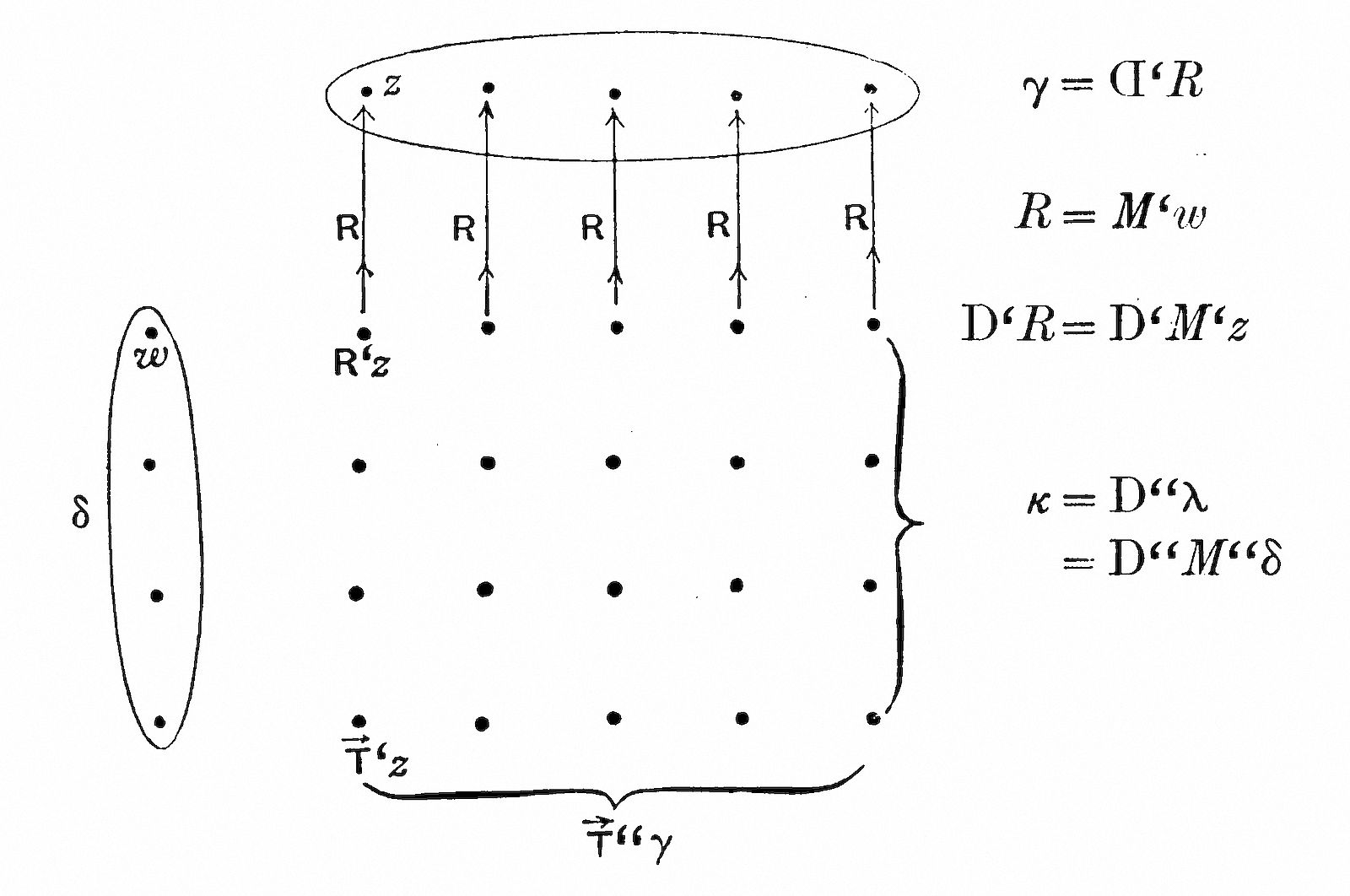
The following propositions, which illustrate certain generalizations of the relations of rows and columns, may be made clearer by the accompanying figure, in which, for the sake of simplicity, all the classes concerned are taken to be finite.
Let be a set of classes, constituted by four rows of five dots in the figure, which are each given as similar to a given class , represented by the top row of five dots in the figure, namely the row enclosed in an oval. We assume that an actual correlating relation is given correlating each member of with . Let be the class of these relations, and assume that consists of one correlator for each member of , and that . Thus , and . Put . Then, if , relates to every member of the column below , i.e. consists of the four dots which are vertically below ; assuming, what in the circumstances is possible, that each dot is placed below its correlate in . Thus represents the columns, while represents the rows.
We prove, in *116·41, that , the class of rows, has double similarity with , or, what comes to the same thing, with . Hence it follows that , which is the whole class of dots, is similar to or , and that , which is the product of the numbers of the columns, is equal to or . The correlator which is used for proving these propositions is , where, if is a member of and is a member of , correlates with .
Similarly, by correlating with , calling the correlator , we have , i.e. , whence . Hence , i.e. the class of rows, has double similarity with or , whence the product of the numbers of the rows is or .
Finally, we take a class similar to or (illustrated in the figure by the column of dots enclosed in an oval), and calling a correlator of and , we replace by and by . We thus find that, if correlates with a class of relations whose domains are mutually exclusive, and which each correlate their domains with a given class , then has double similarity with , whence the same results as before with in place of or .
The following propositions are useful in connecting multiplication with exponentiation, and in proving the formal laws of exponentiation.
*116·4·401 are lemmas for *116·41.
*116·4.
Dem.
*116·401.
Dem.
*116·41.
Dem.
The following proposition is merely another form of *116·41.
*116·411.
Dem.
*116·412·413 are lemmas for *116·414.
*116·412.
*116·413.
*116·414.
*116·42.
*116·422.
Dem.
*116·43.
Dem.
The above proposition is used in *116·534·61.
*116·44.
Dem.
*116·45.
Dem.
The above proposition is used in *116·676.
We have now to prove the three formal laws of exponentiation, namely Of these the first is an immediate consequence of the distributive law, while the second and third result from forms of the associative law of multiplication.
*116·5.
Dem.
In the last line of the above proof, *73·43 is required because the two 's involved have not been proved to be of the same type. They are in fact of the same type, but it is unnecessary to prove this.
*116·51.
Dem.
*116·52.
Dem.
The following propositions are lemmas for The principal previous propositions used in the proof are *115·6 and *116·43. The proof proceeds as follows. This, using *115·6, and putting , in place of and of that proposition, is similar to Now by *113·65, putting , . We now apply *116·43, taking as the of that proposition, or rather, taking . Thus we find Hence our proposition follows.
*116·529.
In *150, this notation will be introduced as a permanent definition. For the present, we only introduce it to avoid , which is awkward.
*116·53.
Dem.
The hypothesis is not necessary in the above proposition; but the proof is simpler with the hypothesis, and we do not need the proposition without the hypothesis.
*116·531.
Dem.
*116·532.
Dem.
*116·533.
Dem.
*116·534.
Dem.
*116·535.
The hypothesis is not necessary, as we shall now prove.
*116·54.
Dem.
In obtaining (5), we use *73·43 as well as *113·611, because 's of different types are involved.
*116·55.
Dem.
This completes the proof of the second of the formal laws of exponentiation. The following propositions are lemmas for the third of these laws, namely
*116·6.
Dem.
*116·601.
*116·602.
Dem.
*116·603.
*116·604.
Dem.
*116·605.
Dem.
*116·606.
Dem.
*116·607.
*116·61.
*116·611.
*116·62.
Dem.
*116·63.
Dem.
This completes the proof of the third of the formal laws of exponentiation.
*116·64.
*116·651.
Dem.
*116·652.
The following propositions are lemmas for *116·661, which is an extension of *116·52.
*116·653.
Dem.
*116·654.
Dem.
*116·655.
This proposition is an extension of *116·5.
The hypothesis is unnecessary in the above proposition, as we shall now prove.
*116·656.
Dem.
*116·657.
*116·658.
Dem.
*116·659.
Dem.
*116·66.
Dem.
*116·661.
This proposition is an extension of *116·52.
The following propositions are concerned in proving *116·68, which is an extension of *116·54, where the and of that proposition are replaced by the members of a class .
*116·67.
Dem.
*116·671.
Dem.
*116·672.
Dem.
*116·673.
Dem.
*116·674.
Dem.
*116·675 .
Dem.
*116·676.
Dem.
*116·68.
Dem.
The above proposition is an extension of *116·54·55.
The following propositions are lemmas for
The proposition and its proof are due to Cantor.
*116·7.
Dem.
In this and following propositions, the class is introduced solely as a known class consisting of two terms. Any other class of two terms will serve equally well.
*116·71.
Dem.
*116·711.
Dem.
*116·712.
Dem.
*116·713.
Dem.
*116.714.
Dem.
*116·715.
Dem.
*116·72.
Dem.
*116·8.
Dem.
*116·81.
Dem.
*116·82.
*116·83.
*116·9.
*116·901.
*116·91.
*116·92.