Volume 1 / Part 4 — *176. EXPONENTIATION.
Reading edition
*176. EXPONENTIATION.
Summary of *176.
The definition of exponentiation is framed on the analogy of the definition in cardinals, i.e. we put We put also, what is often a more convenient form,
The relation has for its field (unless ) the class of Cantor's "Belegungen," i.e. the class . It arranges these by a form of the principle of first differences, namely as follows : Suppose and are two members of , and suppose there is in a term for which the -representative precedes the -representative , i.e. for which , and suppose further that all terms in which are earlier than , i.e. for which , have their -representative and their -representative identical; in this case we say that has to the relation . This may be stated as follows, provided we assume that and are series: Let and be two one-valued functions whose possible arguments are all the members of , while their values are some or all of the members of . Then we say that has to the relation if the first argument for which the two functions do not have the same value gives an earlier value to than to .
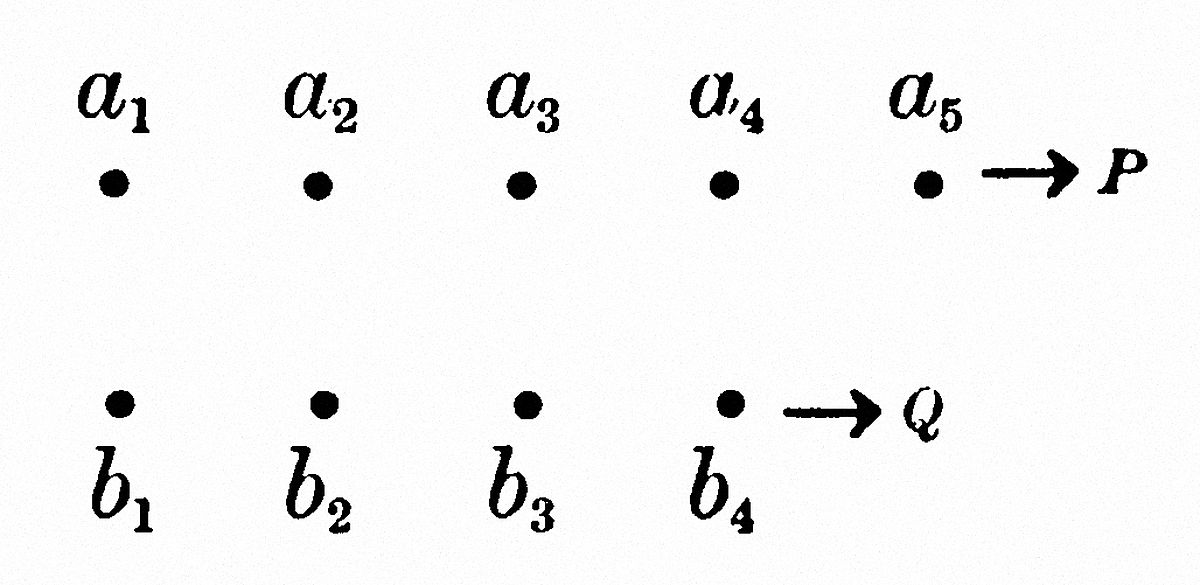
Thus for example let be the series , , , , , and let be the series , , , . Then and are to be such that or is defined when, and only when, is or or or , and the value of or is or or or or . Then if and , precedes ; if , and , precedes ; and so on. Thus in this case the first term of the series generated by is the one for which when has any of the values , , , . Thus the first term of the series is , i.e. . The next term will be The next is , and so on. This makes it evident that our series has the structure required of a series which is to represent the th power of .
The two relations and are ordinally similar, since is one-one when its field is limited to . This follows from *116·131, together with
If is a correlator of and , and is a correlator of and , then and , with their converse domains limited, are respectively correlators of with and of with . This shows that the relation-number of depends only upon those of and , which is of course essential if is to afford a definition of exponentiation.
If the multiplicative axiom is assumed, then if is a relation which is like , and whose field consists of relations which are like , and , the product of is like . That is, if we put , so that consists of terms each of which has terms, the product of has terms. This gives the connection of multiplication with exponentiation.
There are two formal laws of exponentiation which hold for relation-numbers, namely They both need a hypothesis: the first needs while the second needs because it is proved by means of the associative law (*174·43).
The first of the above formal laws can be generalized, by putting in place of , and taking the product of the various powers where , , ... , and the products are taken in the order determined by . The resulting generalization is
The proof of this proposition results immediately from *174·43 and *162·35.
The proof of the second of the formal laws is more difficult. We observe, to begin with, that
Assuming suitable hypotheses, this, by *162·35, which is like , by *174·43. But . Thus our result will follow if we can prove Now one member of the field of will be
This is like , because . Hence is a series of terms each of which is like , and the whole series of such terms is like . If we assumed the multiplicative axiom, this would suffice to prove the result. But it is possible to obtain our result without assuming the multiplicative axiom.
For this purpose, we proceed as follows. The correlator of is , by *165·361 and *172·3. Call this . Then This, by the help of two or three lemmas, suffices to prove that whence the result follows.
The principal propositions of the present number are the following:
*176·1.
*176·11.
These propositions merely embody the definitions.
*176·14.
*176·151.
It will be observed that in relation-arithmetic, , whereas in cardinal arithmetic . The difference is due to the fact that there is no ordinal number 1 (cf. *153).
*176·181.
*176·182.
*176·19.
*176·2.
*176·21. With the same hypothesis, correlates and .
*176·22.
*176·24.
This proposition connects multiplication and exponentiation.
*176·31.
*176·311·32·321. Similar propositions for ,
*176·34.
We come next to the formal laws. We have
*176·42.
*176·44.
This is an extension of *176·42.
*176·57.
*176·01.
*176·02.
*176·1.
*176·11.
*176·12.
Dem.
The above proposition is used in *176·19. It has the merit of giving a direct formula for , instead of one which proceeds by way of .
*176·13.
*176·131.
Owing to this proposition, propositions stating analogies between ordinal and cardinal powers mostly require the hypothesis or its equivalent, because an ordinal power whose index is zero is itself zero, whereas a cardinal power whose index is zero is 1.
*176·132.
*176·133.
*176·14.
Dem.
*176·15.
Dem.
*176·151.
*176·16.
*176·18.
Dem.
*176·181.
*176·182.
*176·19.
Dem.
The above proposition is often useful, since it gives a direct formula for , not one which passes by way of or .
*176·2.
Dem.
*176·21.
Dem.
*176·22.
*176·23.
Dem.
*176·24.
*176·3.
Dem.
*176·31.
Dem.
*176·311.
*176·32.
Dem.
*176·321.
*176·33.
*176·34.
Dem.
*176·341.
*176·35.
Dem.
The above proposition is used in the theory of finite ordinals (*261·64).
The following propositions are concerned in proving (with a suitable hypothesis) and its extension
*176·4.
Dem.
*176·41.
*176·42.
Dem.
*176·43.
Dem.
*176·44.
The following propositions are lemmas for
*176·5.
Dem.
*176·501.
Dem.
*176·502.
Dem.
*176·503.
Dem.
*176·51.
Dem.
*176·52.
Dem.
*176·53.
Dem.
*176·54.
Dem.
*176·541.
Dem.
*176·55.
Dem.
*176·56.
Dem.
*176·57.
Dem.
This completes the proof of the second formal law of exponentiation.