XXVIII. OSSIP GABRILOWITSCH
Reading edition
CHARACTERISTIC TOUCH ON THE PIANO
Arthur Hochman, Russian pianist and composer, once remarked to me, in reference to the quality of tone and variety of tonal effects produced by the various artists now before the public:
"For me there is one pianist who stands above them all—his name is Gabrilowitsch."
The quality of tone which this rare artist draws from his instrument, is unforgettable. I asked him one morning, when he was kind enough to give me the opportunity for a quiet chat, how he produced this luscious singing quality of tone.
"A beautiful tone? Ah, that is difficult to describe, whether in one hour or in many hours. It is first a matter of experiment, of individuality, then of experience and memory. We listen and create the tone, modify it until it expresses our ideal, then we try to remember how we did it.
"I cannot say that I always produce a beautiful tone; I try to produce a characteristic tone, but sometimes it may not be beautiful: there are many times when it may be anything but that. I do not think there can be any fixed rule or method in tone production, because people and hands are so different. What does for one will not do for another. Some players find it easier to play with high wrist, some with low. Some can curve their fingers, while others straighten them out. There are of course a few foundation principles, and one is that arms and wrists must be relaxed. Fingers must often be loose also, but not at the nail joint; that must always be firm. I advise adopting the position of hand which is most comfortable and convenient. In fact all forms of hand position can be used, if for a right purpose, so long as the condition is never cramped or stiff. I permit either a high or low position of the wrist, so long as the tone is good. As I said, the nail joint must remain firm, and never be crushed under by the weight of powerful chords, as is apt to be the case with young players whose hands are weak and delicate.
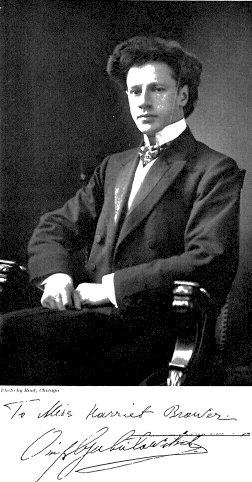
TO MISS HARRIETTE BROWER, OSSIP GABRILOWITSCH
TECHNICAL STUDY
"Yes, I am certainly in favor of technical practise outside of pieces. There must be scale and arpeggio study, in which the metronome can be used. But I believe in striving to make even technical exercises of musical value. If scales are played they should be performed with a beautiful quality and variety of tone; if one attempts a Czerny étude, it should be played with as much care and finish as a Beethoven sonata. Bring out all the musical qualities of the étude. Do not say, 'I'll play this measure sixteen times, and then I'm done with it.' Do nothing for mechanical ends merely, but everything from a musical standpoint. Yes, I give some Czerny to my students; not many études however. I prefer Chopin and Rubinstein. There is a set of six Rubinstein Studies which I use, including the Staccato Étude.
"In regard to technical forms and material, each player may need a different tonic. I have found many useful things in a work by your own Dr. William Mason, Touch and Technic. I have used this to a considerable extent. To my knowledge he was the first to illustrate the principle of weight, which is now pretty generally accepted here as well as in Europe.
"An ancient and famous philosopher, Seneca, is said to have remarked that by the time a man reaches the age of twenty-five, he should know enough to be his own physician, or he is a fool. We might apply this idea to the pianist. After studying the piano for a number of years he should be able to discover what sort of technical exercises are most beneficial; if he cannot do so he must be a fool. Why should he always depend on the exercises made by others? There is no end to the list of method books and technical forms; their name is legion. They are usually made by persons who invent exercises to fit their own hands; this does not necessarily mean that they will fit the hands of others. I encourage my pupils to invent their own technical exercises. They have often done so with considerable success, and find much more pleasure in them than in those made by others.
"Two of the most important principles in piano playing are: full, round, exact tone; distinct phrasing. The most common fault is indistinctness—slurring over or leaving out notes. Clearness in piano playing is absolutely essential. If an actor essays the rôle of Hamlet, he must first of all speak distinctly and make himself clearly understood; otherwise all his study and characterization are in vain. The pianist must likewise make himself understood; he therefore must enunciate clearly.
VELOCITY
"You speak of velocity as difficult for some players to acquire. I have found there is a general tendency to play everything too fast, to rush headlong through the piece, without taking time to make it clear and intelligible. When the piece is quite clear in tone and phrasing, it will not sound as fast as it really is, because all the parts are in just relation to each other. As an illustration of this fact, there is a little Gavotte of mine, which I had occasion to play several times in Paris. A lady, a very good pianist, got the piece, learned it, then came and asked me to hear her play it. She sat down to the piano, and rushed through the piece in a way that so distorted it I could hardly recognize it. When she finished I remonstrated, but she assured me that her tempo was exactly like mine as she had heard me play the piece three times. I knew my own tempo exactly and showed her that while it did not differ so greatly from hers, yet my playing sounded slower because notes and phrasing were all clear, and everything rightly balanced.
POWER
"How do I gain power? Power does not depend on the size of the hand or arm; for persons of quite small physique have enough of it to play with the necessary effect. Power is a nervous force, and of course demands that arms and wrists be relaxed. The fingers must be so trained as to be strong enough to stand up under this weight of arms and hands, and not give way. I repeat, the nail joint must remain firm under all circumstances. It is so easy to forget this; one must be looking after it all the time.
MEMORIZING
"In regard to memorizing, I have no special rule or method. Committing to memory seems to come of its own accord. Some pieces are comparatively easy to learn by heart; others, like a Bach fugue, require hard work and close analysis. The surest way to learn a difficult composition, is to write it out from memory. There is a great deal of benefit in that. If you want to remember the name of a person or a place, you write it down. When the eye sees it, the mind retains a much more vivid impression. This is visual memory. When I play with orchestra, I of course know every note the orchestra has to play as well as my own part. It is a much greater task to write out a score from memory than a piano solo, yet it is the surest way to fix the composition in mind. I find that compositions I learned in early days are never forgotten, they are always with me, while the later pieces have to be constantly looked after. This is doubtless a general experience, as early impressions are most enduring.
"An orchestral conductor should know the works he conducts so thoroughly that he need not have the score before him. I have done considerable conducting the past few years. Last season I gave a series of historical recitals, tracing the growth of the piano concerto, from Mozart down to the present. I played nineteen works in all, finishing with the Rachmaninoff Concerto."
Mr. Gabrilowitsch has entirely given up teaching, and devotes his time to recital and concert, conducting, and composing.