XIII. HAROLD BAUER
Reading edition
THE QUESTION OF PIANO TONE
Buried deep in the heart of old Paris, in one of the narrow, busy thoroughfares of the city, stands the ancient house in which the master pianist, Harold Bauer, has made a home.
One who is unfamiliar with Paris would never imagine that behind those rows of uninviting buildings lining the noisy, commercial street, there lived people of refined and artistic tastes. All the entrances to the buildings look very much alike—they seem to be mere slits in the walls. I stopped before one of the openings, entered and crossed a paved courtyard, climbed a winding stone stairway, rang at a plain wooden doorway, and was ushered into the artist's abode. Once within, I hardly dared to speak, lest what I saw might vanish away, as with the wave of a fairy's wand. Was I not a moment before down in that dusty, squalid street, and here I am now in a beautiful room whose appointments are all of quiet elegance—costly but in exquisite taste, and where absolute peace and quiet reign. The wide windows open upon a lovely green garden, which adds the final touch of restful repose to the whole picture.
Mr. Bauer was giving a lesson in the music salon beyond, from which issued, now and again, echoes of well-beloved themes from a Chopin sonata. When the lesson was over he came out to me.
"Yes, this is one of the old houses, of the sort that are fast passing away in Paris," he said, answering my remark; "there are comparatively few of them left. This building is doubtless at least three hundred years old. In this quarter of the city—in the rue de Bac, for instance—you may find old, forbidding looking buildings, that within are magnificent—perfect palaces; at the back of them, perhaps, will be a splendid garden; but the whole thing is so hidden away that even the very existence of such grandeur and beauty would never be suspected from without."
He then led the way to the music-room, where we had an hour's talk.
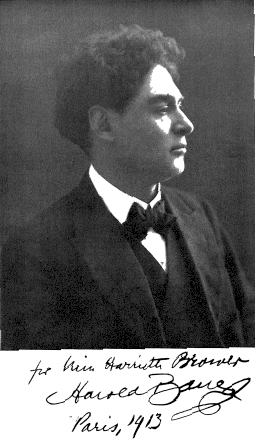
HAROLD BAUER
"I was thinking as I drove down here," I began, "what the trend of our talk might be, for you have already spoken on so many subjects for publication. It occurred to me to ask how you yourself secure a beautiful tone on the piano, and how you teach others to make it?"
Mr. Bauer thought an instant.
"I am not sure that I do make it; in fact I do not believe in a single beautiful tone on the piano. Tone on the piano can only be beautiful in the right place—that is, in relation to other tones. You or I, or the man in the street, who knows nothing about music, may each touch a piano key, and that key will sound the same, whoever moves it, from the nature of the instrument. A beautiful tone may result when two or more notes are played successively, through their difference of intensity, which gives variety. A straight, even tone is monotonous—a dead tone. Variety is life. We see this fact exemplified even in the speaking voice; if one speaks or reads in an even tone it is deadly monotonous.
VARIETY OF TONE
"Now the singer or the violinist can make a single tone on his instrument beautiful through variety; for it is impossible for him to make even one tone which does not have shades of variation in it, however slight they may be, which render it expressive. But you cannot do this on the piano: you cannot color a single tone; but you can do this with a succession of tones, through their difference, through their relation to each other. On the other hand you may say any tone is beautiful if in the right place, no matter how harsh it may be. The singer's voice may break from emotion, or simulated emotion, in an impassioned phrase. The exact note on which it breaks may not be a beautiful one, it may even be very discordant, but we do not think of that, for we are moved by the meaning back of the tones. So on the piano there may be one note in a phrase which, if heard alone, would sound harsh and unpleasant, but in its relation to other tones it sounds beautiful, for it gives the right meaning and effect. Thus it is the relation of tones which results in a 'beautiful tone' on the piano.
"The frequent trouble is that piano teachers and players generally do not understand their instrument. A singer understands his, a violinist, flutist or drummer knows his, but not a pianist. As he only has keys to put down and they are right under his hand, he does not bother himself further. To obviate this difficulty, for those who come to me, I have had this complete model of piano-key mechanism made. You see I can touch the key in a variety of ways, and the results will be different each time. It is necessary for the pianist to look into his instrument, learn its construction, and know what happens inside when he touches a key.
"As you say, there are a great many methods of teaching the piano, but to my mind they are apt to be long, laborious, and do not reach the vital points. The pianist may arrive at these after long years of study and experimenting, but much of his time will be wasted in useless labor.
"In my own case, I was forced by necessity to make headway quickly. I came to Paris years ago as a violinist, but there seemed no opening for me then in that direction. There was opportunity, however, for ensemble work with a good violinist and 'cellist. So I set to work to acquire facility on the piano as quickly as possible. I consulted all the pianists I knew—and I knew quite a number—as to what to do. They told me I must spend many months on technic alone before I could hope to play respectably, but I told them I had no time for that. So I went to work to study out the effects I needed. It didn't matter to me how my hand looked on the keyboard; whether my fingers were curved, flat, or stood on end. I was soon able to get my effects and to convince others that they were the effects I wanted. Later on, when I had more leisure, I took more thought about the position of hand and fingers. But I am convinced that much time is spent uselessly on externals, which do not reach the heart of the matter.
"For instance, players struggle for years to acquire a perfectly even scale. Now I don't believe in that at all. I don't believe a scale ever should be even, either in tone or in rhythm. The beginner's untrained efforts at a scale sound like this"—the speaker illustrated at the piano with a scale in which all the tones were blurred and run into each other; then he continued, "After a year's so-called 'correct training,' his scale sounds like this"—again he illustrated, playing a succession of notes with one finger, each tone standing out by itself. "To my thinking such teaching is not only erroneous, it is positively poisonous—yes, poisonous!"
"Is it to be inferred that you do not approve of scale practise?"
"Oh, I advise scale playing surely, for facility in passing the thumb under and the hand over is very necessary. I do not, however, desire the even, monotonous scale, but one that is full of variety and life.
"In regard to interpretation, it should be full of tonal and rhythmic modifications. Briefly it may be said that expression may be exemplified in four ways: loud, soft, fast, and slow. But within these crude divisions what infinite shades and gradations may be made! Then the personal equation also comes in. Variety and differentiation are of supreme importance—they are life!
"I go to America next season, and after that to Australia; this will keep me away from my Paris home for a long time to come. I should like to give you a picture to illustrate this little talk. Here is a new one which was taken right here in this room, as I sat at the piano, with the strong sunlight pouring in at the big window at my left."
On a subsequent occasion, Mr. Bauer spoke further on some phases of his art.
"As you already know I do not believe in so-called 'piano technic,' which must be practised laboriously outside of pieces. I do not believe in spending a lot of time in such practise, for I feel it is time wasted and leads nowhere. I do not believe, for instance, in the struggle to play a perfectly even scale. A scale should never be 'even,' for it must be full of variety and life. A perfectly even scale is on a dead level; it has no life; it is machine-made. The only sense in which the word 'even' may be applied to a scale is for its rhythmic quality; but even in this sense a beautiful scale has slight variations, so that it is never absolutely regular, either in tone or rhythm.
"Then I do not believe in taking up a new composition and working at the technical side of it first. I study it in the first place from the musical side. I see what may be the meaning of the music, what ideas it seeks to convey, what was in the composer's mind when he wrote it. In other words, I get a good general idea of the composition as a whole; when I have this I can begin to work out the details.
"In this connection I was interested in reading a statement made by Ruskin in his Modern Painters. The statement, which, I think, has never been refuted, is that while the great Italian painters, Raphael, Coreggio, and the rest have left many immature and imperfect pictures and studies in color, their drawings are mature and finished, showing that they made many experiments and studies in color before they thought of making the finished black and white drawing. It seems they put the art thought first before the technical detail. This is the way I feel and the way I work.
AVOID RESTRICTING RULES
"Because our ancestors were brought up to study the piano a certain way, and we—some of us—have been trained along the same rigid lines, does not mean there are no better, broader, less limited ways of reaching the goal we seek. We do not want to limit ourselves or our powers. We do not need to say: 'Now I have thought out the conception of this composition to my present satisfaction; I shall always play it the same way.' How can we feel thus? It binds us at once with iron shackles. How can I play the piece twice exactly alike? I am a different man to-day from what I was yesterday, and shall be different to-morrow from what I am to-day. Each day is a new world, a new life. Don't you see how impossible it is to give two performances of the piece which shall be identical in every particular? It is possible for a machine to make any number of repetitions which are alike, but a human, with active thought and emotion, has a broader outlook.
"The question as to whether the performer must have experienced every emotion he interprets is as old as antiquity. You remember in the Dialogues of Plato, Socrates was discussing with another sage the point as to whether an actor must have felt every emotion he portrayed in order to be a true artist. The discussion waxed warm on both sides. Socrates' final argument was, If the true artist must have lived through every experience in order to portray it faithfully, then, if he had to act a death scene he would have to die first in order to picture it with adequate fidelity!"
THE QUESTION OF VELOCITY
In speaking of velocity in piano playing and how it is to be acquired, Mr. Bauer continued:
"I believe the quality of velocity is inherent—an integral part of one's thought. Even a child, if he has this inherent quality, can play a simple figure of five notes as fast as they need to be played. People of the South—not on this side of the water—but of Spain and Italy, are accustomed to move quickly; they gesticulate with their hands and are full of life and energy. It is no trouble for them to think with velocity. Two people will set out to walk to a given point; they may both walk fast, according to their idea of that word, but one will cover the ground much more quickly than the other. I think this idea of a time unit is again a limiting idea. There can be no fixed and fast rule as to the tempo of a composition; we cannot be bound by such rules. The main thing is: Do I understand the meaning and spirit of the composition, and can I make these clear to others? Can I so project this piece that the picture is alive? If so, the fact as to whether it is a few shades slower or faster does not enter into the question at all.
OBTAINING POWER
"Many players totally mistake in what power consists. They think they must exert great strength in order to acquire sufficient power. Many women students have this idea; they do not realize that power comes from contrast. This is the secret of the effect of power. I do not mean to say that we must not play with all the force we have at times; we even have to pound and bang occasionally to produce the needed effects. This only proves again that a tone may be beautiful, though in itself harsh, if this harshness comes in the right time and place.
"As with velocity so with power; there is no fixed and infallible rule in regard to it, for that would only be another limitation to the feeling, the poetry, the emotion of the executant's thought. The quality and degree of power are due to contrast, and the choice of the degree to be used lies with the player's understanding of the content of the piece and his ability to bring out this content and place it in all its perfection and beauty before the listener. This is his opportunity to bring out the higher, the spiritual meaning."