XXI. TERESA CARREÑO
Reading edition
EARLY TECHNICAL TRAINING
A music critic remarked, "That ever youthful and fascinating pianist, Teresa Carreño is with us again."
I well remember how fascinated I was, as a young girl, with her playing the first time I heard it—it was so full of fire, enthusiasm, brilliancy and charm. How I longed and labored to imitate it—to be able to play like that! I not only loved her playing but her whole appearance, her gracious manner as she walked across the stage, her air of buoyancy and conscious mastery as she sat at the piano; her round white arms and wrists, and—the red sash she wore!
During a recent talk with Mme. Carreño, I recalled the above incident, which amused her, especially the memory of the sash.
TERESA CARREÑO
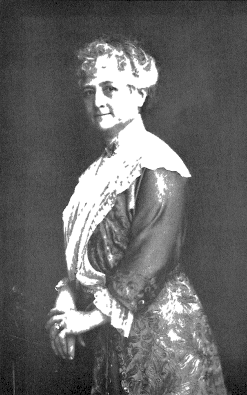
"I assure you that at heart I feel no older now than in the days when I wore it," she said. The conversation then turned to questions of mastering the piano, with particular reference to the remarkable technic of the artist herself.
"The fact that I began my studies at a very early age was a great advantage to me," she said. "I loved the sound of the piano, and began to pick out bits of tunes when I was little more than three. At six and a half I began to study seriously, so that when I was nine I was playing such pieces as Chopin's Ballade in A flat. Another fact which was of the utmost advantage to me was that I had an ideal teacher in my father. He saw that I loved the piano, and decided I must be properly taught. He was passionately fond of music, and if he had not been a statesman, laboring for the good of his country, he would undoubtedly have been a great musician. He developed a wonderful system for teaching the piano, and the work he did with me I now do with my pupils. For one thing he invented a series of stretching and gymnastic exercises which are splendid; they did wonders for me, and I use them constantly in my teaching. But, like everything else, they must be done in the right way, or they are not beneficial.
580 TECHNICAL EXERCISES
"My father wrote out for me a great many technical exercises; to be exact, there were 580 of them! Some consisted of difficult passages from the great composers—perhaps originally written for one hand—which he would arrange for two hands, so that each hand had the same amount of work to do. Thus both my hands had equal training, and I find no difference between them. These 580 exercises took just three days to go through. Everything must be played in all keys, and with every possible variety of touch—legato, staccato, half-staccato, and so on; also, with all kinds of shading."
(Think of such a drill in pure technic, O ye teachers and students, who give little or no time to such matters outside of études and pieces!)
"Part of my training consisted in being shown how to criticize myself. I learned to listen, to be critical, to judge my own work; for if it was not up to the mark I must see what was the matter and correct it myself. The earlier this can be learned the better. I attribute much of my subsequent success to this ability. I still carry out this plan, for there on the piano you will find all the notes for my coming recitals, which I work over and take with me everywhere. This method of study I always try to instill into my pupils. I tell them any one can make a lot of noise on the piano, but I want them, to make the piano speak! I can do only a certain amount for them; the rest they must do for themselves.
VALUE OF TRANSPOSING
"Another item my zealous teacher insisted upon was transposing. I absorbed this idea almost unconsciously, and hardly know when I learned to transpose, so natural did it seem to me. My father was a tactful teacher; he never commanded, but would merely say, 'You can play this in the key of C, but I doubt if you can play it in the key of D.' This doubt was the spur to fire my ambition and pride: I would show him I could play it in the key of D, or in any other key; and I did!
"With all the technic exercises, I had many études also; a great deal of Czerny. Each étude must also be transposed, for it would never do to play an étude twice in the same key for my father. So I may say that whatever I could perform at all, I was able to play in any key.
"For one year I did nothing but technic, and then I had my first piece, which was nothing less than the Capriccio of Mendelssohn, Op. 22. So you see I had been well grounded; indeed I have been grateful all my life for the thorough foundation which was laid for me. In these days we hear of so many 'short cuts,' so many new methods, mechanical and otherwise, of studying the piano; but I fail to see that they arrive at the goal any quicker, or make any more thorough musicians than those who come by the royal road of intelligent, well-directed hard work."
Asked how she obtained great power with the least expenditure of physical strength, Mme. Carreño continued:
"The secret of power lies in relaxation; or I might say, power is relaxation. This word, however, is apt to be misunderstood. You tell pupils to relax, and if they do not understand how and when they get nowhere. Relaxation does not mean to flop all over the piano; it means, rather, to loosen just where it is needed and nowhere else. For the heavy chords in the Tschaikowsky Concerto my arms are absolutely limp from the shoulder; in fact, I am not conscious I have arms. That is why I can play for hours without the slightest fatigue. It is really mental relaxation, for one has to think it; it must be in the mind first before it can be worked out in arms and hands. We have to think it and then act it.
"This quality of my playing must have impressed Breithaupt, for, as you perhaps know, it was after he heard me play that he wrote his famous book on 'Weight Touch,' which is dedicated to me. A second and revised edition of this work, by the way, is an improvement on the first. Many artists and musicians have told me I have a special quality of tone; if this is true I am convinced this quality is the result of controlled relaxation."
I referred to the artist's hand as being of exceptional adaptability for the piano.
"Yes," she answered, "and it resembles closely the hand of Rubinstein. This brings to mind a little incident. As a small child, I was taken to London, and on one occasion played in the presence of Rubinstein; he was delighted, took me under his wing, and introduced me all about as his musical daughter. Years afterward we came to New York, and located at the old Clarendon Hotel, which has housed so many men of note. The first day at lunch, my aunt and I were seated at a table mostly occupied by elderly ladies, who stared at us curiously. I was a shy slip of a girl, and hardly ventured to raise my eyes after the first look around the room. Beside me sat a gentleman. I glanced at his hand as it rested on the table—then I looked more closely; how much it reminded me of Rubinstein's hand! My eyes traveled slowly up to the gentleman's face—it was Rubinstein! He was looking at me; then he turned and embraced me, before all those observing ladles!"
We spoke of Berlin, the home of the pianist, and of its musical life, mentioning von Bülow and Klindworth. "Both good friends of mine," she commented. "What a wonderful work Klindworth has accomplished in his editions of Beethoven and Chopin! As Goethe said of himself, we can say of Klindworth—he has carved his own monument in this work. We should revere him for the great service he has done the pianistic world.
"I always love to play in America, and each time I come I discover how much you have grown. The musical development here is wonderful. This country is very far from being filled with a mercenary and commercial spirit. If Europeans think so it is because they do not know the American at home. Your progress in music is a marvel! There is a great deal of idealism here, and idealism is the very heart and soul of music.
"I feel the artist has such a beautiful calling—a glorious message—to educate a people to see the beauty and grandeur of his art—of the ideal!"