XIX. ELEANOR SPENCER
Reading edition
MORE LIGHT ON LESCHETIZKY'S IDEAS
Eleanor Spencer, whose first American tour is announced for the coming season, happened to be in Berlin during my visit there. I found her in her charming apartments in the Schönberg section of the city, far away from the noise and bustle of traffic. Her windows look out upon a wide inner court and garden, and she seems to have secured the quiet, peaceful environment so essential to an artist's development. Indeed Miss Spencer has solved the problems of how to keep house, with all the comforts of an American home, in a great German city.
"I grew so tired of living in pensions that I took this little apartment over two years ago," she said, "and I like it so much better.
"I have been away from America for nine years, so the foreign cities where I have lived seem almost more like home to me than my native land, to which I have only paid two short visits during those nine years. But I love America, and perhaps you can imagine how eagerly I am looking forward to my coming tour.
"The first eight years of my life were spent in Chicago, and then my family moved to New York. Here I studied with Dr. William Mason. When I was about fifteen I went to Europe for further study, and although I had another master at first, it was not so very long before I went to Vienna, to Leschetizky, for I felt the need of more thorough preparation than I had yet had. There is nothing like a firm technical foundation; it is a rock to build upon; one cannot do great things without it. I have had to labor hard for what I have attained, and am not ashamed to say so. I practise 'all my spare time,' as one of my colleagues expresses it; though, of course, if one studies with the necessary concentration one cannot practise more than five hours to advantage.
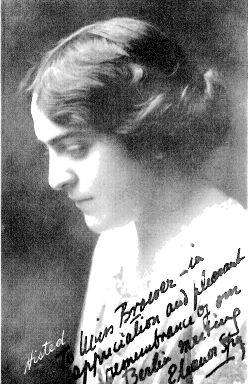
To Miss Brower in appreciation and pleasant remembrance of our Berlin meeting ...ELEANOR SPENCER
"I thoroughly believe in practising technic outside of pieces; I have always done so and still continue to do it. This brings the hand into condition, and keeps it up to the mark, so that difficult compositions are more readily within the grasp, and the technical requirements in them are more easily met. When the hand is in fine condition, exhaustive technical practise in pieces is not necessary, and much wear and tear of nerve force is saved. In this technical practise, to which I give an hour or more daily, I use very simple exercises, but each one contains some principle of touch, movement or condition. Hand over thumb and thumb under hand; different qualities of tone; staccato or clinging touch; scales, arpeggios and various other forms are used. Part of the technic study period is always given to Bach.
"I began my studies in Vienna with Mme. Bree, to get the preparatory foundation, but before long combined her lessons with those of the professor, and later went to him entirely."
"Just here I should like to mention a trifling point, yet it seems one not understood in America by those who say they are teachers of the Leschetizky method. These teachers claim that the professor wishes the fingers placed on a straight line at the edge of the keys, and in some cases they place the tip of the thumb in the middle of its key, so that it extends considerably beyond the tips of the other fingers. Is this the position taught by the Vorbereiters, or favored by Leschetizky?"
Miss Spencer's laugh rang out merrily.
"This is the first I have ever heard of the idea! Such a position must seem very strained and unnatural. Leschetizky, on the contrary, wishes everything done in the most easy, natural way. Of course, at first, when one is seeking to acquire strength and firmness of hand and fingers, one must give time and thought to securing an arched hand and steady first joints of fingers. Later, when these conditions have been thoroughly established, the hand can take any position required. Leschetizky's hand often lies quite flat on the keys. He has a beautiful piano hand; the first joints of the fingers have so long been held firmly curved, that they always keep their position, no matter what he is doing; if he only passes his fingers through his hair, his hand is in shape.
"Leschetizky is indeed a wonderful teacher! The player, however, must divine how to be receptive, how to enter into the master's thought, or it may go hard with him. If he does not understand, nor grasp the master's words he may suffer terribly during the ordeal of the lessons. I have witnessed such scenes! Those who are equal to the situation receive most illuminative instruction.
"I trust I do not give you the impression of being so devoted to, and enthusiastic in, the work I enjoyed with my venerated master that I wish to exclude other masters and schools. I think narrowness one of the most unpleasant of traits, and one I should dread to be accused of. I see so much good in others, their ways and ideas, that, to me, all things great and beautiful in art seem very closely related.
MEMORIZING
"How do I memorize a composition? I first play it over a few times to become somewhat familiar with its form and shape. Then I begin to analyze and study it, committing it by phrases, or ideas, one or two measures at a time. I do not always take each hand alone, unless very intricate; sometimes it is easier to learn both hands together. It is a good thing to study out the melodic line, to build each phrase, to work with it till you get it to suit you. Then come the larger proportions, the big climaxes, which have to be thought out and prepared for in advance. A composition should be so thoroughly your own that you can play it at any time, if your hand is in condition. Or, if it has been laid aside for a long time, a couple of days should bring it back.
"The subject of forming a repertoire is one often overlooked or not understood. The repertoire should be comprehensive and built on broad lines. A pupil intending to make music a profession should know the literature of the piano, not only the small and unimportant works of the great composers (as is too often the case), but the big works as well. If one is well grounded in the classics at an early age, it is of great benefit afterwards.
POWER AND VELOCITY
"For gaining power, heavy chords are very beneficial; combinations of five notes that take in all the fingers are most useful.
"The principle of velocity is the doing away with all unnecessary movement—raising the fingers as little as possible, and so on. But in early stages of study, and at all times for slow practise, exactness and clearness, the fingers must be raised, Leschetizky is a great believer in finger action; he holds it to be absolutely necessary for finger development.
"I have been concertizing for the last three years, and studying alone. This does not mean I have learned all the masters can teach, but only that I have come to a place where I felt I had to go alone, that I must work out what is in me. No master can teach us that; we have to find ourselves alone.
"I shall probably play considerably with orchestra next season. There is a Concerto by Rimsky-Korsakow which is quite short, only one movement. It Is charming and brilliant, and I think has not yet been played in America. There is also a new work by Stavenhagen for piano and orchestra, which is a novelty on the other side. I greatly enjoy playing with orchestra, but of course I shall play various recitals as well."
Miss Spencer has appeared with the best orchestras in England and on the continent, and has everywhere received commendation for her pure, singing tone, plastic touch, and musical temperament. She is certain to have success in America, and to win hosts of friends there.