XIV. A VISIT TO RAOUL PUGNO
Reading edition
TRAINING THE CHILD
"An audience has been arranged for you to-day, with M. Raoul Pugno; he will await you at four o'clock, in his Paris studio." Thus wrote the courteous representative of Musical America in Paris.
It had been very difficult to make appointments with any of the famous French musicians, owing to their being otherwise engaged, or out of the city. I therefore welcomed this opportunity for meeting at least one of the great pianists of France.
At the appointed hour that afternoon, we drove through the busy rue de Clicy, and halted at the number which had been indicated. It proved to be one of those unpromising French apartment buildings, which present, to the passer-by, a stern façade of flat wall, broken by rows of shuttered windows, which give no hint of what may be hidden behind them. In this case we did not find the man we sought in the front portion of the building, but were directed to cross a large, square court. The house was built around this court, as was the custom in constructing the older sort of dwellings.
At last we discovered the right door, which was opened by a neat housekeeper.
"M. Pugno is not here, he lives in the country," she said, in answer to our inquiry. (How difficult these French musicians are to find; they seem to be one and all "in the country"!)
"But, madame, we have an appointment with M. Pugno; will you not be good enough to see if he is not here after all?"
She left us standing, but returned almost immediately with the message that M. Pugno had only that moment entered his studio, to which she would conduct us.
RAOUL PUGNO
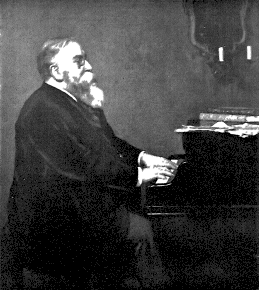
In another moment we had crossed the tiny foyer and were standing within the artist's sanctuary. At first glance one felt as though in an Oriental chamber of some Eastern monarch. Heavy gold and silver Turkish embroideries hung over doors and windows. The walls were covered with many rare paintings; rich objets d'art were scattered about in profusion; an open door led out into a pretty garden, where flowers bloomed, and a fountain dripped into its marble basin. A raised dais at one side of the room held a divan, over which were draperies of Oriental stuffs. On this divan, as on a throne, sat the great pianist we had come to see. He made a stately and imposing figure as he sat there, with his long silvery beard and his dignified bearing. Near him sat a pretty young woman, whom we soon learned was Mlle. Nadia Boulanger, a composer and musician of brilliant attainments.
"I regret that I am unable to converse with you in English, as I speak no language but my own," began M. Pugno, with a courteous wave of the hand for us to be seated.
"You wish to know some of my ideas on piano playing—or rather on teaching. I believe a child can begin to study the piano at a very early age, if he show any aptitude for it; indeed the sooner he begins the better, for then he will get over some of the drudgery by the time he is old enough to understand a little about music.
TRAINING THE CHILD
"Great care must be taken with the health of the child who has some talent for music, so that he shall not overdo in his piano study. After all a robust physical condition is of the first importance, for without it one can do little.
"A child in good health can begin as early as five or six years. He must be most judiciously trained from the start. As the ear is of such prime importance in music, great attention should be paid to tone study—to listening to and distinguishing the various sounds, and to singing them if possible, in solfeggio.
"At the outset a good hand position must be secured, with correct finger movements. Then there must be a thorough drill in scales, arpeggios, chords, and a variety of finger exercises, before any kind of pieces are taken up. The young student in early years, is expected to play various études, as well as the technic studies I have mentioned—Czerny, Cramer, Clementi, and always Bach. In my position, as member of the faculty of the Conservatoire, a great many students pass before me. If I personally accept any pupils, they naturally must be talented and advanced, as I cannot give my time to the children. Still it is interesting to see the child-thought develop."
The conversation turned upon the charming studio with its lovely garden—where absolute quiet could be secured in spite of the noise and bustle of one of the busiest quarters of Paris. The studio itself, we were told, had formerly belonged to the painter Decamps, and some of the pictures and furnishings were once his. A fine portrait of Pugno, life size, filling the whole space above the piano, claimed our attention. He kindly rose, as we admired the painting, and sought a photograph copy. When it was found—the last one he possessed—he presented it with his compliments.
We spoke of Mlle. Boulanger's work in composition, a subject which seemed deeply to interest M. Pugno.
"Yes, she is writing an opera; in fact we are writing it together; the text is from a story of d'Annunzio. I will jot down the title for you."
Taking a paper which I held in my hand, he wrote,
"La Ville Morte, 4 Acts de d'Annuncio; Musique de Nadia Boulanger et Raoul Pugno"
"You will certainly have it performed in America, when it is finished; I will tell them so," I said.
The great pianist smiled blandly and accepted the suggestion with evident satisfaction.
"Yes, we will come to America and see the work performed, when it is completed," he said.
With many expressions of appreciation we took our leave of the Oriental studio and its distinguished occupants; and, as we regained the busy, noisy rue de Clicy, we said to ourselves that we had just lived through one of the most unique experiences of our stay in Paris.
(The above is the last interview ever taken from this great French artist, who passed away a few months later.)
The following items concerning M. Pugno's manner of teaching and personal traits, were given me by Mme. Germaine Schnitzer, the accomplished French pianist and the master's most gifted pupil.
"Pugno had played the piano almost from infancy, and in early youth had taken several piano prizes. Later, however, he gave much more of his time to the organ, to the seeming neglect of the former instrument. How his serious attention was reverted to the piano happened in this wise. It was announced that Edward Grieg, the noted Norwegian, was coming to Paris. Pugno was one day looking over his piano Concerto which had recently appeared. 'Why don't you play the work for the composer when he comes?' asked a friend. 'I am no pianist,' objected Pugno. 'Why not?' said his friend; 'you know enough about the piano, and there are still four weeks in which to learn the Concerto.' Pugno took the advice, practised up the work, played it in the concert given by Grieg, and scored a success. He was then thirty-nine years of age. This appearance was the beginning; other engagements and successes followed, and thus he developed into one of the great pianists of France.
"Pugno was a born pianist; he had a natural gift for technic, and therefore never troubled himself much about teaching technical exercises nor practising them. If the work of a pupil contained technical faults, he made no remarks nor explanations, but simply closed the music book and refused to listen any further. The pupil, of course, retired in discomfiture. He was fond of playing along with the pupil (generally with the left hand), or singing the melodies and themes, in order to give him ideas of the meaning and interpretation of the music. This gave independence to the pupils, though it often afforded them much amusement.
"With advanced students Pugno spoke much about music and what it could express; he translated themes and passages back into the feelings and emotions which had originated them; he showed how all emotions find their counterpart in tones. 'Above all let kindness and goodness control you,' he once wrote; 'if you are filled with kindness, your tone will be beautiful!'
"Pugno's instruction took the form of talks on the inner meaning of the composition, and the art of interpreting it, rather than any training on the technical side; about the latter he concerned himself very little. It goes without saying that only talented pupils made progress under such a master; indeed those without talent interested him not at all. He was a wonderful teacher for those who had the insight to read between the lines, and were able to follow and absorb his artistic enthusiasms.
"I have said that Pugno did not concern himself about teaching the technical side of piano playing. Even with me, his best pupil, he rarely touched upon technical points. I must mention a notable exception. He gave me one technical principle, expressed in a few simple exercises, which I have never heard of from any one else. The use of this principle has helped me amazingly to conquer many knotty passages. I have never given these exercises to any one; I am willing however, to jot them down for you."
(The following is a brief plan of the exercises, as sketched by Mme. Schnitzer)
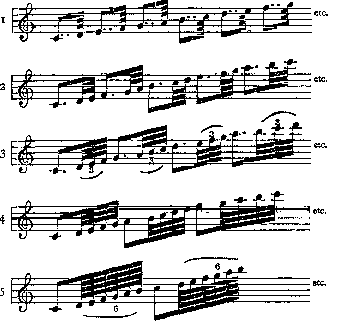
"Pugno wished the thirty-seconds and sixty-fourths to be played with the utmost quickness. This idea is not alone applicable to all scales, but can be used with any difficult passage found in a composition.
"Pugno took a keen interest in my work, my progress and career. A few sentences culled here and there from the many letters of his which I have preserved, may serve to throw more light on the inner nature of the man:
"'I have endeavored to make clear to your young mind the thoughts expressed in music, so that your understanding and your emotions also might grow; all this has created a link of gratitude in you and an affection within me. I have opened the windows for you and have given you light, and I have reaped the satisfaction of my sowing.'
"'Hear all the music you can—do not miss any of the pianists either good or bad; there is always something to be learned, even from a poor player—if it is only what to avoid! Study great works, but even in those there are some figures and phrases which need not be brought into the foreground, lest they attain too much significance.'
"(After playing with Hans Richter's Orchestra): 'What intoxication of sound—what exhilaration and collaboration in music! What a force within us, which sways us and throbs through us, developing and expressing each sentiment and instinct! What art can be compared to music, which finds expression through this medium, called an orchestra. I feel myself greater amid the orchestra, for I have a giant to converse with. I keep pace with him, I lead him where I will—I calm him and I embrace him. We supplement each other; in a moment of authority I become his master and subdue him. The piano alone is too small for me; it does not tempt me to play it except under such conditions—with a grand orchestra!'"