XII. TOBIAS MATTHAY
Reading edition
WATCHING THE ARTIST TEACHER AT WORK
One of the first things accomplished after my arrival in London was to seek out Tobias Matthay, the composer and teacher, for an echo of his fame had reached me across the water.
Matthay has done much to make the principles of piano technic so clear and simple that even a child can understand them. If he has stated facts in a way which seems to some revolutionary it is because these facts are seldom understood by the rank and file of piano teachers. The work he has done has compelled attention and admiration; his ideas are now accepted as undeniable truths by those who at first repudiated them. The writings of Mr. Matthay will doubtless be better known in America a little later on than they are at present. They consist in part of an exhaustive work on The Act of Touch in all its Diversity; First Principles of Piano Playing; Relaxation Studies; The Child's First Steps in Piano Playing; The Principles of Fingering and Laws of Pedaling; Forearm Rotation Principle; and, in press, The Principles of Teaching Interpretation. These very titles are inspiring and suggestive, and show Matthay to be a deep thinker along educational lines.
Cordially Yours, Tobias Matthay
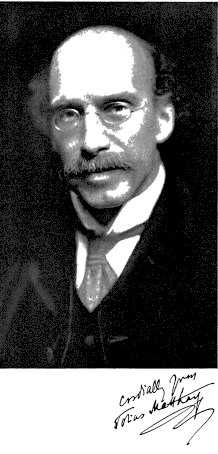
Matthay's activities are enormous. He is professor of advanced piano playing at the Royal Academy of Music; also founder and head of his own school of piano playing. So occupied early and late is he, that it is almost impossible to get a word with him. I was fortunate enough, however, to obtain an hour's audience, and also permission to attend various private classes at the Royal Academy, and hear a number of pupils in recital.
In appearance Matthay is a striking personality. His head and features recall pictures of Robert Louis Stevenson. His tall, muscular form has the stoop of the scholar; and little wonder when one remembers he must sit in his chair at work day in and day out. His somewhat brusk manner melts into kind amiability when discussing the topics in which he is vitally interested. In his intercourse with students he is ever kind, sympathetic and encouraging. They, on their part, treat him with profound respect.
Matthay believes, and rightly, that the beginning pupil should learn essentials of note values, rhythm, time, ear-training and so on, before attempting to play anything at the piano. When first taken to the instrument, its mechanism is carefully explained to the learner, and what he must do to make a really musical tone. He says (Child's First Steps): "Before you take the very first step in tone production, be sure to understand that you must never touch the piano without trying to make music. It is only too easy to sound notes without making music at all. To make music we must make all the sounds mean something, just as it is no use to pretend to speak unless the sounds we make with our lips mean something, that is unless they form reasoned phrases and sentences."
Here nothing is left vague. Matthay shows clearly how all musical Form and Shape imply Movement and Progression: the movement of a phrase toward its cadence; the movement of a group of notes toward a beat or pulse ahead, or the movement of a whole piece toward its climax, etc. This original view of his regarding form, which he has advocated for the last twenty years, is now being accepted generally by the more up-to-date of the English theorists and teachers.
In regard to key mechanism and what must be done to produce all varieties of touch and tone, Matthay has made exhaustive studies. He says (First Principles of Piano Playing): "The two chief rules of technic, as regards the key, are, therefore: Always feel how much the key resists you: feel how much the key wants for every note. Second, Always listen for the moment each sound begins, so that you may learn to direct your effort to the sound only, and not to the key bed. You must never hit a key down, nor hit at it. The finger-tip may fall on the key, and in gently reaching the key you may follow up such fall by acting against the key. This action against the key must be for the sole purpose of making it move—in one of the many ways which each give us quite a different kind of sound. And you must always direct such action to the point in key descent where the sound begins."
I quote also this little summary from the same work:
"(a) It is only by making the hammer-end of the key move that you can make a sound. (b) The swifter the movement the louder the sound. (c) The more gradual this swiftness is obtained the more beautiful the quality of sound. (d) For brilliant tone you may hit the string by means of the key, but do not, by mistake, hit the key instead. (e) You must 'aim' the key to the beginning of each sound, because the hammer falls off the string as you hear that beginning, and it is too late then to influence the sound except its continuance. (f) It is wrong to squeeze the key beds, because it prevents tone, impairs musical result, impedes agility, and is, besides, fatiguing. (g) You must feel the 'giving way point' of the key, so that you may be able to tell how much force is required for each note. Never, therefore, really hit the keys."
Mr. Matthay as minutely gives directions as to the muscular problems of touch and technique. For instance, he explains how all varieties of tone, good and bad, are caused, all inflections of Duration, and the laws which govern the attainment of Agility and ease of Technique; and also explains the nature of incorrect muscular actions which prevent the attainment of all these things. He shows where the released arm weight should be applied, and again, where it should be eliminated; makes clear the two opposite forms of technic implied by "flat" and "bent" finger actions, and he goes exhaustively into the little-understood question of forearm rotary exertions, the correct application of which he proves to be necessary for every note we play.
In speaking of methods in piano teaching, Mr. Matthay said to me:
"I can say I have no method of playing, and moreover I have not much faith in people who have. My teachings merely show how all playing, good or bad, is accomplished. There are certain principles, however, which every player should know, but which, I am sorry to say, are as yet scarcely apprehended even by the best teachers. The great pianists have experimented till they have hit upon effects which they can repeat if all conditions are favorable, and they are in the mood. As a rule they do not know the laws underlying these effects. You may ask the greatest pianists, for example, how to play octaves. 'Oh, I play them thus'—illustrating. Just what to do to attain this result they cannot explain. In my own case I have done much experimenting, but always with the view to discovering how things are done—the facts and laws governing actual tone production and interpretation. I made a study of Rubinstein's playing, for I found he played a great deal better than I did. So I discovered many things in listening to him, which he perhaps could not have explained to me. These facts are incontrovertible and I have brought many of my colleagues to see the truth of them. More than this, I have brought many even of my older colleagues who had a life-time of wrong mental habits to impede them, to realize the truth of my teachings.
"The work of a teacher should speak for itself. For my own part I never advertise, for I can point to hundreds of pupils—this is no exaggeration in the least!—who are constantly before the public, as concert pianists and successful teachers.
"If there is one thing that rouses me deeply, it is the incompetence of so many teachers of piano. They say to the pupil: 'You play badly, you must play better'; but they do not tell the pupil how to play better. They give doses of études, sonatas and pieces, yet never get at the heart of the matter at all. It is even worse than the fake singing teachers; I feel like saying it is damnable!"
It was my privilege to be present at some of Mr. Matthay's private lessons, given at the Royal Academy. Several young men were to try for one of the medals, and were playing the same piece, one of the Strauss-Tausig Valse Caprices.
Matthay listens to a complete performance of the work in hand, then turns back to the beginning and goes over it again for corrections and suggestions. He enters into it with absolute devotion, directing with movements of head and hands as a conductor might direct an orchestra; sometimes he dashes down a chord in the treble to urge more force; at other times lays a restraining hand on the player's arm, where the tone should be softer. His blue pencil is often busy adding phrasing marks. In the pauses he talks over with the pupil the character of the piece, and the effects he thinks should be made. In short his lessons are most helpful and illuminating.
I also had the opportunity to attend a pupils' "Practise Concert," and here the results attained were little short of marvelous. Small children, both boys and girls, played difficult pieces, like the Grieg Variations for two pianos, the Weber Invitation to the Dance, and works by Chopin and Liszt, with accuracy and fluency. Almost every selection was played from memory. The tone was always musical and often of much power, and the pupils seemed thoroughly to understand what they were doing and the meaning of the music. They certainly exemplified the professor's maxim:
"Never touch the piano without trying to make music."
Not long afterward I received a copy of the new book, which had just come from the press. Its comprehensive title is Musical Interpretation, its Laws and Principles, and their Application in Teaching and Performing. The material was first presented in the form of lectures; on repeated requests it has been issued in book form. The author at the outset claims no attempt to treat such a complex problem exhaustively; he has, however, selected the following seven points for elucidation:
1. The difference between Practise and Strumming. 2. The difference between Teaching and Cramming. 3. How one's mind can be brought to bear on one's work. 4. Correct ideas of Time and Shape. 5. Elements of Rubato and its application. 6. Elements of Duration and Pedaling and their application. 7. Some details as to the application of the Element of Tone-variety.
Such themes must cause the thoughtful reader to pause and think. They are treated with illuminating originality. The great aim of the teacher must ever be to awaken thought along correct lines; the pupil must be assisted to concentrate his thought on what he is doing: to constantly think and listen. Teaching does not consist merely in pointing out faults; the teacher must make clear the cause of each fault and the way to correct it. That section of the book devoted to the Element of Rubato, is illustrated with many examples from well-known compositions, by which the principle is explained. He shows how frequently this principle is misunderstood by the inexperienced, who seem to think that rubato means breaking the time; whereas true rubato is the bending of the time, but not breaking it. If we give extra time to certain notes, we must take some time from other notes, in order to even things up.
The subject of Pedaling is aptly explained by means of numerous illustrations. The author deplores the misuse of the damper pedal, which can be made to ruin all the care and effort bestowed on phrasing and tonal effects by the fingers. The fault can, in most cases, be traced to inattention to the sounds coming from the piano.
There are quotable paragraphs on every page, which in their sincerity and earnestness, their originality of expression, stamp themselves on the reader's imagination. Every teacher who is serious in his work and has the best interests of his pupils at heart, should read and ponder these pages.