XI. MARK HAMBOURG
Reading edition
FORM, TECHNIC, AND EXPRESSION
MARK HAMBOURG
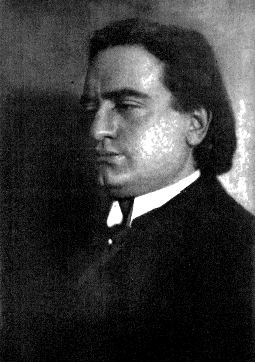
In one of the most quiet, secluded quarters of London can be found the home of the Russian pianist, Mark Hambourg. Mr. Hambourg lives on a terrace, "far from the madding crowd," and difficult enough of access to keep mere curiosity seekers at a distance. One can scarcely picture to one's self, without an actual sight of them, the quaint charm of these short passages or streets, usually termed "terraces," or "gardens." This particular terrace looks out on a restful green park, where luxuriant trees make long shadows on the sunlit turf. The house is large and comfortable—built over a hundred years ago; its rooms are spacious, and the drawing-room and library, which lead one into the other, form a fine music salon. Surely, amid such surroundings, with priceless pictures and objets d'art all about, with exquisite colors, with space and quiet, an artist must find an ideal spot for both work and play. I expressed this thought to Mr. Hambourg when he entered; then we soon fell to discussing the necessary equipment of the teacher and pianist.
"I agree with you," he said, "that it is the beginning of piano study which is the most difficult of all; this is where the teacher has such great responsibility and where so many teachers are so incompetent. Perhaps there are more poor teachers for the piano than for the voice. The organs of voice production cannot be seen, they can only be guessed at; so there may be a little more excuse for the vocal teacher; but for the piano we have the keys and the fingers. It should not therefore be such a very difficult thing to learn to play intelligently and correctly! Yet few seem to have got hold of the right principles or know how to impart them."
"I have heard a number of the young pianists here," I remarked, "and they all play with very little finger action—with fingers close to the keys. Do you advocate this?"
LOW HAND POSITION
"Do not forget that for centuries England has been a country of organists; without doubt organ playing has had some effect on the piano touch. Some schools of piano playing advise lifting the fingers high above the keys, with a view to producing greater power; but I think the tone thus produced is often of a somewhat harsh and disagreeable quality. Then, too, high lifting interferes with smoothness and velocity. For myself I advocate keeping the fingers close to the keyboard, and pressing the keys, which gives the tone a warmer and more elastic quality."
"A point in hand position I should like to ask you about. Some teachers advise placing the finger-tips close to the edge of the keys, forming a straight line with them; it seems to me such a position is forced and unnatural."
Mr. Hambourg smiled assent.
"I do not advocate anything forced and unnatural," he answered. "So many people think that a beautiful touch is 'born, not made,' but I do not agree with them. One can acquire, I am sure, a fine piano touch with the proper study. The principal requirement is, first of all, a loose wrist. This point seems simple enough, but it is a point not sufficiently considered nor understood. No matter how much the player may feel the meaning of the music, he cannot express this meaning with stiff wrists and arms. Some people have a natural flexibility, and to such the securing of a musical tone presents far less difficulty; but with time, patience, and thought, I fully believe all can arrive at this goal.
AMOUNT OF PRACTISE
"In regard to practise I do not think it wise for the aspiring pianist to spend such a great amount of time at the piano. Four hours of concentrated work daily seems to me sufficient. Of course it is the quality of practise that counts. The old saying, 'Practise makes perfect,' does not mean constant repetition merely, but constant thinking and listening. I advise students to stop after playing a passage several times, and think over what the notes mean. This pause will rest ears and hands; in a few moments work can be resumed with fresh vigor.
"I have been so frequently asked to write on the subject of technic that I have done so in a few articles which have been printed in a small booklet. From these you may see what my ideas are on these points. I do very little teaching myself—just a few talented pupils; they must be something out of the ordinary. You see, I do not live in London continuously; I am here only about four months of the year; the rest of the time is spent traveling all over the world. Only that small part of the year when I am stationary can I do any solid work. Here it is generally quiet enough: the Zoological Garden is not far away, however, and sometimes I have the roaring of the lions as an accompaniment to my piano.
"I am always increasing my repertoire, though I find the public does not care for new things; it prefers the old. It may listen to the new if forced to, but it will not attend a recital unless various familiar things are on the program.
"I have made several tours in America. The rush of travel from place to place over there, is fatiguing, but I feel that your people are very appreciative. You demand the best, and concert giving in America is so costly that a manager can afford to exploit only the highest artists. Here in London, where the expense is only about two hundred dollars, say, to get up a recital, almost any one can scrape together that sum and bring himself or herself before the public. In America the outlay is four or five times greater. No wonder that only a very good artist can take the risk."
On leaving, Mr. Hambourg took us to another room, where he showed us with much satisfaction, a very valuable painting of the old Italian school, by Ghirlandajo, of which he is very fond.