Part 2 — Travel
Reading edition
During the 17th century, travel in Virginia was mainly by boat. As the roads leading from Jamestown to the nearby settlements were usually in deplorable condition, especially after heavy rains, the settlers preferred to travel by water whenever possible. As the colony grew, and roads were improved somewhat, travel by horse became more common, especially for short trips. After 1650 the use of wagons increased, and records indicate that a few of the more prosperous planters imported fine carriages from England.
Boats and Ships
Boats used by the settlers varied in size from small flat-bottom boats to fairly large sailing vessels, and included such types as small rowboats, pinnaces, barks, bilanders, schooners, ketches, and sloops. Living on a river, and in a tidewater area of innumerable creeks, bays, and rivers, practically all of the colonists were familiar with handling boats of one type or another.
However, only a few objects relating to boats and ships have been unearthed at Jamestown: small anchors, chains, oar locks, ship bolts and spikes, and tools used by shipwrights and ships’ carpenters.
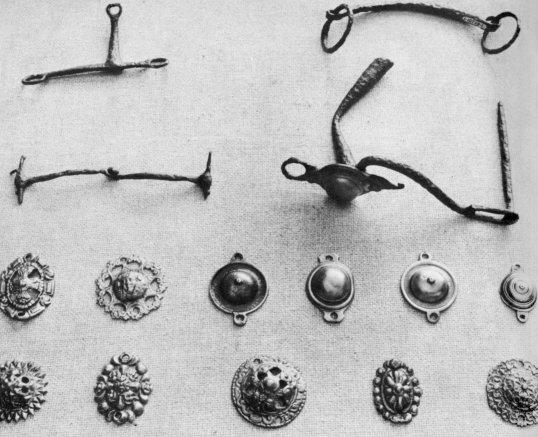
Some bits and bridle ornaments in the Jamestown collection. The artistic designs on many bridle bosses are symbolic of beautiful handiwork performed by craftsmen of a bygone day.
Horses, Wagons, and Carriages
The first English-built road in America (in use by 1608) ran 1 mile from Jamestown Island to Glasshouse Point. Later, as the colony grew, the road was extended to Governor Berkeley’s plantation, about 4 miles from Jamestown, and other nearby settlements. There is some evidence that it was known as the “Old Road” or “Greate Road.”
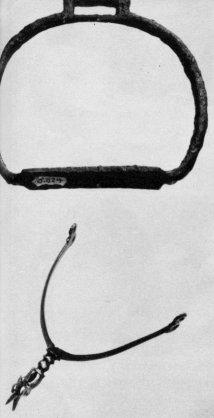
Seventeenth-century spur and stirrup excavated at jamestown.
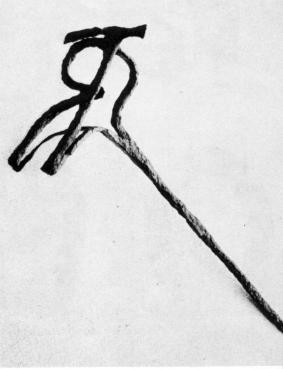
This branding iron was used by one of the colonists during the early days of the settlement.
As early as 1609 “six mares and two horses” were brought to Jamestown. In 1611, 17 horses and mares arrived, and in 1614, Capt. Samuel Argall brought several more. Six years later in 1620, 20 horses were shipped from England. It is most surprising, therefore, that the census of 1625 recorded only 1 horse for the entire colony! By 1649, however, it was estimated that there were 300 horses in Virginia, and most of the successful farmers and wealthy planters owned them after 1650. During the following years, the number of horses increased greatly.
Many well-preserved metal objects relating to horse equipment and riding gear have been unearthed.
Bits and Bridle Ornaments.
—Most bits are of the snaffle variety, although a few curb bits have been recovered. In those days many bits had brass bosses attached to their cheek bars, and many of these attractive ornaments have been unearthed. Some bosses are decorated with raised designs while others are plain. The majority are made of brass, although a few iron bosses have been excavated.
Spurs and Stirrups.
—A few complete spurs have been excavated. While the majority are plain iron some brass spurs in the collection are decorated with very attractive incised or embossed designs. Two or three of the highly decorated brass spurs are probably of Spanish origin. One of them, in excellent condition, was found near an early brick kiln.
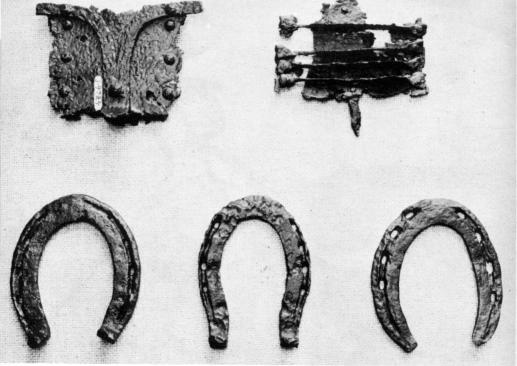
Wrought-iron horseshoes and currycombs used prior to 1650.
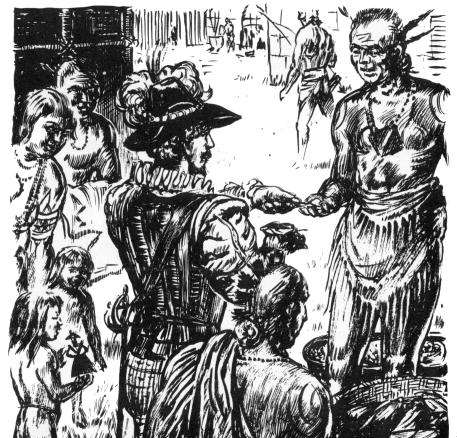
Settlers trading with the Indians—bartering casting counters and other trade goods for furs. (Conjectural sketch by Sidney E. King.)
All stirrups unearthed are made of wrought iron. Some of the steps or stirrup bars are solid, while others have a single slot.
Horseshoes and Currycombs.
—Horseshoes found vary considerably in size, although the majority are relatively small. Many shoes have both toe and heel calks, and in most examples the calks are well worn. The many small shoes that have been excavated may indicate that the horses used in Virginia three centuries ago were much smaller than the 20th-century breeds.
All currycombs found are handwrought, and many have pleasing designs on the backs, formed by the curved iron strips which extend from the handle prong to the back of the comb.
Branding Irons
.—Parts of several branding irons were found including a complete example with initials “TR.”
Wagon and Carriage Parts.
—Archeologists unearthed only a few metal parts from wagons and carriages—reminders of a day when horses and oxen were indispensable animals in the Virginia settlements.