Part 2 — Amusements and Pastimes
Reading edition
The difficult and time-consuming job of conquering the Virginia wilderness (clearing the land, building homes, planting and harvesting crops, and warding off Indian attacks) left few hours for leisure and amusements. There were times, however (especially after the first few hard years had passed), when a colonist could enjoy himself by smoking his pipe, playing a game, practicing archery, bowling, playing a musical instrument, singing a ballad, or taking part in a lively dance. Excavated artifacts reveal that the settlers enjoyed at least these few amusements and pastimes.
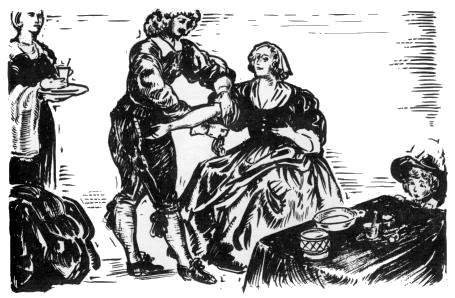
A physician bleeding a patient. (Conjectural sketch by Sidney E. King.)
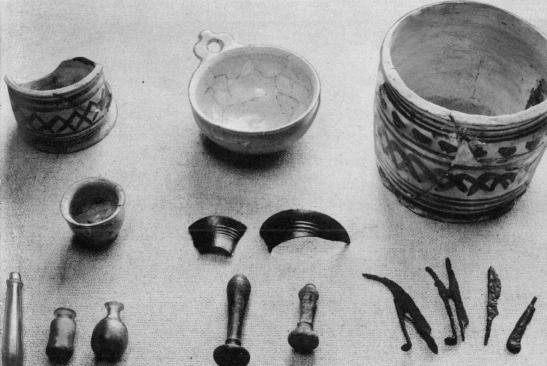
A few items unearthed at Jamestown which were used by doctors and apothecaries. Included are drug jars, ointment pot, bleeding bowl, mortar and pestle fragments, glass vials, and portions of surgical instruments.
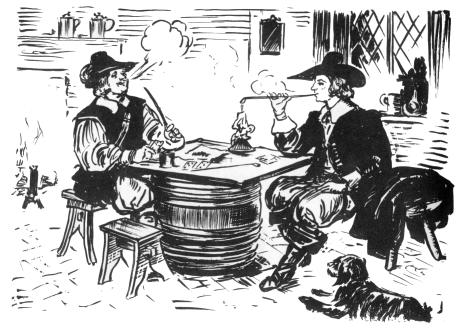
Enjoying a smoke in a tavern, about 1625. (Conjectural sketch by Sidney E. King.)
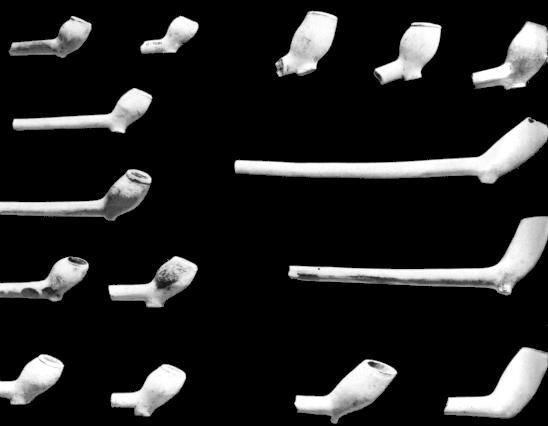
A few of thousands of clay pipe fragments unearthed at Jamestown. The ones shown range in date from 1600 to 1700. During this 100-year period, pipes developed from small bowls to fairly large ones.
Smoking
The first colonists were quite familiar with the use of tobacco, and it is believed that many of them smoked clay pipes. Evidently there was some demand for tobacco pipes by the early planters as one of the men, Robert Cotten, who reached Jamestown in January 1608, was a tobacco pipemaker.
In 1611-12 John Rolfe had experimented with tobacco plants in Virginia (he used Virginia plants as well as varieties from the West Indies and South America), and was successful in developing a sweet-scented leaf. It became popular overnight, and for many years was the staple crop of the infant colony. There was a prompt demand for the new leaf in England, and its introduction there was an important factor in popularizing the use of clay pipes. After 1620 the manufacture of white clay pipes in England increased by leaps and bounds.
It is estimated that there are over 50,000 clay pipe bowls and stem fragments in the Jamestown collection—perhaps the largest assemblage of its kind extant. Pipe bowls and stem fragments were found wherever excavations were made, indicating that the smoking of clay pipes was an extremely popular custom at Jamestown.
During the 1607-1700 period, pipe-bowls developed in size from small to fairly large. In most examples that have been found, the early pipes have larger stem-holes than pipes made during the latter years of the century.
Although the majority of pipes found at Jamestown were imported from England, some were made in Holland. Some of the colonists made their pipes in Virginia from local clay, either by pipemaking machines or by handmolding. The English and Dutch pipes were white in color, whereas the local product was brown. As they were fragile, not a single complete pipe has been unearthed at Jamestown.
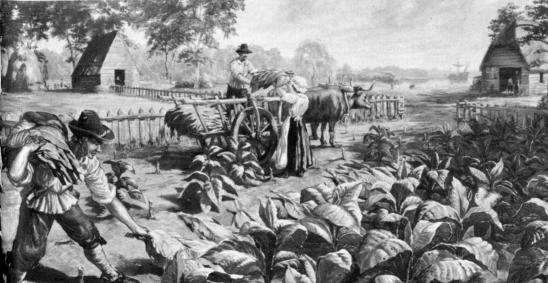
Harvesting tobacco at Jamestown, about 1650. (Painting by Sidney E. King.)
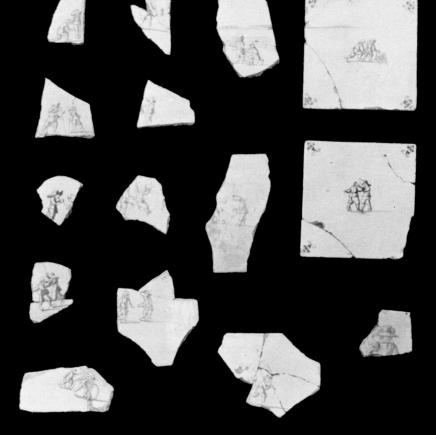
Childrens’ games depicted on Dutch delftware fireplace tiles are very similar to the games children play today. The tiles were made in Holland almost 300 years ago.
Games
A few ivory fragments that have been excavated appear to be parts of dice and chessmen. Chess was popular during the 17th century, and many dice games, including even and odd, hazard, passage, mumchance, and novem were played.
Other games which undoubtedly were played in many Jamestown homes were tick-tack, backgammon, Irish, and cards. Card games were popular, especially primero, trump, piquet, saint, and decoy.
Many 17th-century fireplace tiles in the Jamestown collection are decorated with charming little pictures depicting children’s games. Activities portrayed include skating, bowling, spinning tops, fishing, rolling hoops, using a yo-yo, swinging, wrestling, skipping rope, shooting, playing skittles, riding a hobby horse, sledding, boxing, and playing musical instruments. These pictures remind us that games played by boys and girls today are very similar to those enjoyed by children three centuries ago.
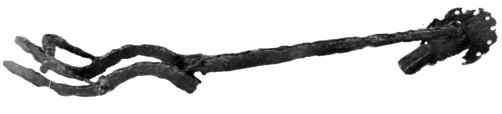
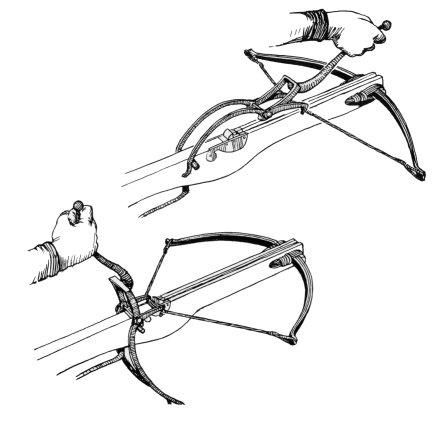
Archeological explorations revealed that the colonists enjoyed archery. The iron lever shown, known as a “goat’s foot,” was used for setting the string of a light hunting crossbow. It was found 4 miles from Jamestown. Illustration showing the use of a “goat’s foot” from Weapons, A Pictorial History by Edwin Tunis.
Archery and Hunting
One interesting item relating to archery has been found 4 miles from Jamestown. Known as a “goat’s foot,” it is an iron lever which was used for pulling back and setting the string of a light hunting crossbow.
Contemporary records indicate that hunting game birds and animals was a popular New World diversion. Such sport served a twofold purpose, as it offered recreation to the settler and helped provide food for his table. Parts of early fowling pieces and numerous lead birdshot (called goose or swan shot during the early years of the 17th century) have been recovered.
Music and Dancing
A large assortment of iron and brass Jew’s harps (also known as Jew’s trumps) have been found. This small instrument is lyre-shaped, and when placed between the teeth gives tones from a bent metal tongue when struck by the finger. Modulation of tone is produced by changing the size and shape of the mouth cavity.
As there is no record of spinets, or virginals, having been used at Jamestown, we have no way of knowing whether such wire-stringed, keyboard instruments were used in the homes of the more prosperous planters, together with other musical instruments of the period.
It is quite certain, however, that the Jamestown settlers knew the songs and ballads which were sung in Great Britain in those days. They were also familiar with English, Irish, Welsh, and Scotch dances. A few contemporary accounts reveal that the Virginia colonists enjoyed merry tunes and ditties, as well as lively dances. Although living in a wilderness, there were times when they could enjoy a few leisure-hour activities and amusements, including singing and dancing.
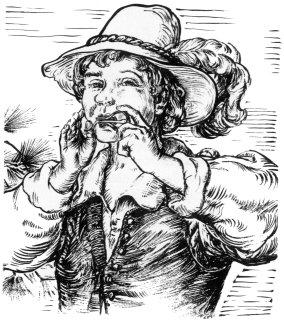
Playing a Jew’s harp—enjoying a little music in the Virginia wilderness. (Conjectural sketch by Sidney E. King.)
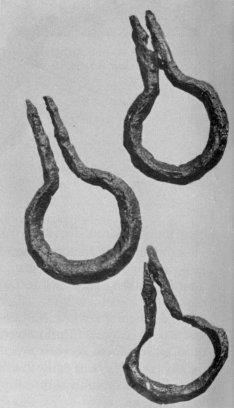
An assortment of Jew’s harps unearthed at Jamestown.
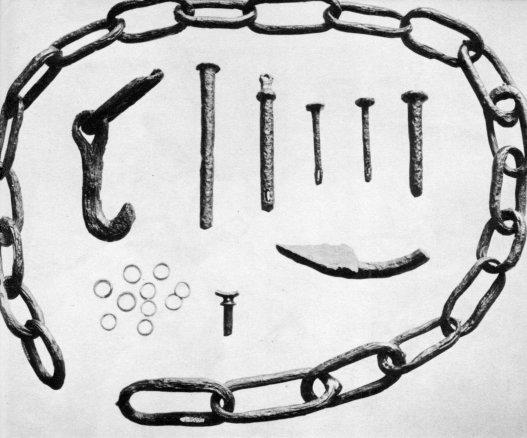
A few objects recovered at Jamestown which were once used on 17th-century boats—reminders of a day when travel in Virginia was largely by water.