Part 2 — Clothing and Footwear
Reading edition
The Jamestown settlers of the middle class were usually dressed in hard wearing, rough clothes made of homespun material, with a slightly better (and perhaps more colorful) costume for Sunday and holiday wear. In 1622 each Englishman who planned to emigrate to Jamestown was advised to supply himself with the following wearing apparel:
“One Monmouth cap [a flat, round cap].
Three falling bands [a neckband or collar of a shirt which turned down over the shoulders].
Three shirts.
One waste-coate.
One suite of Canvase [a suit made of coarse cloth, such as cotton, hemp, tow, or jute].
One suite of Frize [a woolen fabric with a nap].
One suite of Cloth.
Three paire of Irish stockins.
Foure paire of shooes.
One paire of garters.
One doozen of points [a point was a tie or string ending with an anglet and used to join parts of a costume as doublet and hose].”
The women wore plain frocks and petticoats, although a few of the wealthy ladies owned silk, satin, and velvet dresses. Bodices, as a rule, were long pointed, and skirts were full and long.
Perhaps the most unique items of wearing apparel recovered at Jamestown were several leather shoe soles and two almost-complete shoes, found in a dirtlined well in association with artifacts of the 1625-50 period.
For everyday use the Jamestown settlers wore hardwearing clothes made of homespun cloth. (Conjectural sketch by Sidney E. King.)
Other objects unearthed relating to wearing apparel and costume accessories, include an excellent assortment of buckles, buttons, and brass eyelets. Items in the collection which were used in the mending of clothes include needles, pins, and thimbles (both brass and silver).
A leather shoe and several leather shoe soles were uncovered in an early 17th-century well.
A few buckles and buttons in the Jamestown collection. Many are over 300 years old.
Homespun clothes were seldom discarded. The many pins, needles, and thimbles found reveal that mending was a never-ending chore for the busy housewife.
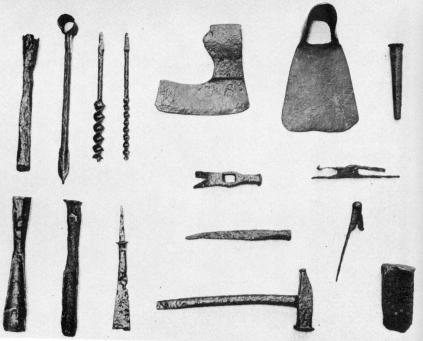
An assortment of carpenters’ tools unearthed at Jamestown. Most of them were used over three centuries ago.
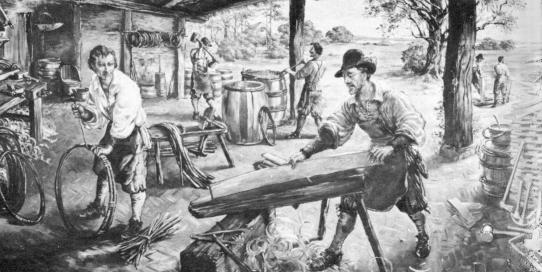
The Jamestown cooper was a busy craftsman. Many barrels, hogsheads, and casks were needed in the colony, and large quantities of barrel staves were made for shipping to England. (Painting by Sidney E. King.)