Part 2 — Table Accessories
Reading edition
In the small houses at Jamestown the kitchen also served as the dining room. During the early years, many settlers probably ate with wooden spoons out of wooden bowls and trenchers, and drank from mugs made of horn, wood, or leather. As the colony became well established, these crude utensils and vessels were used less frequently and were gradually replaced with ones made of pottery, metalware, and glassware. None of the perishable woodenware, horn, or leather items have been found at Jamestown, but a large assortment of more durable objects used at the table have been recovered. Space permits only brief descriptions of the more common types unearthed.
Knives, Forks, and Spoons
The table knives found at Jamestown vary in length from 63/8 to 8¼ Ƅ inches. Most of them have either bone or ivory handles, although 3 have embossed brass handles; and 1, found in a late 17th-century well, has an exquisite handle of banded agate.
The forks in the collection also have bone or ivory handles, the majority displaying 2 steel prongs, or tines. The number of prongs, however, is no positive identification of any particular period, as many English forks of the mid-17th century had 3 prongs, and a few had 4 prongs.
Types of spoons excavated include seal-heads, slipped ends, “puritans,” and trifids. The majority were made of either pewter or latten metal (a brasslike alloy), although 3 in the collection were made of silver. The earliest spoons found have rounded bowls and 6-sided stems (handles), whereas those made after 1650 usually have oval bowls and flat, 4-sided handles. One of the silver spoons, with rounded bowl and slipped end, bears the initials of its owner, WC/E,” on the slipped end of the handle. This spoon appears to have been made between 1600 and 1625, and is still in excellent condition.
The most important spoon in the Jamestown collection, and one of the most significant objects excavated, is an incomplete pewter spoon—a variant of the trifid, or split-end, type common during the 1650-90 period. Impressed on the handle (in the trefoil finial of the stem) is the mark of the maker, giving his name, the Virginia town where he worked, and the year he started business. This is the sole surviving “touch” or mark of an American pewterer of the 17th century. The complete legend, encircling a heart, reads: “IOSEPH COPELAND/1675/CHUCKATUCK.” (Chuckatuck is a small Virginia village in Nansemond County, about 30 miles southeast of Jamestown.) Joseph Copeland later moved to Jamestown where he was caretaker of the statehouse from 1688-91. He may have made pewter in Virginia’s first capital. His matchless spoon found in the old Jamestown soil is the oldest dated piece of American-made pewter in existence.
Pottery and Porcelain
The largest and most representative collection of 17th-century European and early American pottery which has been excavated in America is on exhibition at Jamestown. Thousands of fragments of colorful types have been found, and by the exercise of extreme care and patience, museum technicians have pieced together many early specimens. These examples reveal the kinds of pottery used in the wilderness settlement over three centuries ago. Included in this ceramic collection are pitchers, bowls, jugs, cups, mugs, porringers, milk pans, jars, plates and dishes, pots, and platters. These were used at the table, as well as for the storage of foods, and for other purposes.
While some of the utilitarian earthenware was made at Jamestown, most of the pottery that has been found was imported from England. Many types also came from other European countries, including Germany, Holland, Italy, Spain, and Portugal. One kind of maiolica may have been made in Mexico, while the few fragments of porcelain recovered were made in China.
Because of the great variety and importance of the ceramic collection, a few of the more representative types will be described briefly.
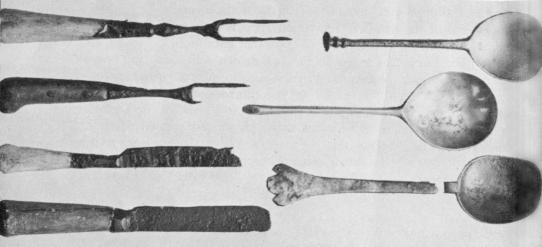
A few knives, forks, and spoons unearthed at Jamestown.
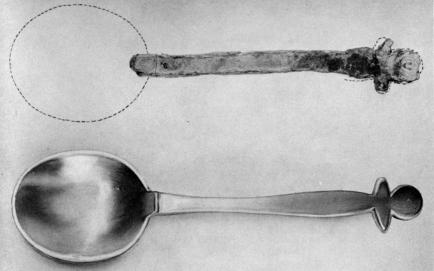
The pewter spoon handle at the top, unearthed at Jamestown, is the oldest dated piece of American pewter in existence. It was made by Joseph Copeland of Chuckatuck, Va., in 1675. The spoon on the bottom is a conjectural restoration of Copeland’s specimen.
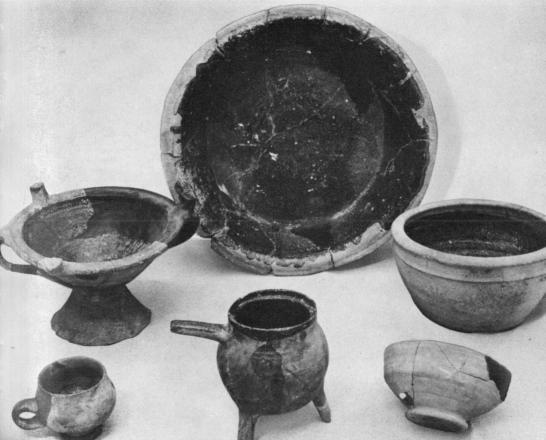
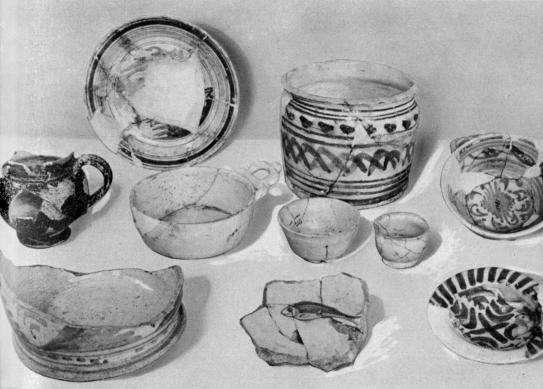
A few examples of lead-glazed earthenware made in England during the 17th century. All were unearthed at Jamestown.
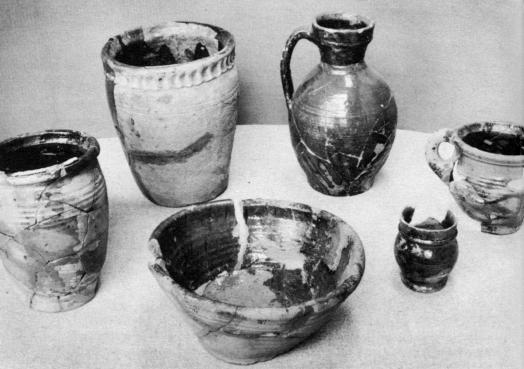
Examples of lead-glazed earthenware made at Jamestown about 1640-50.
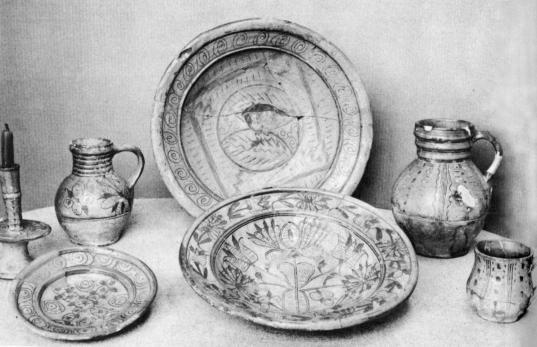
English sgraffito, or scratched, ware—one of the most colorful types of pottery unearthed at Jamestown.
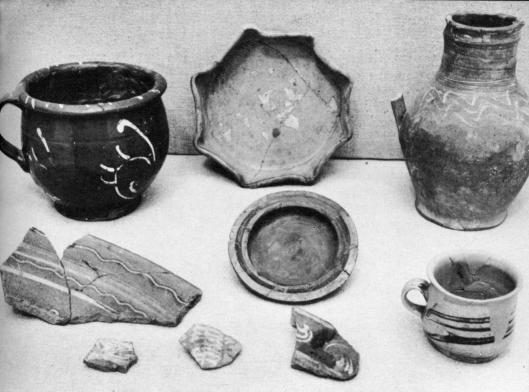
English slip-decorated ware. Although made in England mainly for local consumption, many attractive examples were shipped to Virginia during the 17th century.
Lead-glazed Earthenware.
—Most of these vessels were made for utilitarian purposes, and were usually glazed only on the inside. While some were made at Jamestown, the majority were imported from England. One type, a grit-tempered earthenware, was manufactured in North Devonshire. Another kind, a hard-fired earthenware, was also made in England. At least two distinct types of local-made earthenware have been found, and, as many examples have well-proportioned shapes and attractive designs, it is evident that they were not fashioned by a young apprentice, but by a trained potter who took pride in shaping his wares.
English Sgraffito-ware (a slipware).
—This colorful pottery, beautifully decorated with incised designs, is an English earthenware of red or buff clay on which a slip was applied. Before firing, a decoration was scratched, stippled, or cut through the slip, exposing the darker color of the body. The entire piece then received a transparent lead glaze, either clear or covered with an oxide. The English sgraffito-ware found at Jamestown was made near Barnstaple, in North Devonshire, probably after 1640. The reddish-brown floral and geometric designs which decorate the vessels are unusually attractive against colorful yellow backgrounds. Sgraffito is an Italian word meaning scratched.
English Slip-decorated-ware.
—This colorful English pottery, which was made for everyday use, is a lead-glazed earthenware decorated with a liquid clay or slip. The design was usually dropped or trailed upon the ware from the spout (or quill) of a slip cup, somewhat in the manner a baker decorates a cake with icing; or it may have been painted over a large area or placed on in molded pads. Although most of the slip-decorated-ware found at Jamestown was made in England, there is some evidence that a few vessels may have been manufactured in America during the late 17th century.
English Redware with Marbled Slip Decoration.
—On this type English earthenware, which usually has a red body, the liquid slip was marbled or combed over the surface of the vessel with a toothed instrument of wire or leather to produce the effect of paper-marbling. Some in the Jamestown collection appear to have been made as early as 1625.
Italian Maiolica.
—Maiolica is a word derived from a type of pottery made on the Spanish island of Mallorca. The 17th-century Italian maiolica-ware found at Jamestown is a red-body earthenware with scratched or incised designs—a true sgraffito-ware. Somewhat similar in appearance to the English sgraffito-ware, the desired design was scratched through the cream-colored slip, revealing the reddish-brown body beneath. On many examples, colorful lines were hand painted over or near the incised designs, usually in reds, yellows, and greens, and were covered with a transparent lead glaze.
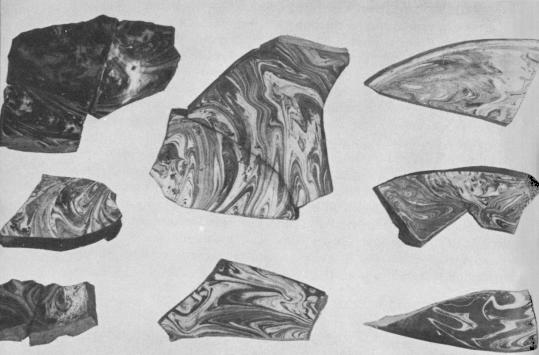
English redware with marbled slip decoration, 1625-50 period or earlier, unearthed at Jamestown.
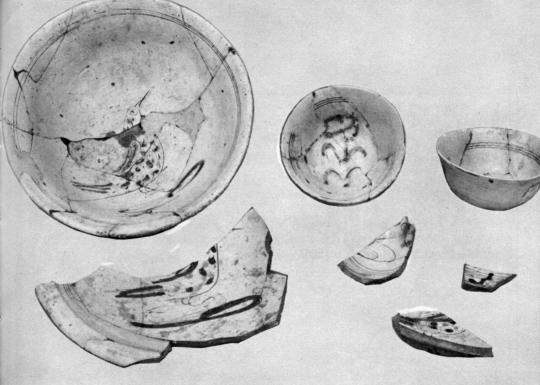
Late 17th-century Italian maiolica bowls excavated at Jamestown.
A few examples of English delftware in the Jamestown collection.
Delftware.
—This is a soft pottery covered with an opaque white tin glaze, and decorated with hand-painted designs, usually in blues and purples. A few specimens excavated are embellished with pleasing patterns in polychrome colors. Most of the delftware unearthed at Jamestown was made in England (Lambeth, Southwark, and Bristol), although a few examples were imported from Holland.
Spanish Maiolica.
—This maiolica is a tin-glazed earthenware with a soft body usually buff in color and porous in texture. The colorful decorations were hand painted on the absorbent surface—usually in greens, blues, yellows, and reddish-browns, against a white background. Some small Spanish jugs in the collection bear very crude dark-red floral designs painted against a cream-colored background. A few examples of maiolica found at Jamestown are believed to have been made in Lisbon, and these usually have designs in blues and dark purples against a white background.
Salt-glazed Stoneware.
—This common but attractive type of pottery found in many excavations at Jamestown includes mugs, jars, bottles, tankards, and jugs. It is a very hard ware which was fired at high temperatures and finished with a salt glaze, formed by throwing common salt into the furnace. The surface of the body has a pitted appearance resembling an orange peel, and is covered with a thin, glasslike coating. Most of the salt-glazed stoneware unearthed was made in Germany, although a small amount was manufactured in England.
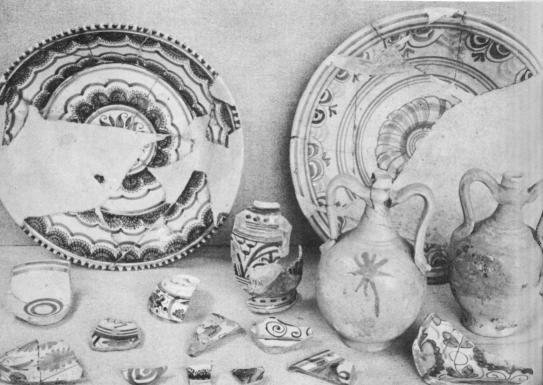
Colorful Spanish maiolica found which appear to have been made before 1650.
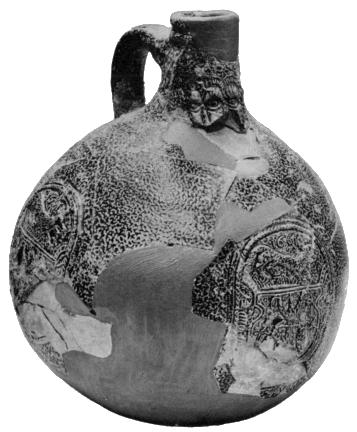
A large German stoneware jug unearthed at Jamestown. The date “1661” appears above the medallion.
A few examples of German salt-glazed stoneware in the Jamestown collection. All were made during the 17th century.
Reconstructed wineglasses and wineglass fragments in the Jamestown collection.
Note the makers’ marks or seals on the wineglass fragments. Only a few English wineglasses bearing 17th-century makers’ seals have been found in America.
Metalware Eating and Drinking Vessels
While large numbers of eating and drinking vessels made of pottery have been excavated on Jamestown Island, only a few fragments of utensils made of silver, pewter, brass, and copper were found. Metalware vessels were relatively scarce during the early years of the settlement, and their almost complete absence in the Jamestown collection may be attributed to the fact that not many of them were discarded, regardless of their worn condition. Only a few metal handles from mugs and cups, and a small number of pewter plate fragments, have been excavated.
Although no complete specimens of domestic silver and pewter eating and drinking vessels were found, 17th-century records and inventories indicate that many Jamestown families owned such wares (especially after 1630), including cups, beakers, dishes, salts, salvers, tankards, porringers, bowls, and plates.
It is of interest that 2 goldsmiths, 2 refiners, and a jeweler arrived at Jamestown in 1608 aboard the supply ship _Phoenix_. Although John Smith related that these artisans “never had occasion to exercise their craft,” it is possible that they made a few metal objects (such as spoons) in the capital city.
Glass Drinking Vessels
Glass was made at Jamestown in 1608-09, and again in 1621-24. It was, in all probability, the first commodity made by the English in a “factory” in the New World. Many glass fragments were found at the furnace site, but none was large enough to reveal what specific glass objects were made there. It appears that drinking glasses may have been among the items manufactured.
The majority of the glass drinking vessels unearthed at Jamestown were made in England, although a few were manufactured in Germany, Italy, and the Low Countries. In the collection are fragments from goblets, beakers, bowls, and wineglasses. Four of the English wineglass stems bear makers’ seals, rare marks seldom found on English drinking vessels.
Glass Wine and Gin Bottles
These comprise a large and important part of the Jamestown collection. Literally thousands of glass fragments from these bottles have been unearthed, and by diligent and patient work a few complete wine and gin bottles have been pieced together.
The glass wine bottles were made in England. The oldest excavated, made between 1640 and 1660, have spherical bodies and tall necks. Those made between 1660 and 1680 have cup-shaped bodies with short necks. Of the period between 1680 and 1700 the neck is very short and the body is wide and squat. Insofar as is known, no glass wine bottles were used at Jamestown before 1640.
Glass wine bottles unearthed at Jamestown ranging in date from 1640 to 1690. Thousands of fragments of these bottles have been recovered.
An assortment of glass bottle seals in the Jamestown collection. Some of the wealthy planters had their initials (or other ornamental device) stamped on the shoulders of the wine bottles which they ordered from England.
This Dutch gin bottle excavated at Jamestown was imported from Holland.
About 1650 the practice of affixing glass seals or buttons on the shoulders of English wine bottles was begun. The seal was inscribed with a name, or initials, or a date; sometimes a coat of arms or a crest, or other device or ornament. Many of these glass bottle seals have been found at Jamestown. As a rule, only the wealthy and influential planters had seals stamped on their wine bottles.
Gin bottles found at Jamestown are tall and square with thin glass sides. Imported from Holland, many were made as early as 1625. One gin bottle was miraculously unearthed intact, and not as much as a chip or crack was found on this 300-year-old fragile specimen.
Food Storage Vessels and Facilities
Many earthenware jars, pots, bowls, and jugs excavated at Jamestown were used for the storage of foods. Wooden and wicker containers were also used, although because of their perishable nature none was unearthed. Seventeenth-century inventories list many of these perishable storage items, including casks, barrels, hogsheads, tubs, bins, and baskets. Leather bottles are also mentioned in a few early records.
Earthenware vessels used for the storage of foods. Some were made at Jamestown, some were imported from England.

“Harvesting” ice, about 1650. Archeological excavations revealed that icehouses were built on the historic island over 300 years ago. (Painting by Sidney E. King.)
A brick-lined storage compartment was found in the cellar (below floor level) of one of the 17th-century buildings. It was used, undoubtedly, for the storage of such easily spoiled foods as milk, cheese, eggs, and cream. Wine, too, was probably kept in bottles in the cool compartment, as many broken bottles were found inside.
An extremely important discovery was a large, deep, ice-storage pit, believed to be the only 17th-century ice pit which has been excavated in Virginia. The conjectural painting on page 48 shows its probable appearance when in use about 1650. Ice-storage pits held dairy products, meats, and other spoilable foods as well as ice. Pond ice was usually cut and stored in the pit in late winter. Sometimes it lasted until late summer or early autumn.