Part 2 — Home Industries
Reading edition
During archeological explorations many artifacts relating to household and town industries were recovered. It is believed that many of these small industries were home activities carried on in the houses at Jamestown. A few of these activities, and the products of them are mentioned briefly.
Spinning and Weaving
A few metal parts from spinning wheels and looms have been excavated—reminders that the pioneer housewife who spun the thread and yarn, and wove the cloth for her large family, was seldom idle.
Malting and Brewing
One Jamestown building or house (whose brick foundations were discovered in 1955) appears to have been used for malting and brewing beer and ale, or carrying out some activity requiring distillation. A few pieces of lead were found which may have been part of a lead cistern for holding barley. The three brick ovens that were uncovered may have been used as drying kilns. A handle from a copper kettle was found near one of the ovens, and pieces of copper and lead pipes were unearthed not far from the building. The structure itself appears to have been used between 1625 and 1660.
Spinning thread or yarn and weaving cloth were endless chores for the women living in the small wilderness settlement. (Conjectural sketch by Sidney E. King.)
Brewing beer at Jamestown. (Conjectural sketch by Sidney E. King.)
Dairying and Cheesemaking
Earthenware milk pans, bowls and pots, iron hoops (from wooden vessels), an earthenware funnel, and parts of skimmers, sieves, and ladles have been excavated. All these are evidence that dairying was an important household industry. This activity was usually carried on in a brick-paved room (with slatted windows) located on the northwest side of the house. Cheese, as well as butter, was probably made in the same room.
Lead and copper pipes, kettle fragments, a brass spigot, and other items found which may have been used for brewing or distilling purposes.
Baking
One of the largest objects that has been found is an earthenware baking oven, which was unearthed in an old ditch near the site of the May-Hartwell House. Restored from over 200 fragments, the oven was probably used between 1650 and 1690. It may have been made at Jamestown, molded of native clay and fired in a pottery kiln. In use, heated stones were placed inside the oven and left until the walls were hot enough for baking. Sometimes, however, the oven may have been placed directly on the embers of the fire. It undoubtedly was used out of doors, near a small house.
Associated Industries
A few artifacts that have been recovered are associated with millers, drapers, basketmakers, cutlers, tailors, barbers, netmakers, and glovers. These tradesmen usually worked in or near their homes.
Earthenware milk pan, brass ladle, funnel fragment, and other items found which relate to dairying and cheesemaking.
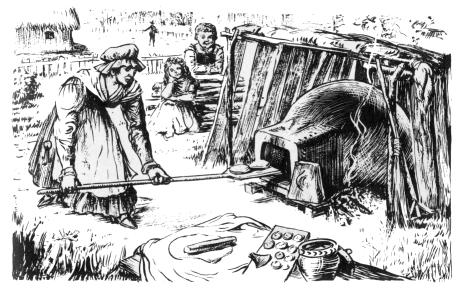
Baking bread in an outdoor baking oven about 1650. (Conjectural sketch by Sidney E. King.)
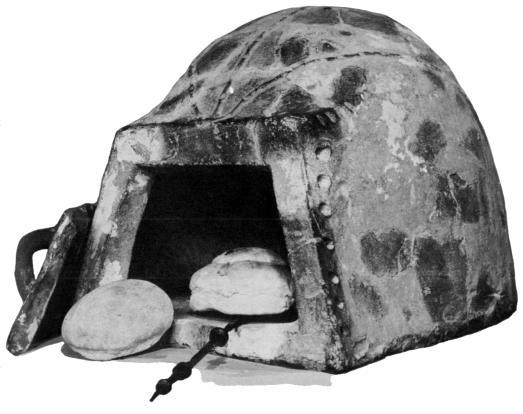
In this oven a Jamestown woman baked bread over 300 years ago. It appears to have been in use between 1650 and 1690.
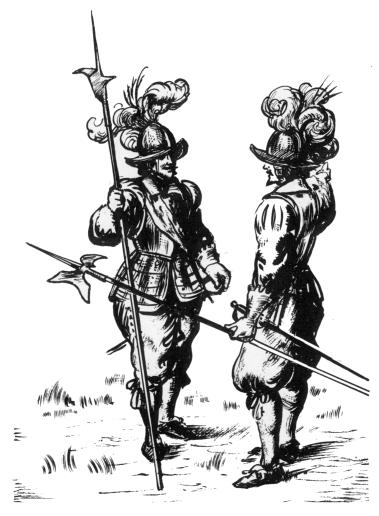
Jamestown soldiers carrying polearms (a halberd and a bill). (Conjectural sketch by Sidney E. King.)