Part 2 — Military Equipment
Reading edition
The vast assemblage of military equipment that has been unearthed (probably the largest collection of late 16th-and 17th-century English weapons used in America) emphasizes the important part which firearms and other weapons played during the early years of the settlement. They helped the colonists to protect themselves from the ever-menacing Indian and from the Spaniards who might at anytime have sailed up the James River to attack the small colony. They were also the means of providing the settlers with much of their food.
During the early years of the colony each Englishman who planned to emigrate to Virginia was advised to supply himself with the following “Armes”:
“One Armour compleat, light.
One long Peece, five foot or five and a halfe, neere Musket bore.
One sword.
One bandaleere [a bandoleer was a belt worn to carry the cases which held the powder charges].
Twenty pound of powder.
Sixty pound of shot or lead, Pistoll and Goose shot.”
Most of the kinds of arms listed have been found at Jamestown and will be described briefly along with other types of weapons which were unearthed.
Polearms
Parts from several polearms, including bills, pikes, and a halberd, have been excavated. The recovered halberd (a polearm with sharp cutting edges and a spearlike point) is typical of the late 16th century, and may have been made as early as 1575. A few bills were unearthed, all dating around 1600. (A bill is a polearm, having a long staff terminating in a hook-shaped blade, usually with spikes at the back and top.) Two pike butts were also unearthed.
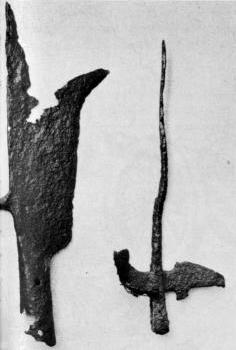
Two early 17th-century polearms—a bill and halberd—unearthed at Jamestown. Both weapons had long wooden handles.
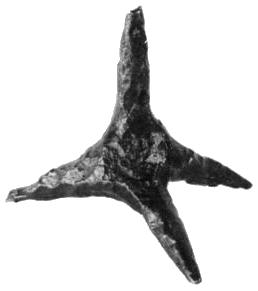
The caltrop unearthed at Jamestown. This sharp-pointed instrument was thrown on the ground to impede an enemy’s infantry and cavalry.
Caltrop
This small item unearthed at Jamestown is an instrument with 4 iron points, so arranged that no matter how it lands, 1 point always projects upward, to impede the progress of an enemy’s cavalry and to prevent surprise attacks.
Swords, Rapiers, and Cutlasses
Types of swords that have been found include broadswords, cutlasses or back swords, and rapiers. Three examples are complete, or nearly so—a cutlass, a broadsword, and a swept-hilt rapier. Many basket hilts were unearthed together with guards from other type swords, pommels, and blade fragments. A number of these edged weapons were made between 1600 and 1625. Several basket-hilted guards and blade fragments were found at the site of an early 17th-century forge, which may have been an armorer’s workshop.
Cannon
One small cannon barrel fragment, possibly from a light cannon known as a robinet, has been unearthed (the bore at the end of the barrel is only 1¼ inches across). A varied assortment of 17th-century cannon balls have also been found, appropriate sizes for such ordnance as demiculverines, sakers, minions, and falcons.
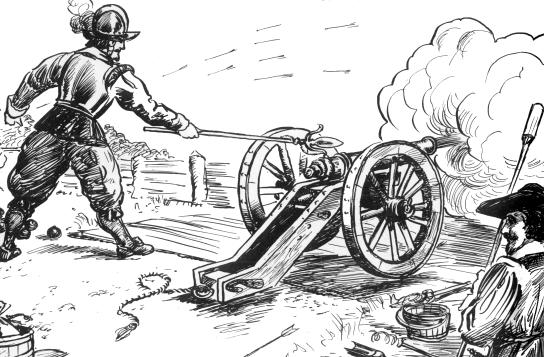
Firing a demiculverine from a bastion at “James Fort.” (Conjectural sketch by Sidney E. King.)
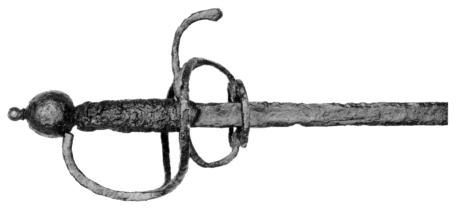
Hilt and portion of blade of a swept-hilt rapier excavated at Jamestown of the 1600-1610 period.
Muskets
An excellent assemblage of 17th-century musket barrels and gun parts have been recovered from the Jamestown soil, reminiscent of times when Indians attempted to wipe out the small settlement.
Among the gunlocks found are matchlocks, wheel-locks, snaphaunces, “doglocks,” and flintlocks. The first settlers were equipped with both wheel-lock and matchlock muskets. Some of the muskets were so heavy, they required a forked ground-rest to shoot (parts of two forked ground-rests have been excavated). Other muskets, like the caliver, were light, and could be fired without the use of a support.
The standard musket during the early years of the settlement was the matchlock. By 1625, however, the picture had changed, for the wheel-lock, snaphaunce, and “doglock,” were being used in large numbers, and the matchlock had become obsolete.
Pistols
Only a few pistol barrels and parts have been unearthed. One pistol barrel is attractively ornamented with silver bands.
Light Armor and Siege Helmet
A breastplate and backpiece from a light suit of armor (probably a pikeman’s suit) were found in a refuse pit. These interesting specimens were probably made in England during the 1600-20 period.
In 1953, Sgt. Floyd E. Painter found an English siege helmet (1600-40 period) 4 miles down the river from Jamestown Island.
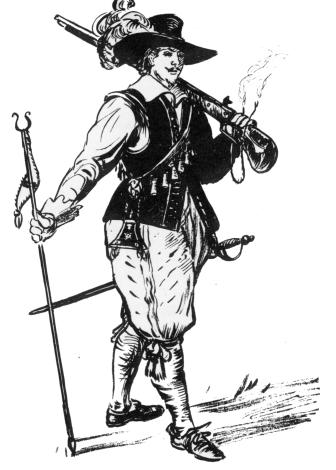
A Jamestown sentry on duty shouldering his heavy matchlock musket. (Conjectural sketch by Sidney E. King.)
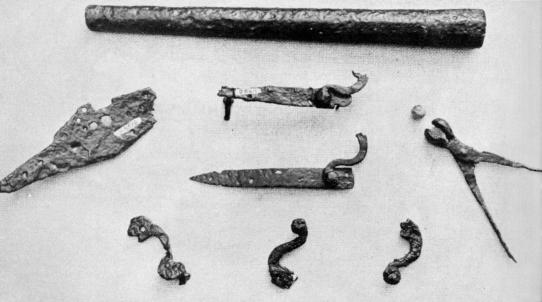
Early musket barrel and gun parts excavated at Jamestown.
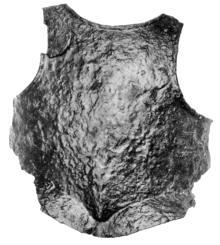
Breastplate from a light suit of armor found in a refuse pit. This was one type used between 1600 and 1640.
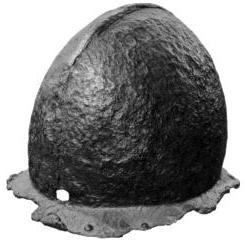
A heavy siege helmet found 4 miles downriver from Jamestown. Weighing over 8 pounds, it was one type used in Europe during the early years of the 17th century.
The early Jamestown settlers were advised to equip themselves with “one armour compleat, light.” (Conjectural sketch by Sidney E. King.)