Book III. INHABITANTS OF THE WATER.
Reading edition
§ I. Cetacea, or Sea Mammalia.

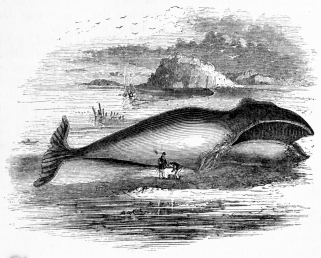
THE COMMON, OR GREENLAND WHALE. (Balæna mysticetus.)
“Nature’s strange work, vast Whales of different form, Toss up the troubled flood, and are themselves a storm; Uncouth the sight, when they in dreadful play, Discharge their nostrils, and refund a sea; Or angry lash the foam with hideous sound, And scatter all the watery dust around; Fearless, the fierce destructive monsters roll, Ingulf the fish, and drive the flying shoal; In deepest seas these living isles appear, And deepest seas can scarce their pressure bear; Their bulk would more than fill the shelvy strait, And fathom’d depths would yield beneath their weight.”
The Whale is not properly a fish; since, though it lives in the sea, and has fins and a tail instead of legs and feet, it resembles in most other respects a seal, and differs from fishes, properly so called, in many important points. Indeed, it is always included in the class Mammalia, by zoologists, as it brings forth its young alive, and nourishes them with its milk; and hence a conceited person, who said he knew every fish from the shrimp to the Whale, was justly laughed at, as neither the Whale nor the shrimp are included in the fishes by zoologists.
The general form of the Whale’s body is that of a fish; but the tail is placed horizontally instead of vertically, and the skeleton of the fins exactly resembles that of a hand affixed to a contracted arm, though it is covered with so thick a skin that no trace of the formation of the bones can be discovered externally. There are only two fins, which are very small, and close to the head. The Whale, however, differs from fishes most materially in its having warm blood; and in its lungs, which are exactly the same as those of quadrupeds. Hence, though the Whale can remain a long time under water without breathing, it is compelled to come to the surface whenever it does breathe, and for this purpose it is furnished with two large nostrils, or blow-holes as they are called. The blow-holes are most beautifully and curiously contrived to close when the animal sinks under water; so that not a drop of water can enter the lungs, however great the pressure may be. The Whale is also provided with a very thick skin, containing an immense quantity of liquid oil, called the blubber, which is so easily detached from the flesh, that when a Whale is killed, the blubber, which is sometimes two feet thick, is taken off by passing a common spade between it and the body. This thick oily skin is a non-conductor of heat, and is thus admirably adapted for preventing the warm blood of the Whale from being chilled by the cold of the water. The true fishes, which are unprovided with such a covering, have cold blood, and are therefore not susceptible of chills.
The common Whale has no teeth in either jaw, but its mouth is furnished with a kind of fringe of numerous long horny laminæ, which are what we call whalebone, and which form a kind of strainer, admitting only the small fish on which the Whale feeds. This Whalebone is one of the valuable products of the whale, though the oil is most important.
“As when enclosing harpooners assail, In hyperborean seas, the slumbering Whale; Soon as the javelins pierce the scaly side, He groans, he darts impetuous down the tide; And, rack’d all o’er with lacerating pain, He flies remote beneath the flood in vain.” Falconer.
Whales are taken in great numbers about Spitzbergen, Greenland, and other northern countries by the English, the Dutch, &c. Considerable fleets of ships are sent out every spring for this purpose. When they begin their fishery, each ship is fastened or moored with nose-hooks to the ice. Two boats, each manned with six men, are ordered by the commodore to look out for the coming of the fish for two hours, when they are relieved by two more, and so by turns; the two boats lie at some small distance from the ship, each separated from the other, fastened to the ice with their boat-hooks, ready to let go in an instant at the first sight of the Whale. Here the dexterity of the Whale hunters is to be admired; for as soon as the animal shows itself, every man is at his oar, and they all rush on the Whale with prodigious swiftness; at the same time taking care to come behind its head, that it may not see the boat, which sometimes so alarms it, that it plunges down again before they have time to strike it. But the greatest care is to be taken of the tail, with which it many times does very great damage, both to the boats and seamen. The harpooner, who is placed at the head or bow of the boat, seeing the back of the Whale, and making the onset, thrusts the harpoon with all his might into its body by the help of a staff fixed to the iron for this purpose, and leaves it in, a line being fastened to it of about two inches in circumference, and one hundred and thirty-six fathoms long. Every boat is furnished with seven of these lines, from the motion of which, when let run, they observe the course of the Whale.
As soon as the Whale is struck, the third man in the boat holds up his oar, with something on the top, as a signal to the ship; at the sight of which the man who is appointed to watch gives the alarm to those that are asleep, who instantly let fall their other four boats, which hang on the tackles, two at each side, ready to let go at a minute’s warning, all furnished with six men each, harpoons, lances, lines, &c. Two or three of these boats row to the place where the Whale may be expected to come up again; the others to assist the boat that first struck it with line; as the Whale will sometimes run out three more boats’ lines, all fastened to each other, for when the lines of the first boat are almost run out, they throw the end to the second to be fastened to theirs, and the second boat does the same to the third, and so on. In this manner line is supplied to such an extent that a large Whale has been known to carry off three miles of it.
A Whale, when he is first struck, will run out above a hundred fathoms of line, before the harpooner is able to take a turn round the boat’s stern; and with such swiftness that a man stands ready to throw water on the line to quench it, in case it should take fire, which it frequently does. There was, many years ago, a boat to be seen in the South Sea Dock at Deptford, the head of which was sawed off by the swiftness of the line running out. The harpoon would be of but little avail in the destruction of this animal; but part of the rowers, either at the first onset, or when, in order to fetch his breath, he rises to the surface and discovers himself to view, throwing aside their oars, and taking up their very sharp lances, thrust them into his body, till they see him spurt the blood through the blow-holes, the sight of which is a sign of the creature’s being mortally wounded. The fishermen, upon the killing of a Whale, are each entitled to some small reward. After the Whale is killed, they cut all the lines that were fastened to it, and then cut off the tail; upon this it instantly turns on its back; and in this manner they tow it to the ship, where they fasten ropes to keep it from sinking; and, when it is cold, begin to cut off the blubber.
The blubber of a Whale is frequently found to be eighteen or twenty inches thick; which yields fifty or sixty puncheons of oil, each puncheon containing seventy-four gallons; and the upper jaw yields about six hundred pieces of whalebone, most of which are about twelve feet long, and six or eight inches broad; the whole produce of a Whale being worth one thousand pounds, more or less, according to the size of the animal. Whilst the men are at work on the back of the Whale they have spurs on their boots, with two prongs, which come down on each side of their feet, lest they should slip, the back of the Whale being very slippery.
When the Whale feeds, it swims with considerable velocity below the surface of the sea, with its jaws widely extended. A stream of water consequently enters its mouth, carrying along with it immense quantities of cuttle-fish, sea-blubber, shrimps, and other small marine animals. The water escapes at the sides; but the food is entangled, and, as it were, sifted by the fringe of whalebone within the mouth; this kind of strainer is rendered necessary by the very small gullet, which in a Whale of sixty feet long, does not exceed four inches in width. The sailors say that a penny-loaf would choke a Whale.
The Whale bellows fearfully when wounded or in distress. Its young is called a cub.
There is also an extensive Whale fishery in the Southern Ocean, carried on chiefly by the Americans. The Whale found in those seas is distinct from the Greenland Whale, and is described by naturalists under the name of Balæna Australis.
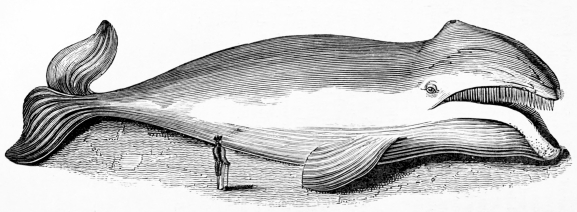
THE RORQUAL, OR FIN-BACKED WHALE, (Balænoptera boops,)
Is a very large Whale, specimens sometimes measuring as much as one hundred feet in length. It is distinguished by its smaller head, and by the existence of a sort of fin on the lower part of its back. The Rorqual is found in the northern seas, and specimens are sometimes seen off our coasts. It is not of much value, as it furnishes far less blubber than the common Whale, and the baleen or whalebone is so short as to be useless.
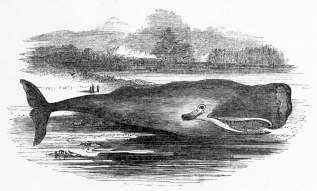
THE SPERMACETI WHALE, OR CACHALOT. (Physeter macrocephalus.)
This animal has teeth in the lower jaw only; and no whalebone. The substance called spermaceti is extracted from its immense head, which is nearly half the size of the entire animal; and the throat is so large that it could swallow a shark.
The quantity of oil produced from the Spermaceti Whale is not so considerable as that obtained from the common or Greenland Whale, but in quality it is far preferable, as it yields a bright flame, without exhaling any nauseous smell. The substance known by the name of ambergris is also obtained from the body of this animal. It is generally found in the stomach, but sometimes in the intestines; and, in a commercial point of view, is a highly valuable production. The spermaceti is in a fluid state while the animal is living, and as soon as it is dead a hole is made in the head, and the liquid taken out with buckets. It becomes solid as it cools, and it is afterwards made into candles, &c.
When we reflect that the same Power whose will has formed the immense bulk of this marine monster has also given animation, senses, and passions to the smallest of the microscopic animalcules, how lowered must be the pride of man, who, standing in the middle, and nearly at equal distance from both, is yet unable to comprehend the mechanism which puts them in motion, and much less that intelligence and power which has given them life, and has assigned to them their respective stations in the universe! Let us then exclaim, with astonishment and gratitude, with the Psalmist: “O Lord, how inscrutable are thy ways, how magnificent thy works!”
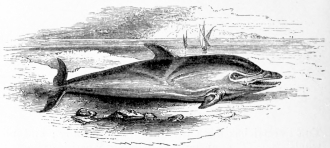
THE DOLPHIN. (Delphinus delphis.)
This animal, like the whale, is not considered a fish, though it lives in the water, as it has warm blood and suckles its young, which are born alive. It has also lungs instead of gills, and is therefore obliged to raise its head above the surface of the water to breathe.
The Dolphin is from six to ten feet in length. The body is roundish, gradually diminishing towards the tail; the nose is long and pointed, the skin smooth, the back black or dusky blue, becoming white below. It has numerous small teeth in each jaw; a dorsal and two pectoral fins, and a tail in the shape of a crescent. The beak-like snout has probably made the French call the Dolphin the sea-goose.
Several curious stories have been related of this animal, most of which are fabulous. The anecdote of Arion, the musician, who, being thrown overboard by pirates, was indebted for his life to one of these animals, is well known, and acquired great credit among ancient poets, as it was said to be by his music that Arion charmed the Dolphin. There are several other fables mentioned by ancient authors to prove the philanthropy of the Dolphin. Since the province of Dauphiné in France has been united to the crown, the heir-apparent has been called “Dauphin,” and quarters a Dolphin on his shield. Falconer, in his beautiful poem, “The Shipwreck,” describes the death of the Dolphin in the following elegant manner:
“—— Beneath the lofty vessel’s stern A shoal of sporting dolphins they discern, Beaming from burnished scales refulgent rays, Till all the glowing ocean seems to blaze. In curling wreaths they wanton on the tide; Now bound aloft, now downward swiftly glide. Awhile beneath the waves their tracks remain, And burn in silver streams along the liquid plain; Soon to the sport of death the crew repair, Dart the long lance, or spread the bated snare. One in redoubling mazes wheels along, And glides, unhappy, near the triple prong. Rodmond, unerring, o’er his head suspends The barbed steel, and every turn attends: Unerring aim’d, the missile weapon flew, And plunging, struck the fated victim through. The upturning points his pond’rous bulk sustain; On deck he struggles with convulsive pain; But while his heart the fatal javelin thrills, And fleeting life escapes in sanguine rills, What radiant changes strike the astonish’d sight, What glowing hues of mingled shade and light! No equal beauties gild the lucid west With parting beams all o’er profusely dressed; No lovelier colours paint the vernal dawn, When orient dews impearl the enamell’d lawn; Than from his sides in bright suffusion flow, That now with gold empyreal seem to glow; Now in pellucid sapphires meet the view, And emulate the soft celestial hue; Now beam a flaming crimson to the eye, And now assume the purple’s deeper dye: But here description clouds each shining ray; What terms of art can Nature’s power display?”
Unfortunately for poetry, the beautiful colours of the dying Dolphin exist entirely in the fancy of the poet; as the Dolphin in a dying state displays no tints but black and white, and it is believed that the notion so prevalent among the ancients of the change of colour in this animal was derived from a true fish, the Dorado, which does exhibit this phenomenon.
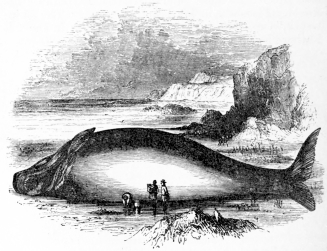
THE WHITE WHALE. (Beluga leucas.)
The White Whale, or Beluga, is included among the dolphins. The body is white, tinged with yellow, or rose-colour, and its proportions are more agreeable than those of most of the cetacea. It measures from twelve to eighteen feet in length. White Whales are gregarious, assembling in flocks or herds, and playing about with rapid and graceful movements. The female has two young ones at a time, over which she watches with the greatest apparent affection. They follow all her movements, and do not quit her till they are nearly full grown. This Whale is generally confined to the northern latitudes, though one was taken in the Firth of Forth in 1815. The oil is of excellent quality, and the flesh eats like beef. According to some writers the flesh, when pickled with vinegar and salt, is as well tasted as pork; and thus the body, which is generally thrown away when the sailors have cut off the blubber, might be used by them as food. The internal membranes are used by the Greenlanders for windows, and the sinews for thread, and the fins and tail, when properly prepared, are said by some of the old writers to be good eating.
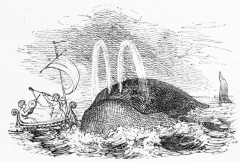
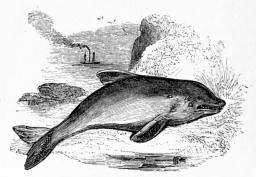
THE PORPOISE. (Phocæna vulgaris.)
The Porpoise is one of the cetacea, and nearly allied to the dolphin, but it has not the beaked snout of that animal. The length of the Porpoise, from the tip of the snout to the end of the tail, is from four to eight feet, and its girth about two feet and a half. The figure of the whole body is conical; the colour of the back is deep blue, inclining to shining black; the sides are grey, becoming white below. The tail is crescent-shaped. There are only three fins, one on the back, and one on each shoulder. The eyes are very small. When the flesh is cut up, it looks very much like pork; but although it was once considered a sumptuous article of food, and is said to have been occasionally introduced at the tables of the old English nobility, it certainly has a disagreeable flavour. Porpoises live on small fish, and appear generally in large shoals, particularly in the mackerel and herring seasons, at which time they do very great damage to fishermen, by breaking and destroying the nets to get at their prey. Their motion in the water is a kind of circular leap; they dive deep, but soon again rise up in order to breathe. They are so eager in the pursuit of their prey, that they sometimes ascend large rivers, and have even been seen above Westminster Bridge. They have no gills, and blow out the water with a loud noise, which in calm weather may be heard at a great distance. They are seen nearly in all seas, and are very common upon the British coasts, where they sport with great activity, chiefly at the approach of a squall.
The Grampus (Phocæna Orca) is a species of Porpoise, and a decided and inveterate enemy to whales; which they attack in great flocks, fastening round them like so many bull-dogs, making them roar with pain, and frequently killing and devouring them. They are usually from twenty to twenty-five feet in length, and in general form and colour resemble the common Porpoise; but the lower jaw is considerably wider than the upper, and the body is somewhat broader and more deep in proportion. The back-fin sometimes measures six feet in length. In one of the poems of Waller, a story (founded on fact) is recorded of the parental affection of these animals. A Grampus and her cub had got into an arm of the sea, where, by the desertion of the tide, they were enclosed on every side. The men on shore saw their situation, and ran down upon them with such weapons as they could at the moment collect. The poor animals were soon wounded in several places, so that all the immediately surrounding water was stained with their blood. They made many efforts to escape; and the old one, by superior strength, forced itself over the shallow into the ocean. But though in safety herself she would not leave her young one in the hands of assassins. She therefore again rushed in; and seemed resolved, since she could not prevent, at least to share the fate of her offspring. The story concludes with poetical justice; for the tide coming in, conveyed them both off in safety; and it is probable, from the great thickness of their skins, that their wounds had not been very deep.
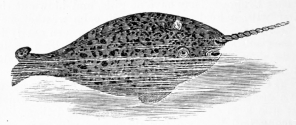
THE SEA-UNICORN, OR NARWHAL, (Monodon monoceros,)
A marine animal, differing from all the cetacea, to which it belongs, in not having any teeth, properly so called, and in being armed with a horn of seven or eight feet in length, which projects from the head. This horn is white, spirally twisted throughout its whole length, and tapering to a point: it is harder, whiter, and more valuable than the ivory of the elephant, and was formerly in high repute for its supposed medical properties: small ones may be sometimes seen set with an elegant head as a walking-stick, and large specimens have been employed as bed-posts. The animal itself is from twenty to forty feet in length, and is occasionally found with two horns; indeed, there is always the germ of a second horn both in the male and female, though it is rarely developed in the former, and never in the latter, from which we may conjecture that the females trust entirely to the males for their defence, as we know is the case with several of the mammalia. When there is only one horn, it is always on the left side of the head; and when there are two, the horn on the left side is always larger than the other. This animal chiefly inhabits the arctic seas, and its food is said to consist of the smaller kinds of flat fish and other marine animals; its horn is useful in breaking away the ice when it wants to come up to breathe. The blubber supplies a small quantity of very fine oil, and the Greenlanders are very partial to the flesh.
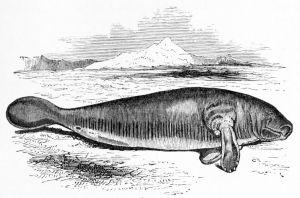
THE MANATEE, (Manatus Australis,)
Also called the Sea Cow, is a great deal smaller than the other cetacea just described, and differs from them in its diet, which consists entirely of marine plants. It haunts the coasts and estuaries of South America, and measures nine or ten feet in length; its head is comparatively small, its jaws are furnished only with grinding-teeth, of which it has thirty-two, its skin is provided with a good many scattered bristles, and its flippers, or fins, with four small nails. This animal not unfrequently raises its head and shoulders out of the water, when it is said to have some resemblance to a human being, and it is probable that the distant view of a nearly related species, the Lamantin, which inhabits the shores of Africa, may have given the ancients their first notion of the Mermaid. The Manatee is captured with harpoons, and its flesh is said to be very good eating. When salted and dried it will keep for a year. It also furnishes an excellent oil, and its skin is used for making harness and whips. The Dugong (Halicore Dugong) is a very similar animal, inhabiting the eastern seas. It grows to a length of eighteen or twenty feet.
§ II. Cartilaginous Fishes.
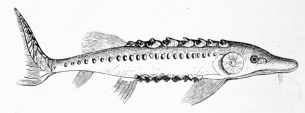
THE STURGEON, (Acipenser sturio,)
Sometimes grows to the length of eight or ten feet, and has been found to weigh five hundred pounds. It has a long, slender, pointed nose, small eyes, and a small mouth destitute of teeth, placed beneath and unsupported by the maxillæ; so that when the animal is dead, the mouth remains always open. The body is covered with five rows of large bony tubercles, and the under side is flat; it has one dorsal fin, two pectoral, two ventral, and one anal. The upper part of the body is of a muddy olive colour, and the under part silvery. The tail is bifurcated, the upper part being much longer than the under. Sturgeons subsist principally on insects and marine plants, which they find at the bottom of the water, where they mostly resort.
The Sturgeon annually ascends our rivers in the summer, particularly those of the Eden and Esk; and when caught, as it sometimes is, in the salmon-nets, it scarcely makes any resistance, but is drawn out of the water apparently lifeless. One of the largest Sturgeons ever caught in our rivers was taken in the Esk a good many years ago: it weighed four hundred and sixty pounds. This fish is found in most of the rivers in Europe; it is also common in those of North America, and especially in the lakes and rivers of Northern Asia.
The flesh of the Sturgeon is delicious; and it was so much valued in the time of the Emperor Severus, that it was brought to table by servants with coronets on their heads, and preceded by music. In London, every Sturgeon that is caught in the Thames is presented by the Lord Mayor to the Sovereign. The roe, when preserved with salt and oil, is called caviar, and is a favourite dish with many persons; the best is made in Russia. The flesh is also pickled or salted, and sent all over Europe. So prolific is this fish, that Catesby says the females frequently contain a bushel of spawn each; and Leeuwenhoek found in the roe of one of them no fewer than one hundred and fifty thousand million eggs!
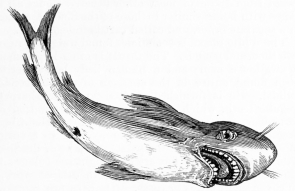
THE SHARK. (Squalus carcharias, or Carcharias vulgaris.)
“Increasing still the terrors of the storms, His jaws horrific arm’d with threefold fate, Here dwells the direful Shark.”
The Shark differs from the whale in not being one of the mammalia. It is cold-blooded, and does not suckle its young. It has no lungs, and its mode of breathing is like that of other fishes, except that its gills are fixed, and the water escapes by five apertures on each side. The body of the Shark is elongated, and tapers gradually from the head to the tail, or is very slightly dilated in the middle. Its muzzle or nose is rounded, and projects very much over the mouth, the nostrils being situated on the under side. The male shark is smaller than the female, and differs from it in appearance, in possessing two elongated appendages, one of which is attached to the hinder edge of each of the ventral fins. The purpose which these appendages are intended to serve is not known. Some of the Sharks produce their young alive, and others lay eggs contained in horny cases of an oblong shape, with long tendrils at each of the four corners. After the young Sharks are hatched, these curious cases are often washed on shore, and are called mermaids’ purses.
The bones of the Shark are like gristle, and very different from those of most other fishes. Hence all the fishes with bones similar to those of the Shark are placed in a separate order, and called cartilaginous fishes.
The White Shark is sometimes found weighing nearly two thousand pounds. The throat is often large enough to swallow a man; and a human body has sometimes been found entire in the stomach of this tremendous animal. He is furnished with six rows of sharp triangular teeth, which amount in all to a hundred and forty-four, serrated on their edges, and capable of being erected or depressed at pleasure, owing to a curious muscular mechanism in the palate and jaws of the Shark. The whole body and fins are of a light ash-colour; the skin rough, and employed to smooth cabinet work, or to cover small boxes or cases. His eyes are large and staring, and he possesses great muscular strength in his tail and fins. Whenever he spies, from the deepest recesses of the sea, a man swimming or diving, he darts from the place, up to his prey, and if unable to take in the whole, or snatch away a limb, he follows for a long time the boat or vessel in which the more nimble swimmer has found a safe and opportune retreat: but seldom does he let any one escape his jaws, and get off entire. Sir Brook Watson was swimming at a little distance from a ship, when he saw a Shark making towards him. Struck with terror at its approach, he cried out for assistance. A rope was instantly thrown; but even while the men were in the act of drawing him up the ship’s side, the monster darted after him, and, at a single snap, tore off his leg.
We are told that, in the reign of Queen Anne, some of the men of an English merchant-ship, which had arrived at Barbadoes, were one day bathing in the sea, when a large Shark appeared, and was rushing upon them. A person from the ship called out to warn them of their danger; on which they all immediately swam to the vessel, and arrived in perfect safety, except one poor man, who was cut in two by the Shark, almost within reach of the oars. A comrade and intimate friend of the unfortunate victim, when he observed the severed trunk of his companion, was seized with a degree of horror that words cannot describe. The insatiate Shark was seen traversing the bloody surface in search of the remainder of his prey, when the brave youth plunged into the water, determining either to make the Shark disgorge, or to be buried himself in the same grave. He held in his hand a long and sharp-pointed knife, and the rapacious animal pushed furiously towards him; he had turned on his side, and had opened his enormous jaws, in order to seize him, when the youth, diving dexterously under, seized him with his left hand, somewhere about the upper fins, and stabbed him several times in the belly. The Shark, enraged with pain, and streaming with blood, plunged in all directions in order to disengage himself from his enemy. The crews of the surrounding vessels saw that the combat was decided; but they were ignorant which was slain, until the Shark, weakened by loss of blood, made towards the shore, and along with him his conqueror; who, flushed with victory, pushed his foe with redoubled ardour, and, by the aid of an ebbing tide, dragged him on shore. Here he ripped up the bowels of the animal, obtained the severed remainder of his friend’s body, and buried it with the trunk in the same grave. This story, however incredible it may appear, is related in the History of Barbadoes, on the most satisfactory authority.
Had nature allowed this fish to seize his prey with as much facility as many others, the Shark tribe would have soon depopulated the ocean, and reigned alone in the vast regions of the sea, till hunger would have forced them to attack and ultimately destroy each other; but the upper jaw of this devouring animal, is so constructed as to offer, by its prominency, an impediment to the Shark’s easily seizing his prey; and consequently when on the point of catching hold of anything, he is obliged to turn on one side, which troublesome evolution often gives the object of his pursuit time to escape. The flesh of this fish is of a disagreeable taste, and cannot be eaten with any kind of relish, except the part near the tail.
Twenty different species of this family are known, and the number of different families of the Shark tribe is very great.
THE GREENLAND SHARK, (Selachus maximus,)
Is another very voracious species; and one extremely difficult to kill. It is the great enemy of the whale, and devours the bodies of those left by the fishers. Its teeth are very small, pointed, and numerous. The snout is short. It is sometimes known as the Basking Shark.
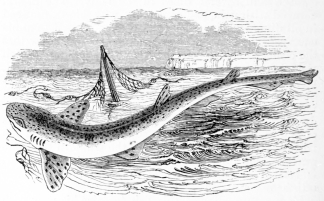
THE DOG-FISHES
Are so excessively voracious, that they are altogether fearless of mankind. They follow vessels with great eagerness, seizing with avidity everything eatable that is thrown overboard; and have sometimes been known to throw themselves on fishermen, and on persons bathing in the sea. As, however, they are much smaller and weaker than most of the other Sharks, they do not always attack their enemies by open force, but generally have recourse to stratagem. They, consequently, conceal themselves in the mud, and lie in ambush, like the ray or skate-fish, (also one of the cartilaginous fishes,) until they have an opportunity of successfully attacking their prey. On the coasts of Scarborough, where haddocks, cod, and Dog-fish are in great abundance, the fishermen universally believe that the Dog-fish make a line or semicircle to encompass a shoal of haddocks and cod, confining them within certain limits near the shore, and eating them as occasion requires: they are therefore considered very destructive to this fishery. The flesh of the Dog-fish is hard and disagreeable; its skin, when dried, is made into the well-known shagreen, and from the liver a considerable quantity of oil may be extracted. Shagreen is also made from the skin of other cartilaginous fishes.
THE HAMMER-HEADED SHARK, (Zygæna malleus,)
Is a very curious kind, having a transverse head like that of a hammer, with an eye at each extremity; and the Fox-Shark, or Thresher (Carcharias vulpes), is remarkable for the enormous length of the upper lobe of its tail, with which it is able to strike with tremendous force. This fish is one of the great enemies of the whale.
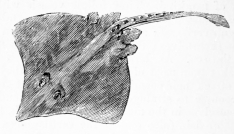
THE SKATE, (Raia batis,)
Is a species of the Ray, which was long disregarded in this country as a coarse, bad-tasted food, but which now appears upon our best tables. It is still, however, disregarded in Scotland and the north of England, where its flesh is principally used as a bait for other fish. On some parts of the continent, where these fish are caught in great abundance, they are dried for sale. The best season for Skate is the spring of the year. The body is broad and flat, of a brown colour on the back, and white on the lower side: the head is not distinct from the body, so that this fish and all belonging to this genus are apparently acephalous, or without a head. The peculiar form of this fish is owing to the large size of the pectoral fins, which extend from the head to the base of the tail, and are very wide in the middle, and so, combined with the sharpness of the snout, give the fish the shape known as rhomboidal. Dr. Monro has remarked, that in the gills of a large Skate there are upwards of one hundred and forty-four thousand subdivisions, or folds; and that the whole extent of this membrane, whose surface is nearly equal to that of the whole human body, may be seen by a microscope to be covered with a network of vessels, that are not only extremely minute, but exquisitely beautiful. The tail of the Skate is long, and generally prickly. The mouth is, as it were, paved with teeth, which are flat, and nearly square in shape. In the full-grown male the centre teeth are pointed, at least in some species. The eggs deposited by the female Skate are very similar to those laid by the shark, being in the shape of a square bag, with two horns at each end as here represented.
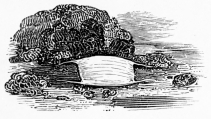
In this horny case the embryo is contained, and grows till it has acquired strength enough to burst through its prison. The colour of the bag is maroon, and the substance like thin brown parchment or leather. The female begins to drop these singly in the month of May, and continues to do so for several months, to the number of two or three hundred. In some parts of Cumberland they are called, by the common people, Skatebarrows, on account of their resemblance to the barrows which are carried by two men, and used for the conveyance of goods, &c.
The Skate sometimes attains a very large size. Willoughby speaks of one so huge that it would have served one hundred and twenty men for dinner. Some naturalists are of opinion that these fishes are the largest inhabitants of the deep, and that only the smallest of them come near the surface of the water, the biggest remaining flat at the bottom of the sea, where an unfathomable deep secures them against the wiles of man.
Nine species of the Skate or Ray are found on the British coasts.
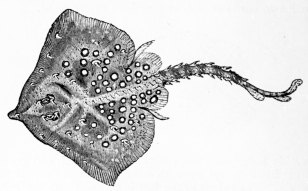
THE THORNBACK, (Raia clavata,)
Resembles the Skate in its general appearance; the principal difference consists in the latter having sharp teeth, and a single row of spines upon the tail, while the former has blunt teeth, and several rows of spines both upon the back and tail. A Thornback was caught near the island of St. Kitt’s, in the year 1634, which measured twelve feet in length, and nearly ten in width. It is sometimes eaten in England, but as its flesh is inferior to that of the Skate, it is generally sold at a low price. The young ones, however, which have the denomination of Maids, are delicate eating.
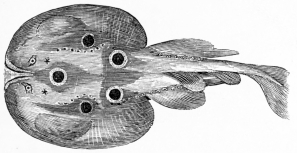
THE TORPEDO, OR ELECTRIC RAY. (Torpedo vulgaris.)
This curious fish is capable of giving a violent shock, like that produced by the electrical machine, to the person who handles it. The body is nearly circular, and thicker than any other of the Ray kind, and is sometimes so large as to weigh between seventy and eighty pounds. The skin is smooth, of a dusky brown colour, and white underneath. The ventral fins form on each side, at the end of the body, nearly a quarter of a circle. The tail is short, and the two dorsal fins are near its origin. The mouth is small, and as in the other species, there are on each side below it five breathing apertures.
The shock imparted by the touch of the Cramp-fish, as the Torpedo is vulgarly called, is often attended with a sudden sickness at the stomach, a general tremor, a kind of convulsion, and sometimes a total suspension of the faculties of the mind. Such power of self-defence has Providence allowed this lumpish and inactive fish. Whenever an enemy approaches, the Torpedo emits from its body that benumbing shock, which incapacitates the other instantly, and it thereby gets time to escape. Nor is it merely a means of defence, but an advantage in other respects, for the Torpedo thus benumbs its prey, and easily seizes upon it. The animals thus killed are also supposed to become more easy of digestion.
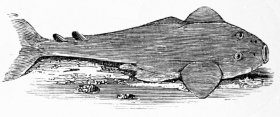
THE MONK-FISH, OR ANGEL-FISH, (Squatina Angelus,)
Is very voracious, and feeds upon all kinds of flat fish, as soles, flounders, &c. It is often caught on the coasts of Great Britain, and of such a size as to weigh sometimes a hundred pounds. This fish seems to be of a middle nature between the rays and sharks, and is called by Pliny the Squatina; a name which seems to bring this species near that of the skate. Its head is large; the mouth has five rows of teeth, which are capable of being raised or depressed at pleasure. The back is of a pale ash-colour; the belly white and smooth. The shores of Cornwall are often frequented by this fish, but its flesh does not deserve to be praised, being hard, and of a very indifferent flavour.
It is supposed to have acquired the name of Angel-fish, from its extended pectoral fins bearing some similarity to wings, certainly, as Mr. Yarrell has remarked, not for its beauty; and of monk-fish, from its rounded head, appearing as if enveloped in a monk’s hood. The skin is rather rough, and is used for polishing, and other works in the arts. Mr. Donovan says that the Turks of the present day make shagreen of it.
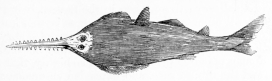
THE SAW-FISH. (Tristis antiquorum.)
This fish is found in the European and Atlantic seas. Its body is flattened anteriorly with four or five branchial openings below on each side; two spiracles behind the eyes; no anal fin; the head prolonged into a depressed bony beak, with strong pointed spines on each side; the lips are rough and sharp like a file, supplying the place of teeth. With its formidable weapon, which resembles a toothed saw, this fish attacks the largest whales, and inflicts very severe wounds. The colour of its body is of a greyish brown above, and paler below; its length about fifteen feet, the saw being about a third of the whole.
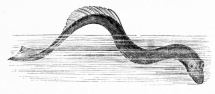
THE LAMPREY. (Petromyzon marinus.)
The Lamprey belongs to the last family of cartilaginous fishes, and is one of the lowest in the scale of vertebrated animals. It grows to the length of about three feet, although the British species, with which we are best acquainted, seldom exceeds twelve inches. To avoid the constant muscular exertions necessary to prevent their being carried away by the current, they attach themselves by the mouth to stones or rocks, and hence are called Petromyzon, Stone-suckers. The Lamprey, although no longer maintaining its ancient repute, is still considered a delicacy; those taken in the Severn being preferred to all others. Henry the First, as is well known, died of a surfeit of them; and in the reign of Henry the Fourth their importation was encouraged by immunities. The Roman epicures prized this fish so highly, that they bestowed the utmost care, and expended enormous sums in rearing them. Pliny tells us that Lucullus formed a fish-pond of such extent, that the fish it contained were, at his death, sold for four million sesterces. These polished barbarians sometimes threw a slave into the ponds where they kept their Murœnæ, or Lampreys, and considered that by this means they fattened the fish and gave them a superior flavour.
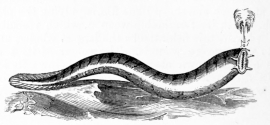
THE HAG-FISH, (Myxine glutinosa,)
A cartilaginous fish, which in its general appearance bears a near resemblance to the Lamprey. Its colour is dusky bluish above, and reddish towards the head and tail; its length from four to six inches. The Hag-fish is remarkable for its total want of eyes; its mouth is of an oblong form, with two beards or cirri on each side, and on the upper part four. On the top of the head is a small spout-hole, furnished with a valve, by which it can be closed at pleasure. A double row of pores extends beneath the body, from one extremity to the other, which on pressure exude a quantity of viscid fluid, which, when attacked by large fish, the Hag throws out, so as to cloud the surrounding element in such a manner as to render itself invisible to its assailants. “The habits of this fish are highly singular: it will enter the bodies of such fishes as it happens to find on the fishermen’s hooks, and which consequently have lost the power of escaping its attack; and gnawing its way through the skin, will devour all the internal parts, leaving only the bones and the skin. If put into a large vessel of sea-water, it is said in a very short space to render the whole water so glutinous that it may easily be drawn out in the form of threads.”
§ III. Bony Fishes.
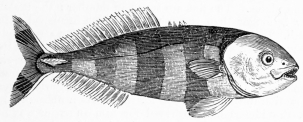
THE PILOT-FISH. (Naucrates ductor.)
The body of this fish is long, the head compressed, rounding off in front, without scales as far as the operculum. The mouth is small, the jaws of equal length, and furnished with small teeth; the palate has a curved row of similar teeth in front, and the tongue has teeth all along. The colour varies in several species. The Pilot-fish will frequently attend a ship during its course at sea for weeks, or even months together; and there are many curious stories told respecting its habits, in occasionally directing a shark where to find a good meal, and also in warning him how to avoid a dangerous bait. Whether this be true or not will be difficult to determine; but it is certain that this little fish is generally found in company with the shark, and picks up the smaller pieces of food which his predatory master drops, either by accident or design.
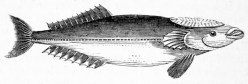
THE REMORA, OR SUCKING-FISH, (Echeneis Remora,)
Resembles the herring; its head is thick, naked, depressed, and marked on the upper side with a curious sucker composed of numerous transverse, movable, serrated plates. The fins are seven in number; the under jaw is longer than the upper, and both furnished with teeth. This fish is provided by nature with a strong adhesive power, and, by means of the grooved space on its head, can attach itself to any animal or body whatever. We might suppose that a small fish with seven acting fins, armed like a galley with oars, would have a great power of motion in the water, but, for some reason unknown to us, Providence has contrived for him an easier way of travelling, by enabling him to fix himself to the hull of a ship, and even to the body of a larger animal than himself, as the whale, the shark, and others. Our forefathers believed that, small as he is, this fish had the power of arresting the progress of a ship in its fastest sailing by adhering to the bottom.
“The Sucking-fish beneath, with secret chains, Clung to the keel, the swiftest ship detains. The seamen run confused, no labour spared, Let fly the sheets, and hoist the topmast yard. The master bids them give her all the sails, To court the winds and catch the coming gales. But, though the canvas bellies with the blast, And boisterous winds bend down the cracking mast, The bark stands firmly rooted in the sea, And will, unmoved, nor winds nor waves obey: Still, as when calms have flatted all the plain, And infant waves scarce wrinkle on the main. No ship in harbour moor’d so careless rides, When ruffling waters tell the flowing tides; Appall’d, the sailors stare, through strange surprise, Believe they dream, and rub their waking eyes.”
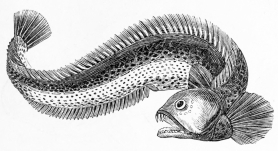
THE SEA-WOLF, OR SEA-BAT, (Anarrhichas lupus,)
Is often caught in the European seas; and is about five or six feet in length, and has a larger and flatter head than the shark. The back, sides, and fins are of a bluish colour; the body is nearly white; the whole skin is smooth and slippery, without any appearance of scales. It is of a very voracious nature, and has a double row of sharp and round teeth, both in the upper and lower jaw. Its appetite, however, does not lead it to destroy fishes similar in shape to itself, as it is supposed to feed chiefly on crustaceous and molluscous animals, whose shells it breaks easily with its teeth. It is sometimes found in the northern seas exceeding twelve feet in length, and owes its name to its natural fierceness and voracity. The fishermen dread its bite, and endeavour as speedily as possible to strike out its fore-teeth, which are so strong, that they are capable of leaving an impression on an anchor. The fins nearest the head spread themselves, when the animal is swimming, in the shape of two large fans, and their motion contributes considerably to accelerate its natural swiftness. The flesh is good, and as it bears salting well it is an important article of food to the Icelanders, in whose seas this fish occurs in great abundance and of large size.
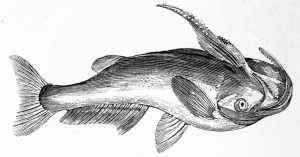
THE HORNED SILURE, (Silurus, or Ageneiosus militaris,)
Grows to a large size, weighing sometimes three hundred pounds, and measuring eight to ten feet in length, and two in breadth. It has a broad, flat, thin head; and the horns, which are on each side of the upper lip, are armed with short crooked spines, like teeth. A remarkable peculiarity in this fish is the dorsal fin, which is close to the head, and is long, stiff, dentated like the horns, and is, no doubt, an instrument of defence. In colour it resembles the eel, and has no scales; only one small fin on the back, and a forked tail; its flesh is esteemed next to that of the eel, and has a similar flavour. This fish is a great depredator, and makes considerable havoc among the smaller inhabitants of the rivers and lakes which it inhabits. It is a native of the fresh waters of Asia. The Danube, and several other rivers of Germany, and the lakes of Switzerland and Bavaria contain numerous specimens of Silurus.
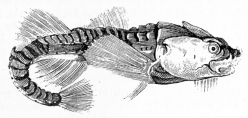
THE FATHER LASHER. (Cottus scorpius.)
The whimsical denomination of Father Lasher, given to this fish, cannot be easily accounted for; perhaps it may be ascribable to the quick and repeated lashings of its tail, when the fish is caught and thrown upon the sand. The length is about eight or nine inches, and it is usually found under stones, on the rocky coasts of our island. In Greenland these fish are so numerous, that the inhabitants depend largely upon them for their food. When made into soup, they are nutritive and wholesome. The head is large, and armed with spines, by which this fish combats every enemy that attacks it, swelling out its cheeks and gill-covers to an unusual size. Its colour is a dull brown, mottled with white, and sometimes mixed with red; the fins and tail are transparent, and the lower part of the body a shining white.
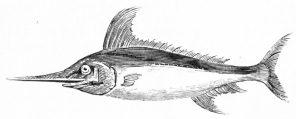
THE SWORD-FISH, (Xiphias gladius,)
Which belongs to the mackerel family, has received its name from its long snout resembling the blade of a sword. It sometimes weighs above one hundred pounds, and is fifteen or even twenty feet in length. The body is of a conical form, black on the back, white under the body; the mouth large, with no teeth; the tail is remarkably forked. The Sword-fish is often taken off the coast of Italy, in the Bay of Naples, and about Sicily. They are struck at by the fishermen, and their flesh is considered as good as that of the sturgeon by the Sicilians, who seem to be particularly fond of it. Other European seas are not destitute of this curious animal.
The Sword-fish and the whale are said never to meet without coming to battle; and the former has the reputation of being always the aggressor. Sometimes two Sword-fishes join against one whale; in which case the combat is by no means equal. The whale uses his tail in his defence; he dives deeply into the water, head foremost, and makes such a blow with his tail, that, should it take effect, it kills the Sword-fish at a single stroke; but the latter is in general sufficiently adroit to avoid it, and immediately rushes at the whale, and buries its weapon in his side. When the whale discovers the Sword-fish darting upon him, he dives to the bottom, but is closely pursued by his antagonist, who compels him again to rise to the surface. The battle then begins afresh, and lasts until the Sword-fish loses sight of the whale, who is at length compelled to swim off, which his superior agility enables him to do. In piercing the whale’s body with the tremendous weapon at his snout, the Sword-fish seldom inflicts a dangerous wound, not being able to penetrate beyond the blubber. This animal can drive its sword with such force into the keel of a ship, as to bury it wholly in the timber. A part of the bottom of a vessel, with the sword imbedded in it, is to be seen in the British Museum.
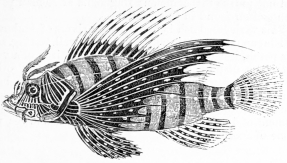
THE FLYING SCORPION.
How admirable is Nature! how extensive her power and how various the forms with which she has surrounded the united elements of animated matter! From the uncouth shape of the wallowing whale, of the unwieldy hippopotamus, or ponderous elephant, to the light and elegant form of the painted moth or fluttering humming-bird, she seems to have exhausted all ideas, all conceptions, and not to have left a single figure untried. The fish represented above is one of those, in the outlines and decorations of which appear the discordant qualities of frightfulness and beauty. Armed cap-à-pie, surrounded with spines and thorns bristling on his back, and fins like an armed phalanx of lance-bearers, and decorated on the body with yellow ribands, interwoven with white fillets, and on the purple fins of his breast with the milky dots of the pintado, the Sea Scorpion presents a very extraordinary contrast. His eyes, like those of which poets sang when celebrating the Nereids and Naiads, consist of black pupils, surrounded with a silver iris, radiated with alternate divisions of blue and black. The rays of the dorsal fin are spiny, spotted brown and yellow, conjoined below by a dark brown membrane, and separate above; the ventral fins are violet with white drops, and the tail and anal fins are a sort of tesselated work of blue, black, and white, united with the greatest symmetry, and not unlike those ancient fragments of Roman pavements often found in this island.
This variegated fish is found in the rivers of Amboyna and Japan; its flesh is white, firm, and well tasting, like our perch, but it does not grow so large; it is of a very voracious disposition, feeding on the young of other fish, some of which, two inches in length, have been found in its craw. The skin has both the appearance and smoothness of parchment. To the tremendous armour of its back, fins, and tail, this fish owes the name of Scorpion.
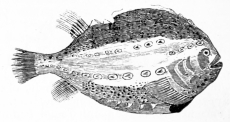
THE LUMP-SUCKER, OR SEA-OWL. (Cyclopterus lumpus.)
This odd-shaped fish derives its name chiefly from the clumsiness of its form; it is also called the Cock Paddle. Its colour, when in the highest perfection, combines various shades of blue, purple, and rich orange; the abdomen is red; it has no scales, but on all sides sharp black tubercles, in shape like warts; on each side are three rows of sharp prickles, and on the back two distinct fins. The great resort of this species is in the Northern seas, about the coast of Greenland; it is also caught in many parts of the British seas during the spring season, when it approaches the shore for the purpose of depositing its spawn; and in the month of March it may be seen at the stalls of the London markets. This unseemly fish is usually about a foot in length, and ten or more inches in breadth, and sometimes weighs seven pounds. The flesh is but indifferent.
The Lump-sucker is very remarkable for the manner in which its ventral fins are arranged. They are united by a membrane so as to form a kind of oval and concave disc, by means of which it is enabled to adhere with great force to any substance to which it fastens itself. Pennant says, that, on throwing an individual of this species into a pail of water, it adhered so firmly to the bottom that, on taking the fish by the tail, the whole pail was lifted up, though it held some gallons.
In the Northern seas great numbers of the different species of Lump-suckers are devoured by the seals, who swallow all but the skins, quantities of which thus emptied are seen floating about in the spring months; it is said that the spots where the seals carry on their depredations can be readily distinguished by the smoothness of the water.
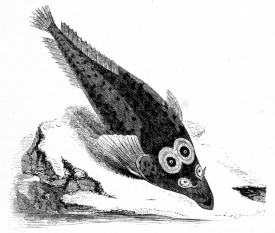
THE OCELLATED SUCKER, (Lepadogaster cornubicus,)
Another Malacopterygious fish, a relative of the Lump-sucker, and chiefly remarkable for the singular appendage observable on its head. It possesses similar tenacity of suction. The utility of this faculty to animals inhabiting the rocky shores and turbulent seas of Greenland is sufficiently obvious.
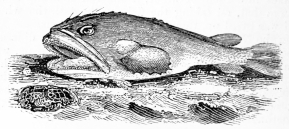
THE ANGLER. (Lophius piscatorius.)
This extraordinary fish is occasionally met with on our coasts, and is commonly known by the names of the Fishing Frog, Toad Fish, and Sea Devil. In shape it is the most uncouth and unsightly of the piscatory tribe, resembling the frog in its tadpole state. It grows to a large size. A specimen taken in the sea, near Scarborough, was between four and five feet in length, the head considerably larger than the body, round at the circumference, flat above; the mouth is of a prodigious size, being a yard in width, and armed with sharp teeth. It lives, as it were, in ambush at the bottom of the sea, and by means of its fins stirs up the mud and sand, so as to conceal itself from other fishes on whom it preys. The manner in which it procures its prey is very extraordinary, the peculiarity of its construction forbidding the possibility of rapid movement. Two long tough filaments are placed above the nose, each of them furnished with a thin appendage, closely resembling a fishing-line when baited and flung out. The back is provided with three others, united by a web, and forming the first dorsal fin. Pliny notices these remarkable appendages, and explains their use. “The Fishing Frog,” says he, “puts forth the slender horns situated beneath his eyes, enticing by that means the little fish to play around till they come within his reach, when he springs upon them.” But it is not only the lesser inhabitants of the water that the Angler ensnares! Codfish of good size are often found in his stomach, and he occasionally seizes upon fishes as they are being drawn up by the line. Mr. Yarrell mentions an instance of an Angler attacking a conger-eel under these circumstances: the eel wriggled through the branchial aperture of his captor, and both were drawn up together.
Cicero also notices this extraordinary creature, in his Treatise on the Nature of the Gods. He observed its wonderful construction when musing on the shores of Sicily.
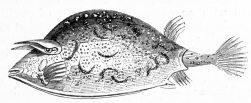
THE FOUR-HORNED TRUNK FISH. (Ostracion quadricornis.)
These singular fishes are distinguished from most others by the bony covering which envelopes them. The head and body are covered with plates of bone, forming an inflexible cuirass, and leaving exposed only the tail, fins, mouth, and a portion of the gill opening. They have no ventral fins, and the dorsal and anal are placed far back. Their liver is large, and abounds with oil. The Trunk-fish is a native of the Indian and American seas. Some of the species are considered excellent eating.
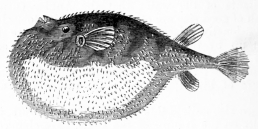
THE GLOBE FISH, (Tetraodon hispidus,)
Is an oblong fish, inhabiting the seas of Carolina, and endowed with an extraordinary power of swelling its under surface into a large globe. This sudden enlargement not only alarms the enemies of the Tetrodon, but prevents them from making good their hold, by presenting to their grasp little more than an inflated bag. It is also covered with spines, which merely adhere to the skin, and are capable of being erected on any sudden emergency; thus giving to an innocent and defenceless creature a most formidable appearance.
When inflated, they roll over on their backs, floating in this position, without any power of directing their course. Some species are reckoned poisonous. One is electrical, (Tetraodon lineatus,) and is found in the Nile; when left on shore by the inundations, it always inflates its body, becomes dried in this condition, and is then picked up by the children, and used as a ball.
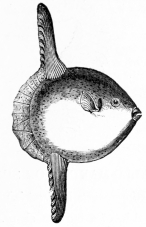
THE SUN FISH, (Orthagoriscus mola,)
Appears like the fore part of the body of a large fish, which has been amputated in the middle. The mouth is small, with two broad teeth only in each jaw. Its nearly circular form, and the silvery whiteness of the sides, together with their brilliant phosphorescence during the night, have obtained for it very generally the appellations of sun or moon fish. While swimming, it turns round like a wheel, and sometimes floats with its head above water, when it appears like a dying fish. It grows to a large size; sometimes being four or five feet in length, and weighing from three to five hundred pounds. The back of this curious marine animal is of a rich blue colour. It frequents the coasts of both the ancient and new continent, and has been found on the shores of England.
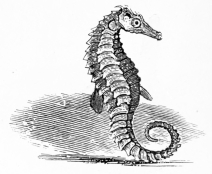
THE CAVALLO-MARINO, OR SEA-HORSE. (Hippocampus brevirostris.)
This is a small fish, of a curious shape. The length is from six to ten, and sometimes twelve, inches; the head bears some resemblance to that of a horse, whence originates its name. A series of longitudinal and transverse ridges run from the head to the tail, which is spirally curved and prehensile.
The following account of two specimens taken alive at Guernsey, in June, 1835, by F. C. Lukis, Esq., is extracted from Yarrell’s “British Fishes.” These creatures were kept about twelve days in a glass vessel, and their actions were equally novel and amusing. “An appearance of search for a resting-place induced me,” says Mr. Lukis, “to consult their wishes, by placing seaweed and straws in the vessel: the desired effect was obtained, and has afforded me much to reflect upon in their habits. They now exhibit many of their peculiarities, and few subjects of the deep have displayed, in prison, more sport or more intelligence.
“When swimming about, they maintain a vertical position; but the tail is ready to grasp whatever meets it in the water, quickly entwines in any direction round the weeds, and, when fixed, the animal intently watches the surrounding objects, and darts at its prey with the greatest dexterity.
“When the animals approach each other, they often twist their tails together, and struggle to separate or attach themselves to the weeds: this is done by the under part of their cheeks or chin, which is also used for raising the body when a new spot is wanted for the tail to entwine afresh. The eyes move independently of each other, as in the chameleon, and this, with the brilliant changeable iridescence about the head, and its blue bands, forcibly reminds the observer of that animal.”
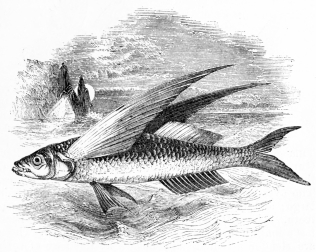
THE FLYING FISH OF THE OCEAN. (Exocætus volitans.)
This fish has a slender body, a projecting under-lip, and very large and prominent eyes. The ventral fins are small, but the pectoral fins are so long and wide as to answer the purpose of wings, and aided by them the fish is enabled to rise out of the water, and support itself in the air. It must not be supposed, however, that the Flying-fish can soar like a bird; on the contrary, it can only spring from the water to a considerable height (sometimes as much as twenty feet), and fly about a hundred and fifty, or two hundred yards; most commonly, however, it does not rise above two or three feet from the water, and remains fluttering over the surface for about a hundred yards, when it again drops into its native element. There is another Flying-fish (Exocætus exiliens) in the Mediterranean.
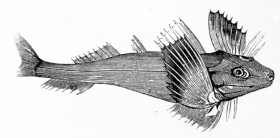
THE GURNARD. (Trigla cuculus.)
This genus is divided into several species. The Red Gurnard has fins and body of a bright red colour; and the head is large, and covered with strong bony plates. The eyes are large, round, and vertical; the mouth is large; and the palate and jaws are armed with sharp teeth. The gill-membrane has seven rays. The back has a longitudinal spinous groove on each side. There are slender articulate appendages at the base of each pectoral fin. This fish is not unfrequently met with on the southern shores of England; and is often seen exposed in the fish-markets of the maritime towns of Dorset and Devonshire, as well as in Cornwall. It is a pleasant-tasting fish, when properly stuffed and baked, the flavour being similar to that of the haddock.
Whilst in the water, the colours of the Red Gurnard are almost inconceivably brilliant and beautiful, particularly in the broad glare of sunshine, as they then vary, in the most pleasing manner, with every motion of the fish.
The Grey Gurnard (Trigla gurnardus) usually measures from one to two feet in length. The extremity of the head, in front, is armed on each side with three short spines. The forehead and the covers of the gills are silvery; the latter being finely radiated. The body is covered with small scales; the upper parts are of a deep grey, spotted with white and yellow, and sometimes with black; and the lower parts silvery. About the months of May and June, the Grey Gurnards approach the shores in considerable shoals, for the purpose of depositing their spawn in the shallows; at other times they reside in the depths of the ocean, where they have a plentiful supply of food in crabs, lobsters, and other shell-fish, on which it is supposed they for the most part feed. They are occasionally found on the shores of Great Britain and Ireland, in the spawning season.
The Lucerna is caught in the Mediterranean Sea, and is of a very curious shape; its fins about the gills being so large, and spreading so much like a fan on each side, that they appear somewhat like wings. The tail is bifid, and the scales very small. The flesh is esteemed among the Italians, and the Lucerna is often seen in the fish-markets of Naples, Venice, and other towns on the sea-shore. This fish much resembles the Father Lasher and the Gurnard; and it is called Lucerna because it shines in the dark.
The Flying Gurnard (Dactyloptera Mediterranea), which is the commonest flying-fish of the Mediterranean Sea, is about a foot long; it is brown above, reddish below, and has blackish fins spotted with blue. The pectoral fins with which it supports itself in the air are of immense extent. On each operculum there is a long and pointed spine, with which the fish can inflict severe wounds.
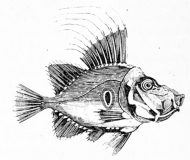
THE JOHN DORY. (Zeus faber.)
It would be an inexcusable neglect to pass this fish unnoticed, not on account of its disputing with the haddock the honour of having been pressed by the fingers of the apostle, nor of its having been trodden upon by the gigantic foot of St. Christopher, when he carried on his shoulders a divine burden across an arm of the sea, but for the excellence of its flesh. It has been for some years in such favour with our epicures, that one of them, a comedian of high repute (Quin), took a journey to Plymouth merely to eat this fish in perfection. Its body presents the shape of a rhomboid, but the sides are much compressed; the mouth is large, and the snout long, composed of several cartilaginous plates, which wrap and fold one over another, in order to enable the fish to catch its prey. The colour is a dark green, marked with black spots, with a golden gloss, whence the name originated. They inhabit the coasts of England, and particularly Torbay, whence they are sent to the fish-markets of London.
When the Dory is taken alive out of the water, it is able to compress its internal organs so rapidly that the air, in rushing through the openings of the gills, produces a kind of noise somewhat like that which, on similar occasions, is emitted by the gurnards.
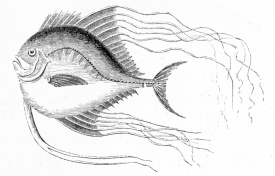
THE BLEPHARIS. (Blepharis ciliaris.)
This species of the Dory is of a bright silver colour, with a cast of bluish-green on the back. Several of the last rays, both of the dorsal and anal fin, extend beyond the membrane, reaching even farther than the tail itself. It has been supposed that the smaller kind of fishes may be attracted with these long flexible filaments, and mistake them for worms, while the Zeus, concealed among the sea-weeds, lies in wait for its prey. It is a native of the Indian seas.
THE OPAH, OR KING FISH. (Lampris guttatus.)
This is a most splendid fish, of a fine green colour on the back, and yellowish green on the belly. The back and sides exhibit brilliant purplish and golden tints, the whole surface is covered with numerous white spots, and the fins are of a beautiful vermilion colour; so magnificent is its costume, that it has been justly remarked that it looks “like one of Neptune’s lords dressed for a court day.” The King Fish is found apparently in the seas of all parts of the world; it is nowhere common, but seems to be more abundant in warm climates.
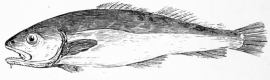
THE COD-FISH, (Gadus morrhua,)
Is a noble inhabitant of the seas; not only on account of its size, but also for the goodness of its flesh, either fresh or salted. The body measures sometimes above three, and even four feet in length, with a proportionable thickness. The back is of a brown olive colour, with white spots on the sides, and the lower part of the body is entirely white. The eyes are large and staring. The head is broad and fleshy, and esteemed a delicious dish.
The fecundity of all fishes must be an object of the greatest astonishment to every observer of nature. In the year 1790, a Cod-fish was sold in Workington market, Cumberland, for one shilling: it weighed fifteen pounds, and measured two feet nine inches in length, and seven inches in breadth: the roe weighed two pounds ten ounces, one grain of which contained three hundred and twenty eggs. The whole, therefore, might contain, by fair estimation, three million nine hundred and four thousand four hundred and forty eggs. From such a trifle as this we may observe the prodigious value of the fishing trade to a commercial nation, and hence draw a useful hint for increasing it; for, supposing that each of the above eggs should arrive at the same perfection and size, its produce would weigh twenty-six thousand one hundred and twenty-three tons; and consequently would load two hundred and sixty-one sail of ships, each of one hundred tons burden. If each fish were brought to market, and sold as the original one, for one shilling, the produce then would be one hundred and ninety-five thousand pounds; that is to say, the first shilling would produce twenty times one hundred and ninety-five thousand, or three million nine hundred thousand shillings.
In the European seas, the Cod begins to spawn in January, and deposits its eggs in rough ground among rocks. Some continue in roe until the beginning of April. Cod-fish are reckoned best for the table from October to Christmas. The air-bladders, under the name of sounds, are pickled, and sold separately.
The chief fisheries for Cod are in the Bay of Canada, on the great bank of Newfoundland, and off the isle of St. Peter, and the isle of Sable. The vessels frequenting these fisheries are from a hundred to two hundred tons burden, and will each catch thirty thousand Cod, or more. The best season is from the beginning of February to the end of April. Each fisherman takes only one Cod at a time, and yet the more experienced will catch from three to four hundred in a day. It is a fatiguing work, owing particularly to the intense cold they are obliged to suffer during the operation.
Cod frequently grow to a very great size. The largest that is known to have been caught in this kingdom was taken at Scarborough, in the year 1775; it measured five feet eight inches in length, and five feet in circumference, and weighed seventy-eight pounds. The usual weight of this fish is from fourteen to forty pounds.
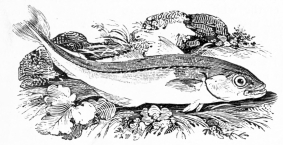
THE HADDOCK, (Gadus æglefinus,)
Is much less in size than the cod-fish, and differs somewhat from it in shape; it is of a bluish colour on the back, with small scales; a black line is carried on from the upper corner of the gills on both sides down to the tail; in the middle of the sides, under the line a little beneath the gills, is a black spot on each shoulder, which resembles the mark of a man’s finger and thumb; from which circumstance it is called St. Peter’s fish, alluding to the fact recorded in the seventeenth chapter of St. Matthew: “Go thou to the sea, and cast an hook, and take up the fish that first cometh up; and when thou hast opened his mouth, thou shalt find a piece of money; that take, and give unto them for me and thee.” And while St. Peter held the fish with his fore-finger and thumb, it is fabled, that the skin received, and preserved to this day, the hereditary impression.
Haddocks migrate in immense shoals, which usually arrive on the Yorkshire coast about the middle of winter. These shoals are sometimes known to extend from the shore nearly three miles in breadth, and in length from Flamborough Head to Tynemouth Castle, a distance of fifty miles; and, perhaps, even farther. An idea of the number of Haddocks may be formed from the following circumstance: three fishermen, within a mile of the harbour of Scarborough, frequently loaded their boat with these fish twice a day, taking each time a ton weight of them!
The flesh of the Haddock is harder and thicker than that of the whiting, and not so good; but it is often brought upon the table, either broiled, boiled, or baked, and is by many much esteemed. The Haddocks caught on the Irish coast, near Dublin, are unusually large, and of a fine flavour, and unite to the firmness of the turbot much of its sweetness. They are in season from October to January.
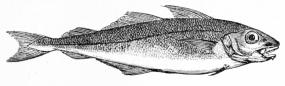
THE WHITING, (Gadus Merlangus, or Merlangus vulgaris,)
Is seldom more than twelve inches in length, and of a slender and tapering form. The scales are small and fine. The back is silvery, and when just taken out of the sea reflects the rays of light with great lustre and gloss. The flesh is light, wholesome, and nourishing; and is often recommended to sick or convalescent patients, when other food is not approved of. The Whiting is found on the coasts of England, and is in its proper season from August to February.
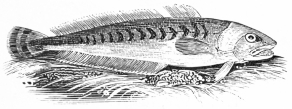
THE LING, (Lota molva,)
THE LING, (Lota molva,)
Is usually from three to four feet in length, though some have been caught much larger. The body is long, the head flat, the teeth in the upper jaw small and numerous, with a small beard on the chin; its dorsal and anal fins are very long.
These fish abound on the coasts of Great Britain and Ireland, and great quantities are salted for home consumption and exportation. On the eastern coasts of England they are in their greatest perfection from the beginning of February to the end of May. They spawn in June: at this season, the males separate from the females, who deposit their eggs in the soft oozy ground at the mouth of large rivers.
In a commercial point of view, the Ling may be considered a very important fish. Nine hundred thousand pounds weight are annually exported from Norway. In England, these fish are caught and cured in somewhat the same manner as the cod. Those which are caught off the shores of America are by no means so much esteemed as those which frequent the coasts of Great Britain and Norway; and the Ling in the neighbourhood of Iceland are so bad, that the inhabitants are unable to find a sale for them in any country except their own. The roe and air-bladders, or sounds of the Ling, are pickled, and sold separately.
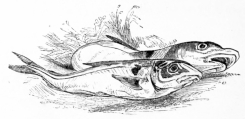
THE HAKE, (Gadus merluccius,)
Is a coarse fish, nearly allied to the Ling, and is caught in great abundance on the Devonshire and Cornwall coast. It is also found on the coasts of Ireland and Scotland, where it is called stock-fish, and is often confounded with cod.
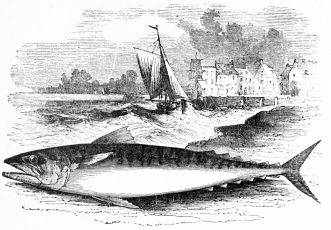
THE MACKEREL, (Scomber Scomber,)
Is taken and well known in all parts of the world. It is usually about a foot or more in length; the body is thick, firm, and fleshy, slender towards the tail; the snout sharp, the tail forked, the back of a lovely green, beautifully variegated, or, as it were, painted with black strokes; the under part of the body is of a silvery colour, reflecting, as well as the sides, the most elegant tints of the opal and the mother-of-pearl. Nothing can be more interesting and pleasing to the eye than to see Mackerel, just caught, brought on shore by the fishermen, and spread, with all their radiancy, upon the pebbles of the beach, at the first rays of the rising sun; but when taken out of their element, they quickly die.
Mackerel visit our shores in vast shoals; but, from being very tender and unfit for long carriage, they are found less useful than other gregarious fish. The usual bait is a bit of red cloth, or a piece of the tail of the Mackerel. The great fishery for them is in some parts of the south and west coasts of England: this is of such an extent as to employ, in the whole, a capital of nearly two hundred thousand pounds. The fishermen go out to the distance of several leagues from the shore, and stretch their nets, which are sometimes miles in extent, across the tide during the night. A single boat has been known to bring in, after one night’s fishing, a cargo that has been sold for nearly seventy pounds. The roes of the Mackerel are used in the Mediterranean for caviar. In Cornwall, and also in several parts of the continent, Mackerel are preserved by pickling and salting; and in this state possess a flavour somewhat like that of the salmon. Their voracity has scarcely any bounds; and when they get among a shoal of herrings, they will make such havoc as frequently to drive it away. Mackerel are in season from March to June.

THE GAR-FISH, (Belone vulgaris,)
Of which the figure above is an exact representation, is of a very extraordinary form. The body, in shape and colour, is not unlike that of a mackerel, but is much more elongated, and the jaws are protracted into a kind of lance, nearly half as long as the rest of the body. It is vulgarly supposed that this fish leads the phalanxes of mackerel through the regions of the deep; and, like a faithful and experienced pilot, traces their journey, points out their dangers, and conducts them to their destination. A curious singularity of this creature is, that its bones are of a bright green colour; the flesh is not so firm nor of so good a flavour as that of the mackerel, but it sells pretty well whenever it comes to market.
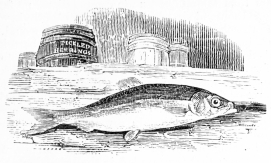
THE HERRING. (Clupea Harengus.)
This fish is somewhat like the mackerel in shape, as well as in delicacy of taste, although it differs much in flavour. It is about nine or ten inches long, and about two and a half broad, and has blood-shot eyes; the scales large and roundish; the tail forked; the body of a fat, soft, delicate flesh, but more rank than that of the mackerel, and therefore less wholesome. Yet some people are so very fond of it, that they call the Herring the King of Fishes. They swim in shoals, and spawn once a year, about the autumnal equinox, at which time they are the best. They come into shallow water to spawn, like the mackerel; and hence they periodically visit our coasts, retiring again to the deep waters when the spawning season is over.
The fecundity of the Herring is astonishing. It has been calculated that if the offspring of a single pair of Herrings could be suffered to multiply unmolested and undiminished for twenty years, they would exhibit a bulk ten times the size of the earth. But, happily, Providence has contrived the balance of nature by giving them innumerable enemies. All the monsters of the deep find them an easy prey; and, in addition to these, immense flocks of sea-fowl watch their outset, and spread devastation on all sides.
In the year 1773, the Herrings for two months were in such immense shoals on the Scotch coasts, that it appears from tolerably accurate computations, no fewer than one thousand six hundred and fifty boat-loads were taken in Loch Torridon in one night. These would, in the whole, amount to nearly twenty thousand barrels.
This fish is prepared in different ways, in order to be kept for use through the year. The white, or pickled Herrings, are washed in fresh water, and left the space of twelve or fifteen hours in a tub full of strong brine, made of fresh water and sea-salt. When taken out, they are drained, and put in rows or layers in barrels, with salt.
Red Herrings are prepared in the same manner, with this difference, that they are left in the brine double the time above mentioned; and when taken out, placed in a large chimney constructed for the purpose, and containing about twelve thousand, where they are smoked by means of a fire underneath, made of brushwood, for the space of twenty-four hours.
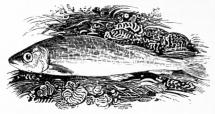
THE SPRAT, (Clupea Sprattus,)
A well-known fish, between four and five inches in length, the back fin very remote from the nose; the lower jaw longer than the upper, and the eyes blood-shot, like those of the herring, to which it is nearly allied. Sprats arrive yearly in the beginning of November in the river Thames; and generally a large dish of them is presented on the table at Guildhall, on Lord Mayor’s Day, November 9th. They continue through the winter, and depart in March. They are sold by measure, and yield a great deal of sustenance to poor people in the winter season. It is reported that they have been taken yearly about Easter-time in a lake in Cheshire, called Kostern Mere, and in the river Mersey, in which the sea ebbs and flows seven or eight miles below the lake.
The Sardine (Clupea Sardina) is caught on the southern shores of France, where it is held in great repute; and from its abounding in the neighbourhood of the island of Sardinia, it is called the Sardine. It is sent here pickled in the same way as herrings, and packed in barrels.
THE PILCHARD. (Clupea Pilchardus.)
The chief difference between this fish and the herring is, that the body of the Pilchard is more round and thick; the nose shorter in proportion, turning up; and the under jaw shorter. The back is more elevated, and the belly not so sharp. The scales adhere very closely, whilst those of the herring easily drop off. It is also, in general, of considerably smaller size.
About the middle of July, Pilchards appear in vast shoals off the coast of Cornwall. These shoals remain till the latter end of October, when it is probable they retire to some undisturbed deep, at a little distance, for the winter.
The Pilchard fishery is an important branch of commerce. From a statement of the number of hogsheads exported each year, for ten years, from 1747 to 1756 inclusive, from the four ports of Fowy, Falmouth, Penzance, and St. Ives, it appears that Fowy exported yearly one thousand seven hundred and thirty-two hogsheads; Falmouth, fourteen thousand six hundred and thirty-one; Penzance and Mount’s Bay, twelve thousand one hundred and forty-nine; St. Ives, one thousand two hundred and eighty-two: in all, twenty-nine thousand seven hundred and ninety-four hogsheads. Every hogshead, for ten years last past, together with the bounty allowed for exportation, and the oil made out of it, has amounted, one year with another, at an average, to the price of one pound thirteen shillings and three pence; so that the cash paid for Pilchards exported has, at a medium, annually amounted to the sum of forty-nine thousand five hundred and thirty-two pounds. The above was the state of the fishing several years ago; at present it is still more extensive, the average annual produce of the Cornish fisheries amounting to about twenty-one thousand hogsheads, which contain no less than sixty millions of Pilchards.
THE WHITEBAIT. (Clupea alba.)
This beautiful little fish is a pure white, without spots on either side. Immense quantities are caught from the beginning of April to the end of September, in the Thames; but they are so delicate as scarcely to bear carriage, and are therefore thought best when eaten as near as possible to the place where they were taken; and hence the custom of having Whitebait dinners at the taverns at Greenwich and Blackwall. It was long supposed that the Whitebait was the fry of the shad, but it is now proved to be a distinct species.
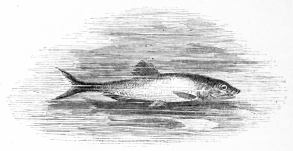
THE ANCHOVY. (Engraulis encrasicolus.)
Like the herring and sprat, these fish leave the depths of the open sea, in order to frequent the smooth and shallow places of the coast, for the purpose of spawning. The fishermen generally light a fire on the shore, for the purpose of attracting the Anchovies, when they fish for them in the night. After they are cleaned, and their heads cut off, they are cured in a particular way, and packed in small barrels for sale and exportation. Anchovies are occasionally found both in the North Sea and in the Baltic; but they are in much greater number in the Mediterranean than in any other part of the world. They have sometimes, though rarely, been caught in the river Dee, on the coasts of Flintshire and Cheshire. The upper jaw of this fish is longer than the under; the back is brown; the sides silvery; fins short; the dorsal fin, opposite the ventrals, transparent; the tail fin-forked. Its length is about three inches.
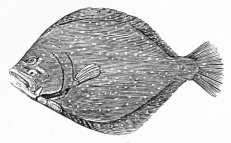
THE TURBOT. (Rhombus maximus.)
The Turbot is a well-known fish, and much esteemed for the delicate taste, firmness, and sweetness of its flesh. Juvenal, in his fourth Satire, gives us a very ludicrous description of the Roman emperor Domitian assembling the Senate to decide how and with what sauce this fish should be eaten. The Turbot is sometimes two feet and a half long, and about two broad. The scales on the skin are so very small that they are hardly perceptible. The colour of the upper side of the body is a dark brown, spotted with dirty yellow; the under side a pure white, tinged on the edges with a somewhat flesh-colour, or pale pink. There is a great difficulty in baiting the Turbot, as it is very fastidious in its food. Nothing can allure it but herrings or small slices of haddocks, and lampreys; and as it lies in deep water, flirting and paddling on the ooze at the bottom of the sea, no net can reach it, so that it is generally caught by hook and line. It is found chiefly on the northern coasts of England, Scotland, and Holland.
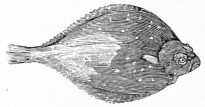
THE PLAICE, (Platessa vulgaris,)
A well-known English fish, nearly allied to the turbot. It has smooth sides, an anal spine, and the eyes and six tubercles are placed on the same side of the head. The body is very flat, and the upper part of the fish of a clear brown colour, marked with orange-coloured spots, and the belly white. Plaice spawn in the beginning of February, and when full-grown assume something like the shape of a turbot; but the flesh is very different, being soft and nearly tasteless.
When near the ground they swim slowly and horizontally, but if suddenly disturbed they change the horizontal to the vertical position, darting along with meteor-like rapidity, and then again quickly resuming their inactive habits at the bottom of the water. Plaice feed on small fish and young crustacea, and have sometimes been taken on our coasts weighing fifteen pounds, but a fish half that weight is considered very large. The finest kind, called Diamond Plaice, are caught on the Sussex coast. These fish are in considerable demand as food, though by no means equal to the turbot and sole. Those of a moderate size are reckoned the best eating.
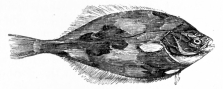
THE FLOUNDER. (Platessa flesus.)
The principal distinction between the plaice and the Flounder consists in the former having a row of six tubercles behind the left eye, of which this fish is entirely destitute; it is also a little longer in the body, and, when full-grown, somewhat thicker. The back is of a dark olive colour, spotted. In taste, they are reckoned more delicate than the plaice. They live long after being taken out of their element, and are often cried in the streets of London, but they seldom appear on the tables of the rich and dainty. They are common in the British rivers, and in all large rivers which obey the impression of the tide, and they feed upon worms bred in the mud at the bottom of the water.
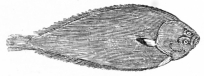
THE SOLE, (Solea vulgaris,)
Is well known as a very excellent fish, whose flesh is firm, delicate, and of a pleasing flavour. Soles grow to the length of eighteen inches, and even more, in some of our seas. They are often found of this size and superiority in Torbay, whence they are sent to market at Exeter and several other towns in Devonshire and the adjacent counties. They are found also in the Mediterranean and several other seas, and, when in season, are in great requisition for the most luxurious tables. The upper part of the body is brown; the under part white; one of the pectoral fins is tipped with black, the sides are yellow, and the tail rounded at the extremity. It is said that the small Soles, caught in the northern seas, are of a much superior taste to the large ones, which the southern and western coasts afford.
This fish has also the quality of keeping sweet and good for several days, even in hot weather, and is thought to acquire a more delicate flavour by being thus kept. On this account it is that Soles in the London markets are frequently more esteemed than those which are cooked immediately after they are taken out of the sea.
In the economy of flat fish we have an account of one circumstance which is very remarkable: among various other marine productions, they have been known to feed on shell-fish, although they are furnished with no apparatus whatever in their mouth which would seem to be adapted for reducing these to a state calculated for digestion.
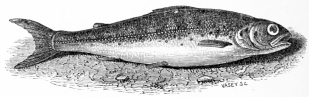
THE SALMON-PINK, BRANDLING, PAR, OR SKEGGER.
This brilliant little fish is the smallest of the salmonidæ, and is only found in rivers frequented by salmon; for whenever a river becomes deserted by them, the samlet also disappears. This fish is considered to be the fry of the true salmon, and Mr. Young, in a recent essay, has, we think, fairly established the fact; but Mr. Yarrell and other naturalists assert it to be a distinct species.
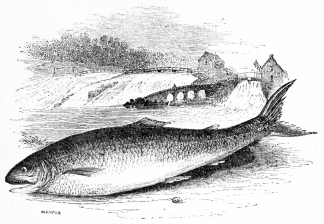
THE SALMON, (Salmo salar,)
Is the boast of large rivers, and one of the noblest inhabitants of the sea, if we esteem it by its bulk, colour, and the sweetness of its flesh. Salmon are found of a great weight, and sometimes measure five feet in length. The colour is beautiful, a dark blue dotted with black spots on the back, merging to silvery white on the sides, and white with a little shade of pink below. The fins are comparatively small. These fish, though they live principally in the sea, come up the rivers at the spawning season, to a considerable distance inland, where the female deposits her eggs. Soon after, both she and the male take an excursion to the vast regions of the sea, and do not visit any of the land streams again till the next year, when they return for the same purpose. They are so powerfully impelled by this natural impulse, that, if they are stopped when swimming up a river by a fall of water, they spring up with such a force through the descending torrent, that they stem it till they reach the higher bed of the stream; and on this account small cascades on the Tweed and other rivers are often called Salmon-leaps. The Salmon is in a great measure confined to the northern seas, being unknown in the Mediterranean, and in the waters of other warm climates. The flesh is red when raw, rather paler when salted or boiled; it is an agreeable food, fat, tender, and sweet, and excels in richness all other fresh-water fish; however, it does not agree with every stomach, and is often injurious when eaten by sick persons.
In the river Tweed, about the month of July, the capture of Salmon is astonishing: often a boat-load, and sometimes nearly two, may be taken at a tide; and in one instance more than seven hundred fish were caught at a single haul of the net. From fifty to a hundred at a haul are very common. Some of these are sent to London by the railway; but part are slightly salted and pickled, in which state they are called kipper. The season for fishing commences in the Tweed in February, and ends about old Michaelmas-day. On this river there are about forty considerable fisheries, which extend upwards, about fourteen miles from the mouth; besides many others of less consequence. These, several years ago, were let at an annual rent of more than ten thousand pounds; and to defray this expense, it has been calculated that upwards of two hundred thousand Salmon must be caught there, one year with another. The principal Salmon fisheries in Europe are in the rivers, or on the sea-coasts adjoining the large rivers of England, Scotland, and Ireland. The chief English rivers in which they are now caught are the Tyne, the Trent, the Severn, and the Tweed. They were formerly found in the Thames, but none have been taken there for many years. The Salmon fry go down the river to the sea in April. A young Salmon under two pounds in weight is called a Salmon Peel, and a larger one a Grilse. Salmon cannot be eaten too fresh, and is very unwholesome when stale.
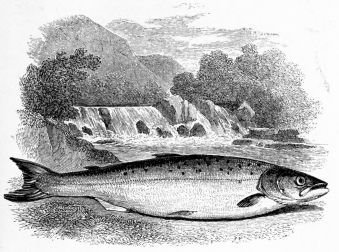
THE SALMON TROUT, (Salmo Trutta,)
Also called the Bull Trout, or Sea Trout, is thicker in the body than the common trout, and weighs about three pounds; it has a large smooth head, which, as well as the back, is of a bluish tint, with a green gloss; the sides are marked with numerous black spots, and the tail is broadest at the end. It is said that in the beginning of summer the flesh of this fish reddens, and remains this colour till the month of August; which is very probably owing to their being on the point of spawning. Like the salmon, this fish inhabits the sea; but in the months of November and December it enters the rivers, in order to deposit its roe; and consequently, in the spawning season, it is occasionally found in lakes and streams, at a great distance from the sea. It is very delicate, and much esteemed on our tables. Some people prefer this fish to salmon; but they are both apt to cause illness when eaten in too great a quantity.
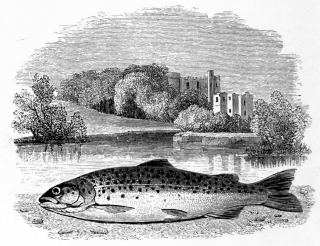
THE TROUT. (Salmo-fario.)
This fish, in figure, resembles the salmon; it has a short roundish head, and a blunt snout. Trouts are fresh-water fish, and they breed and live constantly in rivers and small pellucid streams which sparkle over clean pebbles and beds of sand.
They feed on river flies and other water insects, and are so fond of them, and so blindly voracious, that anglers deceive them with artificial flies made of feathers, wool, and other materials, which resemble very closely the natural ones. In Lough Neagh, in Ireland, Trouts have been caught weighing thirty pounds; and we are told, that in the Lake of Geneva, and in the northern lakes of England, they are found of a still larger size. It holds the first place among the river fish, and its flesh is very delicious, but difficult of digestion when old, or kept too long. They spawn in the month of December, and deposit their eggs in the gravel at the bottom of rivers, dykes, and ponds. Unlike most other fish, the Trouts are least esteemed when near spawning. They are properly in season in the months of July and August, being then fat and well-tasted.