BOOK II. INHABITANTS OF THE AIR.
Reading edition
§ I. Raptores. Diurnal Birds of Prey.

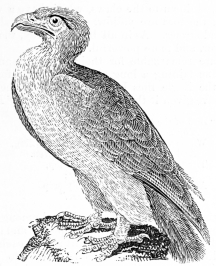
THE GOLDEN EAGLE. (Aquila chrysaëtos.)
“But who the various nations can declare, That plough with busy wing the peopled air? These cleave the crumbling bark for insect food, Those dip the crooked beak in kindred blood: Some haunt the rushy moor, the lonely woods; Some bathe their silver plumage in the floods; Some fly to man, his household gods implore, And gather round his hospitable door, Wait the known call, and find protection there From all the lesser tyrants of the air. The tawny Eagle seats his callow brood High on the cliff, and feasts his young with blood.” Barbauld.
The Golden Eagle is one of the largest and most powerful of all those birds that have received the name of Eagle. It weighs above twelve pounds. Its length, from the point of the beak to the end of the tail, is about three feet; the breadth, when the wings are extended, is seven or eight feet. The beak is horny, crooked, and very strong. The feathers of the neck are of a rusty colour, and the rest dark brown. The feet are feathered down to the claws, which have a wonderful grasp; the toes are yellow, and the four talons are crooked and strong. As in all birds of prey, the female is the larger, and more powerful.
Eagles are remarkable for their longevity, and their faculty of sustaining a long abstinence from food. Of all birds the Eagle flies highest; and from thence the ancients have given it the epithet of the Bird of Heaven:
“Bird of the broad and sweeping wing, Thy home is high in heaven, Where wide the storms their banners fling, And the tempest’s clouds are driven. Thy throne is on the mountain top, Thy fields the boundless air; And hoary peaks, that proudly prop The skies, thy dwellings are.”
This formidable bird may be considered among its own species what the lion is among quadrupeds; and in many respects they have a strong similitude to each other. Solitary, like the lion, he keeps the wilds to himself alone; it is as extraordinary to see two pairs of Eagles in the same mountain, as two lions in the same plain.
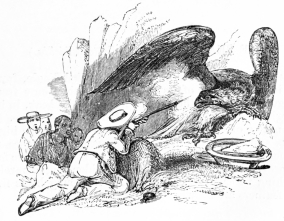
The Eagle is found in Great Britain and Ireland, in Germany, and nearly all parts of Europe. It is carnivorous, and, when unable to obtain the flesh of larger animals, feeds on serpents and lizards. The story of the Eagle, brought to the ground after a severe conflict with a cat, which it had seized and taken up into the air with its talons, is very remarkable; Mr. Barlow, who was an eye-witness of the fact, made a drawing of it, which he afterwards engraved. Two instances are said to have occurred in Scotland of the Eagle having flown away with infants to its nest; but in both cases it is added that the children were recovered, without being materially injured. This bird has been often tamed, but in this situation it still preserves an innate love of liberty. The nest of the Eagle is composed of strong sticks, and generally built on the point of an inaccessible rock, whence it darts upon its prey with the rapidity of lightning. The period of incubation is said to be thirty days; and when the young are hatched, both the male and female exert all their industry to provide for their wants. In the county of Kerry a peasant is said once to have formed the resolution of plundering an Eagle’s nest built upon a small island in the beautiful lake of Killarney. He accordingly swam to the island while the parents were away; and, after robbing the nest of the young, was preparing to swim back with the Eaglets tied in a string; but while he was yet up to the chin in the water, the old Eagles returned, and, missing their family, fell upon the invader with such fury, that, in spite of all his resistance, they despatched him with their beaks and talons.
Another native of Kerry was more fortunate in his dealings with the Eagles. During a season of scarcity he obtained sustenance for himself and his family by plundering an Eagle’s nest of the food brought in by the parents for their young ones: and he was so artful as to prolong the supply by cutting the wings of the Eaglets so as to prevent their flying, and thus compelled the old birds to continue their attention to their progeny.
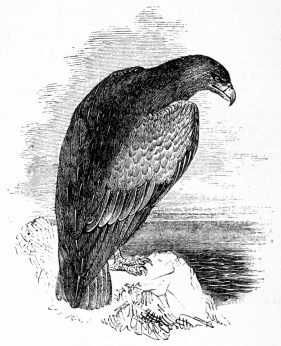
THE SEA EAGLE. (Haliaëtus albicilla.)
This bird, known also as the White-tailed Eagle, from the inside feathers of its tail being white, differs from the golden eagle in the greater length of its beak, in its sluggish and cowardly habits, and in its coarser taste. It is a native of Great Britain, where it inhabits the high rocks and cliffs that overhang the sea, and whence it pounces on the birds, fish, or seals that it can procure for its prey. It is smaller than the golden eagle, rarely reaching three feet in length; and in young birds the tail feathers are brown.
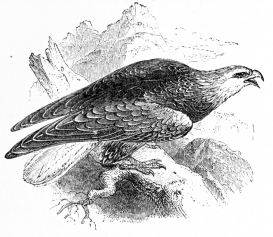
THE WHITE-HEADED, OR BALD EAGLE. (Haliaëtus leucocephalus.)
This bird is about three feet long, and seven feet broad, measuring to the tips of the extended wings. The bill resembles that of the golden eagle, and from the chin hang some small hairy feathers like a beard. As it is found alike in the frigid and the torrid zone, it is provided for enduring rapid changes of temperature, and its whole body is clothed under the feathers with a kind of down, white and soft like that of the swan. This bird builds its nest on lofty cliffs by the sea-shore, and on the banks of rivers or lakes, and feeds almost entirely upon fish.
It is generally regarded by the Anglo-Americans with peculiar respect, as the chosen emblem of their native land. The great cataract of Niagara is mentioned as one of its favourite places of resort, not merely as a fishing station, where it is enabled to satiate its hunger upon its most congenial food, but also in consequence of the vast quantity of four-footed beasts, which, unwarily venturing into the stream above, are borne away by the torrent, and precipitated down those tremendous falls:
“High o’er the watery uproar silent seen, Sailing sedate in majesty serene, Now ’midst the pillar’d spray sublimely lost, And now emerging, down the rapids toss’d, Glides the Bald Eagle, gazing calm and slow O’er all the horrors of the scene below; Intent alone to sate himself with blood, From the torn victim of the raging flood.”
The number of birds of prey of various kinds which assemble at the foot of the rocks to glut themselves upon the banquet thus provided for them, is said to be incredibly great, but they are all compelled to give place to the Eagle when he deigns to feed on dead animals; and the crow and the vulture submit without a struggle to the exercise of that tyranny, which they know it would be in vain to resist. “We have ourselves,” says Wilson, “seen the Bald Eagle, while seated on the dead carcase of a horse, keep a whole flock of vultures at a respectful distance, until he had fully sated his own appetite:” and he adds another instance, in which many thousands of tree squirrels having been drowned, in one of their migrations, in attempting to pass the Ohio, and having furnished for some length of time a rich banquet to the vultures, the sudden appearance among them of the Bald Eagle at once put a stop to their festivities, and drove them to a distance from their prey, of which the Eagle kept sole possession for several successive days.
These Eagles sometimes hunt in pairs in a manner which shows their great sagacity. Aware that water-fowl have the power of eluding their grasp by diving, they hover at a distance from each other over their prey. One of them then darts towards it with great swiftness, but the water-fowl easily avoids the first attack by diving. The pursuer then rises into the air, and his mate resumes the attack just as the fowl is emerging to breathe, and compels it to plunge again. The Eagles continue alternately to proceed in this manner till their victim is so exhausted that it falls an easy prey.
This Eagle also frequently attacks the Osprey or Fish Hawk, when he is returning from a successful excursion loaded with a large fish, and compels him to drop his prey; the Eagle then descends with wonderful rapidity, and generally succeeds in seizing the fish before it reaches the water.
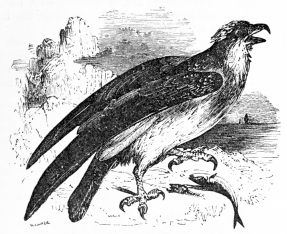
THE OSPREY, OR FISHING HAWK. (Pandion haliaëtus.)
“True to the season, o’er our sea-beat shore The sailing Osprey high is seen to soar With broad unmoving wing; and circling slow, Marks each loose straggler in the deep below; Sweeps down like lightning, plunges with a roar, And bears its struggling victim to the shore.”
This bird is always found on the sea-shore, or near rivers or lakes, as it feeds entirely on fish. It is common in Great Britain, and also in America, where large colonies of it are found, the birds living together like rooks. “When looking out for its prey,” says Dr. Richardson, “it sails with great ease and elegance, in undulating and curved lines, at a considerable height above the water, till it perceives its prey, when it pounces down upon it. It seizes the fish with its claws, sometimes scarcely appearing to dip its feet in the water, and at others plunging entirely under the surface with force sufficient to throw up a considerable spray. It emerges again, however, so speedily, as to render it evident that it does not attack fish swimming at any great depth.” The toes are armed beneath with numerous sharp points, evidently intended to assist the bird in getting a firm hold of its slippery prey.
The Osprey builds a large nest either on trees or rocks, and lays two or three eggs, which have a reddish tinge, and are spotted with brown at the larger end. The old birds feed the young ones even after they have left the nest, and only rear one brood in the year.
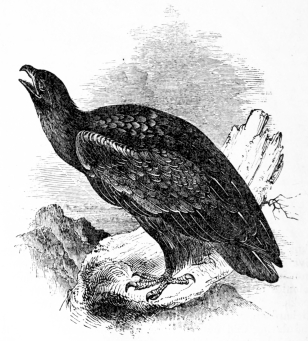
THE BLACK EAGLE.
Some ornithologists suppose this to be merely the golden eagle in its young state, but others make it a distinct species. It is about twice as large as the raven. The parts about the beak and the eye are bare of feathers, and somewhat reddish; the head, neck, and breast black; in the middle of the back, between the shoulders, there is a large white spot, dashed with red; a black streak sweeps along the feathers, and is followed by a white one; the remaining part of the wing to the tip is of a dark ash-colour. This bird has beautiful hazel eyes, full of animation: his legs are feathered down a little below the tarsal joint, the naked part being red; his talons are very long. He is found in France, Germany, Poland, and delights in Alpine mountains, where he makes the vales and woods resound with his incessant screamings when in search of prey.
The Abbé Spallanzani had an eagle of this species, so powerful as to be able to kill dogs that were much larger than itself. When a dog was placed before it, the bird would ruffle up the feathers on its head and neck, cast a dreadful look at its victim, take a short flight, and immediately alight on its back. It held the head firmly with one foot, and thus secured the dog from biting, and with the other grasped one of his flanks, at the same time driving its talons into the body; and in this attitude it continued, till the dog expired with fruitless outcries and efforts.
The eyes of eagles are celebrated for their brilliancy and strength, which has given rise to the popular opinion that they can gaze on the sun without shrinking: though this, from the overhanging eyebrow of the Eagle, would be an extremely difficult feat for the bird to perform. The eyes of all birds are curiously constructed, so as to enable them to see both distant objects and near ones with equal facility; and for this purpose they are furnished with a membrane placed near the edge of the crystalline lens of the eye, by which it can be moved at pleasure. The orbit of the eye is formed of about twelve or sixteen bony plates, which slide over each other when necessary. Birds are also furnished with an additional eyelid, of extremely thin texture, with which they occasionally appear to shade their eyes.
THE VULTURE. (Vultur Monachus.)
The first rank in the description of birds has been given to the eagle, not on account of its size, but because it is nobler in its habits and more delicate in its appetites. But it belongs to the falcon tribe, and should be placed after the Vultures. The eagle, unless pressed by famine, will not stoop to carrion; and generally devours only what he has earned by his own pursuit. The Vulture, on the contrary, is disgustingly voracious; and seldom attacks living animals when it can be supplied with dead. The eagle meets and singly opposes his enemy: the Vulture, if he expects resistance, calls in the aid of its kind, and overpowers its prey by combination. Putrefaction, instead of deterring, only serves to allure it. The Vulture seems among birds what the jackal and hyæna are among quadrupeds, who prey upon carcases, and root up the dead.
Vultures may be easily distinguished from eagles by the nakedness of their heads and necks, which are without feathers, and only covered with a very slight down, or a few scattered hairs; their eyes are more prominent; those of the eagle being buried more in the socket, and shaded by an overhanging eyebrow. Their claws are shorter and less hooked. The inside of the wing is covered with a thick down, which is different in them from all other birds of prey. Their attitude is not so upright as that of the eagle, and their flight is more difficult and heavy.
In this description we may include the Golden, the Ash-coloured, and the Brown Vulture, which are inhabitants of Europe; the Spotted and the Black Vulture of Egypt; the Bearded Vulture, the Brazilian Vulture and the King of the Vultures, of South America. They all agree in their nature, being equally indolent, rapacious, and unclean. The Condor also belongs to the Vulture tribe.
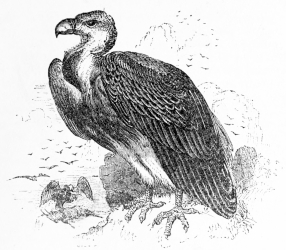
THE KING VULTURE. (Vultur, or Sarcorhamphus papa.)
The King Vulture, or King of the Vultures, is so called, because when he makes his appearance amongst a whole company of other birds of his kind engaged in a feast upon a dead carcase, they all retire before him and wait respectfully at a little distance until this monarch has eaten his fill. He is an inhabitant of South America.
The head and neck of this bird are without feathers; the body above, reddish buff, beneath, yellowish white: quills greenish black; tail black; craw pendulous, and orange-coloured. It is about the size of a turkey; and is chiefly remarkable for the odd formation of the skin of the head and neck; this skin, which is of an orange colour, arises from the base of the bill, whence it stretches on each side of the head; the eyes are surrounded by a red skin, and the iris has the colour and lustre of pearl. Upon the naked part of the neck is a collar formed by soft longish feathers. Into this collar the bird sometimes withdraws his whole neck, and sometimes a part of its head, so that it looks as if it had hidden its neck in its body.
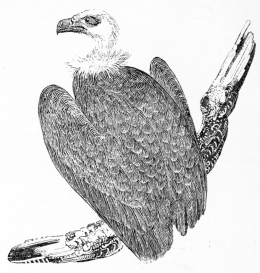
THE CONDOR. (Vultur gryphus.)
This bird measures three or four feet long, and its wings, when expanded, from ten to twelve feet. Its bill and talons are exceedingly large and strong; and its courage is equal to its strength. The throat is naked, and of a red colour. The upper parts in some individuals (for they differ greatly in colour) are variegated with black, gray, and white, and the body is scarlet. Round the neck it has a white ruff of loose hairy feathers. The feathers on the back are generally quite black, and perfectly bright. These enormous birds, which are inhabitants of South America, breed among the highest and most inaccessible rocks. The female makes no nest, but lays two white eggs, somewhat bigger than those of a turkey, on the bare rock. Some writers have affirmed that a Condor can carry off a sheep in its claws, and others that it has carried off children in the same manner; but these tales are manifestly absurd, as the Condor’s feet and talons are not fitted for carrying any great weight. Both the talons and the bill are indeed of extraordinary strength, but they are intended for tearing objects to pieces; and consequently we find that the Condor feeds chiefly on dead or dying cattle, or horses, which he tears to pieces and devours where they lie. When the Condor is gorged the hunters attack him, but his strength and fierceness are so great, that one of Sir Francis Head’s companions, who attempted to seize a gorged Condor, said he never had “such a battle in his life;” though he had been a Cornish miner and was reckoned an excellent wrestler in his own country.
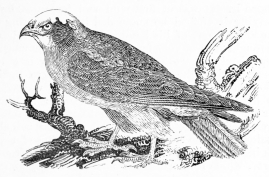
THE BUZZARD. (Falco Buteo, or Buteo vulgaris.)
“The noble Buzzard ever pleased me best; Of small renown, ’t is true; for, not to lie, We call him but a Hawk by courtesy.” Hind and Panther.
This is a rapacious bird, of the hawk kind, and the most common of all in England. It is of a sluggish, indolent nature, often remaining perched on the same bough for the greater part of the day: as if, indifferent either to the allurements of food or of pleasure, it were doomed, like some of the human species, to pass its allotted span of life in passive contemplation. It feeds on mice, rabbits, frogs, and often on all sorts of carrion. Too idle to build itself a nest, it frequently seizes upon the old habitation of a crow, which it lines afresh with wool and other soft materials. In general this bird, whose colour varies considerably, is brown varied with yellow specks; at a certain age its head becomes entirely gray. The female generally lays two or three eggs, which are mostly white, though sometimes spotted with yellow. Its length is usually twenty-two inches, and its breadth upwards of fifty.
The following anecdote, related by Buffon, will show that the Buzzard may be so far tamed as to be rendered a faithful domestic. A Buzzard, which had been caught in a snare, was brought to a gentleman, who undertook to tame it. It was at first wild and ferocious, but by depriving it of food he succeeded in constraining it to come and eat out of his hand. By pursuing this plan he brought it to be very familiar; and, after having shut it up about six weeks, he began to allow it a little liberty, taking the precaution, however, to tie both pinions of its wings. In this condition it walked out into his garden, and returned when called to be fed; after some time, thinking he might trust to its fidelity, he removed the ligatures, and fastened a small bell above its talon, and also attached to its breast a bit of copper with his name engraved on it. He then gave it entire liberty, which it soon abused; for it took wing and flew into the forest of Belesme. The bird was given up for lost; but four hours afterwards, it rushed into the gentleman’s hall, pursued by five other Buzzards, which had driven it into its former asylum. After this adventure it preserved its fidelity, coming every night to sleep under the window. It soon became familiar, attended constantly at dinner, sat on a corner of the table, and often caressed its master with its head and bill, emitting a weak, sharp cry, which, however, it sometimes softened. It had a singular propensity of seizing from the head and flying away with the red caps of the peasants; and so alert was it in whipping them off, that they found their heads bare without knowing what was become of their caps; it even treated the wigs of the old men in the same way, hiding its booty in the tallest trees.
Wilson says that one he shot in the wing lived with him several weeks: but refused to eat. It amused itself by hopping from one end of the room to the other, and sitting for hours at the window, looking down on the passengers below. At first, he put himself in an attitude of defence when approached; but after some time became quite familiar, permitting himself to be handled. Though he lived so long without food, his stomach was found on dissection to be enveloped in solid fat of nearly an inch in thickness.
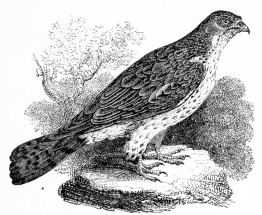
THE HONEY-BUZZARD. (Falco, or Pernis apivorus.)
This Buzzard eats lizards, frogs, and snails. It also feeds upon the larvæ of bees and wasps, which form the chief food of the young birds. Buffon says that in winter, when fat, it is good eating, a very rare circumstance with birds of this genus. It seldom flies, excepting from one bush to another; but, when on the ground, it runs with great rapidity, like a domestic fowl.
Willoughby observes that it builds its nest with twigs, on which it lays wool to receive its eggs. He saw one that took possession of an old kite’s nest to breed in, and that fed its young with the larvæ of wasps, for in the nest were found the combs of wasps’ nests, and, in the stomachs of the young, fragments of wasp-maggots. In the nest were two young ones, covered with white down, spotted with black. In the crop of one of them were two lizards entire, with their heads lying towards the mouth, as if they sought to creep out.
It would be highly interesting could we discover the manner in which this bird conducts its attack on a wasps’ nest. The close feathering round the base of the bill, is, no doubt, a protection against the stings of the insects which they attack.
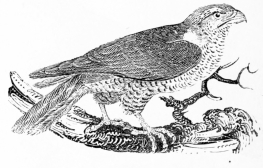
THE GOSHAWK, (Falco, or Astur palumbarius,)
Breeds in lofty trees in Scotland, and destroys a great quantity of small game, which he seizes with his sharp and crooked talons, and carries to his nest. He is of the hawk tribe, and somewhat larger than the common buzzard; his bill is blue, and he has a white stripe over each eye, and also a large white spot on each side of the neck. The general colour of the plumage is deep brown; the breast and belly white, transversely streaked with black; and the legs yellow. Buffon, who brought up two young Goshawks, a male and a female, makes the following observations: “The Goshawk, before it has shed its feathers, that is, in the first year, is marked on the breast and belly with longitudinal brown spots; but after it has had two moultings they disappear, and their place is occupied by transverse bars, which continue during the rest of its life.” He further observes that, “though the male was much smaller than the female, it was fiercer and more vicious.” The Goshawk is found in France and Germany; it is not common in England, but is more so in Scotland. In former times the custom of carrying a Hawk or Falcon on the hand was confined to men of high distinction; so that it was a saying among the Welsh, “You may know a gentleman by his Hawk, horse, and greyhound.” Even the ladies in those times were partakers of this gallant sport, and have been represented in pictures with Hawks on their hands. At present hawking is almost entirely laid aside in this country, as the expense which attended it, being very considerable, confined it to princes and men of the highest rank. In the time of James the First, Sir Thomas Monson is said to have given a thousand pounds for a cast of Hawks. In the reign of Edward the Third it was made felony to steal a Hawk; to take its eggs, even in a person’s own grounds, was punishable with imprisonment for a year and a day, together with a fine at the king’s pleasure. Such was the delight our ancestors took in this royal sport, and such were the means by which they endeavoured to secure it. The Falcons, or Hawks, chiefly used in these kingdoms were the Goshawk, the Peregrine Falcon, Iceland Falcon, and the Ger Falcon. The game usually pursued were cranes, wild geese, pheasants, and partridges. The Duke of St. Albans is still hereditary grand falconer of England, but the office is not now exercised, except for the Duke’s own amusement.
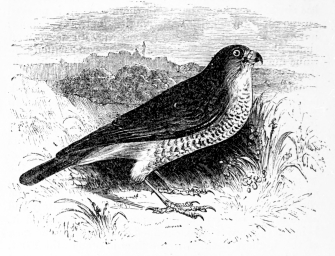
THE SPARROWHAWK. (Falco, or Accipiter nisus.)
The Sparrowhawk is a bold-spirited bird; the length of the male is twelve inches, that of the female fifteen; the beak is short, crooked, and of a bluish tint, but very black towards the tip; the tongue black, and a little cleft; the eyes of a middling size. The crown of the head is of a dark brown; above the eyes, in the hinder part of the head, there are sometimes white feathers; the roots of the feathers of the head and neck are white, the rest of the upper side, back, shoulders, wings, and neck of a dark brown. The wings, when closed, scarcely reach to the middle of the tail; the thighs are strong and fleshy, the legs long, slender, and yellow; the toes also long, and the talons black. The female lays about five eggs, spotted near the blunt end with brown specks. When wild they feed only upon birds, and possess a boldness and courage above their size; but in a domestic state they do not refuse raw flesh and mice. They can be made obedient and docile, and readily trained to hunt quails and partridges.
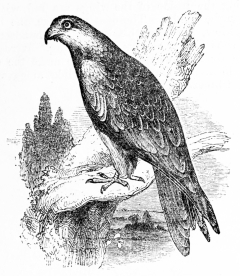
THE KITE. (Falco Milvus, or Milvus regalis.)
THE KITE. (Falco Milvus, or Milvus regalis.)
This bird, though it belongs to the falcon tribe, is called ignoble, because it is never used in hawking. It is easily distinguished from other birds of prey by its forked tail, and the slow and circular eddies it describes in the air whenever it spies from the regions of the clouds a young duck or a chicken which has strayed too far from the brood. When this is the case, the Kite, pouncing on it with the rapidity of a dart, seizes it in its talons, and carries it off to its nest. It is, however, a great coward, and if the hen flies at it, which she always does if she sees it, it will drop the chicken and fly off. It is larger than the common buzzard; and though it weighs somewhat less than three pounds, the extent of its wings is more than five feet. The head and neck are of a pale ash colour, varied with longitudinal lines across the shafts of the feathers; the back is reddish; the lesser rows of the wing feathers are party-coloured, of black, red, and white; the feathers covering the inside of the wings are red, with black spots in the middle. The eyes are large, the legs and feet yellow, the talons black. It is a handsome bird, and seems almost always on the wing. It rests itself on the air, and does not appear to make the smallest effort in flying, but rather to glide along with the gentlest breeze.
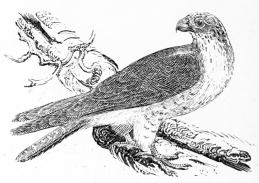
THE FALCON.
The Falcon is a predaceous bird, of which there are several species. Of these the Gerfalcon (Falco Gyrfalco) is the largest, and is found in the northern parts of Europe; and, next to the eagle, is the most formidable, active, and intrepid of all voracious birds, and the most esteemed for falconry. The bill is crooked and bluish; the irides of the eye dusky; and the whole plumage of a whitish hue, marked with dark lines on the breast, and dusky spots on the back.
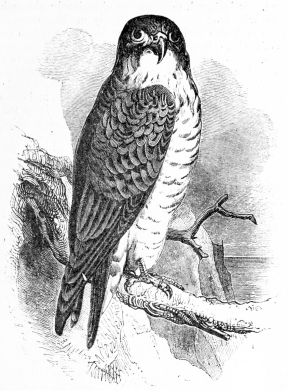
THE PEREGRINE FALCON. (Falco peregrinus.)
The Peregrine Falcon, which is the most common kind, is from fifteen to eighteen inches in length. The bill is blue at the base, and black at the point; the head, back, scapulars, and coverts of the wing are barred with deep black and blue; the throat, neck, and upper part of the breast are white, tinged with yellow; the bottom of the breast, belly, and thighs are of a grayish white; and the tail is black and blue. Wilson enumerates no less than ten varieties, dependent chiefly upon age, sex, and country. It is found, more or less abundantly, throughout the whole of Europe, principally in the mountain districts in North and South America, dwelling in the clefts of rocks, especially such as are exposed to the mid-day sun. It breeds upon the cliffs in several parts of England, but appears to be more common in Scotland and Wales. Its food consists principally of small birds; but it scruples not to attack the larger species, and sometimes gives battle even to the kite. Falcons rarely take their prey upon the ground, like the more ignoble birds of the class to which they belong; but pounce upon it from aloft, in a directly perpendicular descent as it flies through the air, bear it downwards by the united impulse of the strength and rapidity of their attack, and sticking their talons into its flesh, carry it off in triumph to the place of their retreat. Like most predatory animals, they are stimulated to action by the pressure of hunger alone, and remain inactive and almost motionless while the process of digestion is going on, until the renewed cravings of their appetite stimulate them to further exertion. In different stages of its growth, the Peregrine Falcon has been known by various English names. Its proper appellation among falconers is the Slight Falcon, the term Falcon Gentle being equally applicable to all the species when rendered manageable. In the immature state, this Falcon is also called a Red Hawk, from the prevailing colour of its plumage. The male is called a Tiercel, to distinguish it from the female, which, in the Falcon tribe, is commonly one-third larger than the male.
In China there is said to be a variety, which is mottled with brown and yellow, and used by the emperor of China in his sporting excursions, when he is usually attended by his great falconer, and a thousand of inferior rank. Every bird has a silver plate fastened to its foot, with the name of the falconer who has the charge of it, that, in case it should be lost, it may be restored to the proper person; but if it should not be found, the name is delivered to another officer, called the guardian of lost birds, who, to make his situation known, erects his standard in a conspicuous place among the army of hunters.
In Syria there is a species of Falcon, which the inhabitants call Shaheen (Falco peregrinator), and which is of so fierce and courageous a disposition, that it will attack any bird, however large or powerful, which presents itself. “Were there not,” says Dr. Russel, in his Account of Aleppo, “several gentlemen now in England to bear witness to the fact, I should hardly venture to assert that, with this bird, which is about the size of a pigeon, the inhabitants sometimes take large eagles. This Hawk was in former times taught to seize the eagle under the pinion, and thus depriving him of the use of one wing, both birds fell to the ground together; but the present mode is to teach the Hawk to fix on the back, between the wings, which has the same effect, only, that as the bird tumbles down more slowly, the falconer has more time to come to his Hawk’s assistance; but in either case, if he be not very expeditious, the falcon is inevitably destroyed. I never saw the Shaheen fly at eagles, that sport having been disused before my time; but I have often seen him take herons and storks. The Hawk, when thrown off, flies for some time in a horizontal line, not six feet from the ground; then mounting perpendicularly, with astonishing swiftness, he seizes his prey under the wing, and both together come tumbling to the ground.”
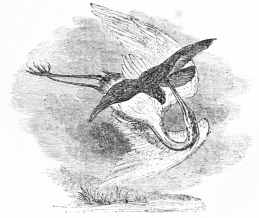
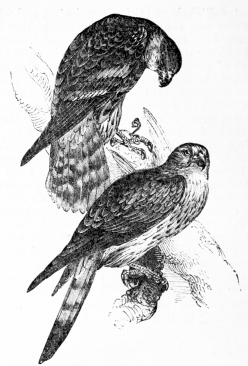
THE MERLIN, (Falco æsalon,)
Is the smallest British species of the Falcon tribe, and, as its name implies, is not very different in size from the blackbird; the word Merlin signifying in French a small merle, or blackbird. Though small the Merlin is not inferior in courage to any of the other Hawks; it is noted for its boldness and spirit, often attacking and killing at one stroke a full-grown partridge or a quail; but it differs from the Falcons and all the other rapacious kinds, in the male and female being of equal size. The back of this bird is party-coloured, of dark blue and brown; the quill feathers of the wings black, with rusty spots; the tail is about five inches long, of a dark brown or blackish colour, with transverse white bars: the breast is of a yellowish white, with streaks of rusty brown pointing downwards; the legs are long, slender, and yellow; the talons black. The head is encircled with a row of yellowish feathers, not unlike a coronet. In the male the feathers on the rump, next the tail, are bluer; a mark by which the falconers easily discern the sex of the bird. The Merlin does not breed here, but visits us in October: it flies low, and with great celerity and ease. In the days of falconry, the Merlin was considered the lady’s hawk.
In ancient days—in ancient days, When ladies took a strange delight In hawks and hounds and sporting ways, A Merlin was a pleasant sight. “ ’T was gentle when, in trappings gay, Upon its lady’s wrist it stood; Till its hood was raised and it saw its prey, When its eye betrayed the bird of blood.”
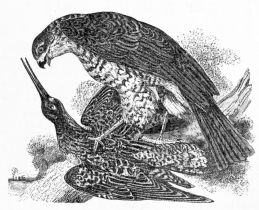
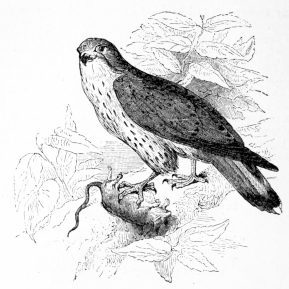
THE KESTREL, (Falco tinnunculus,)
Is the commonest of all the British Hawks, and may be seen in almost all parts of the country hovering over the fields in search of mice and other small animals. His flight is very peculiar. He advances only for a short distance at a time, and then suspends himself in the air by very short but quick movements of his wings. If no prey make its appearance beneath him, he then goes on a little further, and again remains stationary, but the moment a mouse or other small quadruped stirs amongst the grass, his wings close, and he descends with the greatest velocity. The Kestrel will also feed upon small birds and insects.
The Kestrel is a handsome little Hawk, from twelve to fifteen inches in length, with a blue beak and yellow cere and feet. Its plumage is reddish brown or fawn colour, elegantly marked with black spots and bars. Its nest is built among rocks, or in the holes and corners of old buildings and church towers, and the female lays four or five eggs, which are reddish white, with brown spots.
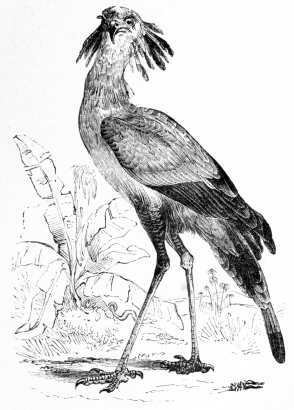
THE SECRETARY BIRD. (Serpentarius reptilivorus.)
This singular bird, which is a native of Southern Africa, differs from all the other predaceous birds in the great length of its legs, which are so long that some naturalists have placed it among the Wading Birds. It stands between three and four feet high when erect, and is of a bluish ash colour on the back and nearly white beneath; its tail is long, and has the two middle feathers much longer than the others and nearly reaching to the ground; and the back of the head is adorned with a tuft of black feathers, which the bird can raise at pleasure. It is from this tuft that the bird has obtained his name; the Dutch colonists of the Cape of Good Hope fancied they saw some resemblance in it to the pen of a clerk stuck behind his ear, and accordingly called him the Secretary Bird. Clerks and secretaries are no doubt useful personages in their way, and the Secretary Bird, although he cannot take his pen from behind his ear, finds abundance of work to do, although of a kind very different from the peaceful labours of his namesakes. He is the great destroyer of the snakes and other reptiles which swarm in many parts of Southern Africa, and which, but for him, would increase in numbers so as to become a positive nuisance. And here we may call our young readers to admire the wonderful manner in which the structure of a hawk has been modified by the hand of the Creator to suit it for a particular mode of life. As the bird advances to attack a snake his long legs, protected by hard horny scales, elevate his body to a considerable height above the ground, thus giving him an advantageous position, and at the same time enabling it to move with great speed. One of the large and powerful wings, armed at the end with a strong spur, is raised a little from the body and held forward like a shield, but constantly shaken, as if to distract the attention of the foe, and thus, like a skilful boxer sparring up to his antagonist, the Secretary makes his way towards his intended prey. As he approaches he watches for the moment when the snake is about to spring upon him; a single blow from the spurred wing is usually sufficient to lay the reptile writhing in the ground in a helpless state; it is then soon despatched and as speedily swallowed. Some idea of the quantity of reptiles destroyed by this bird may be gained from Le Vaillant’s statement, that the crop of one of them examined by him contained eleven lizards, three snakes as long as a man’s arm, and eleven small tortoises, together with a good many insects. The inhabitants of the Cape Colony are quite aware of the services rendered to them by the Secretary Bird, and sometimes keep him among their poultry to protect them from injurious animals; he is said to behave with great propriety under these circumstances, rarely doing any mischief to his companions, unless his supply of food has been neglected.
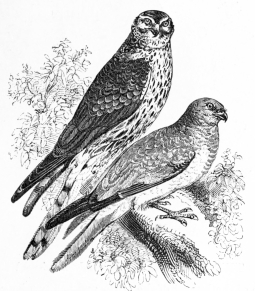
THE HEN HARRIER, (Circus cyaneus,)
Is seen about forests, heaths, and other retired places, especially in the neighbourhood of marshy grounds, where it destroys vast numbers of snipes, woodcocks, and wild ducks. It is about seventeen inches long, and three feet wide; its bill is black, and cere yellow. The upper part of its body is of a bluish gray; and the back of the head, breast, belly, and thighs are white. The legs are long, slender, and yellow; and the claws black.
§ II.—Nocturnal Birds of Prey.
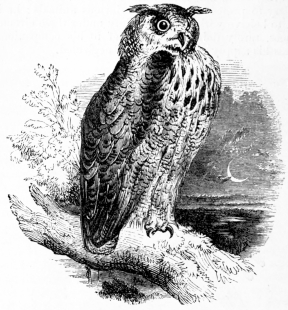
THE HORNED OWL, (Bubo maximus,)
Is one of the largest of the Owls, and has two long tufts growing from the top of its head, above its ears, and composed of six feathers, which it can raise or lay down at pleasure. Its eyes are large, and encircled with an orange-coloured iris; the ears are large and deep, and the beak black; the breast, belly, and thighs, are of a dull yellow, marked with brown streaks; the back, coverts of the wings, and quill feathers, are brown and yellow; and the tail is marked with dusky and red bars. It inhabits the north and west of England, and Wales. The conformation of the organ of sight in the Owl is so peculiar, and so much in its nature resembling that of the feline kind, that it can see much better at dusk than by daylight. The Barn Owl sees in a greater degree of darkness than the others; and, on the contrary, the Horned Owl is enabled to pursue his prey by day, though with difficulty. Owls are sometimes tamed by persons in the country, who carefully rear them in a domestic state, from their propensity to chase and devour mice and other vermin, of which they clear the houses with as much address as cats. The Owl is a solitary bird, and is said to retire into holes in towers and old walls in the winter, and pass that season in sleep.
“The solitary bird of night, Through the pale shade now wings his flight, And quits the time-shook tower; Where, shelter’d from the blaze of day, In philosophic gloom he lay, Beneath his ivy bower.” Carter.
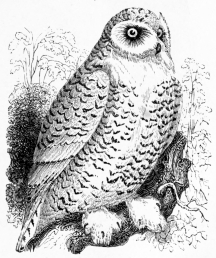
THE HARFANG, OR GREAT SNOWY OWL.
The Harfang, or Great Snowy Owl, (Surnia nyctea,) is another species which takes its prey occasionally by daylight. It is seldom seen in England, but frequently visits North Britain, particularly the Orkney and Shetland Islands. It is one of the few Owls that feed on fish, into which it strikes its talons while in the water, and carries them off to its nest. These Owls are very common in the northern parts of North America, and are eaten not only by the Indians, but by the Europeans engaged in the fur trade.
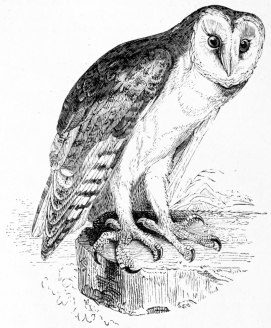
THE WHITE, BARN, OR SCREECH OWL. (Srix flammea.)
“—— from yonder ivy-mantled tower, The moping Owl does to the moon complain Of such as, wandering near her secret bower, Molest her ancient solitary reign.” Gray.
This bird is about the size of a large pigeon. Its beak, hooked at the end, is more than an inch and a half long. There is a circle or wreath of white, soft, and downy feathers, encompassed with yellow ones, beginning from the nostrils on each side, passing round the eye and under the chin, somewhat resembling the hood that women used to wear; so that the eyes appear to be sunk in the middle of the feathers, and only the tip of the beak projects from them. The breast and feathers of the inside of the wings are white, and marked with a few dark spots; the upper parts of the body are of a fine pale yellow colour, variegated with black and white spots. The legs are covered with a thick down to the feet, but the toes have only thin-set hairs around them.
In ancient mythology, another common species, the Brown Owl (Syrnium aluco), was consecrated to Minerva, the goddess of wisdom; in allusion to the lucubrations of wise men, who study in retirement and during the night.
“Now the Hermit Owlet peeps From the barn, or twisted brake; And the blue mist slowly creeps, Curling on the silver lake.” Cunningham.
§ III.—Insessores, or Perching Birds.
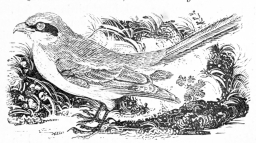
THE BUTCHER-BIRD, OR SHRIKE. (Lanius excubitor.)
The Great Butcher-bird, or Shrike, is about as large as a thrush; its bill is black, an inch long, and hooked at the end. It is only an occasional visitor to this country, where it is generally found between autumn and spring. “The Shrike,” says Mr. Yarrell, “feeds on mice, shrews, small birds, frogs, lizards, and large insects. After having killed its prey, it fixes the body in a forked branch, or upon a sharp thorn, the more readily to tear off small pieces from it. It is from their habit of killing and hanging up their meat, that the Shrikes are called Butcher-birds.” The head, back, and rump are ash-coloured; the chin and lower part of the body white; the breast and throat varied with dark lines crossing each other; the tips of the feathers of the wings are, for the most part, white; it has a black spot by the eye; the outermost tail feathers of the male are all over white; the two middlemost have only their tips white, the rest of the feathers being black, as well as the legs and feet. It builds its nest among thorny shrubs and dwarf trees, and furnishes it with moss, wool, and downy herbs, where the female lays five or six eggs. A peculiarity belonging to the birds of this kind is, that they do not, like most other birds, expel the young ones from the nest as soon as they can provide for themselves, but the whole brood live together in one family. The Butcher-bird will chase all the small birds upon the wing, and will sometimes venture to attack partridges, and even young hares. Thrushes and blackbirds are frequently their prey: the Shrike fixes on them with its talons, splits the skull with its bill, and feeds on them at leisure. On this account Linnæus classed the Shrikes with the birds of prey; but modern naturalists have placed them with the insect-eaters, as insects are their principal food. It is easy to distinguish these birds at a distance, not only from their going in companies, but also from their manner of flying, which is always up and down, seldom in a direct line, or obliquely.
The Little Butcher-bird (Lanius collurio), called in Yorkshire, Flusher, is about the size of a lark, with a large head. About the nostrils and corners of the mouth it has black hairs or bristles; and round the eyes a large black longitudinal spot; the back and upper side of the wings are of a rusty colour; the head and rump cinereous; the throat and breast white, spotted with red. It builds its nest of the stalks of plants, and the female lays six eggs, nearly all white, except at the blunt end, which is encircled with brown or dark red marks. The female is somewhat larger than the male; the head is of a rust colour, mixed with gray; the breast, belly, and sides of a dirty white; the tail deep brown; the exterior web of the outer feathers white. Its manners are similar to those of the large Butcher-bird. It frequently preys on young birds, which it takes in the nest; it likewise feeds on grasshoppers, beetles, and other insects. During the period of incubation, the female soon discovers herself at the approach of any person by her loud and violent outcries.
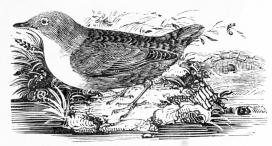
THE WATER OUZEL, OR DIPPER, (Cinclus aquaticus,)
Is found in most parts of this island, and is about the size of the common blackbird. It feeds upon aquatic insects and small fish. The head and upper side of the neck are of a kind of umber colour, and sometimes black with a shade of red; the back and coverings of the wings are a mixture of black and ash-colour, the throat and breast perfectly white.
The Dipper is said to walk along the bottom of a lake or river as easily as on land; but this is far from being the case, as, though it readily plunges into the water, it appears to tumble about in a very extraordinary manner, with its head downwards. Even on land the bird walks awkwardly, as its feet are best adapted for the slippery stones on which it passes the greater part of its life, watching for the insects which it picks up on the edge of the water. Its movements under water are really performed by means of the wings, the bird positively flying through the water. When disturbed, it usually flirts up its tail, and makes a chirping noise. Its song in spring is said to be very pretty. In some places this bird is supposed to be migratory.
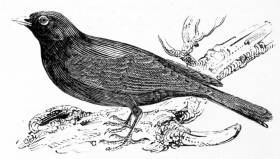
THE BLACKBIRD. (Turdus Merula.)
“The smiling morn, the breathing spring, Invite the tuneful birds to sing; And, while they warble from each spray, Love melts the universal lay.” Mallet.
This well-known songster does not soar up to the clouds, like the lark, to make his voice resound through the air; but keeps to the shady groves, which he fills with his melodious notes. Early at dawn, and late at dusk, he continues his pleasing melody; and when incarcerated in the narrow space of a cage, still cheerful and merry, he strives to repay the kindness of his keeper by singing to him his natural strains; and beguiles his irksome hours of captivity by studying and imitating his master’s whistle. Blackbirds build their nests with great art, making the outside of moss and slender twigs, cemented together and lined with clay, and covering the clay with soft materials, as hair, wool, and fine grass. The female lays four or five eggs, of a bluish green colour, spotted all over with brown. The bill is yellow, but in the female the upper part and point are blackish; the inside of the mouth, and the circumference of the eyelids are yellow. The name of this bird is sufficiently expressive of the general colour of his body. He feeds on berries, fruit, insects, &c.
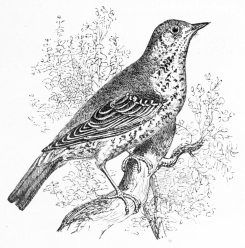
THE MISSEL THRUSH. (Turdus viscivorus.)
The Missel Thrush, so called from its feeding on the berries of the misletoe, differs but little from the Song Thrush, except in size. He is larger than the fieldfare, while the Throstle is smaller. The female lays five or six bluish eggs, with a tint of green, and marked with dusky spots.
The Song Thrush or Throstle, (Turdus musicus,) is one of the best songsters of the evening hymn in the grove. His voice is loud and sweet; the melody of his song is varied, and, although not so deep in the general diapason of the woodland concert as that of the blackbird, yet it fills up agreeably, and bursts through the inferior warblings of smaller performers. His breast is of a yellowish white, spotted with black or brown dashes, like ermine spots.
The term Merle for the Blackbird, and Mavis for the Thrush, are used chiefly by the poets.
“Merry is it in the good green wood, When the Mavis and Merle are singing, When the deer sweeps by, and the hounds are in cry, And the hunter’s horn is ringing.” Scott. “Take thy delight in yonder goodly tree, Where the sweet Merle and warbling Mavis be.” Drayton.
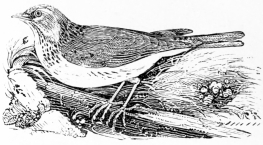
THE REDWING, (Turdus iliacus,)
Is rather less than the song thrush; but the upper part of the body is of the same colour; the breast not so much spotted; the coverings of the feathers of the under side of the wings, which in the thrush are yellow, are of orange colour in this bird; by which marks it is generally distinguished. The body is white, the throat and breast yellowish, marked with dusky spots. It is migratory in this island, builds its nest in hedges, and lays six bluish eggs. Like the fieldfare, it leaves us in spring, for which reason its song is quite unknown to us; but it is said to be very pleasing. It is delicate eating; and the Romans held it in such estimation, that they kept thousands of them together in aviaries, and fed them on a sort of paste made of bruised figs and flour, to improve the delicacy and flavour of their flesh. Under this management these birds fattened, to the great profit of their proprietors, who sold them to Roman epicures for three denarii, or about two shillings sterling each, which at that early period was a large price.
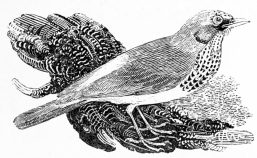
THE FIELDFARE, (Turdus pilaris,)
Is a well-known bird in this country. Fieldfares fly in flocks, together with the redwing and starling, and change their haunts according to the season of the year. They abide with us in winter, and disappear in spring, so punctually, that after that time not one is to be seen. The flesh is esteemed a great delicacy, and is highly prized in Germany, where it is known as the Krammsvögel, and is sold in the markets of Westphalia by the dozen. Their favourite food is the juniper-berry, whence its German name. The head is ash-coloured, and spotted with black: the back and coverts of the wings of deep chesnut colour; the rump cinereous; and the tail black, except the lower part of the two middle feathers, which are ash-coloured, and the upper sides of the exterior feathers, which are white. They collect in large flocks; and it is supposed they keep watch, like the crow, to mark and announce the approach of danger. On any person approaching a tree that is covered with them, they continue fearless, till one at the extremity of the bush, rising on its wings, gives a loud and peculiar note of alarm. They then all fly away, except one, which continues till the person approaches still nearer, to certify, as it were, the reality of the danger, and afterwards he also flies off, repeating the note of alarm.
Mr. Knapp, in his “Journal of a Naturalist,” says, that in the county of Gloucestershire the extensive low-lands of the river Severn, in open weather, are visited by prodigious flocks of these birds.
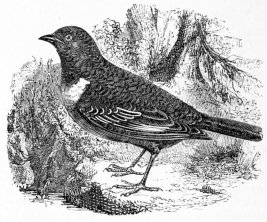
THE RING OUZEL. (Turdus torquatus.)
The Ring Ouzel differs from the fieldfare and redwing, to which it is nearly allied, in being a summer visitor to the British islands, instead of a winter one. It is found only in the wildest and most mountainous districts; particularly among the Welsh mountains and on Dartmoor, in Devonshire, where it has been known to breed.
THE MOCKING BIRD, (Turdus polyglottus,)
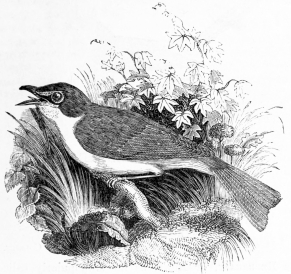
Which is also a species, is found in both North and South America, and in the West Indian islands. He has a beautiful song, which he varies by imitating the notes of almost all other birds, so that a person passing by his haunt is regaled with a complete ornithological concert, all by a single performer. Unfortunately, the Mocking Bird’s taste is not equal to his musical powers. His talent for imitation is so great that he mimics every sound he hears, and as he introduces all his imitations freely into his songs, he often interrupts the most delightful melody with the scream of a hawk, the bark of a dog, the squalling of a cat, or similar discordant noises.
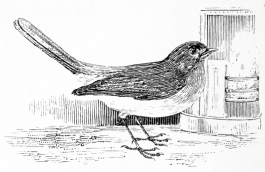
THE ROBIN, OR REDBREAST. (Erythacus rubecula.)
“The Redbreast oft, at evening hours, Shall kindly lend his little aid, With hoary moss, and gathering flowers, To deck the ground where thou art laid.” Collins.
The Redbreast, or Robin, as he is popularly called, seems always to have enjoyed the protection of man, more than any other bird. The prettiness of his shape, the beauty of his plumage, the quickness of his motions, his familiarity with us in winter, and, above all, the melody and sweetness of his voice, claim our admiration, and have insured him that security which he enjoys among us; though the aid of fable has also been called in, to guard him from the assaults of thoughtless boys.
“Little bird with bosom red, Welcome to my humble shed! Courtly domes of high degree Have no room for thee and me; Pride and pleasure’s fickle throng Nothing mind an idle song. Daily near my table steal, While I pick my scanty meal; Doubt not, little though there be, But I’ll cast a crumb for thee; Well rewarded if I spy Pleasure in thy glancing eye; And see thee, when thou’st eat thy fill, Plume thy breast, and wipe thy bill.” Langhorne.
In the winter season, impelled by the potent stimulus of hunger, the Redbreast frequents our barns, gardens, and houses, and often alights, on a sudden, on the rustic floor; where, with his broad eye incessantly open, and looking askew upon the company, he picks up eagerly the crumbs of bread that fall from the table, and then flies off to the neighbouring bush, where, by his warbling strains, he expresses his gratitude for the liberty he has been allowed. He is found in most parts of Europe, but nowhere so commonly as in Great Britain. His bill is dusky; his forehead, chin, throat, and breast are of a deep orange-colour, inclining to vermilion; the back of his head, neck, back, and tail are of a pale olive-brown colour; the wings are somewhat darker, the edges inclining to yellow; the legs and feet are the colour of the bill. The female generally builds her nest in the crevice of some mossy bank, near places which human beings frequent, or in some part of a human dwelling. Robins have been known to build in a sawpit where men worked every day, and in various other equally extraordinary places. When the Crystal Palace at Sydenham was being fitted up, several Robins built their nests in holes of the large roots used to raise the flower beds within the building. So little fear did they exhibit that their bright eyes might be seen glancing from holes close to which men were passing every moment. The elegant poet of The Seasons gives us a very exact and animated description of this bird in the following lines:
“—— —— Half afraid, he first Against the window beats: then, brisk alights On the warm hearth; then, hopping on the floor, Eyes all the smiling family askance, And pecks, and starts, and wonders where he is, Till, more familiar grown, the table-crumbs Attract his slender feet.”
An old Latin proverb tells us that two Robin Redbreasts will not feed on the same tree; it is certain that the Redbreast is a most pugnacious bird, and that he does not live in much harmony and friendship with those of his own kind and sex. The male may be known from the female by the colour of his legs, which are blacker.
The Redbreast attends the gardener when digging his borders; and will, with great familiarity and tameness, pick out the worms almost close to his spade.
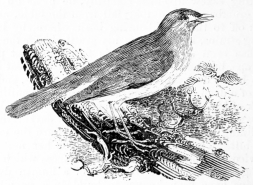
THE NIGHTINGALE. (Philomela luscinia.)
“Sweet bird, that shunn’st the noise of folly, Most musical, most melancholy! Thee, chantress, oft, the woods among, I woo to hear thy even song.” Milton.
The Nightingale has little to boast of in respect to plumage, which is of a pale tawny colour on the head and back, dashed with a slight shade of olive; the breast and upper part of the belly incline to a grayish tint, and the lower part of the belly is almost white; the exterior web of the quill feathers is of a reddish brown; the tail of a dull red; the legs and feet ash-coloured; the irides hazel; and the eyes large, bright, and staring. But it is hardly possible to give an idea of the extraordinary power which this small bird possesses in its throat, as to the extension of sound, sweetness of tone, and versatility of notes. Its song is composed of several musical passages, each of which does not continue more than the third part of a minute; but they are so varied, the passing from one tone to another is so fanciful and so rapid, and the melody so sweet and so mellow, that the most consummate musician is pleasingly led to a deep sense of admiration on hearing it. Sometimes, joyful and merry, it runs down the diapason with the velocity of lightning, touching the treble and the base nearly at the same instant; at other times, mournful and plaintive, the unfortunate Philomela draws heavily her lengthened notes, and breathes a delightful melancholy around. These have the appearance of sorrowful sighs; the other modulations resemble the laughter of the happy. Solitary on the twig of a small tree, and cautiously at a certain distance from the nest, where the pledges of his love are treasured under the fostering breast of his mate, the male fills constantly the silent woods with his harmonious strains, and during the whole night entertains and repays his female for the irksome duties of incubation. The Nightingale not only sings at intervals during the day, but waits till the blackbird and the thrush have uttered their evening call, even till the stock and ringdoves have, by their soft murmurings, lulled each other to rest, and then pours forth his full tide of melody:
“—— —— Listening Philomela deigns To let them joy, and purposes, in thought Elate, to make her night excel their day.” Thomson.
It is a great subject of astonishment that so small a bird should be endowed with such potent lungs. If the evening is calm, it is supposed that its song may be heard above half-a-mile. This bird, the ornament and charm of our spring and early summer evenings, as it arrives in April, and continues singing till June, disappears on a sudden about September or October, when it leaves us to pass the winter in the North of Africa and Syria. Its visits to this country are limited to certain counties, mostly in the south and east; as, though it is plentiful in the neighbourhood of London, and along the south coast in Sussex, Hampshire, and Dorsetshire, it is not found in either Cornwall or Wales. As soon as the young are hatched, the song of the male bird ceases, and he only utters a harsh croak, by way of giving alarm when any one approaches the nest. Nightingales are sometimes reared up, and doomed to the prison of a cage; in this state they sing ten months in the year, though in their wild life they sing only as many weeks. Bingley says that a caged Nightingale sings much more sweetly than those which we hear abroad in the spring.
The Nightingale is the most celebrated of all the feathered race for its song. The poets have in all ages made it the theme of their verses; some of these we cannot resist giving:
“The Nightingale, as soon as April bringeth Unto her rested sense a perfect waking, Which late bare earth, proud of new clothing, springeth, Sings out her woes——.” Sir Philip Sidney.
“—— —— —— Beast and bird, They to their grassy couch, these to their nests, Were slunk; all but the wakeful Nightingale; She all night long her amorous descant sung.” Milton.
“And in the violet-embroidered vale, Where the lovelorn Nightingale Nightly to thee her sad song mourneth well.” Milton.
“O Nightingale, that on yon bloomy spray Warblest at eve, when all the woods are still, Thou with fresh hope the lover’s heart dost fill, While the jolly hours lead on propitious May, Thy liquid notes that close the eye of day, First heard before the shallow cuckoo’s bill, Portend success in love. Oh, if Jove’s will Have linked that amorous power to thy soft lay, Now timely sing, ere the rude bird of hate Foretell my hopeless doom in some grove nigh; As thou from year to year hast sung too late For my relief, yet hadst no reason why: Whether the muse, or love, call thee his mate, Both them I serve, and of their train am I.” Milton. “—— —— Now is the pleasant time, The cool, the silent, save where silence yields, To the night-warbling bird, that, now awake, Tunes sweetest his love-laboured song.” Milton.
“How all things listen while thy muse complains, Such silence waits on Philomela’s strains, In some still evening, when the whispering breeze Pants on the leaves, and dies upon the trees.” Pope.
“There’s a bower of roses by Bendemeer’s stream, And the Nightingale sings round it all the year long; In the days of my childhood, ’t was like a sweet dream To sit in the roses, and hear the bird’s song. “That bower and its music I never forget, But oft when alone, in the bloom of the year, I think, Is the Nightingale singing there yet? Are the roses still bright by the calm Bendemeer?” Moore.
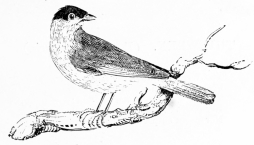
THE BLACK-CAP, (Curruca atricapilla,)
Is a very small warbler, not weighing above half-an-ounce. The top of the head is black, whence he takes his name; the neck ash-coloured, the back an ashy-brown, the wings of a dusky colour, the tail nearly the same; the nether part of the neck, throat, and upper part of the breast of a pale ash colour; the lower part of the belly white.
The Black-cap visits us about the middle of April, and retires in September; it frequents gardens, and builds its nest near the ground. The female lays five eggs of a pale reddish-brown, sprinkled with spots of a darker colour. This bird sings sweetly, and so like the nightingale, that in Norfolk it is called the mock nightingale. White observes, that it has usually a full, sweet, deep, loud, and wild pipe, yet the strain is of short continuance, and its motions desultory; but when it sits calmly, and earnestly engages in song, it pours forth very sweet but inward melody; and expresses a great variety of modulations, superior perhaps to any of our warblers, the nightingale excepted. While it sings, its throat is greatly distended.
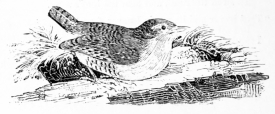
THE WREN. (Troglodytes vulgaris.)
“Fast by my couch, congenial guest, The Wren has wove her mossy nest; From busy scenes and brighter skies To lurk with innocence she flies; Her hopes in safe repose to dwell, Nor aught suspects the sylvan cell.” T. Warton.
The Wren is a very small bird; but, as if nature had intended to compensate the want of size and bulk in the individuals, by multiplying them to a greater extent, this little bird is one of the most prolific of the feathered tribe, its nest containing often upwards of eighteen eggs, of a whitish colour, and not much bigger than a pea. The male and female enter by a hole contrived in the middle of the nest, and which, by its situation and size, is accessible only to themselves. The Wren weighs no more than three drachms. Its notes are very sweet, and rival those of the robin redbreast, in the middle of winter, when the coldness of the weather has condemned the other songsters to silence. Like the redbreast, it frequently approaches the habitation of man, enlivening the rustic garden with its song during the greater part of the year. It begins to make a nest early in the spring, but frequently deserts it before it is lined, and searches for a more secure place. The Wren does not, as is usual with most other birds, begin to build the bottom of the nest first. When against a tree, its primary operation is to trace upon the bark the outline, and thus to fasten it with equal strength to all parts. It then, in succession, closes the sides and top, leaving only a small hole for entrance.
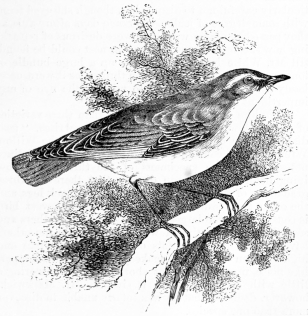
THE WILLOW WREN. (Sylvia trochilus.)
The Willow Wren is somewhat larger than the common Wren. The upper parts of the body are of a pale olive-green; the under parts are pale yellow, and a streak of yellow passes over the eyes. The wings and tail are brown, edged with yellowish green; and the legs are inclined to yellow. This bird is migratory, visiting us usually about the middle of April, and taking its departure towards the end of September. The female constructs her nest in holes at the roots of trees, in hollows of dry banks, and other similar places. It is round, and not unlike the nest of the Wren. The eggs are dusky white, marked with reddish spots, and are five in number. A Willow Wren had built in a bank of one of the fields of Mr. White, near Selborne. This bird, a friend and himself observed as she sat in her nest, but were particularly careful not to disturb her, though she eyed them with some degree of jealousy. Some days afterwards, as they passed the same way, they were desirous of remarking how the brood went on; but no nest could be found, till Mr. White happened to take up a large bundle of long green moss, which had been thrown, as it were, carelessly over the nest, in order to mislead the eye of any impertinent intruder.
Mr. White distinguished no fewer than three varieties of the Willow Wren. “I have now,” he writes, “past dispute, made out three distinct species of the Willow Wrens, which constantly and invariably use distinct notes.” “I have specimens of the three sorts now lying before me, and can discern that there are three gradations of sizes, and that the least has black legs, and the other two, flesh-coloured ones. The yellowest bird is considerably the largest, and has its quill feathers and secondary feathers tipped with white, which the others have not. The last haunts only the tops of trees and high beechen woods, and makes a sibilous grasshopper-like noise, now and then, at short intervals, shivering a little with its wings when it sings.” Mr. Markwich, however, declared that he was totally unable to discover more than one species.
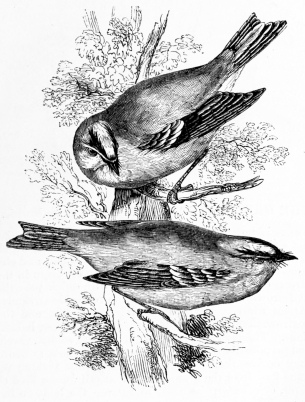
THE GOLDEN-CRESTED WREN, (Regulus cristatus,)
Is the smallest of British birds, measuring only three inches and a half in length. It is of an olive colour, with a beautiful crest of golden yellow feathers on its head. This charming little bird is generally found in fir woods; it feeds on insects, and has a soft and pleasing song.
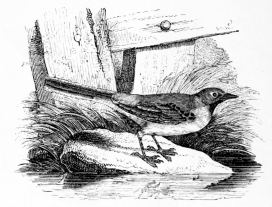
THE GREY WATER WAGTAIL. (Motacilla boarula.)
There is not a brook purling along two flowery banks, not a rivulet winding through the green meadow, which is not frequented by this beautifully coloured and elegantly shaped little creature. We even see them in the streets of country towns, following with quick pace the half-drowned fly or moth, which the road-side streamlet carries away. Next to the robin redbreast and the sparrow, they are the boldest in approaching our habitations. The Wagtails are much in motion; seldom perch, and perpetually flirt their long and slender tails, (whence they derive their name,) principally after picking up some food from the ground, as if that tail were a kind of lever, or counterpoise, used to balance the body on the legs. They are observed to frequent, more commonly, those streams where women come to wash their linen; probably not ignorant that the soap, the froth of which floats upon the water, attracts those insects which are most acceptable to them.
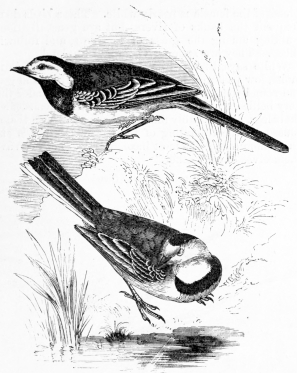
PIED WAGTAILS.
There are two common species of Wagtails, the Grey kind and the Pied Wagtail. The Grey Wagtail is retiring in its habits, and much slower in its motions; its breast is yellow, and its wings grayish, but the Pied Wagtail, which is a very lively little bird, and seems always in a bustle, is black, softening into ash-colour and white; it is also bold, and will take the food thrown to it with as much confidence as a robin redbreast.
The Yellow Shepherdess (Budytes flava) is another species of Wagtail. The male is olive-green on the back, and yellow on the lower part of the body, but the breast of the female is nearly white. These birds do not frequent the banks of rivers, but are generally found walking among the grass of meadows, and following sheep. They are summer visitors to England.
White says, that “while the cows are feeding in the moist, low pastures, broods of Wagtails, white and grey, run round them, close up to their noses, and under their very bellies, availing themselves of the flies that settle on their legs, and probably finding worms and larvæ that are roused by the trampling of their feet. Nature is such an economist that the most incongruous animals can avail themselves of each other.”
“Interest makes strange friendships!”
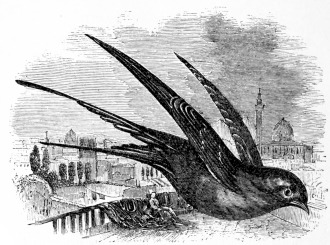
THE SWALLOW. (Hirundo rustica.)
“From the low-roof’d cottage ridge See the chattering Swallow spring; Darting through the one-arch’d bridge, Quick she dips her dappled wing.” Cunningham.
Swallows are easily distinguished from all other birds, not only by their general structure, but by their twittering note and mode of flying, or rather darting from place to place.
They appear in Britain in April, and build in some outhouse, or, in part of a human dwelling, where they lay their eggs and hatch their young. About August they disappear, and do not return till the following spring. Swallows kept in a cage moult about Christmas, and seldom live till spring.
There are several species of the Swallow: the general characters of which are a small beak, but large, wide mouth, for the purpose of swallowing flying insects, their natural food; and long forked tail and extensive wings, to enable them to pursue their prey. The common Swallow builds under the eaves of houses, or in chimneys, near their top; it is frequently called the Chimney Swallow from its preference for the last-mentioned rather singular situation; the Martin also builds under eaves, and most commonly against the upper corner or side of our very windows, and seems not afraid at the sight of man, yet it cannot be tamed, or even kept long in a cage. The nature of the Swallow’s nest is worthy of close observation: how the mud is extracted from the sea-shores, rivers, or other watery places; how masoned and formed into a solid building, strong enough to support a whole family, and to face the “pelting storm,” are wonders which ought to raise our mind to Him who bestowed that instinct upon them.
It is related that a pair of Swallows built their nest for two successive years on the handle of a pair of garden shears, that were stuck up against the boards of an outhouse; and, therefore, must have had their nest spoiled whenever the implement was wanted. And what is still more strange, a bird of the same species built its nest on the wings and body of an owl that happened to hang dead and dry from the rafter of a barn, and so loose as to be moved by every gust of wind. This owl, with the nest on its wings, and with eggs in the nest, was taken to the museum of Sir Ashton Leaver as a curiosity. That gentleman, struck with the singularity of the sight, furnished the person who brought it with a large shell, desiring him to fix it just where the owl had hung. The man did so; and in the following year a pair of Swallows, probably the same, built their nest in the shell and laid eggs.
Modern poets have not been unmindful of the Swallows; and our immortal Shakspeare mentions the Martin, in Macbeth, in the following manner:
“This guest of summer, The temple-haunting Martlet, does approve, By his loved mansionry, that the Heaven’s Breath smells wooingly here. No jutty, frieze, Buttress, nor coigne of ’vantage, but this bird Hath made his pendent bed and procreant cradle: Where they most breed and haunt, I have observed, The air is delicate.”
“The Swallow,” writes Sir Humphry Davy, “is one of my favourite birds, and a rival of the nightingale, for he cheers my sense of seeing as much as the other does my sense of hearing. He is the glad prophet of the year, the harbinger of the best season—he lives a life of enjoyment amongst the liveliest forms of nature—winter is unknown to him; and he leaves the green meadows of England in autumn for the myrrh and orange groves of Italy, and for the palms of Africa; he has always objects of pursuit, and his success is secure. Even the beings selected for his prey are poetical, beautiful, and transient. The ephemeræ are saved by his means from a slow and lingering death in the evening, and killed in a moment when they have known nothing but pleasure. He is the constant destroyer of insects, the friend of man, and may be regarded as a sacred bird. His instinct, which gives him his appointed season, and teaches him when and where to move, may be regarded as flowing from a divine source; and he belongs to the oracles of nature, which speak the awful and intelligible language of a present Deity.”
The Chimney Swallow is, on the head, neck, back, and rump, of a shining black colour, with purple gloss and sometimes with a blue shade; the throat and neck are of the same colour; the breast and belly are white, with a dash of red. The tail is forked, and consists of twelve feathers. The wings are of the same colour with the back. Swallows feed upon flies and other insects; and generally hunt their prey on the wing:
“Away! away! thou summer bird; For Autumn’s moaning voice is heard, In cadence wild, and deepening swell, Of winter’s stern approach to tell.”
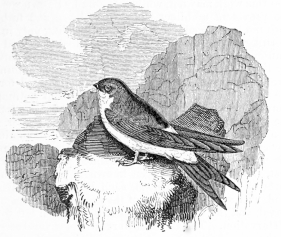
HOUSE MARTIN, OR WINDOW SWALLOW. (Hirundo urbica.)
The Martin is something less than the swallow, with a comparatively large head, and a wide mouth; the colour of the upper parts a bluish black, the rump and all the under parts of the body white, the bill black; the legs covered with short white down.
These birds begin to appear about the middle of April, and for some time pay no attention to the business of nidification, but sport and play about as if to recruit themselves from the fatigue of the journey.
Should the weather prove favourable, it begins to build early in May, placing its nest generally beneath the eaves of a house, often against a perpendicular wall: without any projecting ledge to support any part of the nest, its utmost efforts are necessary to get the first foundation firmly fixed, so as to carry the superstructure safely. On this occasion, it not only clings with its claws, but partly supports itself by strongly inclining its tail against the wall, making that a fulcrum; and thus fixed, it plasters the materials into the face of the brick or stone. But that this work may not, while soft, sink by its own weight, the provident architect has the prudence and forbearance not to proceed too fast; but by building only in the morning, and dedicating the rest of the day to food and amusement, he gives it sufficient time to dry and harden. By this method, in about ten days, the nest is formed, strong, compact, and warm, and perfectly fitted for all the purposes for which it is intended. But nothing is more common than for the house-sparrow, as soon as the shell is finished, to seize on it, eject the owner, and line it according to its own peculiar manner. Sometimes, however, the Martins prove too clever for the sparrow; when the intruder obstinately retained possession of the nest, the Martins have been known to collect from all parts of the neighbourhood, each bringing a pellet of mud, with which the orifice of the nest was soon securely closed, and the unfortunate sparrow was then left to die of starvation. The Martin will return for several seasons to the same nest, where it happens to be well sheltered and secured from the injuries of the weather. They breed the latest of all our swallows, often having unfledged young ones even so late as Michaelmas.
The first hatch consists of five eggs, which are white, inclining to dusky at the thicker end; the second, of three or four; and of a third, of only two or three. While the young birds are confined to the nest the parents feed them, adhering by the claws to the outside; but as soon as they are able to fly they receive their nourishment on the wing, by a quick and almost imperceptible motion.
“Welcome, welcome, feathered stranger, Now the sun bids Nature smile; Safe arrived and free from danger, Welcome to our blooming isle.” Franklin.
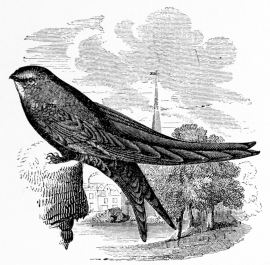
THE SWIFT, (Cypselus apus,)
Which is sometimes called the Black Martin, arrives in England later, and takes its departure earlier than any of our swallows. The Swift is the largest of the swallow tribe, and the most rapid in its flight. Its nest, which is generally built in the crevices of old towers and steeples, is constructed of dried grass, feathers, thread, and similar materials, glued together by a sort of spittle, with which the bird is provided. The bird collects them whilst on the wing, picking them up with great dexterity. They seldom alight upon the ground, and if by accident they fall upon a level surface, they recover themselves with difficulty, owing to the shortness of their legs, and the length of their wings. During the heat of the day they remain within their holes, and at morning and evening sally out in quest of food. They may then be seen in flocks, whirling round some lofty edifice, or describing in mid-air an endless series of circles upon circles. Swifts fly higher, and wheel with bolder wing than the swallows, with whom they never intermingle.
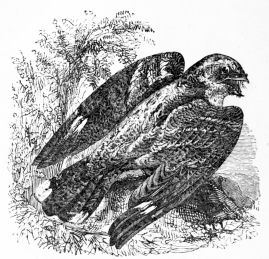
THE GOATSUCKER. (Caprimulgus Europæus.)
This curious bird, called also the Nightjar, and the Fern Owl, comes to this country from Africa about the middle of May and usually leaves by the end of August. These birds are generally found in low bushes, or amongst tufts of large ferns, and generally fly at night: hence their name of Fern Owl. The beak is furnished with bristles, and the middle toe of each foot has a claw toothed like a comb. The female lays her eggs upon the ground, without any nest, and lays only two. The name of Goatsucker originated in an absurd idea that this bird sucked the goat’s milk, from its habit of lying on the ground near cows or she goats, and catching the flies that torment them by fixing on their udders. Mr. Waterton, who is certainly the closest observer of nature who ever wrote on Natural History, states, in one of his very interesting works, that he has frequently seen the Goatsuckers catching insects in this manner, and thus proving themselves the best of friends to the animals they are accused of annoying.
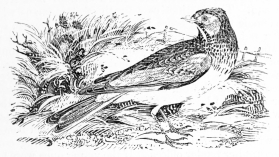
THE SKYLARK. (Alauda arvensis.)
“Go, tuneful bird, that gladd’st the skies, To Daphne’s window speed thy way; And there on quivering pinions rise, And there thy vocal art display.” Shenstone.
The Skylark is distinguished from most other birds by the long spur on the back toe, the earthy colour of his feathers, and by singing as he mounts in the air. These birds generally make their nest in meadows among the high grass, and the tint of their plumage resembles so much that of the ground, that the body of the bird is hardly distinguishable as it runs along.
“The daisied lea he loves, where tufts of grass Luxuriant crown the ridge: there, with his mate, He founds their lonely house, of withered herbs, And coarsest spear-grass; next the inner work, With finer, and still finer fibres lays, Rounding it curious with his speckled breast.” Grahame.
Larks breed twice a year, in May and July, rearing their young in a short space of time. They are caught in great quantities in winter, and are considered choice and delicate food. It is a melancholy observation, that man should feed upon, and indulge his sense of taste with those very birds which have so often delighted his sense of hearing with their songs, when they usher to the gladdened creation the return of their best friend, the sun. The instinctive warmth of attachment which the female Skylark bears towards her own species, even when not her nestling, is remarkable. “In the month of May,” says Buffon, “a young hen bird was brought to me, which was not able to feed without assistance. I caused her to be reared; and she was hardly fledged, when I received from another place a nest of three or four unfledged larks. She took a strong liking to these newcomers, which were but little younger than herself; she tended them night and day, cherished them beneath her wings, and fed them with her bill. Nothing could interrupt her tender offices. If the young ones were torn from her she flew to them as soon as they were liberated, and would not think of effecting her own escape, which she might have done a hundred times. Her affection grew upon her; she neglected food and drink; she at length required the same support as her adopted offspring, and expired at last, consumed with maternal solicitude. None of the young ones long survived her. They died one after another; so essential were her cares, which were equally tender and judicious.”
The Lark mounts almost perpendicularly, and by successive springs, into the air, where it hovers at a vast height. Its descent is in an oblique direction, unless threatened by some ravenous bird of prey, or attracted by its mate, when it drops to the ground like a stone. On its first leaving the earth, its notes are feeble and interrupted; but, as it rises, they gradually swell to their full tone. As the Lark’s flight is always at sun-rise, there is something in the scenery that renders its song peculiarly delightful: the opening morning, the landscape just gilded by the rays of the returning sun, and the beauty of the surrounding objects, all contribute to heighten our relish for its pleasing melody.
“—— Up springs the Lark, Shrill-voiced and loud, the messenger of morn, Ere yet the shadows fly, he, mounted, sings Amid the dawning clouds, and from their haunts Calls up the tuneful nations.” Thomson. “Alas! it’s no thy neebor sweet, The bonnie Lark, companion meet! Bending thee ’mang the dewy weet! Wi’ speckled breast, When upward springing, blythe to greet The purpling east.” Burns.
“Early, cheerful, mounting Lark, Light’s gentle usher, morning’s clerk, In merry notes delighting.” Sir John Davis.
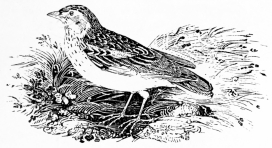
THE WOODLARK. (Alauda arborea.)
This species is smaller than the skylark, and its voice deeper; it has also a circle of white feathers encompassing the head, from eye to eye, like a crown or wreath, and the utmost feather of the wing is much shorter than the second, whereas in the common lark they are nearly equal. This bird sometimes emulates the nightingale; for which, when pouring forth his sweet melody in the grove, during a silent night, he is often mistaken. These birds sit and perch upon trees, unlike the common lark, which always keeps to the ground. They build their nest at the foot of a bush, near the bottom of a hedge, or in high dry grass. The number of their eggs is about four, of a pale bloom colour, beautifully mottled, and clouded with red and yellow. Like the skylark, they assemble in large flocks during frosty weather. Their usual food consists of small beetles, caterpillars, and other insects, as well as the seeds of numerous kinds of wild plants.
“Bright o’er the green hills rose the morning ray, The Woodlark’s song resounded on the plain, Fair nature felt the warm embrace of day, And smiled through all her animated reign.” Langbourn.
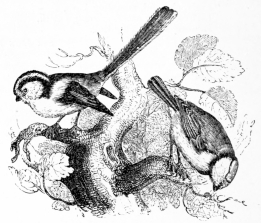
THE TITMOUSE, OR TOM-TIT. (Parus cæruleus.) THE LONG-TAILED TIT. (Parus caudatus.)
The common Titmouse or Tom-tit is a very small bird, only four inches and a half in length. He has a blue head, with white cheeks and a white stripe over each eye; his back is greenish, his wings and tail blue, and the lower surface of his body yellow. This bird, and all the species related to it, live on insects, as well as on seeds. When kept in a cage, it is really amusing to see with what quickness the Titmouse darts at any fly or moth which comes imprudently within its reach. If this kind of food be deficient, as generally happens in winter, it feeds upon several kinds of seed, and particularly that of the sunflower, which it dexterously holds upright between its claws and strikes powerfully with its sharp little bill, till the black covering splits, and yields its white contents to the persevering bird. Its general food consists of insects, which it seeks in the crevices of the bark of trees, and when thus engaged, clinging in every possible position to the branches, it looks like a very diminutive blue parrot. In winter the Titmouse visits our gardens and orchards, where he is often seen picking the buds of fruit trees to pieces; but in doing this he inflicts little or no injury upon the gardener, his object being the capture of insects which would probably cause far more mischief in the ensuing summer. The nest of the Titmouse is built in the hole of a tree or wall; the female lays usually eight or ten eggs, and when sitting defends her nest with great courage, pecking at the fingers of boys so vigorously that in some parts of the country she is known by the name of Billy Biter. The Long-tailed Tit is also a common bird about hedges, orchards, and plantations. He is an active lively little fellow, and resembles the common Tit in his habits.
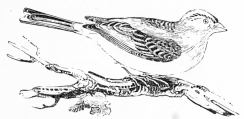
THE YELLOWHAMMER, OR YELLOW BUNTING. (Emberiza citrinella.)
This bird is somewhat larger than the sparrow. Its head is of a greenish yellow, spotted with brown; the throat and belly are yellow; the breast and sides, under the wings, mingled with red. These birds build their nests on the ground, near some bush, where the female lays five or six eggs. The Yellowhammer may be sometimes seen perched on the finger of some poor man or woman in the streets of London, in a state of complete tameness; but this is the transitory effect of intoxication, and soon after the bird is bought and brought home, it dies, overcome by the power of the laudanum that has been given it.
This bird feeds on seeds and various sorts of insects, and is common in every lane, on every hedge, throughout the country, flitting before the traveller, and about the bushes. Happily for him, we have not yet acquired the taste of the natives of Italy, where the Yellowhammer falls a daily victim to the delicacy of the table, and where its flesh is esteemed very delicious eating. There he is often fattened, for the purpose of gratifying the palate of epicures.
The Ortolan, (Emberiza hortulana,) which is another species of the same genus, is common in the central and southern provinces of Europe, where it is thought exquisitely flavoured as an article of food. When first taken it is frequently very lean, but if supplied with abundance of food, it is said to be so greedy, that it will eat till it dies of repletion.
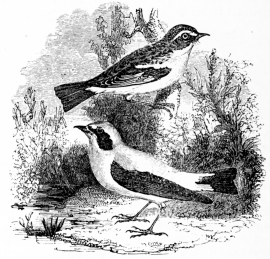
THE WHEATEAR, AND WHIN CHAT. (Saxicola ænanthe and S. rubetra.)
The Wheatear is one of our earliest visitants, and may be found in every part of Britain. In the North, it generally frequents heaps of stones, ruins, or the dry stone walls of burial-grounds, and though it is a very handsome bird, and in the early season sings sweetly, its haunts have obtained it a bad name. The common alarm-note resembles the sound made in breaking stones with a hammer, and as it utters that note from the top of the heap which haply covers the bones of one who perished by the storm, or his own hand, popular fancy has not unnaturally associated the Wheatear with the superstition that belongs to the place of graves. Beneath that heap of stones, or in some neighbouring fallow, its nest may be discovered, formed of moss and dried grass, lined with hair, feathers, or wool, and containing five or six eggs of a delicate bluish white. These birds congregate on the southern downs about the middle of July; they are then caught in vast numbers, in horse-hair nooses, which are set between two pieces of turf turned against each other.
The Whin Chat is a beautiful bird, compact in form, with a rich and elegant plumage. Its song, which is peculiarly soft and sweet, may be heard in spring on the bushy margins and gorse of extensive heaths. Its nest, constructed in thick tufts of grass and under bushes, is most carefully concealed. It is usually approached by a labyrinth to which the rising of the bird affords no clue, and it may long be sought in vain, though perhaps not more than a yard distant all the time. The eggs are bluish green, without any spots, and are never more than six in number.
The following lines, addressed to the English Ortolan, or Wheatear, by Mrs. Charlotte Smith, allude to the foolish timidity of that bird:
“To take you, shepherd boys prepare The hollow turf, the wiry snare, Of those weak terrors well aware, That bid you vainly dread The shadows floating over downs, Or murmuring gale, that round the stones Of some old beacon, as it moans, Scarce moves a thistle’s head. And if a cloud obscure the sun, With faint and fluttering heart you run Into the pitfall you should shun, And only leave when dead.”
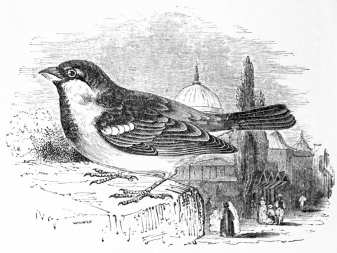
THE SPARROW. (Passer domesticus.)
This bird is, next to the robin redbreast, the boldest of the small feathered tribe which frequent our barns and houses: he is a courageous little creature, and fights undauntedly against birds ten times bigger than himself. Sparrows are accused of destroying a great quantity of corn, and in several counties the landlord or farmer puts a price on a Sparrow’s head; but the farmer is the person most injured by the plan, as the good Sparrows, in ridding land of caterpillars, more than compensate for the loss of grain they destroy. Mr. Bradley, in his Treatise on Husbandry and Gardening, shows, by a calculation, that a pair of Sparrows, during the time they have their young ones to feed, destroy on an average, every week, three thousand three hundred and sixty caterpillars.
This bird is easily tamed, and will hop about the house, and on the table with great familiarity. It will feed on anything, and is particularly fond of meat cut into small pieces. The song of the Sparrow, if we can so call its chirping, is far from agreeable: this arises, however, not from want of powers, but from its attending solely to the note of the parent bird. A Sparrow, when fledged, was taken from the nest and educated under a linnet: it also heard by accident a goldfinch; and its song was in consequence a mixture of the two. The male is particularly distinguished by a jet-black spot under the bill upon a whitish ground. Sparrows are found nearly in every country of the world.
THE LINNET, (Fringilla linota or Linota cannabina.)
Is about the size of the goldfinch; and compensates, by an extremely melodious voice, the want of variety in its plumage, which, except in the red-breasted species, is nearly all of one colour. Its musical talents are, like those of many other birds, repaid with captivity; for it is kept in cages on account of its singing.
The Redpole (Fringilla linaria) is a small species of Linnet, little more than four inches in length, distinguished by a deep blood-red spot on the crown of his head. He visits Britain in the autumn and stays with us during the winter, his favourite summer residence being far away in the north. Redpoles are taken in great numbers by the bird-catchers in the autumn. Their only song is a twittering note, but they are often attached by a brace and chain to an open cage and trained to draw their water in a bucket.
The Green Linnet is rather larger than the house sparrow. Its head and back are of a yellowish-green, the edges of the feathers grayish; the rump and breast more yellow. The plumage of the female is much less vivid, inclining to brown. Its song is trifling, but in confinement it becomes tame and docile, and will catch the notes of other birds.
THE CANARY-BIRD. (Fringilla, or Carduelis canaria.)
As his name imports, this bird is a native of the Canary Islands; where, in his wild state, he has a dusky gray plumage, and a much stronger voice than when in a cage. In our northern countries his feathers undergo a great alteration; and the bird often becomes entirely white or yellow. Of this bird, Buffon says, “that if the nightingale is the chantress of the woods, the Canary is the musician of the chamber; the first owes all to nature, the second something to art. With less strength of organ, less compass of voice, and less variety of note, the Canary has a better ear, greater facility of imitation, and a more retentive memory; and as the difference of genius, especially among the lower animals, depends in a great measure on the perfection of their senses, the Canary, whose organ of hearing is more susceptible of receiving and retaining foreign impressions, becomes more social, tame, and familiar; is capable of gratitude and even attachment; its caresses are endearing, its little humours innocent, and its anger neither hurts nor offends. Its education is easy; we rear it with pleasure, because we are able to instruct it. It leaves the melody of its own natural note, to listen to the melody of our voices and instruments. It accompanies us, and repays the pleasure it receives with interest, while the nightingale, more proud of his talent, seems desirous of preserving it in all its purity, at least it appears to attach very little value to ours, and it is with great difficulty that it can be taught any of our airs. It despises them, and never fails to return to its own wild wood notes. Its pipe is a masterpiece of nature, which human art can neither alter nor improve; while that of the Canary is a model of more pliant materials, which we can mould at pleasure; and therefore it contributes in a much greater degree to the pleasures of society. It sings at all seasons, cheers us in the dullest weather, and adds to our happiness, by amusing the young and delighting the recluse, charming the tediousness of the cloister, and gladdening the soul of the innocent and captive.” It breeds generally twice a year when domesticated; and it sometimes happens that the female lays her eggs for the second time before the first brood is fledged. The male then good-naturedly takes her place on the eggs while she feeds the young ones, and feeds them in his turn, when she sits in the nest. They are very easily tamed, when brought up with attention and kindness, and take their food out of the hand, often perching on the shoulder of their mistress, and feeding out of her mouth. The Canary-bird is sometimes, and with success, matched with the linnet or the goldfinch; and the produce is a beautiful bird, partaking of the talents and plumage of both.