BOOK II. INHABITANTS OF THE AIR. (continued 3)
Reading edition
“If the Partridge had the woodcock’s thigh, ’Twould be the best bird that e’er did fly.”

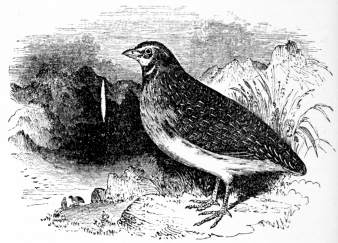
THE QUAIL, (Coturnix dactylisonans,)
Is a small bird, being in length no more than seven inches. The colour of the breast is a dirty pale yellow, and the throat has a little mixture of red: the head is black, and the body and wings have black stripes upon a hazel-coloured ground. Its habits and manner of living resemble those of the partridge, and it is either caught in nets by decoy birds, or shot by the help of the setting-dog, its call being easily imitated by tapping two pieces of copper one against another. The flesh of the Quail is very luscious, and next in flavour to that of the partridge. Quails are birds of passage, the only peculiarity in which they differ from all other of the poultry kind; and such prodigious numbers have sometimes appeared on the western coast of the kingdom of Naples, that one hundred thousand have been caught in one day, within the space of three or four miles. In some parts of the south of Russia they abound so greatly, that at the time of their migration they are caught by thousands, and sent in casks to Moscow and St. Petersburg. The female seldom lays more than six or seven eggs.
The ancient Athenians kept this bird merely for the sport of fighting with each other, as game-cocks do, and never ate the flesh. The Quail was that wild fowl which God thought proper to send to the chosen people of Israel as a sustenance for them in the desert.
The Chinese Quail is a beautiful little bird, and is often kept in cages in China, for the singular purpose, as it is said, of warming people’s hands in winter; as taking the soft, warm body of the bird in the hand diffuses through it an agreeable warmth. It is also very pugnacious, and is employed in fighting.
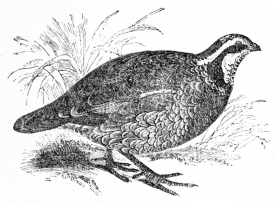
THE AMERICAN QUAIL, (Ortyx Virginianus,)
Is larger than the Common Quail, and is something between a Quail and a Partridge.
The Californian Quail (O. Californicus) is distinguished by its possession of a curious crest or tuft of feathers on the crown of the head.
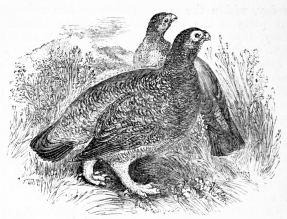
THE RED GROUSE. (Lagopus scoticus.)
“High on exulting wing the Heath-Cook rose, And blew his shrill blast o’er perennial snows.” Rogers.
This bird is called by some ornithologists the Moor Cock, and by others Red Game. The beak is black and short; over the eyes there is a bare skin of a bright red. The general colour of the plumage is red and black, variegated, and intermixed with each other, except the wings, which are brownish, spotted with red, and the tail, which is black; the feet are covered with thick feathers down to the very claws. It is common in the north of England, in Scotland, and in Wales; and not only affords great diversion to the noblemen and gentlemen of those countries who are fond of shooting, but also repays them well for their trouble, as the flesh is very delicate, and holds on our table an equal place with that of the partridge and the pheasant. The season of Grouse shooting commences on the 12th of August. In winter they are found in flocks of sometimes fifty to one hundred in number, which are termed by sportsmen packs, and become remarkably shy and wild, seldom allowing the sportsman to approach them within one hundred yards. They keep near the summits of the heathy hills, and seldom descend to the lower grounds. Here they feed on the mountain berries and on the tender tops of the heath. The hen lays seven or eight eggs of a reddish black colour.
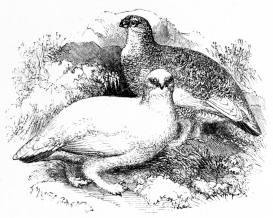
THE PTARMIGAN, OR WHITE GROUSE, (Lagopus vulgaris,)
Is somewhat larger than a pigeon; its bill is black, and its plumage in summer is of a pale brown colour, elegantly mottled with small bars and dusky spots. The head and neck are marked with broad bars of black, rust-colour, and white; the wings and belly are white. The White Grouse is fond of lofty situations, where it braves the severest cold. It is found in most of the northern parts of Europe and America, even as far as Greenland. In this country it is only to be met with on the summits of some of our highest hills, chiefly in Scotland, and in the Hebrides and Orkneys, but sometimes in Cumberland and Wales. Its plumage becomes pure white in winter, with the exception of the tail feathers, which remain black.
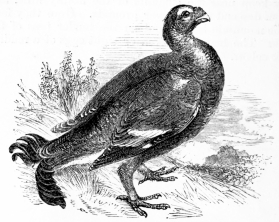
THE BLACK COCK, (Tetrao tetrix,)
Is about four pounds in weight; but the female, which is usually called the Grey Hen, is often not more than two. The plumage of the whole body of the male is black, and glossed over the neck and rump with shining blue; the coverts of the wings are of a dusky brown, with the quill feathers black and white. The tail is much forked in the male. These birds never pair; but in the spring the males assemble at their accustomed haunts on the tops of heathy mountains, where they crow and clap their wings:
“And from the pine’s high top brought down The giant Grouse, while boastful he display’d His breast of varying green, and crow’d and clapp’d His glossy wings.” Gisborne.
The females, at this signal, resort to them. The males are very quarrelsome, and fight together like game-cocks. On these occasions they are so inattentive to their own safety, that two or three have sometimes been killed at one shot; and instances have occurred of their having been knocked down with a stick.
Like the Capercalzie, or Cock of the Woods, a larger species of this genus, these birds are common in Russia, Siberia, and other northern countries, chiefly in wooded and mountainous situations; and in the northern parts of our own island on uncultivated moors.
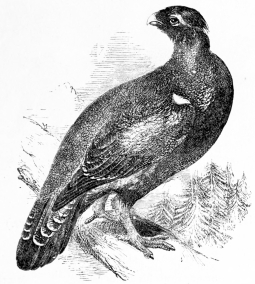
THE CAPERCALZIE, (Tetrao urogallus,)
Was also formerly an inhabitant of the forests of Scotland, but has been extinct in Britain for many years. The male is as large as a good-sized turkey, the female considerably smaller. Several attempts have been made to rear the Capercalzie, and domesticate it in this country, but without effect. They are now most numerous in Sweden, where they are much esteemed as food. Of late years they have been brought to the English market, and are considered very good eating.
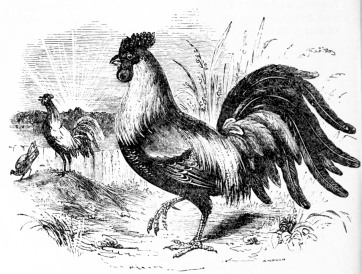
THE COMMON COCK. (Gallus domesticus.)
“While the Cock, with lively din, Scatters the rear of darkness thin; And to the stack, or the barn door, Stoutly struts his dames before.” Milton.
This bird is so well known that it would be needless to say much of him. His plumage is various and beautiful, his courage very great and proverbial, and his intuitive knowledge of the period of sunrise has baffled the most scrutinising researches of naturalists. When of a good breed, and well taught to fight, he will die rather than yield to his adversary. The hen lays a great number of eggs, and will hatch as many as thirteen at one sitting; but this is considered the extreme number, being as many as she can well cover. When in the secluded state of incubation she eats very little; and yet is so courageous and strong that she will rise and fight any men or animals that dare to approach her nest. It is impossible to conceive how, with such a scanty sustenance as she takes, she can, for twenty-one days, emit constantly from her body as much heat as would raise Fahrenheit’s thermometer to ninety-six degrees. The flesh of this bird is delicate and wholesome, and universally relished as nourishing and agreeable food.
There are several varieties of families of this fowl. The Hamburg Cock has a beautiful tuft of feathers about his ears and on the top of his head; and the Bantam has his legs and toes entirely feathered, which is more an impediment than an ornament to the bird.
The cruel sport of cockfighting may be traced back to the earliest antiquity. The Athenians seem to have received it from India, where it is even now followed with a kind of frenzy; and we are told that the Chinese will sometimes risk not only the whole of their property, but their wives and children, on the issue of a battle. The religion of the Greeks could not see that game with pleasure, and therefore cockfighting was allowed only once a year; but the Romans adopted the practice with rapture, and introduced it into this island. Henry VIII. delighted in this sport, and caused a commodious house to be built for the purpose, which, although now applied to a very different use, still retains the name of the Cockpit. The part of our ships so called, seems also to indicate that in former times the diversion of cockfighting was permitted, in order to beguile the tedious hours of a long voyage. The Cock has been a subject of considerable interest with the poets; and has been very commonly called by them “Chanticleer:”
“Within this homestead lived, without a peer For crowing loud, the noble Chanticleer.” Dryden.
“The feathered songster, Chanticleer, Had wound his bugle-horn, And told the early villager The coming of the morn.” Chatterton.
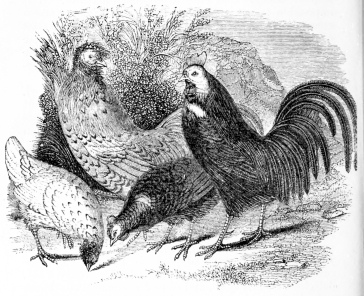
BANKIVA COCK.—JAGO COCK AND HEN.—SPANISH COCK AND HEN.
From the Bankiva fowl nearly all the various kinds of fowls found in British poultry-yards are said to have sprung. It is a native of the island of Java, and is characterised by a red indented comb, red wattles, and ash-grey legs and feet. The cock has a thin indented or scalloped comb, and wattles under the mouth. The feathers of the neck are long, falling down, and rounded at the tips, and are of the finest gold colour. The head and neck are fawn-coloured, the wing-coverts dusky brownish and black; the tail and belly black. The hen is of a dusky ash-grey and yellowish colour, and has a much smaller comb and beard than the cock.
THE PADUAN, OR JAGO FOWL. (Gallus giganteus.)
The wild species, termed by Marsden the Jago fowl, is a native of Java and Sumatra, and is supposed by Temminck to be the original of this fine breed, though little is known of the wild sort, further than that it is double the size of the Bankiva, or common fowl. Marsden says he has seen in the East a cock of this species tall enough to pick crumbs from a dining-table. They are said to weigh from eight to ten pounds. The combs of both the cock and hen are large, frequently double, of the form of a crown, with a tufted crest of feathers, which is largest in the hen; the voice is stronger and harsher than that of other fowls; but the most singular peculiarity is, that they do not come into full feather till about half grown. The Cochin-China fowls are said to be a variety of the Jago fowls. There are numerous hybrids and varieties of the Jago fowl found under different names in poultry-yards, but all of them lay fine large eggs, and are highly esteemed for the excellent flavour of their flesh. One of the most interesting of these varieties is called
THE SPANISH FOWL,
the body and tail feathers of which are of a rich black, with occasionally a little white on the breast. The cock of this variety is a most majestic bird; its deportment is grave and stately, and its eyes are encircled with a ring of brown feathers, from which rises a black tuft that covers the ears. There are other similar feathers behind the comb and beneath the wattles. The legs and feet are of lead colour, except the sole of the foot, which is yellowish.
THE BANTAM FOWL
is a small variety, with short legs, most frequently feathered to the toes, so as sometimes to obstruct walking. Many Bantam fanciers prefer those which have clear bright legs, without any vestige of feathers. The full-bred Bantam cock should have a rose comb, a well-feathered tail, full hackles, a proud lively carriage, and ought not to weigh more than a pound. The nankeen coloured and the black are the greatest favourites. If of the latter colour, the bird should have no feathers of any other sort in his plumage. The nankeen bird should have his feathers edged with black, his wings barred with purple, his tail feathers black, his hackles slightly studded with purple, and his breast black, with white edges to the feathers. The hens should be small, clean-legged, and match in plumage with the cock.
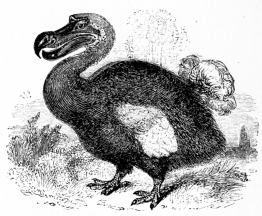
THE DODO. (Didus ineptus.)
Swiftness has generally been considered the attribute of birds, but the Dodo appears never to have had any title to this distinction. Instead of exciting the idea of swiftness by its appearance, in the drawings that have been preserved of it, it strikes the imagination as a thing the most unwieldy and inactive of all nature. Its body is massive, almost round, and covered with grey feathers. It is just barely supported upon two short thick legs, like pillars; while its head and neck rise from it in a manner truly grotesque. The neck, thick and pursy, is joined to the head, which consists of two immense jaws, opening far beyond the eye. The Dodo formerly inhabited the Isle of France; but it has been long extinct—so long, indeed, that the very fact of its ever having existed at all has been a subject of dispute amongst naturalists and scientific men. A great deal of evidence, in the form of old pictures as well as in writings, has been brought forward to prove that the Dodo is not a fabulous bird, and its reality is now generally admitted. In fact, we have very reliable testimony that a single specimen was actually exhibited publicly in London in the year 1638.
The Dodo was supposed by the earliest naturalists who described it, to be a kind of turkey, as in the flavour of its flesh it resembled that bird. Later naturalists supposed it to be a kind of swan, and this opinion was followed by the celebrated Buffon. Others thought it was a kind of vulture; and others, judging from the shortness of its wings, placed it in the ostrich tribe. Modern naturalists, however, having carefully examined the bones of the bird, which have been preserved, are of opinion that it was a gigantic pigeon. An entire specimen existed about a hundred years ago in the Ashmolean Museum at Oxford, but only part of the bird and one of the feet remain; there is also a foot preserved in the British Museum. There is a reference to this extinct species in Humboldt’s Cosmos. (See Bohn’s edition, vol. i. page 29, and a note on the Dodo, by Dr. Mantell, at the end of the volume.)
The Solitaire is another remarkable bird which was formerly found in the Mauritius and the adjoining islands, but which has now become extinct.
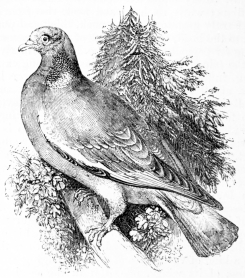
THE RINGDOVE, CUSHAT, OR WOOD PIGEON, (Columba palumbus,)
Is the largest Pigeon found in our island, by which it may be distinguished from all others; its weight is about twenty ounces, its length eighteen inches, and its circumference about thirty. It is usually known as the Wood Pigeon. This bird is of a bluish grey colour, with the feathers of the sides of the neck tipped with white, forming several imperfect rings; the breed is common in Britain. Its habits are like those of other birds of the tribe, but it is so strongly attached to its native freedom, that all attempts to domesticate it, with a few rare exceptions, have hitherto proved ineffectual.
These birds build their nests chiefly on the pine, or holly, with dried sticks thrown rudely together; and the eggs, which may frequently be seen through the bottom of the nest, are larger than those of the domestic Pigeon.
Mr. Montague bred up a curious assemblage of birds, which lived together in perfect amity; it consisted of a common pigeon, a ringdove, a white owl, and a sparrowhawk; the ringdove was master of the whole.
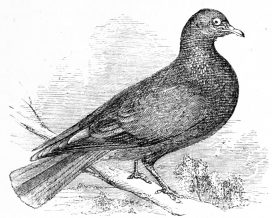
THE STOCKDOVE. (Columba ænas.)
“The Stockdove, recluse, with her mate, Conceals her fond bliss in the grove, And murmuring seems to repeat, That May is the mother of love.” Cunningham.
This bird is called the Stockdove, because it builds in the stocks of trees which have been headed down, and are become thick and bristly; and not, as some have supposed, because it is the stock, or original, from which all the tame pigeons have sprung. Sometimes these birds lay their eggs in deserted rabbit-warrens, on the sod, without making any nest.
The colour of the Stockdove is generally of a deep slate or lead tint, with rings of black about the feathers. While the beech woods were suffered to cover large tracts of ground, these birds used to haunt them in myriads, frequently extending above a mile in length, as they went out in the morning to feed. They are still found in considerable quantities in many parts of England, but never in Scotland, forming their nests in the hollows of trees; not like the ringdove, on boughs. Their murmuring strains, or cooings, in the morning and at dusk, are highly pleasing, and throw an agreeable melancholy on the solitude of the grove. The poet of the Seasons expresses this in the following lines, with a beautiful instance of imitative harmony:
“—— the Stockdove breathes A melancholy murmur through the whole.” Spring.
Wordsworth also gives a pleasing description of the mournful cooing of these birds:
“I heard a Stockdove sing or say His homely tale this very day; His voice was buried among trees, Yet to be come at by the breeze; He did not cease; but cooed and cooed; And somewhat pensively he wooed; He sang of love with quiet blending, Slow to begin, and never ending; Of serious faith and inward glee, That was the song—the song for me.”
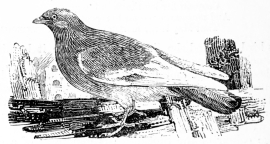
THE ROCKDOVE. (Columba livia.)
The shape of this bird, which is the original stock of our domestic Pigeons, is well known, and the plumage of the wild birds is exactly similar to that of the commonest kind seen in our dove-cots—bluish-grey, with black bands across the wings. In its wild state it inhabits the cavities of high rocks and cliffs on the sea coast, where it is found abundantly in our own country. The female Pigeon lays two eggs at a time, which produce generally a male and a female. It is pleasing to see how eager the male is to sit upon the eggs, in order that his mate may rest and feed herself. The young ones, when hatched, are fed from the crop of the mother, who has the power of forcing up the half-digested peas which she has swallowed to give them to her young. The young ones, open-mouthed, receive this tribute of affection, and are thus fed three times a day.
There are upwards of twenty varieties of the domestic Pigeon, and of these the carriers are the most celebrated. They obtain their name from being sometimes employed to convey letters or small packets from one place to another. The rapidity of their flight is very wonderful. Lithgow assures us that one of them will carry a letter from Babylon to Aleppo (which, to a man, is usually thirty days’ journey) in forty-eight hours. To measure their speed with some degree of exactness, a gentleman, many years ago, on a trifling wager, sent a Carrier Pigeon from London, by the coach, to a friend at Bury St. Edmunds, and along with it a note, desiring that the Pigeon, two days after its arrival there, might be thrown up precisely when the town clock struck nine in the morning. This was accordingly done, and the Pigeon arrived in London at half-past eleven o’clock on the same morning, having flown seventy-two miles in two hours and a half. An instance of still greater speed is mentioned by Mr. Yarrell, in which a Carrier flew from Rouen to Ghent, a hundred and fifty miles in a straight line, in one hour and a half. From the instant of its liberation, its flight is directed through the clouds, at a great height, to its home. By an instinct altogether inconceivable, it darts onward, in a straight line, to the very spot whence it was taken, but how it can direct its flight so exactly will probably for ever remain unknown to us.
“Led by what chart, transports the timid Dove, The wreaths of conquest, or the vows of love? Say through the clouds what compass points her flight? Monarchs have gazed, and nations blessed the sight. Pile rocks on rocks, bid woods and mountains rise, Eclipse her native shades, her native skies:— ’Tis vain! through ether’s pathless wilds she goes, And lights at last where all her cares repose. Sweet bird, thy truth shall Harlem’s walls attest, And unborn ages consecrate thy nest.” Rogers.
The Carrier Pigeon is easily distinguished from the other varieties by a broad circle of naked white skin round the eyes, by the large fleshy wattle at the base of its bill, and by its dark blue or blackish colour.
It would be as fruitless as unnecessary to attempt to describe all the varieties of the Tame Pigeon; for human art has so much altered the colour and figure of this bird, that pigeon-fanciers, by pairing a male and female of different sorts, can, as they express it, “breed them to a feather.” Hence we have the various names of Carriers, Tumblers, Jacobins, Croppers, Pouters, Bunts, Turbits, Shakers, Fantails, Owls, Nuns, &c., all of which may, at first, have accidentally varied from the Rockdove, and these have been further improved by crossing, food, and climate. An actual post system, in which pigeons were the messengers, was established by the Sultan Noureddin Mahmoud, which lasted about a century, and ceased in 1258, when Bagdad fell into the hands of the Moguls.
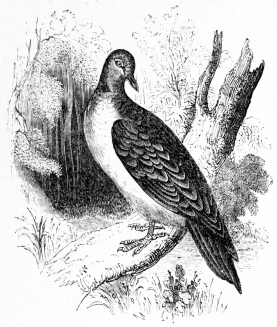
THE TURTLE DOVE. (Columba turtur.)
“Go, beautiful and gentle Dove, And greet the morning ray; For lo! the sun shines bright above, And the rain is pass’d away.” Bowles.
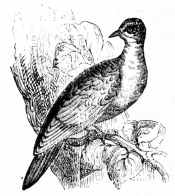
This Dove brings to the heart and mind the most pleasing recollections; its name is nearly synonymous with faithfulness and unvariable affection. The male or female is so much attached to its respective mate that it is said, perhaps with more poetry than truth, that if one die the other will never survive; however, the author of these observations was an eye-witness to the death of a female Turtle Dove, who was unfortunately killed by a spaniel, in the absence of the male; the disconsolate survivor, after having in vain searched everywhere for his mate, came and mournfully perched upon the wonted trough, waiting patiently for her to repair thither in order to get food; but, after two days of unavailing expectation, he, by spontaneous abstinence, pined and died on the place. Such examples are not common; and we believe that, when not domesticated, the appearance of another female, in the time of coupling, sets at defiance all natural propensity to constancy, and puts an end to the much-famed disconsolate widowhood. Their general colour is a bluish grey; the breast and neck of a whitish purple, with a ringlet of beautiful white feathers with black edges about the sides of the neck. Nothing can express the sensation which is excited in a feeling mind when the tender and sweetly plaintive notes of the Turtle Dove breathe from the grove on a beautiful spring evening:
“Deep in the wood, thy voice I list, and love Thy soft complaining song, thy tender cooing; Oh, what a winning way thou hast of wooing, Gentlest of all thy race—sweet Turtle Dove! Thine is a note which doth not pass away Like the light music of a summer’s day; Hushing the voice of mirth, and staying folly, And waking in the breast a gentle melancholy.” Inglis.
§ VI. Grallatores, or Waders.
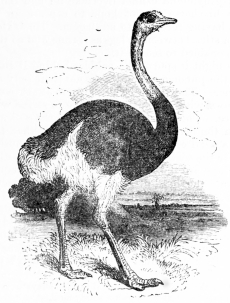
THE OSTRICH. (Struthio camelus.)
This bird is a native of Africa, and is so tall that when it holds up its head it is seven or eight feet in height. The head is very small in comparison with the body, being hardly bigger than one of the toes, and is covered, as well as the neck, with a kind of down, or thin-set hair, instead of feathers. The sides and thighs are entirely bare and flesh-coloured. The lower part of the neck, where the feathers begin, is white. The wings are very short in proportion to the size of the bird, and in fact are too small to enable it to fly; but when it runs, which it does with a strange jumping kind of motion, it raises its short wings and holds them quivering over its back, where they seem to serve as a kind of sail to gather the wind, and carry the bird onwards. The speed which it will thus attain is enormous. The swiftest greyhound cannot overtake it; and indeed an Arab on his horse cannot hope to capture an ostrich without having recourse to stratagem. He dexterously throws a stick between its legs as it runs, and so tripping it up, is enabled to secure it.
In its flight it spurns the pebbles behind it like shot against the pursuer. And this is not their only mode of annoyance. They have been known to attack men with their claws, with which they are able to strike with terrific force. The feathers of the back in the cock are coal black, in the hen only dusky, and so soft that they resemble a kind of wool. The tail is thick, bushy, and round; in the cock whitish, in the hen dusky, with white tops. These are the feathers so generally in requisition to decorate the head-dress of ladies and the helmets of warriors.
The Ostrich swallows anything that presents itself, leather, glass, iron, bread, hair, &c., but the old notion that the Ostrich could digest metals is certainly incorrect. An Ostrich in the Zoological Gardens in the Regent’s Park was killed by swallowing a lady’s parasol.
“O’er the wild waste the stupid Ostrich strays In devious search, to pick a scanty meal, Whose fierce digestion gnaws the temper’d steel.” Mickle’s Lusiad.
They are polygamous birds, one male being generally seen with two or three, and sometimes with five, females. The female Ostrich, after depositing her eggs in the sand, trusts them to be hatched by the heat of the climate; in the Book of Job there is a beautiful passage relating to this habit of the Ostrich, “which leaveth her eggs in the earth, and warmeth them in the dust; and forgetteth that the foot may crush them, or that the wild beast may break them. She is hardened against her young ones, as though they were not hers. Her labour is in vain; without fear, because God hath deprived her of wisdom; neither has he imparted to her understanding. What time she lifteth up her head on high, she scorneth the horse and his rider.” It appears, however, that the female Ostrich sits upon her eggs like other birds, although generally at night only, and brings up her young. The eggs are as large as a young child’s head, with a hard stony shell, and one has been known to weigh upwards of three pounds. The time of incubation is six weeks. That Ostriches have great affection for their offspring may be inferred from the assertion of Professor Thunberg, who says that he once rode past the place where a hen Ostrich was sitting in her nest, when the bird sprang up and pursued him, evidently with a view to prevent his noticing her eggs or young. Every time he turned his horse towards her she retreated ten or twelve paces, but as soon as he rode on again she pursued him till he had got to a considerable distance from the place where he had started her. In the tropical regions, some persons breed Ostriches in flocks, for they may be tamed with very little trouble. When M. Adanson was at Podar, a French factory on the southern bank of the river Niger, two young but full-grown Ostriches, belonging to the factory, afforded him a very amusing sight. They were so tame that two little blacks mounted both together on the back of the largest. No sooner did he feel their weight than he began to run as fast as possible, and carried them several times round the village, and it was impossible to stop him otherwise than by obstructing the passage. This sight pleased M. Adanson so much that he wished it to be repeated, and, to try their strength, directed a full-grown negro to mount the smaller, and two others the larger of the birds. This burden did not seem at all disproportioned to their strength. At first they went at a tolerably sharp trot, but when they became a little heated they expanded their wings, as though to catch the wind, and moved with such fleetness that they scarcely seemed to touch the ground. The foot of the Ostrich has only two toes, one of which is extremely large and strong.
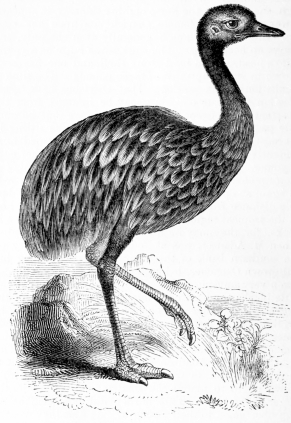
THE RHEA, (Rhea Americana,)
Or American Ostrich, is about half as big as the African species. It has its head covered with feathers, and each of its feet consists of three toes. It is found on the great plains of South America, and, like the African Ostrich, is polygamous, but the curious part of the matter is that the females often lay their eggs almost anywhere on the ground, and the male takes the trouble of collecting them into a sort of nest, and sitting on them until the young birds are hatched. When thus occupied, the males often become very fierce, and will attack any one that approaches them too closely.
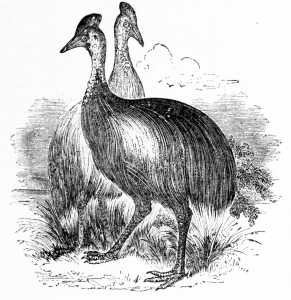
THE CASSOWARY, (Casuarius galeatus,)
Instead of the beautiful plumes of the ostrich, has his wings furnished only with five stiff quills without barbs, which project curiously from the feathers of the body. His plumage is black; his head is small and depressed, with a horny crown or helmet, and covered with a naked red skin; the head and neck are deprived of feathers; about the neck are two protuberances of a bluish colour, in shape like the wattles of a cock. The feathers consist of long, slender, separate barbs, which hang down on each side of the body, so that at a distance he looks as if he were entirely covered with the hairs of a bear rather than with the plumage of a bird. His height is about five feet. The Cassowary is as voracious as the ostrich, and eats indiscriminately whatever comes in his way, and does not seem to have any sort of predilection in the choice of his food. The Dutch travellers assert that he can devour not only glass, iron, and stones, but even burning coals, without testifying the smallest fear, or sustaining the least injury; and it is said that the passage of his food is performed so speedily that even eggs will pass unbroken. He is a native of some of the Indian islands. The eggs of the female are nearly fifteen inches in circumference, of a greenish colour. It has been said of the Cassowary that he has the head of a warrior, the eye of a lion, the armament of a porcupine, and the swiftness of a courser.
A Cassowary once kept in the menagerie of the museum at Paris, devoured every day between three and four pounds weight of bread, six or seven apples, and a bunch of carrots. In summer it drank about four pints of water in the day, and in winter somewhat more. It swallowed all its food without bruising it. This bird was sometimes ill-tempered and mischievous, and much irritated when any person approached it of a dirty or ragged appearance, or dressed in red clothes, and frequently attempted to strike at them by kicking forward with its feet. It has been known to leap out of its enclosure and to tear the legs of a man with its claws.
The Cassowary is very vigorous and powerful; its beak being, in proportion, much stronger than that of the ostrich, it has the means of defending itself with great advantage, and of easily pulling down and breaking in pieces almost any hard substance. It strikes in a very dangerous manner with its feet either behind or before, not unlike the kicking of a horse, at any object which offends it, and runs with surprising swiftness.
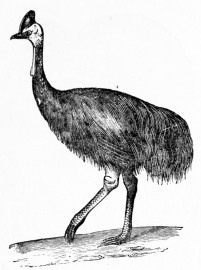
THE EMEU. (Dromaius Novæ Hollandiæ.)
The head of this bird is without any horny crest, and feathered, but the cheeks and throat are nearly naked. The general colour is a dull brown, mottled with a dingy grey, and the young are striped with black. In appearance it closely resembles the ostrich, next to which it is the tallest bird known, but is of a more thick-set and clumsy make, though at the same time very swift and strong, and able to make a formidable defence against its hunters and their dogs, by kicking in a very vigorous and dangerous manner. It is, however, very docile, and if taken young may be easily tamed. The flesh is considered excellent eating, and is said to possess a flavour something between a sucking-pig and a turkey. The only sound that this bird emits is a low drumming noise, produced by means of a valve attached to the lungs. The female Emeu lays her eggs in different places, but they are afterwards collected by the male, by rolling them to one place, when he sits on them.
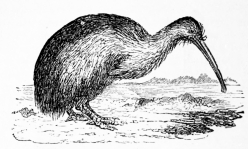
THE APTERYX. (Apteryx Australis.)
This curious bird, which has the shortest wings of any member of its class, is found only in New Zealand, where it is called Kivi-Kivi by the natives, in imitation of its cry. It is smaller than any of the species of wingless birds just described, and its legs are short and stout; it has three strong front toes on each foot, and a short hinder toe armed with a very strong claw. The body of the Apteryx is something like that of the cassowary in its form; the neck is rather long, and, like the head, clothed with feathers; but the most singular part of the bird is its bill, which is long, rather slender, and slightly curved, and has the nostrils situated quite at its tip. This curious structure of the bill is intended to enable the bird more readily to obtain the worms and insects upon which it feeds, and which it drags out of their holes in the ground. It runs quickly, but only at night, and when in motion it might easily be mistaken for a small dusky-brown quadruped. The plumage resembles that of the emeu in its texture, and the skins are highly esteemed by the New Zealanders, who use them for making cloaks.
Among the many curious characteristics of this bird is its habit of leaning, when at rest, upon the tip of its long bill. When hunted it scrapes a hole in the sand with its powerful feet, in which it hides; or it runs into some natural cavity, if there is any near, where access is difficult for its pursuers, and often makes a valiant defence.
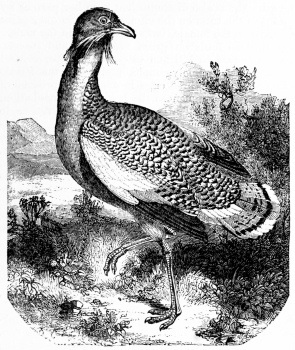
THE BUSTARD, (Otis tarda,)
Is a large and fine bird which was formerly common in some parts of England, but has now become so rare here that the capture of a specimen is looked upon as something remarkable. It is still abundant in some parts of the continent of Europe. The male Bustard measures nearly four feet in length, and has the head and neck greyish, the back buff or pale chestnut, with a great many black bars, and all the lower part of the body white. From each side of the chin there springs a tuft of slender feathers about seven inches in length, standing out like a pair of stiff moustaches. The female is a good deal smaller than the male, or about three feet in length; she is also distinguished from her partner by the want of the tufts on the chin, although in some cases these exist in the female, but shorter than in the male.
The Bustard feeds on green vegetables and insects, and are also said to kill and eat small quadrupeds and reptiles. They are polygamous, and when the female has laid her two or three eggs in a slight depression of the ground, and commenced the business of incubation, the male most ungallantly deserts her, and retires to take his ease in some neighbouring marsh. It was formerly supposed that the male Bustard paid so much attention to his mates as to provide them with water, which he was said to bring to them in a large pouch, capable of holding nearly a gallon, situated under his throat. It is true that the female is without this appendage; but modern naturalists all agree in stating that the male bird is never seen in company with the female after she has begun to sit. The use of this pouch is therefore still a subject of controversy.
The female lays her eggs among clover, or more frequently in corn-fields, the nest being merely a hollow scraped in the ground. The eggs are two, or sometimes three, in number, and their colour is a yellowish-brown, inclining to green.
A peculiarity of the Bustard, noticed by most naturalists, is the extreme rapidity with which they can run. They skim along the ground, raising the wings over the back in the same manner as the ostrich. It is said that in former times, when the breed was commoner, it was a practice to hunt the young birds, before they had acquired the power of flying, with greyhounds.
As an article of food the flesh of the Bustard has always been held in great estimation.
There are several other species peculiar both to Asia and Africa.
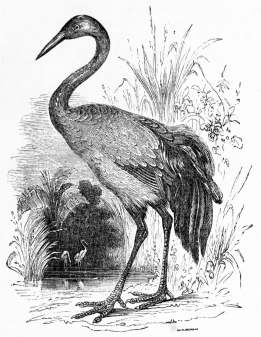
THE CRANE. (Grus cinerea.)
Cranes frequent marshy places, and live upon small fish and water-insects. Their long beaks enable them to search the water and mud for their prey, and their long necks prevent the necessity of their stooping to pick up from between their feet the objects of their search. The top of the head, the throat, and sides of the neck are of a blackish hue; the back, the wings, and the body are ash-coloured. The tertial feathers of the wings are very long, with loose webs, forming elegant plumes, which fall over the sides of the tail. They used to be common in the fen countries, Lincolnshire and Cambridgeshire, but are not now so frequently seen in England as formerly. In their flight, Cranes mount high in the air, but their voices can be heard even when the birds cease to be perceptible to the eye, and it is said that their sight is so keen that they discover at a great distance any field of corn or other food which they are fond of, and presently alight and enjoy it. These depredations they generally commit during the night, trampling down the ground as if it had been marched over by an army. They generally form themselves in the air in the shape of a wedge.
“—— —— Part more wise, In common, ranged in figure, wedge their way, Intelligent of seasons, and set forth Their aëry caravan high over seas Flying, and over lands, with mutual wing Easing their flight. So steers the prudent Crane Her annual voyage, borne on winds. The air Floats as they pass, fann’d by unnumber’d wings.” Milton.
This bird lives to a considerable age, and as it is easily tamed, it has been ascertained that the Crane often reaches his fortieth year. Its nest is usually built amongst the reeds and sedges of a marsh, but sometimes upon a ruined building. The female lays two eggs, of a pale brown colour, with darker spots.
According to Kolben, they are often observed in large flocks on the marshes about the Cape of Good Hope. He says he never saw a flock of them on the ground that had not some placed apparently as sentinels, to keep a look out while the others are feeding, who on the approach of danger immediately give notice to the rest. These sentinels stand on one leg, and at intervals stretch out their necks, as if to observe that all is safe. On notice being given of danger, the whole flock are in an instant on the wing. Kolben also adds that in the night time each of the watching Cranes, which rest on their left legs, hold in their right claw a stone of considerable weight, in order that, if overcome by sleep, the falling of the stone may awaken them.
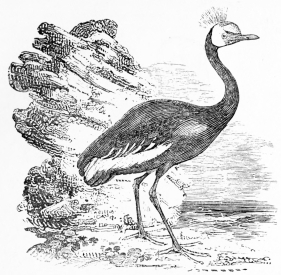
THE BALEARIC CRANE, OR CROWNED DEMOISELLE, (Balearica pavonina,)
Is originally, as the name expresses, a native of Majorca and Minorca, in the Mediterranean sea, which were formerly called the Balearic Isles, but is chiefly found now in the Cape Verd Islands. The shape of its body is not unlike that of the common Crane, but it has a principal and distinctive mark on the head; which is, a tuft of hairs, or rather strong greyish bristles, standing out like rays in all directions, from which peculiarity this species takes its other name of the Crowned Heron. They roost and feed in the manner of peacocks.
The Demoiselle, or Numidian Crane (Anthropoides virgo), is remarkable for the grace and symmetry of its form, and the elegance of its deportment. It is rather larger than the species above described, and is a native of many parts of Africa. It frequents damp and marshy places, in search of small fishes, frogs, &c., which are its favourite food. It is easily domesticated.
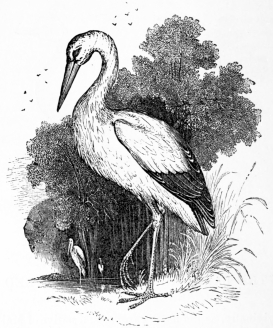
THE STORK. (Ciconia alba.)
The neck, head, breast, and body of this bird are white, the rump and exterior feathers of the wings black; the eyelids naked; the tail white, and the legs long, slender, and of a red colour. Storks are birds of passage. When leaving Europe they assemble together on some particular night, and all take their flight at once. As they feed on frogs, lizards, serpents, and other noxious creatures, it is not to be expected that man should be inimical to them, and therefore they have been generally a favourite with the nations they visit. The Dutch have laws against destroying them: they are therefore very common in Holland, and build their nests and rear their young on the tops of houses and chimneys in the middle of its most frequented and populous cities, and may be seen by dozens familiarly walking about the markets, where they feed on the offal. In some places, the stork is supposed to be a herald of good fortune to the house on which it builds its nest, and the inhabitants place boxes on their roofs to induce the birds to take up their abode there.
The Stork much resembles the crane in its conformation, but appears somewhat more corpulent. The former lays four eggs, whereas the latter lays but two.
It is said that Storks visit Egypt in such abundance, that the fields and meadows are white with them. The Egyptians, however, are not displeased with the sight; as frogs are there generated in such numbers, that did not the Storks devour them, they would overrun everything. Between Belba and Gaza, the fields of Palestine are often rendered desert on account of the abundance of mice and rats; and were they not destroyed the inhabitants could have no harvest. The disposition of the Stork is mild and placid; it is easily tamed, and may be trained to reside in gardens, which it will clear of insects and reptiles. It has a grave air, and a mournful aspect; yet, when roused by example, exhibits a certain degree of gaiety; for it joins in the frolics of children, hopping about and playing with them.
During their migrations, Storks are observed in vast quantities. Dr. Shaw saw three flights of them leaving Egypt, and passing over Mount Carmel, each of which appeared to be nearly half a mile in width; and he says they were three hours in passing over.
The Stork, like the ibis, was an object of worship among the ancients, and to kill them was a crime punishable with death. The Stork is remarkable for its great affection towards its young. This was remarkably evinced during the great conflagration of Delft, in Holland, during which a female Stork was noticed using every endeavour to carry off her young family, and continuing this labour of love until the smoke and flames prevented her own escape, and she perished with her brood.
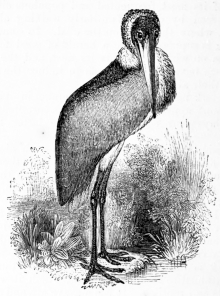
THE ADJUTANT, (Leptoptilus argala,)
Also called the Gigantic Crane, is a bird of the stork kind, and a native of India, and other warm countries. The head and neck are bare of feathers, as in the ostrich; the former looking as if made of wood; the latter of a flesh-colour. The coverts of the wings and the back are black, with a bluish cast; the under part of the body whitish; the legs are long, without feathers, and of a greyish hue, as are the thighs, which seem to be as slender as the leg. The bill is of enormous size, and the bird is fond of clatting the two mandibles together. Under the chin, there is a kind of bag or pouch which hangs down in front of the neck, like the dewlap of a cow; in this the Adjutant stores away any provisions that may fall in his way, after his immediate wants are satisfied. He is a most voracious bird, and devours every kind of food, and as he has no objection to carrion, his presence is encouraged in towns, where he assists the vultures, crows, dogs, and jackals, in performing the duties of scavengers. Indeed his rapacity is so great that he swallows such innutritious substances as bone with such eagerness and relish as to have received the name of “Bone-eater,” or “Bone-taker.” When he comes about the houses he requires to be carefully watched, as his power of swallowing is so great that a fowl, a rabbit, or even a leg of mutton, is disposed of at a single mouthful. Sir E. Horne states that in the stomach of an Adjutant were found a tortoise nearly a foot long, and a large black cat; from, which we may see that the Adjutant is by no means squeamish in his diet.
The Adjutant is indeed a very gigantic bird. Its wings often measure fourteen or fifteen feet from tip to tip, and it is five feet high when it stands erect.
Dr. Latham, in his “General History of Birds,” gives some very interesting information about the habits of this bird. “One of them, a young bird about five feet high, was brought up tame, and presented to the chief of the Bananas, where M. Speakman lived; and being accustomed to be fed in the great hall, soon became familiar, daily attending that place at dinner-time, placing itself behind its master’s chair frequently before the guests entered. The servants were obliged to watch narrowly, and to defend the provisions with switches; but, notwithstanding, it would frequently seize something or other, and even purloined a whole boiled fowl, which it swallowed in an instant. Its courage is not equal to its voracity, for a child of eight or ten years old soon puts it to flight with a switch. Everything is swallowed whole, and so accommodating is its throat that not only an animal as big as a cat is gulped down, but a shin of beef broken asunder serves it but for two morsels.”
Another species of Adjutant (Leptoptilus marabou) is found in tropical Africa. It is even uglier than the Indian bird, which has not much beauty to boast of, but is valuable not only as a scavenger, but from its furnishing those beautiful plumes called marabout feathers, which are so much used for ladies’ head-dresses.
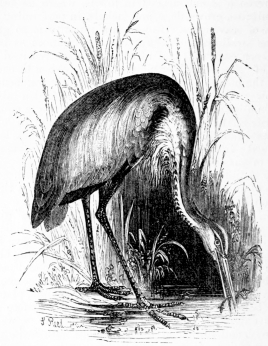
THE COMMON HERON. (Ardea cinerea.)
The habits of the Heron are peculiar. Perched on a stone, or the stump of a tree, by the solitary current of a brook, his neck and long beak half-buried between his shoulders, he will wait the whole day long, patient and unmoved, for the passing of a small fish, or the hopping of a frog; but his appetite is insatiable.
This bird is about four feet long from the tip of the bill to the end of the claws; to the end of the tail about thirty-eight inches; its breadth, when the wings are extended, is about five feet. The male is distinguished by a crest or tuft of black feathers hanging from the hinder part of his head, which in chivalrous times was of great value, and held as a peculiar mark of distinction when worn above the plume of ostrich feathers.
Virgil places the Heron among the birds that are affected by and foretell the approaching storm:
“When watchful Herons leave their watery stand, And mounting upward with erected flight, Gain on the skies, and soar above the sight.” Dryden.
The Heron, though living chiefly in the vicinity of marshes and lakes, forms its nest on the tops of the loftiest trees. It resembles the rook in its habits: a great number of Herons living together in what is called a Heronry, as rooks do in a rookery. The female lays four large eggs, of a pale green colour; the natural term of this bird’s life is said to exceed sixty years.
In England, Herons were formerly ranked among the royal game, and protected as such by the laws; and when falconry was in fashion, the pursuit of the Heron was a favourite amusement.
“—— —— Now, like the wearied stag, That stands at bay, the Hern provokes their rage; Close by his languid wing in downy plumes Covers his fatal beak, and cautious hides The well-dissembled fraud. The falcon darts Like lightning from above, and in her breast Receives the latent death: down plumb she falls, Bounding from earth, and with her trickling gore Defiles her gaudy plumage. See, alas! The falconer in despair, his favourite bird Dead at his feet: as of his dearest friend, He weeps her fate; he meditates revenge, He storms, he foams, he gives a loose to rage; Nor wants he long the means; the Hern fatigued, Borne down by numbers, yields, and prone on earth He drops; his cruel foes wheeling around Insult at will.” Somerville.
It is extremely dangerous to go near a wounded Heron, and the utmost caution is necessary in doing so. Though apparently almost dead, he will yet dart at his enemy’s face, and sometimes inflict a most severe wound.
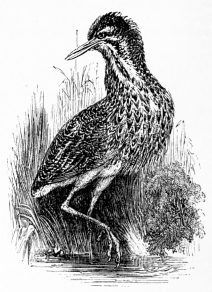
THE BITTERN, (Botaurus stellaris,)
Is not quite so large as the common heron; its head is small, narrow, and compressed at the sides. The crown is black, the throat and sides of the neck red, with narrow black lines, and the back of a pale red, mixed with yellow. The claws are long and slender, the inside of the middle one being serrated, the better to enable it to hold its prey. The bill is about four inches in length. The most remarkable character in this bird is the hollow and yet loud rumbling of his voice; his bellowing is heard at the distance of a mile, at the time of sunset, and it is hardly possible to conceive at first how such a body of sound, resembling the lowing of an ox, can be produced by a bird comparatively so small. The booming noise was formerly believed to be made while the bird plunged its bill into the mud; hence Thomson:
“—— So that scarce The Bittern knows his time, with bill ingulf’d To shake the sounding marsh.”
And Southey also describes the peculiar noise of this bird in his poem of Thalaba:
“And when at evening, o’er the swampy plain, The Bittern’s boom came far, Distinct in darkness seen— Above the low horizon’s lingering light, Rose the near ruins of old Babylon.”
Sometimes in the evening the Bittern soars on a sudden in a straight, or, at other times, in a spiral line, so high in the air, that it ceases to be perceptible to the eye. When attacked by the buzzard, or other birds of prey, it defends itself with great courage, and generally beats off such assailants; neither does it betray any symptoms of fear when wounded by the sportsman, but eyes him with a keen, undaunted look; and, when driven to extremity, will attack him with the utmost vigour, wounding his legs, or aiming at his eyes with its sharp and piercing bill. It was formerly held in much estimation at the tables of the great, and is again recovering its credit as a fashionable dish. The flesh is considered delicious. In autumn it changes its abode, always commencing its journey at sunset. Its precautions for concealment and security seem directed with great care and circumspection. It usually sits in the reeds with its head erect; and thus, from its great length of neck, sees over their tops, without itself being perceived by the sportsman. The principal food of these birds, during summer, consists of fish and frogs; but in autumn they resort to the woods in pursuit of mice, which they seize with great dexterity, and always swallow whole. About this season they usually become very fat.
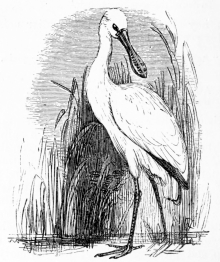
THE SPOONBILL, (Platalea leucorodia,)
Is a large bird; the colour of the whole body is white, and the resemblance of the bill to a spoon has caused the denomination of the bird. In some specimens the plumage inclines from white to pink colour. On the hind part of the head is a beautiful white crest, reclining backward. The legs and feet are black. The wisdom of Providence is most conspicuous in the conformation of the bill, which is entirely adapted to the habits and manner of feeding of these birds: the frogs and fishes, which constitute the principal food of the Spoonbill, may often escape the thin and narrow beak of the heron and other birds, but the mandibles of this bird are so large at the end, that the prey cannot slip aside. Like rooks and herons, Spoonbills build their nests on the tops of high trees, and lay three or four eggs, which are white, sprinkled with pale red, and the size of those of a hen. These birds are very noisy during the breeding season. The Spoonbill migrates northward in the summer, and returns to southern climes on the approach of winter; and is found in all the intermediate low countries between the Faroe Isles and the Cape of Good Hope.
The American or Roseate Spoonbill (Platalea Ajaja) is very beautiful. Its colour is white, tinged with rose, which deepens in the wings and tail into the richest carmine. The feet are half-webbed, and the bird is generally found on the sea-coast, where it wades into the sea in quest of the small shell-fish of different kinds, on which it feeds.
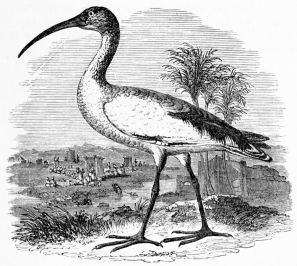
THE IBIS. (Ibis religiosa.)
The Ibis was regarded as a sacred bird by the ancient Egyptians, who used to have these birds walking about in their temples, and embalmed their bodies after death with as much care as those of their priests and kings. The cause of this veneration is not clearly ascertained, some authors supposing it to be due to the services rendered by the bird in destroying serpents and other noxious creatures; others to a fanciful resemblance between the bird and one of the moon’s phases; and others, again, to the arrival of the birds in Egypt at or about the period of the annual inundation of the Nile. The sacred Ibis has a long, stout, curved black bill; the head and neck are black and naked, and the plumage is white, with the tips of the wings black. Another species, the Glossy Ibis (Ibis falcinellus), shared the veneration of the Egyptians with the Sacred Ibis; it has a more slender bill than the Sacred Ibis, and its plumage, which is beautifully glossy, is dark green above and reddish-brown beneath. This bird is common in the south of Europe, and specimens have been shot in England. The Scarlet Ibis (Ibis rubra) is a beautiful species, which adorns the banks of the great rivers of South America, in company with the Roseate Spoonbill.
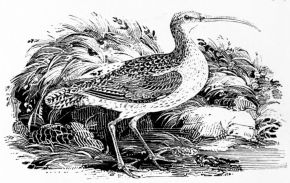
THE CURLEW. (Numenius arquatus.)
“Soothed by the murmurs of the sea-beat shore, His dun-grey plumage floating to the gale, The Curlew blends his melancholy wail With those hoarse sounds the rushing waters pour.” Miss Williams.
“Wild as the scream of the Curlew, From rock to rock the signal flew.” Sir Walter Scott.
The Curlew is a large bird, weighing about twenty-four ounces; and is found in winter on the sea-shore on all sides of England. The middle parts of the feathers of the head, neck, and back are black, the borders or outsides ash-coloured, with a mixture of red; and the lower part of the body white. The beak has a regular curve downward, and is soft at the point. This bird’s flesh may challenge for flavour and delicacy that of any other water-fowl, and the people of Suffolk say proverbially:
“A Curlew, be she white, be she black, She carries twelve pence on her back:”
but it must be confessed that the quality and goodness of the flesh of Curlews depend on their manner of feeding, and the season in which they are caught. When they dwell on the sea-shore, they acquire a kind of rankness, which is so strong, that, unless they are basted on the spit with vinegar, they are not agreeable eating.
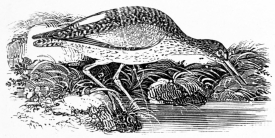
THE REDSHANK. (Totanus calidris.)
This bird has received its name from the colour of its legs, which are of a crimson red. In size it is between the lapwing and the snipe, and is sometimes called the Pool Snipe. The head and back are of a dusky ash-colour, spotted with black, the throat party-coloured black and white, the black being drawn down along the feathers. The breast is whiter, with fewer spots. The Redshank delights in the fen countries, and in wet and marshy grounds, where it breeds and rears its young. The female lays four whitish eggs, with olive-coloured dashes, and marked with irregular spots of black. Pennant and Latham say, that it flies round its nest when disturbed, making a noise like a lapwing. It is not so common on the sea-shore as several others of its kindred. We must here observe, that this bird has often been mistaken for others. The fact is, that several birds changing their plumage, and increasing or diminishing their size according to their age, the season of the year, and the climate they live in, set all nomenclators at defiance, and confound all classifications.
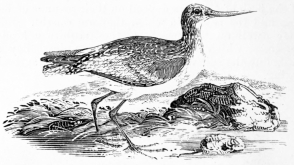
THE GODWIT, (Limosa ægocephala,)
Is met with in various parts of Great Britain, and is rather larger than the woodcock, which it much resembles in appearance. In spring and summer it resides in the fens and marshes, where it rears its young, and feeds on small worms and insects; but in winter it seeks the salt marshes and the sea-shore, where it feeds upon the shell-fish and marine animals left by the retiring tide. A peculiarity belonging to this bird is the shape of its bill, which is a little turned upwards. The head, neck, and back are of a reddish brown; the under part of the body white; the legs dusky, and sometimes black.
The Godwit is much esteemed by epicures as a great delicacy, and sells very high. It is caught in nets, to which it is allured by a stale or stuffed bird, in the same manner and in the same season as the ruffs and reeves.
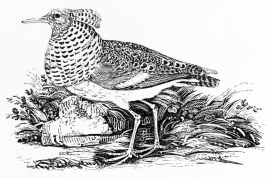
THE RUFF AND REEVE. (Machetes pugnax.)
It is curious to see, in our observation of natural objects, how the creative power of Providence seems to have tried all forms and shapes in the composition of species. In the cock bird of this species a circle or collar of long feathers, somewhat resembling a ruff, encompasses the neck under the head, whence the bird has received the name of Ruff. It is about a foot in length, with a bill about an inch long. There is a wonderful and almost infinite variety in the colours of the feathers of the males; so that in spring there can scarcely be found two exactly alike; but after moulting they become all alike again.
The males are sometimes called Fighters, on account of their quarrelsome disposition. It is a bird of passage, and arrives in the fens of Lincolnshire, and other similar places, in the spring. Mr. Pennant tells us, that in the course of a single morning more than six dozen have been caught in one net, and that a fowler has been known to catch between forty and fifty dozen in a season.
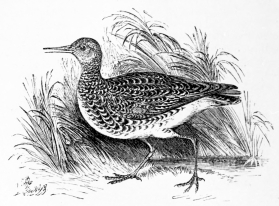
The female is called a Reeve, and its flesh is thought a great delicacy for the table. They are smaller than the cocks, and their feathers undergo no change. The Ruff and Reeve are taken in nets. They used to be seen in vast numbers in many parts of England, especially in the Isle of Ely and the Lincolnshire fens. The improvements in drainage and cultivation that have been made during the present century have deprived these birds of their accustomed haunts, and they are no longer common. A writer of the last century said he had seen the ground so covered with the nests and eggs of Plovers and Reeves that “one could scarce take a step without stepping on them.” They are now most common on the shores of southern Scotland and of Northumberland.
Reeves are fattened for the table by feeding them on boiled rice or wheat, bread and milk, hemp seed, &c. They are obliged to be kept in a dark room during the process, as the least gleam of light is the signal for a furious battle.
THE SNIPE. (Scolopax gallinago.)
“The Snipe flies screaming from the marshy verge, And towers in airy circles o’er the wood; Still heard at intervals; and oft returns, And stoops as bent to alight; then wheels aloft With sudden fear, and screams and stoops again, Her favourite glade reluctant to forsake.” Gisborne.
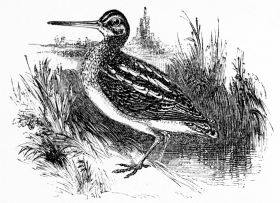
The Snipe weighs about four ounces. A pale red line divides the head longways; the chin under the bill is white; the neck is a mixture of brown and red; the lower part of the body is almost all white. The back and wings are of a dusky colour. The flesh is tender, sweet, and in flavour ranks next to that of the woodcock. Snipes feed especially upon small red worms, and insects, which they find in muddy and swampy places, on the banks of rivulets and brooks, and on the clayey margin of ponds. It is said that Snipes remain with us all the summer, and build in moors and marshes, laying four or five eggs; but most of them are migratory, and, when forced by severe frosts to sheltered springs, are often seen in large flights. Mr. Daniel states that, about thirty years ago, Snipes were so abundant in the fens of Cambridgeshire, that as many were taken in Milton fen, by means of a lark-net, in one night, and by a single man, as could be contained in a small hamper.
THE WOODCOCK, (Scolopax rusticola,)
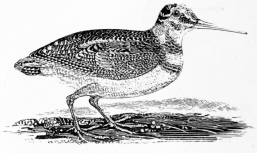
Is somewhat less than the partridge. The upper side of the body is party-coloured of red, black, and grey, and very beautiful. From the bill almost to the middle of the head it is of a reddish ash-colour. The lower part of the body is grey, with transverse brown lines; under the tail the colour is somewhat yellowish; the chin is white, with a tincture of yellow. Woodcocks are migratory birds, coming over into Britain in autumn, and departing again in the beginning of spring; they pair before they go, and are seen flying in braces.
The colours of this timid bird render it difficult to discern him among the withered stalks and leaves of fern, sticks, moss, and grass, which form the background of the scenery, by which he is sheltered in his moist and solitary retreats. By habit only is the sportsman enabled to discover him, and his leading marks are the full eye and glossy silver white-tipped tail of the bird. The flesh is held in high estimation, and hence he is eagerly sought after. It is hardly necessary to observe that in dressing a Woodcock for the spit the entrails are not drawn, but are allowed to drop upon slices of toasted bread, and are relished as a delicious kind of sauce. By some late observations, it appears that several individuals of the species remain with us the whole year. They frequent especially wet and swampy woods, the thick hedges near rivulets, and places affording them their allotted food, which consists of very small insects found in the moist ground.
“The Woodcock’s early visit and abode Of long continuance, in our temperate clime, Foretell a liberal harvest.” Philips.
THE KNOT, (Tringa Canutus,)
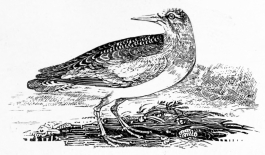
Is a small bird, whose head and back are of a dusky ash-colour, or dark grey; while the lower part of the body is pure white, or white varied by black lines. The sides under the wings are spotted with brown. The bird weighs about four ounces and a half, and generally makes its appearance in Lincolnshire in the beginning of winter, and abides there for two or three months, after which they fly off in flocks. They are caught in great numbers by nets, into which they are decoyed by carved wooden figures, painted to represent themselves, and placed within them, much in the same way as the ruff. When the knot is fat, its flesh is considered excellent food. It is also fattened for sale, and then considered equal to the ruff in flavour. The season for taking it is from August to November, after which the frost compels it to disappear. This bird is said to have been a favourite dish with Canute the Great; and Camden observes that its name is derived from his—Knute, or Knout, as he was called—which, in process of time, has been changed to Knot.
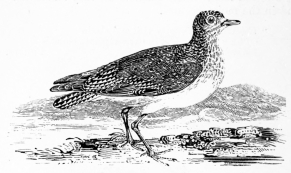
THE GREY PLOVER, (Squatarola cinerea,)
Is about twelve inches long and twenty-four across the wings: the head, back, and coverts of the wings are black, with tips of a greenish white; the chin white; the throat spotted with brown or dusky spots; the breast and thighs white. The flavour of the flesh, when the bird is caught in the proper season, is delicate and savory; at other times it is hard, and has a strong and rank taste. This bird is generally found in small packs, and is not nearly so common as the beautiful Golden Plover. The male becomes entirely black on the lower surface in the spring, or black interspersed with patches and spots of white.
The Grey Plover is found in the northern parts of Europe, and, it is said, breeds in Egypt, Java, and Japan. Like the Ruff, it is an exceedingly quarrelsome bird, and fights fiercely in the spring. The young, when hatched, are covered with a thick, soft down, and immediately begin to follow their parents about and search for food.
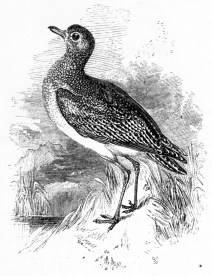
THE GOLDEN PLOVER, (Charadrius pluvialis,)
Is about the size of the former. The colour of the whole upper side is black, thick set with yellowish green spots; the breast brown, with spots as on the back; the body is white. The male of this species is also black beneath in the spring. The flesh is sweet and tender, and therefore esteemed a choice dish in this and other countries.
The Golden Plover feeds principally during the night, and during the day time may be seen sitting or standing on the ground, asleep. The parent birds are very careful in guarding their young. When any intruder approaches their nest, they use all sorts of stratagems to divert his attention.
The “Plover eggs,” frequently seen at the tables of the opulent and luxurious, are not those of the Plover, but of the Lapwing.
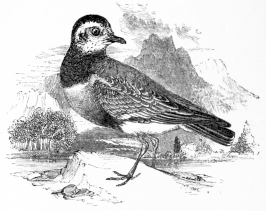
THE DOTTREL, (Charadrius morinellus,)
Is proverbially accounted a foolish bird, yet why so it is hardly possible to say. Its length is about ten inches; the bill is not quite an inch long, and is black. The forehead is mottled with brown and grey; the top of the head is black; and over each eye there is an arched line of white. The back and wings are a light brown; the breast is a pale dull orange; the middle of the body is black, and the rest and the thighs are of a reddish white. The tail is brown, black towards the end, and tipped with white. This bird is migratory, and makes its appearance in Lincolnshire, Cambridgeshire, and Derbyshire in April, but soon leaves those counties and passes on towards the north, breeding in the mountains of the north of England and Scotland. In April, and sometimes in September, Dottrels are seen in Wiltshire and Berkshire. They are generally caught, like other birds, by night; when, dazzled by the light of a torch, they are at a loss to know where to fly for safety, the whole place being in darkness, and generally select the very spot which they should avoid. Many ridiculous stories have been propagated about the gestures of this bird, and its endeavouring to imitate the actions of the fowler, and thereby falling into the snare laid for him; but they ought to be entirely disbelieved.
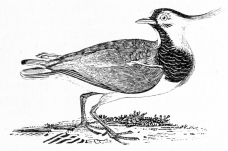
THE LAPWING, OR PEEWIT. (Vanellus cristatus.)
This well-known bird is found in nearly all countries, and is of the size of a common pigeon. The female lays four or five eggs, of a yellow colour, varied all over with large black spots and strokes. Lapwings build their nests on the ground in the middle of some field or heath, open and exposed to view, laying only some few straws under the eggs: so soon as the young are hatched, they instantly forsake the nest, running away with the shell on their back, and following the mother, only covered with a kind of down, like young ducks. The parents have been impressed by nature with the most attentive love and care for their offspring; for if the fowler, or any other enemy, should come near the nest, the female, panting with fear, lessens her call to make her enemies believe that she is much further off, and thereby deceives those that search for her brood; she also sometimes pretends to be wounded, and utters a faint cry as she limps away, to lead the fowler from her nest. This bird is really beautiful, although it does not exhibit that gaudiness of colours of which other species of the feathered tribe can boast: it weighs about half-a-pound. The head, and the crest which elegantly adorns it, is black; this crest, composed of unwebbed feathers, is about four inches in length. The back is of a dark green, glossed with blue shades; the throat is black; the hinder part of the neck and the breast are white. The Lapwing, when in search of food, stamps with his feet upon the ground, and when the earth-worms, alarmed at the noise, appear, he seizes and devours them. His voice, on the swampy places along the sea-shores, heard at night, resembles the sound of peewit, or teewit, and hence his name in several parts of Great Britain; he is also called the Great Plover by several ornithologists. This bird is one of those who attract the fowler’s attention in winter:
“With slaughtering gun th’ unwearied fowler roves, When frosts have whiten’d all the naked groves; Where doves in flocks the leafless trees o’ershade, And lonely woodcocks haunt the watery glade. He lifts his tube, and levels with his eye; Straight a short thunder breaks the frozen sky: Oft, as in airy rings they skim the heath, The clamorous Lapwings feel the leaden death: Oft, as the mounting larks their notes prepare, They fall, and leave their little lives in air.” Pope.
The following anecdote, from Bewick’s “History of Birds,” exhibits the domestic nature of the Lapwing, as well as the art with which it conciliates the regard of animals materially differing from itself, and generally considered as hostile to every species of the feathered tribe. Two Lapwings were given to a clergyman, who put them into his garden; one of them soon died, but the other continued to pick up such food as the place afforded, till winter deprived it of its usual supply. Necessity soon compelled it to draw nearer to the house, by which it gradually became familiarised to occasional interruptions from the family. At length one of the servants, when she had occasion to go into the back kitchen with a light, observed that the Lapwing always uttered his cry of “pee-wit,” to obtain admittance. The bird soon grew more familiar; as the winter advanced, he approached as far as the kitchen, but with much caution, as that part of the house was generally occupied by a dog and cat, whose friendship, however, the Lapwing at length conciliated so entirely, that it was his regular custom to resort to the fireside as soon as it grew dark, and spend the evening and night with his two associates, sitting close by them, and partaking of the comforts of a warm hearth. As soon as spring appeared, he discontinued his visits to the house, and betook himself to the garden; but, on the approach of winter, he had recourse to his old shelter and friends, who received him very cordially. Security was productive of insolence; what was at first obtained with caution, was afterwards taken without reserve; he frequently amused himself with washing in the bowl which was set for the dog to drink out of; and while he was thus employed, he showed marks of the greatest indignation if either of his companions presumed to interrupt him. He died in the asylum he had thus chosen, being choked with something that he had picked up from the floor.
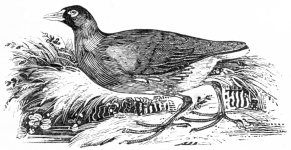
THE WATER-HEN, (Gallinula chloropus,)
Is also called the Moor-Hen, or Moor-Coot, and the Gallinule. The breast is of a lead-colour, the lower part of the body inclining to ash-colour, and the back dark olive brown. As she swims or walks, she often flirts up her tail. Water-hens feed upon aquatic plants and roots, and upon the small insects which adhere to them; they grow fat about the latter end of September, and their flesh is then considered nearly equal to that of the teal; yet it can seldom be entirely deprived of its fishy taste. They build their nests amongst reeds, long grass, roots, and stumps by the water-side, breeding twice or thrice in the course of a summer; the eggs are white, with a tint of green, dashed with brown spots.
There are very few countries in the world where these birds are not to be found. They generally prefer the cold mountainous regions in summer, and lower and warmer situations during winter.
“The fish are leaping, and the Water-hen Dives up and down. A storm is coming on.” Schiller.—William Tell.
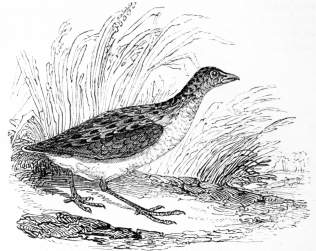
THE CORN-CRAKE, OR LAND-RAIL, (Ortygometra crex,)
Is a migratory bird, appearing in England in April, and departing in October. At the time of its arrival it is very lean, but becomes excessively fat before it quits the island. Their favourite haunts are cold and humid upland districts, corn-fields in the vicinity of water, and marshy grass-lands. Their cry is a peculiar roll of short notes, all in the same key and of the same length. The sound, crec, crec, crec, has been compared to the noise made by drawing the finger along the teeth of a comb. The legs of the Corn-Crake are unusually long for the size of the bird, and hang down while it is on the wing. Its flesh is greatly esteemed for its delicate flavour. This bird is never seen on the wing in this country, and is extremely difficult to capture; they cannot be made to rise like partridges and many other birds, nor is it of much use to invade their cover. They glide through the corn, without the least perceptible rustle, and with wonderful rapidity, considering the size of the bird, and if the sportsman follows in the direction of the sound, it ceases for a while, and then, perhaps, is heard far in the rear; if he follows it again, it is not long before the sound is heard setting in its former or some other direction.
It is said by some writers that the Corn-Crake is a sort of natural ventriloquist, and can make his note appear to proceed from quite another direction than the spot in which he lies hid. It is probable, however, that the delusion arises from the astonishing swiftness with which the bird passes through the covers, where it is usually found. And as they can never be made to rise, the observer has very seldom the means of deciding whether the bird was in the place its cry seemed to proceed from or not.
The nest is made in a hole in the ground, and is lined with dead leaves, moss, and other soft substances. There are generally ten, twelve, or fourteen eggs. The peculiar cry by which the bird is recognised is only uttered during the period of incubation.
Corn-Crakes are occasionally found to have a great fondness for water. An anecdote is related by Craven, in his “Young Sportsman’s Manual,” of a young bird of this species, in the possession of a Mr. Jervis, which had a remarkable partiality for water, in which it would dive and splash, as if unused to any other element. If the habits of this bird could be watched more closely, perhaps we should find that this fondness for water is not uncommon in its wild state.
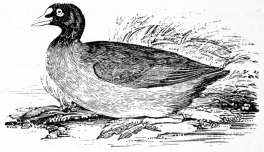
THE COOT. (Fulica atra.)
This bird has so many traits in its character, and so many features in its general appearance like the rails and water-hens, that to place it after them seems a natural and easy gradation; and accordingly this has been done by Cuvier, though it was considered by Linnæus to belong to a group distinct from those birds, and from the waders in general, on account of its being fin-footed, and its constant attachment to the waters, which, indeed, it seldom quits. The manner in which Coots build their nest is very ingenious. They form it of interwoven aquatic weeds, and place it among the rushes, in such a way that it may occasionally rise with, but not be washed away by, the stream: and if ever this accident happens, steady on her nest, the hen does not desert her brood, but follows with them the destiny of their floating cradle. This bird, in the figure and shape of its body, resembles the water-hen, and weighs about twenty-four ounces. The feathers about the head and neck are low, soft, and thick. The colour about the whole of the body is black, but of a deeper hue about the head. The sere rises upon the forehead in a peculiar manner, and appears as if Providence had designed it for a means of defence. It changes its whitish colour to a pale red or pink in the breeding season. Coots are very shy, and seldom venture abroad before dusk. When attacked, they defend themselves with their feet, and they do this so energetically, that sportsmen say, “Beware of a winged Coot, or he will scratch you like a cat.”
§ VII. Palmipedes, or Web-footed Birds.
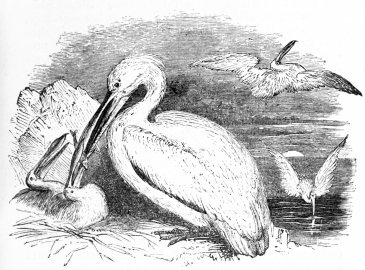
THE PELICAN, (Pelicanus onocrotalus,)
Is in size about equal to the swan; the colour of the body is white, inclining to pink; the beak is straight and long, with a sharp hook at the end; the skin of the lower mandible is so capable of distension, that it may be dilated to contain fish in large quantities. This pouch Providence has allotted to the bird, that he may bring to his eyrie sufficient food for several days, and save himself the trouble of travelling through the air, and watching and diving so often. The legs are black, and the four toes palmated. It is a very indolent, inactive, and inelegant bird, often sitting whole days and nights on rocks or branches of trees, motionless and in a melancholy posture, till the resistless stimulus of hunger spurs it on, and forces it to the sea in search of nourishment; when thus excited to exertion, the Pelican flies from the spot, and, raising itself thirty or forty feet above the surface of the water, turns its head with one eye downward, and continues to fly in that position till it sees a fish near the surface. It then darts down with astonishing swiftness, seizes its prey with unerring certainty, and stores it in its pouch. Having done this, it rises into the air, and repeats the same action till it has procured a sufficient stock. The Pelican is by no means destitute of natural affection, either towards its young ones or towards others of its own species. Clavigero, in his “History of Mexico,” says, that sometimes the Americans, in order to procure, without trouble, a supply of fish, cruelly break the wing of a live Pelican, and, after tying the bird to a tree, conceal themselves near the place. The screams of the miserable bird attract other Pelicans to the place, which, he assures us, eject a portion of the provisions from their pouches for their imprisoned companion. As soon as the men observe this, they rush to the spot, and after leaving a small quantity for the bird, carry off the remainder.
In America, Pelicans are often rendered domestic, and are so trained, that at command they go in the morning and return before night with their pouches distended with prey, part of which they are made to disgorge, while the rest is left them for their trouble. The bird is said to live sometimes a hundred years.
Our forefathers attributed extraordinary affection to this bird, more than is attested by any save heraldic evidence. Thus, in several crests, it is represented in the act of feeding its young with its own blood, which it procures by striking its breast with the sharp point of its beak. And the ancients fully believed that in times of scarcity the female Pelican resorted to this means of supporting her brood. The nest of the Pelican is made with sedges and grass, close to the water’s edge; the female lays two or three white eggs, and the male is said to supply his partner with food while she is engaged in the work of incubation.
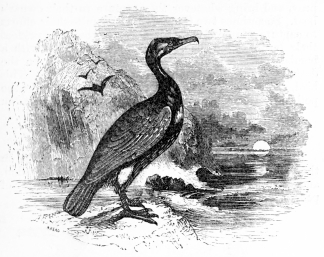
THE CORMORANT, (Phalacrocorax carbo,)
Is a large water-bird, nearly allied to the pelican, possessed with a very voracious appetite, and consequently of a very rapacious disposition. It lives upon all sorts of fish; the fresh water and the briny waves of the sea both paying a large contribution to its craving stomach. The bill is about five inches in length, and of a dusky colour; the predominant tints of the body are black beneath, and dark brown above; on each thigh there is a white patch. The smell of these birds when alive is excessively rank and disagreeable; and their flesh is so disgusting that even the Greenlanders, among whom they are very common, will scarcely eat it. They were formerly tamed in England for the purpose of catching fish, as falcons and hawks were for chasing the fleet inhabitants of the air. This custom is still in practice in China. The birds are taken to the water in a boat, with leather thongs tied round their necks to prevent their swallowing the fish; at the word of command they descend into the water, swim about, and dive in pursuit of prey, and bring whatever they capture to their owner’s boat. Sometimes two Cormorants will unite their efforts to capture a large fish; and if any of the birds neglect their business the man will slap on the water with a bamboo, as a schoolmaster does with his cane on the desk, to recall the idlers to a sense of their duty. This bird, although of the aquatic kind, is often seen, like the pelican, perched upon trees. Milton tells us that Satan
“—— —— —— On the tree of life, The middle tree, and highest there that grew, Sat like a Cormorant.”
In the year 1793, one of them was observed sitting on the vane of St. Martin’s steeple, Ludgate Hill, London, and was shot there in the presence of a great number of people.
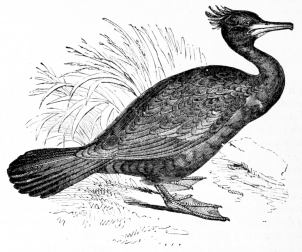
THE SHAG, OR CRESTED CORMORANT, (Phalacrocorax graculus,)
Is of a dark green, with a singular tuft on the front of the head in the spring. It breeds in rocky caves on the sea-coast.
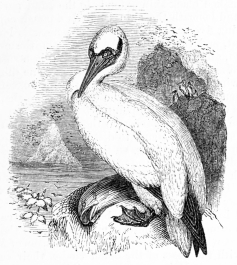
THE GANNET, OR SOLAN GOOSE. (Sula bassana.)
These birds are insatiably voracious, but are somewhat particular in their choice of prey; disdaining, unless in great want, any food worse than herrings or mackerel. No fewer than one hundred thousand Gannets are supposed to frequent the rocks of St. Kilda; and of these, including the young ones, at least twenty thousand are annually killed for food by the inhabitants. The Gannet is somewhat more than three feet in length, and weighs about seven pounds. The bill is six inches long, straight almost to the point, where it is a little bent; its edges are jagged, to enable it the better to secure its prey; and about an inch from the base of the upper mandible there is a sharp process pointing forward. The general colour of the plumage is a dingy white, with a greyish tinge. Surrounding each eye there is a naked skin of a fine blue colour; from the corner of the mouth a narrow slip of naked black skin extends to the hind part of the head; and beneath the chin there is a pouch capable of containing five or six herrings. The neck is long; the body flat, and very full of feathers. On the crown of the head, and the back part of the neck, is a small buff-coloured space. The quill-feathers, and some other parts of the wings, are black; as are also the legs, except a fine pea-green stripe in front. The tail is wedge-shaped, and consists of twelve sharp-pointed feathers.
These birds chiefly resort to those uninhabited islands where man seldom comes to disturb them. The islands to the north, Ailsa Craig, on the west coast of Scotland, the Skelig Islands, off the coasts of Kerry in Ireland, and those that lie in the North Sea off Norway, abound with them. But it is on the Bass Bock, in the Frith of Forth, that they are seen in the greatest abundance. “There is a small island,” says the celebrated Harvey, “called the Bass, not more than a mile in circumference; the surface is almost wholly covered during the months of May and June with the nests of the Solan Geese, their eggs, and their young. It is scarcely possible to walk without treading on them: the flocks of birds upon the wing are so numerous as to darken the air like a cloud; and their noise is such, that one cannot without difficulty be heard by the person next to him. When one looks down upon the sea from the precipice, its whole surface seems covered with infinite numbers of birds of different kinds, swimming and pursuing their prey. If, in sailing round the island, one surveys its hanging cliffs, in every crag or fissure of the broken rocks may be seen innumerable birds, of various sorts and sizes, more than the stars of heaven when viewed in a serene night. If they are viewed at a distance, either receding or in their approach to the island, they seem like one vast swarm of bees.”
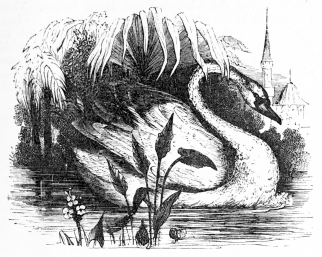
THE SWAN. (Cygnus olor.)
“Fair is the Swan, whose majesty prevailing O’er breezeless water, on Locarno’s lake, Bears him on, while, proudly sailing, He leaves behind a moon-illumined wake: Behold! the mantling spirit of reserve Fashions his neck into a goodly curve— An arch thrown back between luxuriant wings Of whitest garniture, like fir-tree boughs. To which, on some unruffled morning, clings A flaky weight of winter’s purest snows! Behold! as with a gushing impulse heaves That snowy prow, and softly cleaves The mirror of the crystal flood; Vanish inverted hill, and shadowy wood, And pendent rocks, where’er in gliding state Winds the mute creature, without visible mate Or rival, save the queen of night, Showering down a silver light From heaven upon her chosen favourite!” Wordsworth.
The two best known species of this elegantly-formed and majestic bird are commonly known as the Wild and the Tame, or the Whooping and Mute, Swans. They may easily be recognised by the peculiarities of the bill: the Tame Swan has the bill orange-coloured, with its base black, and surmounted by a black knob; the Wild Swan has no knob, and it is the tip instead of the base of the bill that is black.
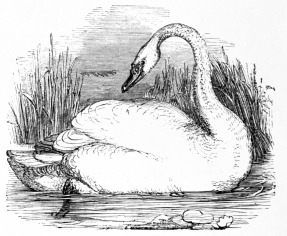
THE WILD SWAN, WHOOPING SWAN, OR WHISTLING SWAN, (Cygnus ferus,)
Is also a fine bird, with beautifully white plumage; unlike the Tame Swan, which is nearly mute, it has a loud and rather melodious voice, which it utters frequently, as it flies along at a great height in the air, during its migrations. It is found in England in the winter, but resides all the year in the north of Scotland. Its favourite place for breeding is in the extreme north. The Tame Swan is the largest of our web-footed water-fowl, sometimes weighing about thirty pounds: the whole body of the full-grown Swan is covered with a beautiful pure white plumage, but the young ones are grey; under the feathers is a thick, soft down, which is of very great use, and often employed as an ornament. The elegance of form which this bird displays, when, with his arched neck and half-displayed wings, he sails along the crystal surface of a tranquil stream, which reflects, as he passes, the snowy beauty of his dress, is worthy of admiration. Thomson describes the Swan in the following beautiful manner:
“—— —— —— The stately sailing Swan Gives out his snowy plumage to the gale, And arching proud his neck, with oary feet, Bears forward fierce, and guards his osier isle, Protective of his young.”
Swans have for ages been protected on the river Thames as royal property; and it continues at this day to be accounted felony to steal their eggs: by this means their increase is secured, and they prove a delightful ornament to that noble river. Latham says the estimation in which they were held, in the reign of Edward IV., was such, that only those who possessed a freehold of the clear yearly value of five marks were permitted even to keep any. In those times, hardly a piece of water was left unoccupied by these birds, as they gratified the palate as well as the eye of their lordly owners of that period: but the fashion of those days has passed away, and Swans are by no means as common now as they were formerly, being by most people accounted a coarse kind of food, and consequently held in little estimation: but the Cygnets (so the young Swans are called) are still fattened for the table, and are sold very high, commonly for a guinea each, and sometimes more; hence it may be presumed they are better food than is generally imagined.
At Abbotsbury there was generally a noble Swannery, the property of the Earl of Ilchester, where six or seven hundred birds were kept, but the collection has of late been much diminished. The Swannery belonged anciently to the abbot, and, previously to the dissolution of monasteries, the Swans frequently amounted to double the above number.
From the whiteness of this bird, the expression of a “Black Swan” was used in ancient times as equivalent to a nonentity; but a species nearly entirely black has been lately discovered in Australia. This bird is as large as the white Swan, and its bill is of a rich scarlet. The whole plumage (except the primaries and secondaries, which are white) is of the most intense black.
Swans are very long lived, sometimes attaining the great age of a century and a half.
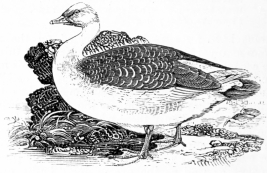
THE WILD GOOSE. (Anser ferus.)
“The farmer’s Goose, who in the stubble Has fed without restraint or trouble, Grown fat with corn, and sitting still, Can scarce get o’er the barn-door sill; And hardly waddles forth to cool Her body in the neighbouring pool; Nor loudly cackles at the door, For cackling shows the Goose is poor.” Swift.
The Goose is very different in outward appearance from the last-named bird. Stupidity in her look, uncouthness in her walk, and heaviness in her flight are her principal characteristics. But why should we dwell upon these defects? they are not such in the great scale of the creation. Her flesh feeds many, and is not disdained even by the great; her feathers keep us warm; and even the very pen I hold in my hand was plucked from her wing.
These birds are kept in vast quantities in the fens of Lincolnshire; several persons there having as many as a thousand breeders. They breed in general only once a year, but if well kept they sometimes hatch twice in a season. During their sitting, the birds have spaces allotted to each, in rows of wicker pens placed one above another; and the Goose-herd, who has the care of them, drives the whole flock to water twice a day, and bringing them back to their habitations, places every bird (without missing one) in its own nest. It is scarcely credible what numbers of Geese are driven from the distant counties to London for sale, frequently two or three thousand in a drove; and, in the year 1783, one drove passed through Chelmsford, in its way from Suffolk to London, that contained more than nine thousand. However simple in appearance or awkward in gesture the Goose may be, it is not without many marks of sentiment and understanding. The courage with which it protects its offspring and defends itself against ravenous birds, and certain instances of attachment, and even of gratitude, which have been observed in it, render our general contempt of the Goose ill-founded.
The Goose was held in great veneration among the Romans, as having by her watchfulness saved the Capitol from the attack of the Gauls. Virgil says, in the seventh book of the Æneid,
“The silver goose before the shining gate There flew, and by her cackle saved the state.” Dryden.
The colour of this useful bird is generally white; though we often find them of a mixture of white, grey, black, and sometimes yellow. The feet which are palmated, are orange-coloured, and the beak is serrated. The male of the Goose is called the Gander; and the young ones Goslings. Geese are very long-lived, one is known to have lived above seventy years.
The Wild Goose is the original of the tame one, and differs much in colour from her, the general tint of its feathers being a greyish black. Wild Geese fly by night in large flocks to more southern countries; and their clang is heard from the regions of the clouds, although the birds are out of sight.