Book I. I. QUADRUPEDS, OR FOUR-FOOTED BEASTS. (continued 3)
Reading edition
§ VIII.—Ruminating Animals.

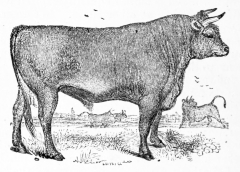
THE BULL. (Bos Taurus.)
There are, perhaps, no animals more generally useful to mankind than the race of oxen, in all their states of existence. They are called ruminating animals; that is, after they have eaten their food they possess the power of returning it from the first stomach into the mouth, to be again masticated before it is finally digested. This is called chewing the cud; and as the animal generally lies down, and looks very thoughtful while the operation is performing, it is said to be ruminating.
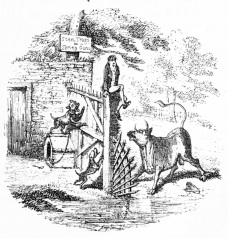
The Bull is a very fierce creature, and when enraged, runs about, tossing up his tail, and roaring most fearfully. When attacked by men or dogs, he tears up the ground with his feet, and then gallops after his assailants, endeavouring to toss them with his horns; and very often pursues in this manner any one he sees, particularly if they appear frightened. When in danger of being attacked by a Bull, the best course is to stand still, and open an umbrella, or flap a shawl, or something of that kind, in the Bull’s face; as with all his fierceness he is a great coward, and only pursues those who fly from him.
The Ox, or Bullock, is used in some parts of the country for drawing carts and waggons, and ploughing; and its flesh is called beef. The skin is tanned and made into leather; the hair is mixed with mortar; the bones are used for knife-handles, chess-men, counters, and other things, as a substitute for ivory; from its horns are made combs, and various other articles; the fat is used in making candles; the blood in refining sugar: and, in short, every part has some important use.
The common charge of stupidity urged against the Ox is wholly unfounded, as the following anecdote, recorded by Mr. Bell, will show. A cow, feeding in a pasture, the gate of which was open, was much annoyed by a mischievous boy, who amused himself by throwing stones at her. The peaceful animal, after enduring this patiently for some time, went up to him, and hooking the end of her horn into his clothes, carried him out of the field and laid him down in the road. She then returned calmly to her pasture, leaving him quit for a severe fright and a torn garment.
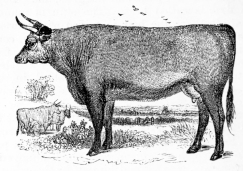
THE COW.
The Cow is the female of the ox tribe, and her young is called a calf. A young Cow, when under two years old, is called a heifer. The Cow is as useful to mankind as the ox, except in ploughing and drawing; but to make amends, she supplies us with milk, from which butter and cheese are made. The Cow gives from six to twenty quarts of milk in a day: and the faculty of giving it in such abundance, and with so much ease, is a striking peculiarity, for this animal differs in this part of its organization from most others, having a large udder, and longer and thicker teats, than the largest animal we know of; it has likewise four teats, whilst all other animals of the same nature have but two; it also yields the milk freely to the hand, whilst all other animals, at least those that do not ruminate in the same manner, refuse it, unless their young, or some adopted animal, be allowed to partake it. The age of the Cow is known by her horns; at four a ring is formed at their roots, and every succeeding year another ring is added. Thus, by allowing three years before their appearance, and then reckoning the number of rings, the creature’s age may be exactly known.
Calves, when quite young, are helpless creatures, from the great length and weakness of their legs. Sometimes they are killed when young, and their flesh is then called veal. The stomach of the calf, when it is killed, is taken out, and cleaned and salted; it is then hung up to dry, and is called rennet. In making cheese, a bit of rennet is soaked in water, which when poured into milk, turns it to curd. The curd is then separated from the whey, and put into a press, when it becomes cheese.
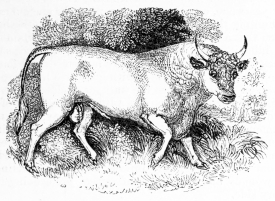
THE WILD BULL.
In the Duke of Hamilton’s park in Scotland, Lord Tankerville’s at Chillingham, in Northumberland, and some other places, there is a breed of wild cattle, possibly the last remains of those which at one period overran this island. The colour is white, with muzzle and ears black, or very dark red.
At the first appearance of any person near them, these animals set off at full gallop; and at the distance of two or three hundred yards wheel round and come boldly up again, tossing their heads in a menacing manner. On a sudden they make a full stop at the distance of forty or fifty yards, and look wildly at the object of their surprise; but on the least motion they all turn round, and gallop off again with equal speed, but not to the same distance, forming a smaller circle; and again returning, with a bolder and more threatening aspect than before, they approach much nearer, when they make another stand, and again gallop off. This they do several times, shortening their distance, and advancing nearer till they come within a few yards, when most persons consider it prudent to leave them, not choosing to provoke them further, as it is probable that in a few turns more they would make an attack.
The mode of killing these animals, as was practised a few years ago, was the only remnant of the ancient mode of hunting that existed in this country. On notice being given that a Wild Bull would be killed on a certain day, the inhabitants of the neighbourhood assembled, sometimes to the number of a hundred horsemen, and four or five hundred foot, all armed with guns or other weapons. Those on foot stood upon the walls, or climbed into trees, while the horsemen separated a Bull from the rest of the herd, and chased him until he stood at bay, when they dismounted and fired. At some of these huntings, twenty or thirty shots have been discharged before the animal was subdued. On such occasions the bleeding victim grew desperately furious from the smarting of his wounds, and the shouts of savage joy echoing from every side.
When the Cows calve, they hide their young ones for a week or ten days in some sequestered retreat, and go to suckle them two or three times in a day. If any person comes near one of the calves it crouches close upon the ground, and endeavours to hide itself, a proof of the native wildness of the animals. In one instance where a calf was disturbed, it pawed the ground like an old Bull, and attempted to butt with its head, till it fell from weakness. It had done enough, however, to raise an alarm, and the whole herd came to its rescue, compelling the intruder to decamp: for the dams will allow no one to touch their young without attacking him with impetuosity. In the Duke of Hamilton’s park, in the summer of 1841, a calf, which was disturbed by the passing of a carriage near it, bellowed so fearfully as to rouse the whole herd, though they were at a considerable distance.
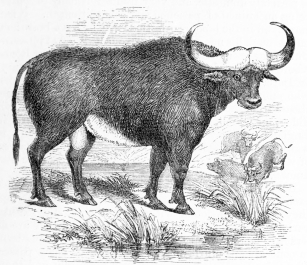
THE AFRICAN BUFFALO (Bubalus Caffer.)
In its general form the Buffalo has a great resemblance to the ox; but it differs from that animal in its horns, and in some particulars of its internal structure. It is larger than the ox; the head is also bigger in proportion, the forehead higher, and the muzzle longer. The horns are large, and of a compressed form, with the exterior edge sharp; they are straight for a considerable length from their base, and then bend slightly upward. The general colour of the animal is blackish, except the forehead and the tip of the tail, which are of a dusky white. The hunch is not, as many have supposed it, a large fleshy lump, but is occasioned by the bones that form the withers being continued, to a greater length than in most other animals. Buffaloes are found in most parts of the torrid zone, and of almost all warm climates; always dwelling in moist and marshy places, where they delight to roll in the mire. In a wild state, the Buffalo is exceedingly fierce; but in some of the tropical countries he is perfectly domestic, and very useful for many purposes, being an animal of patience and great strength. When employed in the labours of agriculture, he has a brass ring put through his nose, by which means he is led at pleasure. Buffaloes are common in the Pontine Marshes near Rome, where they were brought from India in the sixth century. In India they constitute the riches and food of the poor, who employ them in their fields, and make butter and cheese from their milk. They are much valued for their hides; of which, in several countries, and especially in England, military belts, boots, and other implements of war are made. There are various species of Buffaloes, of which the Cape Buffalo, from South Africa, is the best known, and most valuable.
Buffaloes, in their native country, fight so fiercely with each other, that African travellers have remarked that they are seldom found without torn ears, and scars of various kinds on the neck and body. And they are no less treacherous than ferocious, lurking among the trees in concealment until some unfortunate passenger passes. The animal will then suddenly rush upon him, and there is little chance of the victim escaping unless a tree be at hand. The furious beast, not contented with throwing him down and killing him, stands over him for a long time, trampling on and tearing the body to pieces; he then strips off the skin with his rough and prickly tongue. Even after all this he repeatedly returns to the body to gratify afresh his savage disposition.
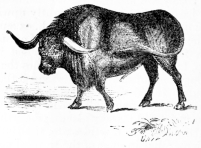
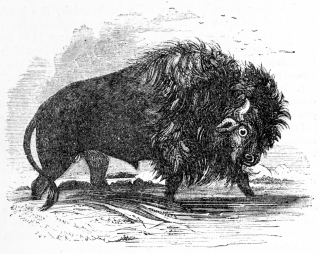
THE BISON. (Bos or Bison Bonasus.)
There are two kinds of Bison; one a native of Europe, and the other of America. The European Bison, or Bonasus, is as large as a bull or ox; maned about the back and neck like a lion; and his hair hanging down under his chin, or nether jaw, like a large beard. The fore parts of his body are thick and strong, but the hinder parts are comparatively slender. He has a little ridge along his face from his forehead down to his nose, which is very hairy; his horns are large, very sharp, and turning towards his back, like those of a wild goat. The American Bison (B. Americanus), attains a size far superior to that of the largest breeds of our common oxen, and is met with throughout nearly the whole of the uninhabited parts of North America, from Hudson’s Bay to Louisiana and the frontiers of Mexico. Captains Lewis and Clarke, and Dr. James, bear frequent testimony to the almost incredible numbers in which these animals assemble on the banks of the Missouri. “Such was their multitude,” say the first-named travellers, “that, although the river, including an island over which they passed, was a mile in breadth, the herd stretched, as thick as they could swim, completely from one side to the other.” And again they say: “If it be not impossible to calculate the moving multitude which darkened the whole plains, we are convinced that twenty thousand would be no exaggerated number.” Dr. James tells us that, “in the middle of the day countless thousands of them were seen coming in from every quarter to the stagnant pools;” their paths, as he informs us elsewhere, being “as frequent, and almost as conspicuous, as the roads in the most populous parts of the United States.”
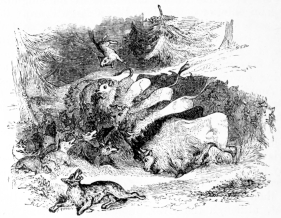
These wild cattle defend themselves from the wolves in the most admirable manner. When they hear their savage enemies approaching they form themselves adroitly into a circle. The weakest are left in the middle, whilst the strongest are on the outside, and present to their foes an impenetrable phalanx of horns. The vignette is an illustration of this subject.
Exciting stories of the buffalo hunt, both American and African, will be seen in Catlin’s North American Indians, and Harris’s Wild Animals and Sports of Southern Africa.
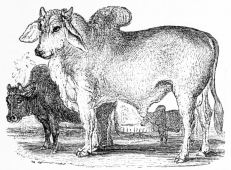
THE ZEBU, OR BRAHMIN BULL. (Bos Indicus.)
Pennant describes the Zebu, or Indian Ox, as sometimes surpassing in size the largest of the European breeds, and the hunch on his shoulders as weighing frequently fifty pounds. There are many varieties, with and without horns, differing in size from that above-named, down to the dimensions of an ordinary hog. They are spread over the whole of Southern Asia, and also in Africa. In all these countries the Zebu supplies the place of the Ox, both as a beast of burden and as an article of food. By the Hindoos they are treated with great veneration, and it is held sinful to deprive them of life, or eat their flesh. A select number are exempted from all labour, and allowed to wander about, and subsist on the voluntary and pious contributions of the devotees of their faith.
Emboldened by the toleration they experience, they make free with every vegetable to which they take a fancy, no one daring to resist or drive them away; often they lie down in the street; no one must disturb them: every one must give place to the sacred Ox of Brahma; thus they are frequently nuisances, which superstition alone would endure.
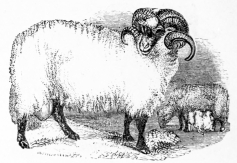
THE SHEEP. (Ovis Aries.)
The Sheep has been so long subjected to the empire of man that it is not known with certainty from what race our domestic species has been derived. It is supposed, however, to be from the Mouflon, or Musmon, of Sardinia and Crete. This animal is one of the most useful ever bestowed on us by a bountiful Providence; and in patriarchal times the number of Sheep constituted the riches of kings and princes. It is universally known, its flesh being one of the chief kinds of human food, and its wool being of great use for clothing. Although of a moderate size, and well covered, it does not live more than nine or ten years. The Ewe has one or two young at a time, and the young one, which is called a lamb, has always been an emblem of innocence.
In its domestic state it is too well known to require a detail of its peculiar habits, or of the methods which have been adopted to improve the breed. No country produces finer Sheep than England, either with larger fleeces or better adapted for the business of clothing. Those of Spain have confessedly finer wool, some of which we generally require to work up with our own, but the weight of a Spanish fleece is much inferior to one of Lincoln or Tees Water. Merino, or Spanish Sheep, have of late years been introduced with some success into our English pastures, and the wool of the hybrids, raised between the Merino Sheep and the South Down Sheep, is thought nearly equal to that of Spain.
In stormy weather, these animals generally hide themselves in caves from the fury of the elements; but if such retreats are not to be found, they collect themselves together, and, during a fall of snow, place their heads near each other, with their muzzles inclined to the ground. In this situation they sometimes remain till hunger compels them to gnaw each other’s wool, which forms into hard balls in the stomach and destroys them. But in general they are sought out and extricated soon after the storm has subsided.
“The Sheep,” Mr. Bell observes, “is one of the most interesting of all animals as regards its historical relations with man. It was the subject of the first sacrifices, and was used in its typical character as an offering of atonement; and the relation which existed between the patriarchal shepherds and their flock was of so intimate and even affectionate a nature as to have afforded the subject of many beautiful passages in the Holy Scriptures.”
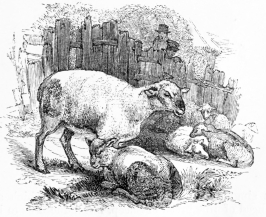
THE RAM
Is the male Sheep, and is so strong and fierce that he will boldly attack a dog, and often comes off victorious: he has even been known, regardless of danger, to engage a bull; and his forehead being much harder than that of any other animal, he seldom fails to conquer. He overcomes the bull, who, by lowering his head, receives the stroke of the Ram between his eyes, which usually brings him to the ground.
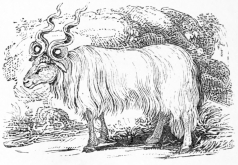
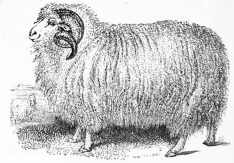
THE WALLACHIAN RAM.
The singular conformation of the horns, which adorn the head of this breed of Sheep, has induced us to insert a figure of the animal in this work, though it is only a variety of the common species. The horns of the Ewe are twisted also, but not so much as those of the Ram, which form, near the head, a spiral line. The wool is much longer than that of the common Sheep, and resembles the hair of the goat. A fine Ram of this species was presented some years since to the Zoological Gardens in the Regent’s park, by Dr. Bowring. It is there called the Parnassian Sheep, having been brought from Mount Parnassus.
THE ARGALI, OR WILD SHEEP OF ASIA,
in figure somewhat resembles a ram, but his wool is rather like the hair of a goat. His horns are large and bent backwards, and his tail is short. He is of the size of a small deer, active, swift, wild, and found in flocks in the rocky, dry deserts of Asia. His flesh and fat are delicious. He is called also the Siberian Sheep or Goat, and is considered by some to be the parent stock of the domestic Sheep.
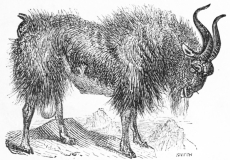
THE GOAT. (Capra hircus.)
The Goat, next to the cow and the sheep, has been always reckoned, especially in ancient and patriarchal times, the most useful domestic animal. Its milk is sweet, nourishing, and medicinal, and better adapted for persons of weak digestion than that of the cow, as it is not so apt to curdle on the stomach. The female has generally two young ones at a time, which are called kids. This animal is admirably adapted for living in wild places; it delights in climbing precipices, and is often seen reposing in peaceful security on rocks overhanging the sea. Nature indeed has in some measure fitted it for traversing these eminences; the hoof being hollow underneath, with sharp edges, so that it can walk as securely on the ridge of a house as on the level ground. The flesh of the goat is seldom eaten; but that of the kid is esteemed a very delicate food, and is frequently eaten on the Continent. In the East, the long soft hair of the goat is used in making the beautiful Cashmere shawls; and from the skin is manufactured morocco leather. The skin of the kid is well known for its use in making gloves.
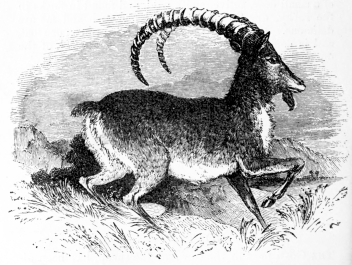
THE IBEX, OR BOQUETIN, (Capra Ibex,)
Is a Wild Goat, which inhabits the Pyrenean mountains, the Alps, and the highest mountains of Greece. He is of an admirable swiftness; his head is armed with two long, knotted horns, inclining backwards; his hair is rough, and of a deep brown colour. The male only has a beard, and the female is less than the male. This animal skips from rock to rock, and often, when pursued, leaps down enormous precipices, and is said to bend his head between his fore legs while springing, so as to break his fall, by alighting partly on his horns. The Ibex has been known to turn on the incautious huntsman, and tumble him down the precipice, unless he has time to lie down, and let the animal pass over him.
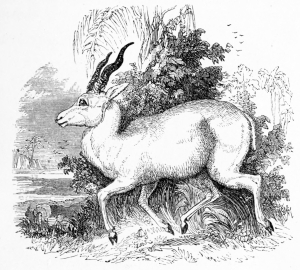
THE ANTELOPE. (Antilope cervicapra.)
These beautiful inhabitants of the temperate regions of Africa, and southern Asia, possess swiftness and elegance of shape in an eminent degree. They are timid, inoffensive, and gregarious. The males have horns like those of the goat, and never shed them; they are smooth, long, twisted spirally, and annulated. The general colour of the hair is brown, and, in some species, a beautiful yellow. The eyes are exceedingly bright, and have often been compared to those of a beautiful nymph by Persian and other poets. Enjoying perfect liberty, they range in herds through the deserts of Arabia, and bound from rock to rock with wonderful agility. Their long and slender legs are peculiarly suited to their habits and manners of life, and are, in some of the species, so slender and brittle as to snap with a very trifling blow. The Arabs, taking advantage of this circumstance, catch them by throwing sticks at them, by which their legs are broken.
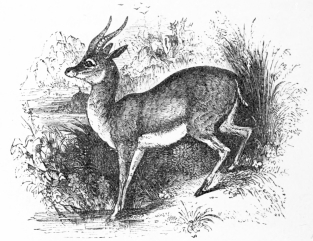
THE GAZELLE. (Antilope Dorcas.)
“The wild Gazelle, on Judah’s hills, Exulting yet may bound, And drink from all the living rills That gush on holy ground. Its airy step and glorious eye May glance in tameless transport by.”—Byron.
The Gazelle is the most elegant of antelopes. The Arabian poets have applied their choicest epithets to the beauty of this animal, and their descriptions have been adopted into our own poetry. Byron, in speaking of the dark eyes of an eastern beauty, says:
“Go look on those of the Gazelle.”
When the Persian describes his mistress, she is “an antelope in beauty,”—“his Gazelle employs all his soul;” and thus, in their figurative language, perfect beauty and Gazelle beauty are synonymous. These animals are spread, in innumerable herds, from Arabia to the river Senegal in Africa. Lions and panthers feed upon them; and man chases them with the dog, the cheetah, and the falcon. The height of the Gazelle is about twenty inches, the skin beautifully sleek, its body extremely graceful, its head unusually light, its ears flexible, its eyes most brilliant and glancing, and its legs as slender as a reed.
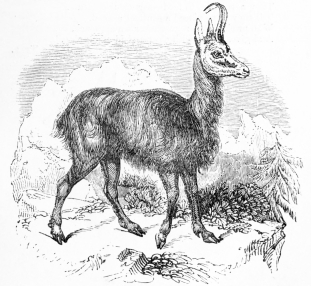
THE CHAMOIS. (Antilope Rupicapra.)
The Chamois is about three feet in length and two in height; its horns six or seven inches long, its ears small, and its head resembling that of the goat. The body is covered with long brown hair, the hue of which varies with the season.
The flesh is considered a savoury food, and the skin is wrought into a soft pliable leather, well known in domestic economy.
The Chamois is found only in the mountainous regions of Europe, where they herd together on lofty and almost inaccessible cliffs and precipices. They are so acute and shy, that it is only by the greatest patience and skill that the hunter can approach near enough to shoot them; and they are so swift, and leap with such extraordinary sureness of foot, that to overtake them is impossible.
“—— —— —— But beasts have reason too. And that we know, we men that hunt the Chamois, They never turn to feed—sagacious creatures— Till they have placed a sentinel a-head, Who pricks his ears whenever we approach, And gives alarm with clear and piercing pipe.” Schiller’s William Tell.
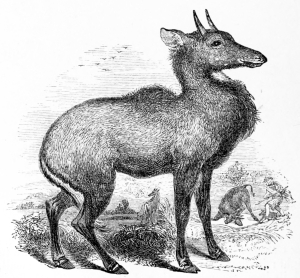
THE NYL GHAU, OR BLUE OX. (Antilope picta.)
THE NYL GHAU, OR BLUE OX. (Antilope picta.)
This is a large kind of antelope, found in India. In the wild state these animals are very ferocious, but they may be domesticated, and in that condition give frequent tokens of familiarity, and even of gratitude, to those under whose care they are placed. The female, or doe, is much smaller than the male, and of a yellowish colour, by which she is easily distinguished from the buck, who is of a grey tint.
Its manner of fighting is very peculiar, and is thus described:—Two of the males, at Lord Clive’s, being put into an enclosure, were observed, while they were at some distance from each other, to prepare for the attack, by falling down upon their knees; they then shuffled towards each other, still keeping upon their knees; and, at the distance of a few yards, they made a spring, and darted against each other with great force.
The following anecdote will serve to show that these animals are sometimes fierce and vicious, and not to be depended upon:—A labouring man, without knowing that the animal was near him, went up to the outside of the enclosure; the Nyl Ghau, with the quickness of lightning, darted against the woodwork with such violence that he dashed it to pieces, and broke one of his horns close to the root. The death of the animal soon after was supposed to be owing to the injury he sustained by the blow.
The Nyl Ghau usually keeps closely concealed in the jungle, but in the night or early morning it sometimes passes into the open ground, to feed in the corn-fields belonging to the neighbouring villages. This is the moment chosen by the natives to attack it. A platform is erected near the spot the Nyl Ghau is known to frequent, from which the hunters can take aim with precision and safety.
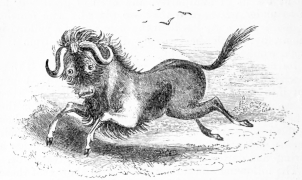
THE GNU. (Antilope Gnu.)
This very singular animal is sometimes called a horned horse; as it has the shape and mane of a horse, with the addition of a formidable pair of horns, a kind of beard below the chin, and a fringe of hair below the body, along the breastbone. The Gnus live together in herds, and when alarmed, fling up their heels, and plunge and rear, tossing their heads and tails, before they gallop off; which they do, the whole herd following their leader singly, like a troop of soldiers. The Gnu inhabits the sandy deserts of South Africa; and its flesh, which is said to resemble beef, is sometimes eaten by the colonists near the Cape of Good Hope. When caught young the Gnu may be tamed, but its disposition is always uncertain, and when offended it throws itself on its knees, like the nyl ghau, and then springing up, butts furiously with its horns.
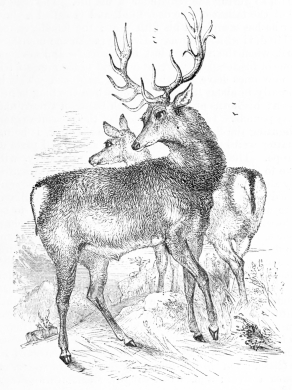
THE STAG. (Cervus Elaphus.)
This animal is the male of the red Deer, and is generally famed for long life, though upon no certain authority. Naturalists agree, however, upon this point, that his life may exceed forty years: but that his existence, as it has been asserted, reaches to three centuries, is too absurd to be believed. His horns are at first very small, but gradually increase in size, as they are yearly shed and renewed, till the stag has completed his fifth year, when they become very large and branching, and remain so during the remainder of his life. The Stag is one of the tallest of the deer kind, and is called a Hart after he has completed his fifth year; the female, called the Hind, is without horns. Every year, in the month of April, when the Stag has lost his horns, he appears conscious of his temporary weakness, and hides himself till his new ones have grown and are hardened. This is generally in about ten weeks, even when the Stag is full grown; his horns at this age weigh between twenty and thirty pounds. Little need be said of the pleasure taken in hunting the Stag, the Hart, and the Roebuck, it being a matter well known in this country, and in all parts of Europe. The following fact, recorded in history, will serve to show that the Stag is possessed of an extraordinary share of courage, when his personal safety is concerned:—In the reign of George the Second, William, Duke of Cumberland, caused a tiger and a Stag to be enclosed in the same area; and the Stag made so bold a defence, that the tiger was at length obliged to give up. The flesh of the Stag is accounted excellent food, and his horns are useful to cutlers; even their shavings are used to make ammonia, so much esteemed in medicine under the name of hartshorn. The swiftness of the Stag has become proverbial, and the diversion of hunting this creature has, for ages, been looked upon as a royal amusement. In the time of William Rufus and Henry the First, it was less criminal to destroy a human being than a full-grown Stag. This animal, when fatigued in the chase, often throws himself into a pond of water, or crosses a river; and, when caught, sheds tears like a child.
“To the which place a poor sequestered Stag, That from the hunter’s aim had ta’en a hurt, Did come to languish; and indeed, my lord, The wretched animal heaved forth such groans That their discharge did stretch his leathern coat Almost to bursting; and the big round tears Coursed one another down his innocent nose In piteous chase.” Shakespeare.
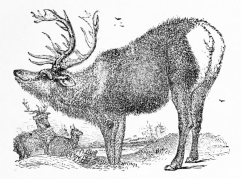
THE WAPITI, (Cervus Canadensis,)
Is a native of Canada and other northern parts of America, and is one of the most gigantic of the Deer tribe, growing to the height of our tallest oxen, and uniting great activity to strength of body and limbs. His horns, which he sheds annually, are very large, branching in serpentine curves, and measuring from tip to tip upwards of six feet. These animals make a shrill noise, resembling the braying of an ass, and are supposed to be the most stupid of the Deer kind. The flesh is coarse, and little esteemed, but the hide, when made into leather, is said not to become hard in drying after being wetted, a quality which entitles it to a preference over almost every other kind. There are several of these splendid animals in the collection of the Zoological Society, in the Regent’s Park, where they continue to form objects of singular interest and attraction. The male is, however, very fierce, always endeavouring to attack those who approach him; and on one occasion seriously injured one of the visitors to the gardens.
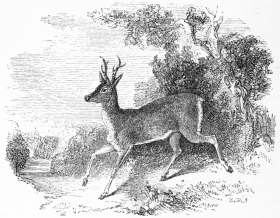
THE ROEBUCK, (Cervus capreolus,)
Is one of the least of the Deer kind known in these climates, being not above three feet in length, and two in height, and seldom lives more than fifteen years. His horns are about nine inches long, round, and divided into three small branches, and his colour is of a brown shade on the back, his face partly black and partly ash-colour, the chest and belly yellow, and the rump white; his tail is short. The Roebuck is more graceful, more active, more cunning, and comparatively swifter than the stag; his flesh is much esteemed. He is very delicate in the choice of his food, and requires a larger tract of country, suited to the wildness of his nature, which can never be thoroughly subdued. No arts can teach him to be familiar with his keeper, nor in any degree attached to him. These animals are easily terrified; and in their attempts to escape will run with such force against the walls of their enclosure, as sometimes to disable themselves: they are also subject to capricious fits of fierceness; and, on these occasions, will strike furiously with their horns and feet at the object of their dislike. The only parts of Great Britain where they are now found are the Highlands of Scotland.
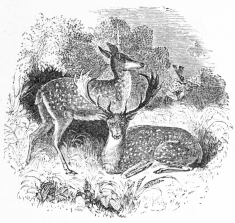
THE FALLOW DEER. (Cervus dama.)
These are the Deer now usually kept in our parks. The beautifully spotted kind are said to have been brought from Bengal, and the very deep brown from Norway by King James I. Their horns are broad and flat; the male is called a buck, the female a doe, and the young one a fawn. The buck casts his horns every spring, and they increase in size annually till he has attained his fifth year. The venison of this Deer is very far superior to that of the red deer, which is coarse and tough. The buck-skin and doe-skin are well known, as furnishing a peculiarly soft and warm leather, which is used for gloves, gaiters, &c. The horns are used for the handles of knives, &c., like those of the stag; and the refuse is, in the like manner, used in the manufacture of ammonia. The buck stands about three feet high, and measures about five feet in length; the doe is somewhat smaller. The tail is much longer than either that of the stag or the roebuck, being nearly seven inches and a half long.
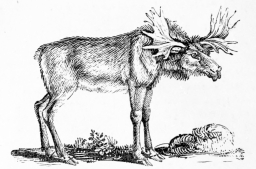
THE ELK, (Cervus Alces,)
Is the largest of all the Deer kind. The antlers, at first simple, and then divided into narrow slips, assume in the fifth year the form of a triangular blade, dentated on the external edge and very thick at the base; they increase with age, till they weigh fifty or sixty pounds, and have fourteen branches to each horn. The Elk lives in forests, feeding upon branches and sprouts of trees, and inhabits Europe, Asia, and America; in the last-named country he is known by the name of the Moose Deer. There is very little difference between the European Elk and the American Moose Deer, though they are larger in the New World than with us, owing perhaps to the extensive forests in which they range. In all places, however, they are timorous and gentle; content with their pasture, and never willing to disturb any other animal. The pace of the Elk is a high, shambling trot, but it runs with great swiftness. Formerly these animals were made use of in Sweden to draw sledges, but their swiftness gave criminals such means of escape, that this employment of them was prohibited under great penalties. The female is less than the male, and has no horns.
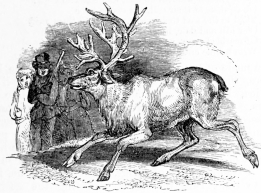
THE REIN-DEER, (Cervus Tarandus, or Rangifer Tarandus,)
Is found in most of the northern regions of Europe, Asia, and America, and its general height is about four feet and a half. The colour is brown above and white beneath; but as the animal advances in age, it often becomes of a greyish white. The hoofs are long, large, and black. Both sexes are furnished with horns, but those of the male are much the largest. To the Laplanders this animal supplies the place of the horse, the cow, the goat, and the sheep; it is their only wealth. The milk affords them cheese; the flesh, food; the skin, clothing; of the tendons they make bowstrings, and when split, thread; of the horns, glue; and of the bones, spoons. During the winter, the Reindeer supplies the want of a horse, and draws sledges with amazing swiftness over the frozen lakes and rivers, or over the snow, which at that time covers the whole country. Innumerable are the uses, the comforts, and advantages which the poor inhabitants of this dreary climate derive from this animal. We cannot sum them up better than in the beautiful language of the poet:
“Their Rein-deer form their riches. These their tents, Their robes, their beds, and all their homely wealth Supply, their wholesome fare, and cheerful cups: Obsequious at their call, the docile tribe Yield to the sled their necks, and whirl them swift O’er hill and dale, heaped into one expanse Of marbled snow, as far as eye can sweep, With a blue crest of ice unbounded glazed.”
The mode of hunting the wild Rein-deer by the Laplanders, the Esquimaux, and the Indians of North America, has been accurately described by late travellers. Captain Franklin gives the following interesting account of the mode practised by the Dog-rib Indians, to kill these animals. “The hunters go in pairs, the foremost man carrying in one hand the horns and part of the skin of the head of a Deer, and in the other a small bundle of twigs, against which he, from time to time, rubs the horns, imitating the gestures peculiar to the animal. His comrade follows, treading exactly in his footsteps, and holding the guns of both in a horizontal position, so that the muzzles project under the arms of him who carries the head. Both hunters have a fillet of white skin round their foreheads, and the foremost has a strip of the same round his wrists. They approach the herd by degrees, raising their legs very slowly, but setting them down somewhat suddenly, after the manner of a Deer, and always taking care to lift their right or left feet simultaneously. If any of the herd leave off feeding to gaze upon this extraordinary phenomenon, it instantly stops, and the head begins to play its part, by licking its shoulders, and performing other necessary movements. In this way the hunters attain the very centre of the herd without exciting suspicion, and have leisure to single out the fattest. The hindmost man then pushes forward his comrade’s gun, the head is dropped, and they both fire nearly at the same instant. The Deer scamper off, the hunters trot after them; in a short time the poor animals halt, to ascertain the cause of their terror; their foes stop at the same moment, and having loaded as they ran, greet the gazers with a second fatal discharge. The consternation of the Deer increases; they run to and fro in the utmost confusion; and sometimes a great part of the herd is destroyed within the space of a few hundred yards.”
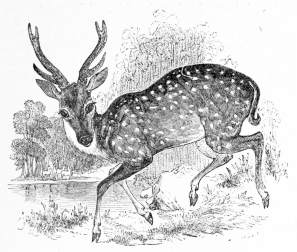
THE AXIS. (Cervus Axis.)
A very beautiful species of the Deer is found in the East Indies, of a light red colour, though some of the kind are of a deeper red. It is about the size of a fallow deer, and often variegated with beautiful spots of bright white. The horns are slender and triple-forked. The Axis is a timid and harmless creature, more ornamental to the landscape, where it skips and plays in a wild state, than useful to man. It is extremely docile, and possesses the sense of smelling to an exquisite degree. Though it is a native of the banks of the Ganges, it appears to bear the climates of Europe without injury.
THE MUSK DEER. (Moschus moschiferus.)
This is a small species of Deer, quite destitute of horns, which lives on the vast plains of Central Asia. It is distinguished by possessing a pair of canine teeth or tusks in the upper jaw; and these teeth, which are not found in the ruminant animals generally, are so long in the Musk Deer that they project from the sides of the mouth and descend below the chin. The Musk Deer is exceedingly active, and leaps to an astonishing height. The male is remarkable for possessing a pouch about the size of an egg, near the navel; this contains a brown, oily matter, of a most powerful odour, which is the well-known perfume called musk, so highly esteemed amongst Eastern nations.
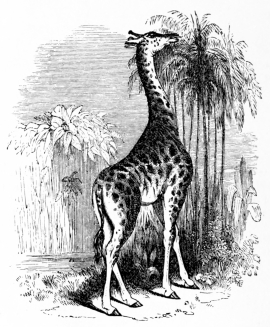
THE GIRAFFE, OR CAMELOPARD. (Camelopardalis Giraffa.)
This most remarkable ruminant, which in its general structure nearly approaches the Deer, has points of affinity also with the antelopes and camels, besides very striking peculiarities of its own.
The head is the most beautiful part of the animal: it is small, and the eyes are large, brilliant, and very full. Between the eyes, and above the nose, is a swelling very prominent and well-defined. This prominence is not a fleshy excrescence, but an enlargement of the bony substance; and it seems to be similar to the two little lumps, or horns, with which the top of the head is armed, and which, being several inches in length, spring on each side of the head, just above the ears, and are terminated by a thick tuft of stiff upright hairs. The neck is remarkably elongated, and it is furnished with a very short, stiff mane, which stands out erect from the skin. The height of a full-grown Giraffe in a wild state is said to be seventeen or eighteen feet, measuring from the hoofs to the tip of the ears; but none of those in England exceed fourteen feet. At first sight, the fore legs appear much longer than the hind ones; but the fact is, that the legs are of the same length, and it is only the height of the withers that occasions the apparent disproportion. Le Vaillant was the first well-informed naturalist who studied the habits of the Giraffe in its wild state. “If,” he says, “among the known quadrupeds, precedency be allowed to height, the Giraffe without doubt must hold the first rank. A male which I have in my collection measured, after I killed it, sixteen feet four inches from the hoof to the extremity of its horns. I use this expression in order to be understood; for the Giraffe has no real horns; but between its ears, at the upper extremity of the head, arise in a perpendicular and parallel direction two excrescences from the cranium, which without any joint stretch to the height of eight or nine inches, terminating in a convex knob, and are surrounded by a row of strong straight hair, which overtops them by several lines. The female is generally lower than the male.... In consequence of the number of these animals which I killed, or had an opportunity of seeing, I may establish as a certain rule that the males are generally fifteen or sixteen feet in height, and the females from thirteen to fourteen feet.” The colour of the Giraffe is a light fawn, marked with spots only a few shades darker. The legs are very slender; and, notwithstanding the length of the neck, it manifests great difficulty in taking anything from the ground. To do this, it puts out first one foot, and then the other; repeating the same process several times; and it is only after several of these experiments that it at length bends down its neck, and applies its lips and tongue to the object in question. In fact, the neck of the Giraffe, although so enormously long, is not very flexible, as it contains only the same number of vertebræ or joints (seven) that is found in other quadrupeds with a much shorter neck; it is admirably adapted for enabling the animal to browse upon the branches of trees, but is not intended to fit it for grazing. It willingly accepts fruit and branches of a tree when offered to it; and seizes the foliage in a most singular manner, thrusting forth a long, reddish, and very narrow tongue, which it rolls round whatever it wishes to secure. Indeed, the tongue is a most remarkable organ in this animal, and we have been witness of some amusing exploits with it. In the Zoological Gardens at Regent’s Park, many a fair lady has been robbed of the artificial flowers which have adorned her bonnet, by the nimble, filching tongue of the rare object of her admiration.
The Giraffe is a native of Africa; and it was for a long time known only by the descriptions of travellers. It was first sent to Europe in 1829; but since that time many have been introduced, and several young ones have been born in the Zoological Gardens in the Regent’s Park.
Le Vaillant, in his entertaining Travels in Africa, gives an animated account of a Giraffe hunt:—“After several hours’ fatigue, we discovered, at the turn of a hill, seven Giraffes, which my pack instantly pursued. Six of them went off together; but the seventh, cut off by my dogs, took another way. I followed it at full speed, but, in spite of the efforts of my horse, she got so much ahead of me that, in turning a little hill, I lost sight of her altogether. My dogs, however, were not so easily put out. They were soon so close upon her, that she was obliged to stop to defend herself. From the place where I was, I heard them give tongue with all their might; and, as their voices appeared all to come from the same spot, I conjectured that they had got the animal in a corner, and I again pushed forward. I had scarcely got round the hill, when I perceived her surrounded by the dogs, and endeavouring to drive them away by heavy kicks. In a moment I was on my feet, and a shot from my carbine brought her to the earth. Enchanted with my victory, I returned to call my people about me, that they might assist in skinning and cutting up the animal. On my return I found her standing under a large ebony-tree, assailed by my dogs. She had staggered to this place, and fell dead at the moment I was about to take a second shot.”
The horns of the Giraffe, small as they are, and muffled with skin and hair, are by no means the insignificant weapons they seem. We have seen them wielded by the males against each other with fearful and reckless force; and we know that they are the natural arms of the Giraffe, most dreaded by the keeper of the present living Giraffes in the Zoological Gardens, because they are most commonly and suddenly put in use. The Giraffe does not butt by depressing and suddenly elevating the head, like the deer, ox, or sheep; but strikes the callous obtuse extremities of the horns against the object of his attack, with a sidelong sweep of the neck.
The Giraffe has a peculiarly awkward manner of trotting, as it moves both the legs on one side at the same time. In galloping, the Giraffe separates its hind legs widely, and at each stride brings them far forward on each side of the fore feet; in this way the animal makes rapid progress, although its appearance is rather extraordinary, and the stones cast backwards by the force of the hind feet not unfrequently assist in protecting it when closely pursued. The female Giraffe in the Regent’s Park was a very bad mother to her first young one, as she would not let it suck, and beat it away whenever it approached. The poor thing was fed with cow’s milk, but it soon died. Later young ones have been more kindly treated, and have in consequence thriven well.
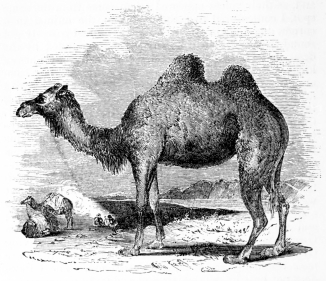
THE BACTRIAN CAMEL. (Camelus Bactrianus.)
“In silent horror, o’er the boundless waste, The driver Hassan with his Camels passed: One cruse of water on his back he bore, And his light scrip contained a scanty store: A fan of painted feathers in his hand, To guard his shaded face from scorching sand; The sultry sun had gained the middle sky, And not a tree, and not a herb was nigh: The beasts with pain their dusty way pursue, Shrill roar’d the winds, and dreary was the view!” Collins.
The Bactrian Camel is a native of the deserts of Asia, and is generally of a brown or ash colour. His height is about six feet. He is one of the most useful quadrupeds in oriental countries; his docility and strength, his endurance of hunger and thirst, and his swiftness, make him a most valuable acquisition to the inhabitants of those desert places. The principal characteristics of the Camel are these:—He has two large and hard bunches on his back, and is destitute of horns; the upper lip is divided like that of the hare; and the hoofs small and placed at the end of two long toes, which are united below by a pad-like sole. But the peculiar and distinguishing characteristic of the Camel is its faculty of abstaining from water for a greater length of time than any other animal; for which nature has made a wonderful provision, by adapting the surface of one of the four stomachs, which it has in common with all ruminating animals, to serve as a reservoir for water, where it remains without corrupting or mixing with the other aliments. By this singular structure it can take a prodigious quantity of water at one draught, and is enabled to pass as much as fifteen days without drinking again. But besides this reservoir of water the animal is said in cases of emergency to draw sustenance from the humps on his back, which are of a fatty substance: thus, after long privation, they become absorbed. A large Camel is capable of carrying ten or even twelve hundredweight, and, like the elephant, is tame and tractable; but, like him, he has his periodical fits of rage, and at these times has been known to take up a man in his teeth, throw him on the ground, and trample him under his feet. Like the horse, he gives security to his rider; and, like the cow, he furnishes his owner with meat for his table, and the female with milk for his drink. The flesh of the young Camel is esteemed a delicacy, and the milk of the female, diluted in water, is the common drink of the Arabians. The hair or fleece, which falls off entirely in the spring, is superior to that of any other domestic animal, and is made into very fine stuffs, for clothes, coverings, tents, and other furniture. The female goes one year with young, and produces but one at a time. The Camel kneels to receive his burthen, and it is said that he refuses to rise if his master imposes upon him a weight above his strength. He has callosities on his knees and on his breast, which prevent him from being hurt by kneeling to take up his load; and sleeps with his knees bent under him, and his breast on the ground. He arrives at maturity in about five years, and the duration of his life is from forty to fifty years.
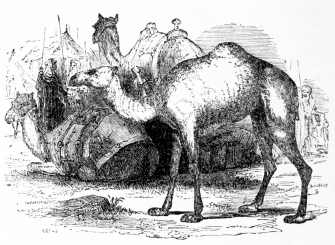
THE ARABIAN CAMEL, OR DROMEDARY. (Camelus Dromedarius.)
Another species of Camel, of less stature than the former, but much swifter, and having but one hard bunch on his back, is domesticated throughout Africa, as well as in Asia. It is said that a Dromedary can travel one hundred miles a day, and carry fifteen hundredweight. Attempts have been made to introduce the Camel and Dromedary into our West India islands, but they have not succeeded; they have, however, been comparatively naturalized near Pisa in Italy. The Camels used as beasts of burden in Egypt are all Dromedaries; and the first experiment which an European makes in bestriding one is generally a service of some little danger, from the peculiarity of the animal’s movement in rising. Denon, the French traveller, has described this with his usual vivacity: “During the French invasion of Egypt, a part of Dessaix’s division,” to which the scientific traveller was attached, “was sent with Camels to a distant post across the desert. The Camel, slow as he generally is in his actions, lifts up his hind legs very briskly at the instant the rider is in the saddle; the man is thus thrown forward; a similar movement of the fore legs throws him backward; each motion is repeated; and it is not till the fourth movement, when the Dromedary is fairly on his feet, that the rider can recover his balance. None of us could resist the first impulse, and thus nobody could laugh at his companions.” Macfarlane, in his work on Constantinople, tells us that upon his first Camel adventure he was so unprepared for the probable effect of the creature’s rising behind, that he was thrown over his head, to the infinite amusement of the Turks, who laughed heartily at his inexperience.
Though the name of Dromedary is very generally applied to all the one-humped camels, both in common parlance and books on Natural History, it is said that the true Dromedary (El Herie) is merely a peculiarly swift camel. The name of Dromedary, indeed, appears to be applied in the East to all the higher bred camels, the genealogy of which is kept by the Arabs as carefully as that of their horses.
Possessing strength and activity surpassing that of most beasts of burthen, docile, patient of hunger and thirst, and contented with small quantities of the coarsest provender, the camel is one of the most valuable gifts of Providence. There is nothing, however, in the exterior appearance of the animal to indicate the existence of any of its excellent qualities. In form and proportions it is very opposite to our usual ideas of perfection and beauty. A stout body, having the back disfigured by a great hump; limbs long, slender, and seemingly too weak to support the trunk; a long, thin, crooked neck, surmounted by a heavily-proportioned head, are all ill-suited to produce favourable impressions. Nevertheless, there is no creature more excellently adapted to its situation, nor is there one in which more of creative wisdom is displayed in the peculiarities of its organization. To the Arabs, and other wanderers of the desert, the Camel is at once wealth, subsistence, and protection.
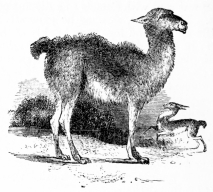
THE LLAMA, OR CAMEL OF AMERICA, (Auchenia glama,)
Is a mild, timorous creature, not above four feet and a half in height, and usually of a brown colour. It bears in form a general resemblance to the Camel; but, instead of a protuberance on the back, it has one on the breast. Llamas are used as beasts of burden by the South Americans, and are so capriciously vindictive, that, if their drivers strike them, they immediately squat down, and nothing but caresses can induce them to rise again. They have been known to kill themselves by striking their heads against the ground in their rage, when by blows they have been urged forward against their will. They express their anger by spitting at their adversary. The Alpacas are much smaller than the Llamas, and of different colours in a domestic state. They are used for the same purposes, and differ little in habits and nature. The wool of both these animals is made use of for several purposes, and is a principal ingredient in the composition of hats in several parts of the new and old continent; and the flesh of the young Llamas is, in their native country, considered a great delicacy, and is as good as that of the fat sheep of Castile. In Peru, where the animals are found, there are public shambles for the sale of their flesh.
§ IX.—Quadrumana, or Four-handed Animals.
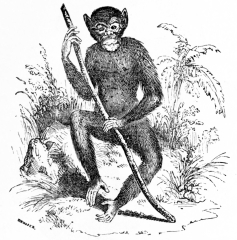
THE OURANG OUTAN. (Simia satyrus.)
Animals of the Monkey tribe are furnished with hands instead of paws; their ears, eyes, eyelids, lips, and breasts resemble those of the human species. For greater facility of description, the animals of this extensive tribe are usually arranged in the three divisions of Apes, Baboons, and Monkeys. Apes are destitute of tails, and the chief of this kind is the Ourang Outan, or Wild Man of the Woods: he is found in the forests of Borneo and Sumatra. He is a solitary animal, and avoids mankind. The largest are said to be six feet high, very active, strong, and intrepid, capable of overcoming the strongest man: they are likewise exceedingly swift, and cannot easily be taken alive. When young, however, the Ourang Outan is capable of being tamed: one of them, shown in London some years ago, was taught to sit at table, make use of a spoon or fork in eating, and drink wine out of a glass. It was mild and affectionate, much attached to its keeper, and obedient to his commands.
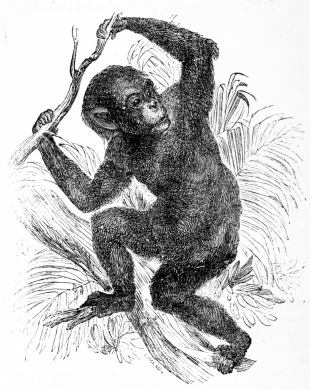
THE CHIMPANZEE. (Simia Troglodytes, or Troglodytes niger.)
This Ape, which is an inhabitant of the great forests of Western Africa, is generally considered to be that which approaches nearest to the human species in its conformation. When full-grown, he measures about five feet in height, standing erect, but this is a posture which he does not naturally prefer, and when on the ground he usually walks upon all fours, applying the outside of his hinder feet and the knuckles of his fore limbs to the earth. His skin is clothed with long coarse black or dark-brown hair, which becomes scanty on the lower surface of the body and on the limbs; the face is naked and of a flesh colour, and at each side there hangs down a great bush of long hair like a whisker. The Chimpanzee lives in the trees, upon the branches of which he is very active, and he has intelligence enough to build himself a sort of hut of branches, usually about thirty or forty feet from the ground. His food consists chiefly of fruits, and he is said to fly from the presence of man.
Young Chimpanzees have frequently been brought to this and other European countries, and several of them have been exhibited in our Zoological Gardens. They are generally gentle and rather melancholy in their deportment, and often show much affection for those who have the charge of them. Of a specimen exhibited in France in his time, Buffon gives the following interesting account: “I have seen this animal,” he says, “present its hand to lead out its visitors, or walk about with them gravely as if it belonged to the company. I have seen it seat itself at table, unfold its napkin and wipe its lips, use its spoon and fork to carry its food to its mouth, pour its drink into a glass, and touch glasses when invited; fetch a cup and saucer to the table, put in sugar, pour out its tea, and leave it to cool before drinking it; and all this without any other instigation than the signs and words of its master, and often of its own accord.” Buffon adds that it had a taste which, no doubt, some of our young readers partake: “It was excessively fond of sugar-plums.”
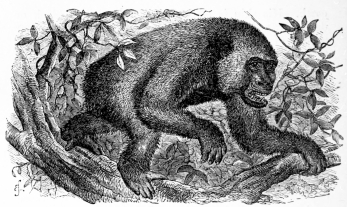
THE GORILLA. (Troglodytes Gorilla.)
This wonderful Ape, which has lately been discovered in the same region inhabited by the Chimpanzee, is thought, in some respects, to possess even a greater resemblance to our own species. He is said to attain a height of seven feet, but the largest specimens hitherto obtained have been rather less than six feet high. By some travellers the Gorilla is said to walk upright, with his hands resting on the nape of his neck, but the state of his knuckles shows that he usually goes, like the Chimpanzee, on all fours. His skin is covered with short grizzled hair, and the naked skin of his face and hands is black. The Gorilla is much dreaded by the negroes who have to pass through the forests frequented by him when engaged in hunting the Elephant; this is not on account of his teeth, although they are sufficiently formidable, but of the enormous strength of his hands, with which he can strangle a man in a moment, and it is even said that the old males never miss an opportunity of performing this operation. It is even said, that as a party of hunters is passing through the forest, one of their number will sometimes disappear suddenly, being caught up by a Gorilla lurking upon the low branches of a tree; the monster speedily strangles his victim and then lets the body fall.
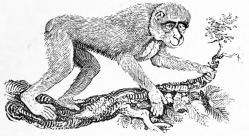
THE MAGOT, OR BARBARY APE, (Inuus sylvanus,)
Is a species of Monkey quite destitute of a tail, which inhabits the northern parts of Africa, and is also found on the Rock of Gibraltar. Caubasson relates a laughable anecdote of one of these animals, which he brought up tame, and which became so attached to him as to be desirous of accompanying him wherever he went: when, therefore, he had to perform divine service, he was under the necessity of shutting him up. One day, however, the animal escaped, and followed the father to church, where, silently mounting on the top of the sounding-board, above the pulpit, he lay perfectly quiet till the sermon began. He then crept to the edge, and, overlooking the preacher, imitated his gestures in so grotesque a manner, that the whole congregation were convulsed with laughter. Caubasson, surprised and displeased at this ill-timed levity, reproved his auditors for their inattention; and on the obvious failure of his reproof, he, in the warmth of zeal, redoubled his gesticulations and his vociferations. These the Ape so exactly imitated that all respect for their pastor was swallowed up in the scene before them, and they burst into a loud and continued roar of laughter. A friend of the preacher at length stepped up to him; and on perceiving the cause of this hilarity, it was with the utmost difficulty he could command a serious countenance while he ordered the Ape to be taken away.
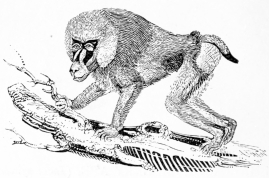
THE BABOON. (Cynocephalus.)
A genus of Quadrumana, which comprises a large, fierce, and formidable race of animals, who, though they in a slight degree partake of the human conformation, like the Ourang Outan, &c., are in their dispositions and habits the very reverse of gentleness and docility. The Baboons are the ugliest of all the Quadrumana. Their eyes are small, and sunk underneath their eyebrows. Their forehead is low, and the development of the snout and face is enormously disproportioned to the size of the skull. Their great strength and fierce disposition make them very much dreaded in the countries they inhabit. Baboons differ from the apes on the one hand, and the monkeys on the other, by having short tails.
The Common Baboon is of a sandy colour, with a reddish shade on the shoulders, head, and back. It is playful and good-tempered when young, but becomes morose and savage with age. Buffon thus describes a full-grown specimen he saw:—“It was not altogether hideous, and yet it excited horror. It seemed to be always in a state of savage ferocity, grinding its teeth, perpetually restless, and agitated by unprovoked fury. It was a stout-built animal, whose nervous limbs and compressed form indicated great force and agility; and, though the length and thickness of its shaggy coat made it appear much larger than it really was, it was so strong and active that it might easily have repelled the attacks of several unarmed men.”
The Cape Baboon, or Chacura (Cynocephalus porcarius), is as big as a large mastiff, covered with hair of an olive-black colour on the back, and with paler hair beneath. He has a canine face; the snout resembles that of a hog, and the nails are flat, but sharp and very strong. It is said that he follows goats and sheep in order to drink their milk; he partakes of human dexterity in getting the kernels out of nuts, and loves to be covered with garments; he stands upright, and imitates with ease many human actions. The cunning of these animals is well exemplified in their mode of plunder. They form long lines, extending from their retreat to the object in view, and then pitch the produce of their theft from hand to hand till it is secure.
The Mandrill is the largest kind of Baboon, being nearly five feet high when it stands upright. It is distinguished from other Baboons by having a large protuberance on either cheek, which is marked with numerous red, blue, and purple stripes.
“Those which have been observed in a domestic state are generally remarked to have had a strong taste for fermented and spirituous liquors. A remarkably fine individual which was long kept at Exeter Change, and afterwards at the Surrey Zoological Gardens, drank his pot of porter daily, and evidently enjoyed it; it was a most amusing sight to see him seated in his little armchair with his quart pot beside him, and smoking his short pipe with all the gravity and perseverance of a Dutchman. In a state of nature his great strength and malicious character render the Mandrill a truly formidable animal. As they generally march in large bands they prove more than a match for the other inhabitants of the forest. The inhabitants themselves are afraid to pass through the woods unless in large companies and well armed.”
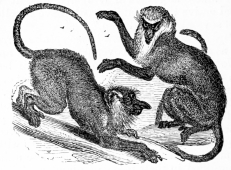
THE PROBOSCIS. (Nasalis larvatus.) THE DIANA MONKEY. (Cercopithecus Diana.)
The Proboscis Monkey is so called from its long projecting and disproportionate nose; it is an inhabitant of the island of Borneo, where it lives in troops on trees in the vicinity of its rivers. It is of a savage disposition. The Diana Monkey is called after the goddess of that name, from the crescent of white hair which ornaments its brow. It is very playful, and one of the most graceful of the tribe; it is found in the hottest parts of Africa. Monkeys are less in stature, and more numerous, than the apes and baboons. They live almost entirely in trees. Their natural food is vegetable—fruit of all sorts, corn, and even grass; but when domesticated, they learn to eat almost anything that is served on our tables.
There are few persons that are not acquainted with the various mimicries of these animals, and their capricious feats of activity. Anecdotes of this kind are very numerous; we shall content ourselves by giving the following:—Captain Stedman, while hunting among the woods of Surinam for provisions, says, that he shot at two of these animals, but that the destruction to one of them was attended with such circumstances as to ever afterwards deter him from going monkey hunting. “Seeing me nearly on the bank of the river, in the canoe,” says he, “the creature made a halt from skipping after his companions, and, being perched on a branch that overhung the water, examined me with the strongest marks of curiosity; while he chattered prodigiously, and kept shaking the boughs on which he rested, with incredible strength and agility. At this time I laid my piece to my shoulder and brought him down from the tree: but may I never again be witness to such a scene! The miserable animal was not dead, but mortally wounded. I seized him by the tail, and taking him in both my hands, to end his torment swung him round, and hit his head against the side of the canoe; but the poor creature still continued to live, and looked at me in the most affecting manner that can be conceived. I therefore knew no other means of ending his murder than to hold him under water till he was drowned: but even in doing this, my heart sickened; for his little dying eyes still continued to follow me with seeming reproach, till their light gradually forsook them, and the wretched animal expired.”
The manner in which some of the Monkey tribe capture shell-fish is remarkably indicative of their cunning and ingenuity. The oysters of the tropical climates, being larger than ours, the Monkeys, when they reach the sea-side, pick up stones, and thrust them between the opening shells, which being thus prevented from closing, the cunning animals eat the fish at their ease. In order to attract crabs, they put their tails before the holes in which they have taken refuge; and when the creatures have fastened on the lure, the Monkeys suddenly withdraw their tails, and thus drag their prey on shore.
The Monkey generally brings forth one at a time, and sometimes two. They are rarely found to breed when brought over into Europe; but those that do exhibit a very striking picture of parental affection. The male and female are never tired of fondling their young one. They instruct it with no little assiduity; and often severely correct it, if stubborn, or disinclined to profit by their example. They hand it from one to the other, and when the male has done showing his regard the female takes her turn in the work of affection.
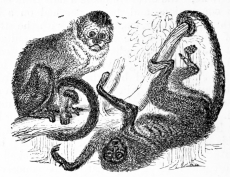
THE CAPUCHIN AND SPIDER MONKEYS, (Cebus Capucinus and Ateles paniscus,)
THE CAPUCHIN AND SPIDER MONKEYS, (Cebus Capucinus and Ateles paniscus,)
Are both natives of South America; they live in large troops, feeding on roots, fruits, and insects, and are much more gentle than those of the old world. Of the Capuchin there are many species, differing from each other in colour only; they are very lively, active, and amusing, and about a foot long. The Spider Monkey, like the Capuchin, has a long prehensile tail, which it uses like a fifth hand. Nature seems by this addition to have more than recompensed them for the want of a thumb, for by it, when they are unable to leap from one tree to another, on account of the distance, they form a kind of chain, with their young upon their backs, hanging down by each other’s tails. One of them holds the branch above, and the rest swing to and fro like a pendulum, until the undermost is enabled to catch hold; the first then lets go his hold, and thus comes undermost in his turn; in this way they can travel a great distance without ever touching the ground. Curious illustrations of this are daily seen at the Zoological Gardens, where there are several of these Monkeys.
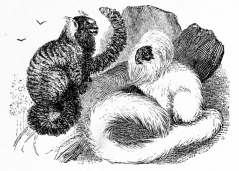
THE OUISTITI AND MARIKINA MONKEYS. (Jacchus vulgaris and Rosalia.)
The Ouistiti, or Marmozet, inhabits the Brazils, and is of small size, not measuring more than seven inches, though his tail is near eleven; he weighs about six ounces, and, like others of his kind, lives not only on vegetables, but also upon insects, the eggs of birds, and even small birds. His face is almost naked, of a swarthy flesh colour, with a white spot above the nose; the tail is full of hair, and annulated with ash-coloured and black rings alternately; his nails are sharp, and his fingers like those of a squirrel.
The Marikina is a beautiful little animal, not above nine inches long, and is sometimes called the Lion Monkey; his hair is long, soft, and glossy; his head is round, his face brown, and his ears hid under the long hairs which surround his face, and which are of a bright red, while those on his body and tail are of a beautiful pale yellow, or gold colour. He is very playful, and of a seemingly robust temperament, for we have seen one which lived five or six years in Paris, without any other particular care than keeping it during the winter in a chamber in which there was a fire every day.
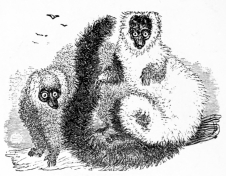
THE LEMUR AND THE MONGOOS, (Lemur macaco and Lemur albifrons,)
May be considered as the connecting link between the Monkeys and the genuine quadruped. Their habits are nocturnal, whence they have been called Lemurs, or ghosts. They pass a considerable portion of the day in sleep, rolled up like a ball, with the large tail passed between the hind legs, and twisted round the neck. They live in troops, more or less numerous, like the apes and monkeys, on trees, and climb with great quickness, and leap with so much force as frequently to rise ten feet at a single bound. They feed on fruits, roots, &c., and carry their food to their mouth with their hands, like the apes; their voice, when not alarmed, is a quick grunt. Their nocturnal and unobtrusive habits may probably account in some degree for the rarity of their appearance. They are all inhabitants of Madagascar, but allied species are also found in Bengal, and other parts of Hindostan, in Ceylon, and Java. The above specimens are from the Zoological Gardens, and are the White-fronted and the Black and White Lemurs.