Book I. I. QUADRUPEDS, OR FOUR-FOOTED BEASTS. (continued 2)
Reading edition

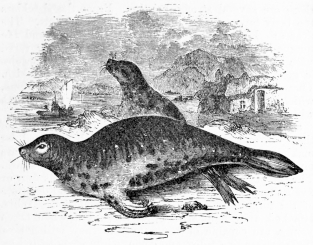
THE COMMON SEAL. (Phoca vitulina.)
The amphibious flesh-eating animals, though nearly allied to the otter in their habits, are very different in the construction of their bodies. Their feet are so short and so enveloped in skin, that they are of scarcely any use in assisting the animal on dry land; so that the Seal’s progress on solid ground is only effected by a sort of half tumbling, jumping, and shuffling motion, excessively ridiculous to a looker-on. The feet, however, which are furnished with strong claws, are of use in enabling the animal to climb out of the water over a rocky shore. For swimming, the Seal is admirably adapted; its long flexible body is shaped like that of a fish, tapering to the tail; and it is furnished with strong webs between the toes, so as to make the fore feet act as oars, and the hind feet, which the animal generally drags behind it like a tail, to serve as a rudder. The Common Seal lives generally in the water, and feeds entirely on fish; only coming to shore occasionally to bask on the sands, and to lie there to suckle its young. The usual length of a Seal is four or five feet. The head is large and round; the neck small and short; and on each side of the mouth there are several strong bristles. From the shoulders the body tapers to the tail, which is very short. The eyes are large: there are no external ears; and the tongue is cleft or forked at the end. The body is covered with short thick-set hair, which in the common species is generally grey, but sometimes brown or blackish. There are, however, several species; and one of them, which is called the sea-leopard, has the fur spotted with white or yellow.
Seals are hunted by the Greenlanders for the sake of their oil, and also for their skins, which are used for making waistcoats and other articles of clothing, and are much prized by the fishermen for their great warmth. The oil, of which a full grown specimen yields four or five gallons, is very clear and transparent, and destitute of the unpleasant odour and taste of whale-oil. When attacked, they fight with great fury; but when taken young, are capable of being tamed; they will follow their master like a dog, and come to him when called by the name given to them. Some years ago a young Seal was thus domesticated. It was taken at a little distance from the sea, and was generally kept in a vessel full of salt water: but sometimes it was allowed to crawl about the house, and even to approach the fire. Its natural food was regularly procured for it; and it was carried to the sea every day, and thrown in from a boat. It used to swim after the boat, and always allowed itself to be taken back. It lived thus for several weeks, and probably would have lived much longer, had it not been sometimes too roughly handled. The females in this climate bring forth in winter, and rear their young upon some sand-bank, rock, or desolate island, at some distance from the main land. When they suckle their young, they sit up on their hinder legs, while the little Seals, which are at first white, with woolly hair, cling to the teats, which are four in number. In this manner the young continue in the place where they are brought forth for twelve or fifteen days; after which the dam brings them down to the water, and accustoms them to swim and get their food by their own industry.
In Newfoundland the Seal-fishery forms an important source of wealth, and numerous ships are sent out every season among the ice in search of Seals. One ship has been known to catch five thousand Seals, but about half that number is the usual quantity taken. As soon as the Seal is killed, it is skinned, and the pelt, as the skin and blubber together is called, being preserved, the body of the Seal is either eaten by the sailors, or left on the ice for the polar bears.
The aboriginal inhabitants of the northern regions have several strange superstitions about Seals. They believe that Seals delight in thunder-storms; and say, that during these times they will sit on the rocks, and contemplate, with apparent pleasure and gratification, the convulsion of the elements. The Icelanders, in particular, are said to believe that these animals are the offspring of Pharaoh and his host, who were converted into Seals when they were overwhelmed in the Red Sea.
Several species of Seals are distinguished by curious appendages to the head, sometimes in the form of a hood, sometimes in that of a projection from the nose. One of the most singular is the Sea Elephant (Morunga proboscidea), an inhabitant of the shores of the numerous islands scattered over the great Southern Ocean. In this curious animal, which often measures twenty-four feet in length, the nose of the male forms a proboscis about a foot long and capable of considerable distension. The female has no such appendage. The young of the Sea Elephant, when just born, is said to be as large as a full grown seal of the common species. The skin in the old animals is very thick, and forms an excellent leather for harness.
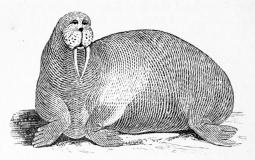
THE WALRUS, MORSE, OR SEA-COW. (Trichechus Rosmarus.)
This very curious animal is nearly allied to the Seal, but is of much greater size, being frequently eighteen feet in length, and from ten to twelve feet in girth. The head is round, the eyes are small and brilliant, and the upper lip, which is enormously thick, is covered with pellucid bristles, as large as a straw. The nostrils are very large, and there are no external ears. The most remarkable part of the Walrus is, however, his two large tusks in the upper jaw; they are inverted, the points nearly uniting, and sometimes exceed twenty-four inches in length! the use which the animal makes of them is not easily explained, unless they help him to climb up the rocks and mountains of ice among which he takes up his abode, as the parrot employs his beak to get upon his perch. The tusks of the Walrus are superior in durability and whiteness to those of the elephant, and, as they keep their colour much longer, are preferred by dentists to any other substance for making artificial teeth.
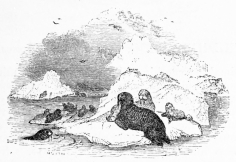
The Walrus is common in some of the northern seas, and will sometimes attack a boat full of men. They are gregarious animals, usually found in herds of from fifty to one hundred or more, sleeping and snoring on the icy shores; but when alarmed they precipitate themselves into the water with great bustle and trepidation, and swim with such rapidity, that it is difficult to overtake them with a boat. One of their number always keeps watch while the others sleep. They feed on shell-fish and sea-weeds, and yield an oil equal in goodness to that of the whale. The white bear is their greatest enemy. In the combats between these animals, the Walrus is said to be generally victorious, on account of the desperate wounds it inflicts with its tusks. The females have only one young one at a time, which, when born, resembles a good-sized pig.
§ II. Insectivorous, or Insect-eating Animals.
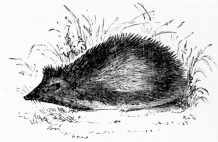
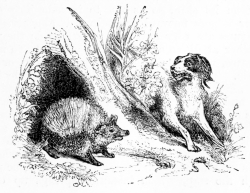
THE HEDGEHOG. (Erinaceus Europæus.)
This animal is something like a porcupine in miniature, and is covered all over with strong and sharp spines or prickles, which he erects when irritated. His common food consists of worms, slugs, and snails; and thus, far from being a noxious animal in a garden, he is a very useful one, as he feeds upon all the insects he can find. Hedgehogs inhabit most parts of Europe. Notwithstanding its formidable appearance, it is one of the most harmless animals in the world. While other creatures trust to their force, their cunning, or their swiftness, this quadruped, destitute of all, has but one expedient for safety, and from this alone it generally finds protection. The instant it perceives an enemy, it withdraws all its vulnerable parts, rolls itself into a ball, and presents nothing to view but a round mass of spines, impervious on every side. When the Hedgehog is thus rolled up, the cat, the weasel, the ferret, and the marten, after wounding themselves with the prickles, quickly decline the combat; and the dog himself generally spends his time in empty menaces rather than in effectual efforts, while the little animal waits patiently till its enemy, by retiring, affords an opportunity for retreat.
The female produces from two to four young ones at a birth. When first born they are blind, and their spines white and soft, but they become hard in a few days. The Hedgehog is said to suck the milk from cows; but this is impossible, as the mouth of the Hedgehog would not admit the teat of the cow. The Hedgehog, however, sometimes destroys eggs, and has been known to attack frogs, mice, and even toads, when pressed by hunger; it will also occasionally eat the tuberous roots of plants, boring under the root, so as to devour it, and yet leave the stem and leaves untouched. The Hedgehog makes himself a nest of leaves and soft wool for the winter, in the hollow trunk of an old tree, or in a hole in a rock or bank; and here, having coiled himself up, he passes the winter in one long unbroken sleep. Hedgehogs may easily be tamed, and are sometimes kept in the kitchens in London houses to destroy the black-beetles. The flesh of the Hedgehog is sometimes eaten; especially by gipsies, who appear to consider it a delicacy. It is said to be well-tasted, and to have abundance of yellow fat.
In times when insect food is scarce he will also regale himself upon apples and pears which have fallen from the trees, but a glance at the structure of the creature ought to be sufficient to convince any one that the charges often brought against him of climbing trees to detach the fruit which he is said afterwards to carry off by the ingenious expedient of throwing himself down upon it from the branches so as to attach it to his spines, are totally without foundation.
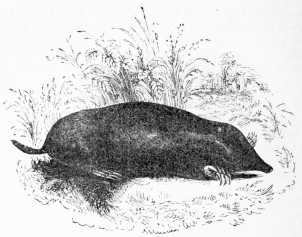
THE MOLE. (Talpa Europæa.)
The Mole is a curious, awkwardly-shaped animal, with a long flexible snout, very small eyes, and hand-like fore feet, armed with very strong claws, with which it scrapes its way through the ground, when it is forming the subterranean passages in which it takes up its abode. The Mole, though it is supposed not to possess the advantage of sight, has the senses of hearing and feeling in great perfection; and its fur, which is short and thick, is set erect from its skin, so as not to impede its progress whether it goes forward or backwards along its runs. These runs are very curiously constructed: they cross each other at different points, but all lead to a nest in the centre, which the Mole makes his castle, or place of abode. The passages are made by the Mole in his search after the earth-worms and grubs, on which he lives; and the molehills are formed by the earth he scrapes out of his runs. These molehills do a great deal of mischief to grass lands, as they render the ground very difficult to mow; and on this account mole-catchers are employed to fix traps in the ground, so that when the mole is running through one of his passages, he passes through the trap, which instantly springs up out of the ground with the poor Mole in it. The female Mole makes her nest at a distance from the male’s castle. She has young only once a year, but she has four or five at a time.
The following curious fact respecting a Mole is related by Mr. Bruce. “In visiting the Loch of Clunie, I observed in it a small island, at the distance of a hundred and eighty yards from the land. Upon this island Lord Airlie, the proprietor, had a castle and small shrubbery. I observed frequently the appearance of fresh molehills; but for some time took it to be the water mouse, and one day I asked the gardener if it was so. He replied it was the Mole, and that he had caught one or two lately; but that five or six years ago he had caught two in traps, and for two years after this he had observed none. But about four years since, coming ashore one summer’s evening in the dusk, he and Lord Airlie’s butler saw, at a small distance upon the smooth water, an animal paddling to and not far distant from the island; they soon closed with the feeble passenger, and found it to be the Common Mole, led by a most astonishing instinct from the nearest point of land, (the castle-hill,) to take possession of this island. It was at this time, for about the space of two years, quite free from any subterraneous inhabitant; but the Mole has, for more than a year past, made its appearance again.”
The Mole is very pugnacious, and sometimes two of the males will fight furiously till one of them is killed.
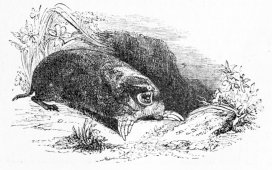
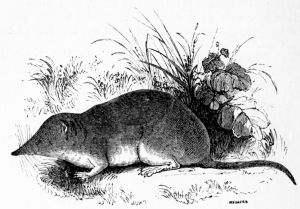
THE SHREW. (Sorex araneus.)
This curious little animal closely resembles a mouse, except in its snout, which is long and pointed, to enable it to grub in the ground for its food, which consists of earthworms, and the grubs of beetles. The Shrew, like the mole, is very fond of fighting; and when two are seen together, they are generally engaged in a furious battle. Like the hedgehog, it has been much scandalized by false reports, as will be seen by the following extract from that most amusing and interesting work, White’s Selborne: “At the south corner of the area, near the church, there stood, about twenty years ago, a very old, grotesque, hollow pollard-ash, which for ages had been looked upon with no small veneration as a shrew-ash. Now a shrew-ash is an ash whose twigs and branches, when applied to the limbs of cattle, will immediately relieve the pains which a beast suffers from the running of a Shrew-mouse over the part affected; for it is supposed that a Shrew-mouse is of so baneful and deleterious a nature, that whenever it creeps over a beast, be it a horse, or cow, or sheep, the suffering animal is afflicted with cruel anguish, and threatened with the loss of the use of the limb. Against this accident, to which they were continually liable, our provident forefathers always kept a shrew-ash at hand, which, when once medicated, would maintain its virtue for ever. A shrew-ash was made thus:—into the body of the tree a deep hole was bored with an auger, and a poor devoted Shrew mouse was thrust in alive, and plugged in.” The cruelty of this, and many other practices of our ancestors, ought to make us thankful that we live in more enlightened days.
The body of the Shrew exhales a rank musky odour, which renders the animal so offensive to cats, that though they will readily kill them, they will not eat their flesh. This noisome odour probably gave rise to the notion that the Shrew-mouse is a venomous animal, and its bite dangerous to cattle, particularly horses. It is, however, neither venomous nor capable of biting, as its mouth is not sufficiently wide to seize the double thickness of the skin, which is absolutely necessary in order to bite.
The female Shrew makes her nest in a bank, or if on the ground, she covers it at the top, always entering on the side; and she has generally from five to seven young ones at a time.
The Water Shrew (Sorex fodiens,) is a beautiful little creature, with somewhat differently formed feet and tail, to enable it to paddle through the water, in which it dives and swims with great agility. When floating “on the calm surface of a quiet brook,” or diving after its food, its black velvety coat becomes silvered over with the innumerable bubbles of air that cover it when submerged; though when it rises again, the fur is observed to be perfectly dry, repelling the water as completely as the feathers of a water-fowl.
§ III. Cheiropterous Animals.
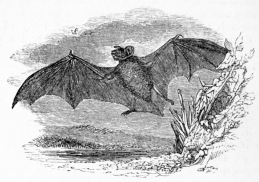
THE BAT. (Vespertilio Noctula.)
The Bat has the body of a mouse, and the wings of a bird. It has an enormous mouth, and large ears, which are of a kind of membrane, thin and almost transparent. The pinions of its wings are furnished with hooks, by which it hangs to trees or the crevices in old walls during the day, a great number of them together, as they only fly at night. The wings of the Bat are very large; those of the Great Bat measuring fifteen inches across. It feeds on insects of various kinds, particularly on cockchafers and other winged beetles, part of which, however, it always throws away. A female Bat that was caught, and kept in a cage, ate meat when it was given to her in little bits, and lapped water like a cat. She was very particular in keeping herself clean, using her hind feet like a comb, and parting her fur so as to make a straight line down the back. Her wings she cleaned by thrusting her nose into the folds, and shaking them. She had a young one born in the cage. It was blind, and quite destitute of hair, and its mother wrapped it in the membrane of her wing, pressing it so closely to her breast, that no one could see her suckle it. The next day the poor mother died, and the little one was found alive, hanging to her breast. It was fed with milk from a sponge, but only lived about a week.
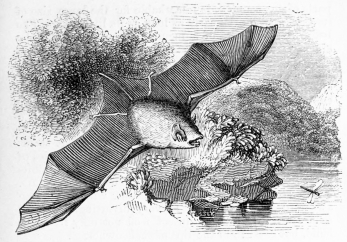
THE PIPISTRELLE. (Vespertilio Pipistrellus.)
This little creature, which is only an inch and a half in length, appears to be the commonest of all Bats in most parts of Britain. It usually resides in cracks and cavities in old brick walls and in sheltered corners about houses, and at the approach of evening quits its retreat, and flies about capturing the gnats and other small twilight-loving insects on which it feeds.
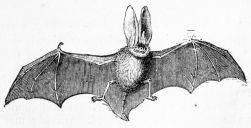
THE LONG-EARED BAT. (Vespertilio or Plecotus auritus.)
The Long-eared Bat, which is not uncommon in many parts of our country, is remarkable for the large size of its ears, which are nearly as long as its little mouse-like body, and composed of a membrane so delicate as to be almost transparent. In front of the concave part of each of these enormous ears there is a slender, pointed membrane, which gives the little creature a most singular appearance when reposing; for the great membranous ears are then folded up, and carefully stowed away under the wings, whilst these pointed lobes, being of a stronger substance, still project from the head, and look like a pair of little horns. The Long-eared Bat seems to be one of the most interesting and amiable species of its tribe; it may be easily tamed, and, indeed, exhibits great confidence from the first moment of its capture. When several are kept together they will play in an awkward manner, which is very diverting, and will soon learn to take their insect food not only from the hand, but even from the lips of their owner.
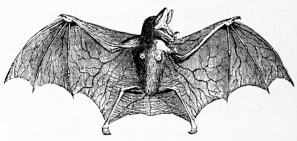
THE VAMPYRE BAT. (Phyllostoma Spectrum.)
The Vampyre Bat, which is a large species, is notorious for its very bad habit of sucking the blood of men and cattle. In making its attacks on man it exercises the greatest caution, alighting close to the feet of its intended victim during his slumbers, and fanning him with its broad wings to keep him cool and comfortable during the subsequent operations. Having made the proper arrangements, the Vampyre proceeds to bite a little piece out of the great toe of the slumberer, and although the wound thus caused is so small that it would not receive the head of a pin, it is deep enough to cause a free flow of blood, which the Vampyre sucks until it can suck no longer. Cattle are generally bitten in the ear. Although there seems to be some exaggeration in many of the accounts given by travellers of the ferocity and sanguinary disposition of the Vampyre, there would appear to be little doubt that the loss of blood caused by its bite may occasionally prove fatal, the sucking being continued, as Captain Stedman says, until the sufferer sleeps “from time into eternity.”
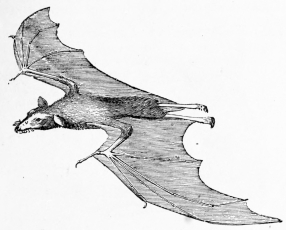
THE KALONG BAT. (Pteropus edulis.)
This Bat, which is also called the Flying Fox, is a native of the Indian Islands. It is a large species, measuring nearly two feet in length, whilst its large leathery wings, resembling those seen in the popular representations of flying demons, extend from tip to tip about five feet. During the day the Kalongs indulge in sleep, for which purpose they prefer an attitude which to our notions would seem very uncomfortable; they suspend themselves by their hind feet to the branches of trees, and thus hang with their heads downwards. They associate in large numbers, and when seen sleeping in the position above described, they look so little like animals that Dr. Horsfield tells us they “are readily mistaken for a part of the tree, or for a fruit of uncommon size suspended from its branches.” At the approach of evening, however, a very different scene presents itself. One by one these supposed fruits are seen to quit their hold upon the branches, and sail away to the plantations of various kinds, to which they do incalculable mischief by devouring every fruit that comes in their way.
§ IV. The Marsupialia, or Pouch-bearing Animals.
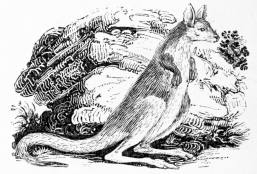
THE KANGAROO. (Macropus giganteus.)
This remarkable animal was first discovered by the celebrated Captain Cook, in New Holland: and as it was the only quadruped discovered on the inland by the first settlers, they attempted to hunt it with greyhounds. The astonishing leaps it took, however, quite puzzled the colonists, who found it extremely difficult to catch. At first it was supposed that there was only one kind of Kangaroo, but now many species have been discovered, some of them not larger than a rat, and others as big as a calf. Kangaroos live in herds; one, older and larger than the rest, appearing to act as a kind of king. The ears of the Kangaroo are large, and in almost constant motion; it has a hare-lip, and a very small head. The fore legs, or rather paws, are short and weak, with five toes, each ending in a strong curved claw. The hind legs, on the contrary, are very large and strong, but the feet have only four toes, and much weaker claws. The tail is very long and tapering; but is so thick and strong near the body, that it forms a kind of third hind leg, and wonderfully assists the animal in supporting itself in its ordinary upright position. Its leaps are of extraordinary extent, being often from twenty to thirty feet in length, and six or eight feet high. When the animal is attacked, it uses its tail as a powerful instrument of defence, and also scratches violently with its hind feet. It generally sits upright, but brings its fore feet to the ground when it is grazing. It lives entirely on vegetable substances. The most curious part of the Kangaroo is the pouch which the female has in front for carrying her young. It is just below her breast, and the young ones sit there to suck; and even when they are old enough to leave the pouch, take refuge in it whenever they are alarmed.
The Kangaroo is easily tamed, and there are many in a tame state in England. In Australia, Kangaroo beef, as it is called, is eaten, and found very nourishing; but it is hard and coarse. The female has generally two young ones at a time, which do not attain their full growth until they are a year old.
When a large Kangaroo is pursued by dogs, it generally takes refuge in a pond, where, from the great length of its hind legs and tail, it can stand with its body half out of the water, while the dogs are obliged to swim. Thus the Kangaroo has a decided advantage; for, as each dog approaches him, he seizes it with his fore paws, and holds it under water, shaking it furiously till the dog is almost suffocated, and very glad to sneak off as soon as the Kangaroo lets him go.
The female, when pursued and hard-pressed by the dogs, will, while making her bounds, put her fore paws into her pouch, take a young one from it, and throw it as far out of sight as she possibly can. But for this manœuvre, her own life and that of her young one would be sacrificed; whereas, she frequently contrives to escape, and returns afterwards to seek for her offspring.
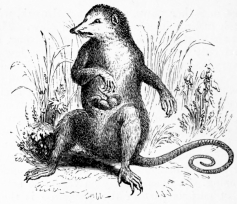
THE VIRGINIAN OPOSSUM. (Didelphis virginiana.)
This creature, which is a native of North America, is about the size of a cat, and its fur is of a dingy white, except the legs, which are brown, and the nose and ears, which are yellowish. There is also a brownish circle round each eye, and the ears are nearly black at the base.
The Opossum generally lives in trees, suspending itself by the tail, by means of which it swings from branch to branch. In this manner it catches the insects and small birds, on which it generally feeds; but sometimes it descends from the tree, and invades poultry-yards, where it devours the eggs, and sometimes the young fowls. It resembles the kangaroo in its pouch for carrying its young, but in no other particular, as it walks on four feet, and its legs are uniform in length; and it has a long flexible tail, which is of no use to it either in leaping, or as a weapon of defence. The tail is, however, of singular use to the young, as when they get too large to be carried in the pouch, they fly to their mother when alarmed, and twisting their long slender tails round hers, leap upon her back. The female Opossum may be sometimes seen thus carrying four or five at once.
The Opossum may be easily tamed, but is an unpleasant inmate, from its awkward figure and stupidity, and its very disagreeable smell. The American Indians spin its hair and dye it red, and then weave it into girdles and other articles of clothing. The flesh of these animals is white and well tasted, and is preferred by the Indians to pork: that of the young ones eats very much like the sucking-pig.
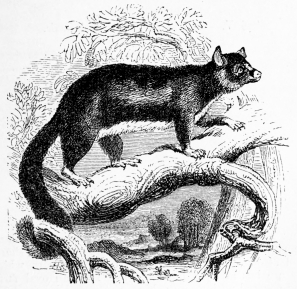
THE PHALANGER. (Phalangista vulpina.)
This animal, which is very common in Australia, has some resemblance in its aspect and colour to a fox; but is much smaller. It has a long, furred tail, very different from that of the opossum. The Phalanger lives amongst the branches of the trees, on which it climbs about at night with great agility; its food consists partly of fruits and partly of small birds, which it easily captures during its nocturnal excursions. It is called the Opossum by the colonists of Australia. There are several kinds of Phalangers, some of which are known as Flying Phalangers, from their having a broad loose fold of skin along each side, which, when stretched out by means of the legs, serves to support the little creature for a time in the air, and enables it to leap to great distances.
§ V.—Rodentia, or Gnawing Animals.
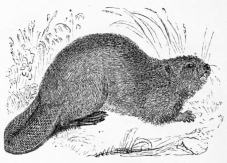
THE BEAVER. (Castor Fiber.)
The Beaver is about the size of the badger; his head short, his ears round and small, his fore teeth long, sharp, and strong, and well calculated for the part which Nature has allotted him: the tail is of an oval form, and covered with a scaly skin.
Beavers are natives of North America, and more particularly the north of Canada. They are also found in Europe, and were formerly abundant in many places. Their houses are constructed with earth, stones, and sticks, neatly arranged and worked together by their paws. The walls are about two feet thick, and are surmounted by a kind of dome, which generally rises about four feet above them. The entrance is on one side, always at least three feet below the surface of the water, so as to prevent it being frozen up. The number of Beavers in each house is from two to four old ones, and about twice as many young. When Beavers form a new settlement, they build their houses in the summer; and then lay in their winter provisions, which consist principally of bark and the tender branches of trees, cut into certain lengths, and piled in heaps on the outside of their habitation, and always under the water; though sometimes the heap is so large as to rise above the surface. One of these heaps will occasionally contain more than a cart-load of bark, young wood, and the roots of the water-lily.
Beavers are hunted for the sake of their skins, which are covered with long hairs, and a short thick fur beneath, which is used in making hats, after the long hairs have been destroyed.
A great many stories have long been believed respecting the Beaver, on the authority of a French gentleman who had resided a long time in North America; but it is now ascertained that the greater part of them are false. The house of the Beaver is not divided into rooms, but consists of only one apartment; and the animals do not use their tails either as a trowel or a sledge, but only as an assistance in swimming. Some years ago a Beaver was brought to this country from America, that had been quite tamed by the sailors, and was called Bunney. When he arrived in England, he was made quite a pet of, and used to lie on the hearth-rug in his master’s library. One day he found out the housemaid’s closet, and his building propensities began immediately to display themselves. He seized a large sweeping brush, and dragged it along with his teeth to a room where he found the door open: he afterwards laid hold of a warming-pan in the same manner; and having laid the handles across, he filled up the walls of the angle made by the brushes with the wall, with hand-brushes, baskets, boots, books, towels, and anything he could lay hold of. As his walls grew high, he would often sit propped up by his tail (with which he supported himself admirably), to look at what he had done; and if the disposition of any of his building materials did not satisfy him, he would pull part of his work down, and lay it again more evenly. It was astonishing how well he managed to arrange the incongruous materials he had chosen, and how cleverly he contrived to remove them, sometimes carrying them between his right fore-paw and his chin, sometimes dragging them with his teeth, and sometimes pushing them along with his chin. When he had built his walls, he made himself a nest in the centre, and sat up in it, combing his hair with the nails of his hind feet.
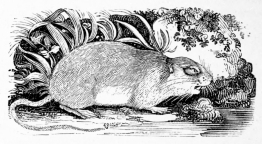
THE MUSK RAT, (Fiber Zibethicus,)
Is a native of Canada, and resembles the beaver in many of his habits. He has a fine musky scent, and makes his holes in marshes and by the waterside, with two or three ways to get in or go out, and several distinct apartments: he is said to contrive one entrance to his hole always below the water, that he may not be frozen out by the ice. This animal is called the Musquash in America, and its fur is used, like that of the beaver, in the manufacture of hats, four or five hundred thousand skins being said to be sent to Europe every year for that purpose. Musk Rats are always seen in pairs; and though watchful, are not timid, as they will often approach quite close to a boat or other vessel. In spring they feed on pieces of wood, which they peel carefully; and they are particularly fond of the roots of the sweet flag (Acorus Calamus). In Canada this animal is called the Ondatra.
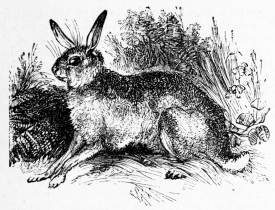
THE HARE. (Lepus timidus.)
This small quadruped is well known at our tables as affording a favourite food, notwithstanding the dark colour of its flesh. Its swiftness cannot save it from the search of its enemies, among whom man is the most inveterate. Unarmed and fearful, the Hare appears almost to sleep with open eyes, so easily is it alarmed. Its hind legs are longer than its fore ones, to enable it to run up hills; its eyes are so prominently placed, that they can encompass at once the whole horizon of the plain where it has chosen its form, for so its seat or bed is called; and its ears so long, that the least noise cannot escape it. It seldom outlives its seventh year, and breeds plentifully. Naturally wild and timorous, the Hare may, however, be occasionally tamed. The following is from the entertaining account given by Cowper, of three Hares that he brought up tame in his house; the names he gave them were Puss, Tiney, and Bess. Tiney was a reserved and surly Hare; Bess, who was a Hare of great humour and drollery, died young. “Puss grew presently familiar, would leap into my lap, raise himself upon his hinder feet, and bite the hair from my temples. He would suffer me to take him up and carry him about in my arms, and has more than once fallen fast asleep upon my knee. He was ill three days, during which time I nursed him, kept him apart from his fellows that they might not molest him, (for, like many other wild animals, they persecute one of their own species that is sick,) and by constant care, and trying him with a variety of herbs, restored him to perfect health. No creature could be more grateful than my patient after his recovery, a sentiment which he most significantly expressed by licking my hand, first the back of it, then the palm, then every finger separately, then between all the fingers, as if anxious to leave no part of it unsaluted; a ceremony which he never performed but once again upon a similar occasion.
“Finding him extremely tractable, I made it my custom to carry him always after breakfast into the garden, where he hid himself generally under the leaves of a cucumber vine, sleeping or chewing the cud, till evening; in the leaves also of that vine he found a favourite repast. I had not long habituated him to this taste of liberty, before he began to be impatient for the return of the time when he might enjoy it. He would invite me to the garden by drumming upon my knee, and by a look of such expression as it was not possible to misinterpret. If this rhetoric did not immediately succeed, he would take the skirt of my coat between his teeth, and pull at it with all his force. Thus Puss might be said to be perfectly tamed, the shyness of his nature was done away, and, on the whole, it was visible, by many symptoms, which I have not room to enumerate, that he was happier in human society than when shut up with his natural companions.”
Hares are included in the list of animals called game, and are hunted with greyhounds, which is called coursing; and also by packs of dogs called harriers and beagles. There are white Hares in the northern regions, the change in colour being the effect of cold.
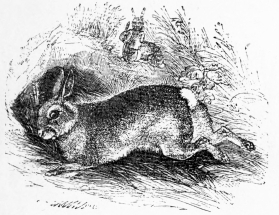
THE RABBIT. (Lepus cuniculus.)
This animal, in a wild state, resembles the hare in all its principal characters, but is distinguished from it by its smaller size, the comparative shortness of the head and hinder legs, the grey colour of the body, the absence of the black tip to the ears, and the brown colour of the upper part of the tail. Its habits, however, are very different, as being from its organization unable to outstrip its enemies in the chase, it seeks its safety and shelter by burrowing in the ground; and instead of leading a solitary life, its manners are eminently social. Its flesh is white and good, though not so much prized as that of the hare.
The female begins to breed when she is about twelve months old, and bears at least seven times a year, generally eight at each time; now supposing this to happen regularly, a couple of Rabbits at the end of four years might see a progeny of almost a million and a half! Fortunately their destruction by various enemies is in proportion to their fecundity, or we might justly apprehend being overstocked by them. The young are born blind, and almost destitute of hair; while those of the hare can see, and are covered with hair.
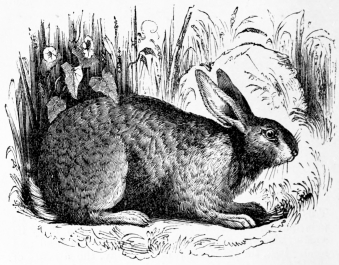
THE DOMESTIC RABBIT.
The Domestic Rabbit is larger than the wild species, owing to its taking more nourishment and less exercise (our example, however, is drawn disproportionately large). Like pigeons, they have their regular fanciers, and are bred of various colours—grey, reddish brown, black more or less mixed with white, or perfectly white. The ears are considered to constitute a principal feature of their beauty, and the animal is most valued when both ears hang down by the side of the head; the animal is then called a double lop; when only one ear drops, it is called a single or horn lop, and when both stretch out horizontally, an oar-lop.
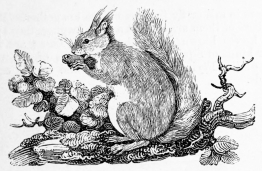
THE SQUIRREL. (Sciurus vulgaris.)
Elegance of shape, spiritedness, and agility to leap from bough to bough in the forest, are the principal characteristics of this pretty animal. The Squirrel is of a deep reddish brown colour, his breast and belly white. He is lively, sagacious, docile, and nimble: he lives upon nuts, and has been seen so tame as to dive into the pocket of his mistress, and search after an almond or a lump of sugar. In the woods he leaps from tree to tree with surprising agility, living a most frolicsome life, surrounded with abundance, and having but few enemies. His time, however, is not entirely devoted to idle enjoyment, for in the luxuriant season of autumn he gathers provisions for the approaching winter, as if conscious that the forest would then be stripped of its fruits and foliage. His tail serves him as a parasol to defend him from the rays of the sun, as a parachute to secure him from dangerous falls when leaping from tree to tree, and, some say, as a sail in crossing the water, which he sometimes does in Lapland on a bit of ice or bark inverted in the manner of a boat.
The American Flying Squirrel (Pteromys volucella) has a large membrane proceeding from the fore feet to the hind legs, which answers the same purpose as the Squirrel’s tail, and enables him to give surprising leaps that almost resemble flying. In the act of leaping, the loose skin is stretched out by the feet, whereby the surface of the body is augmented, its fall is retarded, and it appears to sail or fly from one place to another. Where numbers of them are seen at a time leaping, they appear like leaves blown off by the wind. There are many other kinds of Squirrels in various parts of the world; most of the Flying Squirrels are found in the eastern islands.
THE DORMOUSE, OR SLEEPER. (Myoxus avellanarius.)
These animals build their nests either in the hollow parts of trees, or near the bottom of thick shrubs, and line them most industriously with moss, soft lichens, and dead leaves. Conscious of the length of time they have to pass in their solitary cells, Dormice are very particular in the choice of the materials they employ to build and furnish them; and generally lay up a store of food, consisting of nuts, beans, and acorns; and on the approach of cold weather roll themselves in balls, their tail curled up over their head between the ears, and in a state of apparent lethargy pass the greatest part of the winter, till the warmth of the sun, pervading the whole atmosphere, kindles their congealed blood, and calls them back again to the enjoyment of life. Except in the time of breeding and bringing up its young, the Dormouse is generally found alone in its cell. This animal is remarkable for the very small degree of heat its body possesses during its torpid state, when it appears actually frozen with the cold, and it may be tossed or rolled about without being roused, though it may be quickly revived by the application of gentle heat, such as that of the hands. If a torpid Dormouse, however, be placed before a large fire, the sudden change will kill it.
The American Dormouse, or Ground Squirrel, is a very beautiful animal, striped down the back, and resembling the squirrel in its habits, except that instead of living in trees it burrows in the ground.
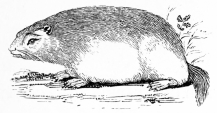
THE MARMOT, OR ALPINE RAT. (Arctomys Marmotta.)
This is a harmless, inoffensive animal, and seems to bear enmity to no creature but the dog. He is caught in Savoy, and carried about in several countries for the amusement of the mob. When taken young, he is easily tamed, and possesses great muscular power and agility. He will often walk on his hinder legs, and uses his fore paws to feed himself, like the squirrel. The Marmot makes his hole very deep, and in the form of the letter Y, one of the branches serving as an avenue to the innermost apartment, and the other sloping downwards, as a kind of sink or drain; in this safe retreat he sleeps throughout the winter, and if discovered may be killed without appearing to undergo any great pain. These animals produce but once a year, and bring forth three or four at a time. They grow very fast, and the extent of their lives is not above nine or ten years. They are about the size of a rabbit, but much more corpulent. When a number of Marmots are feeding together, one of them stands sentinel upon an elevated position; and on the first appearance of a man, a dog, an eagle, or any dangerous animal, utters a loud and shrill cry, as a signal for immediate retreat. The Marmot inhabits the highest regions of the Alps; other species are found in Poland, Russia, Siberia, and Canada.
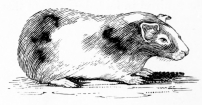
THE GUINEAPIG. (Cavia Cobaya.)
THE GUINEAPIG. (Cavia Cobaya.)
This animal is generally white, variegated with red and black. It is a native of the Brazils, but now domesticated in most parts of Europe, and is about the size of a large rat, though more stoutly made, and without any tail; and its legs and neck are so short, that the former are scarcely seen, and the latter seems stuck upon its shoulders. Guineapigs, though they have a disagreeable smell, are extremely cleanly, and the male and female may be often seen alternately employed in smoothing each other’s skins, disposing their hair, and improving its gloss. They sleep like the hare with their eyes half open, and continue watchful if they apprehend any danger. They are very fond of dark retreats; previously to their quitting which, they look round, and seem to listen attentively; then, if the road be clear, they sally forth in quest of food, but run back on the slightest alarm. They utter a sound like the snore of a young pig. The female begins to produce young when only two months old, and as she does so every two or three months, and has sometimes as many as twelve at a time, a thousand might be raised from a single pair in the course of a year. They are naturally gentle and tame; as incapable of mischief as they seem to be of good, although rats are said to avoid their locality. The upper lip is only half divided; it has two cutting teeth in each jaw, and large and broad ears. They feed on bread, grain, and vegetables.
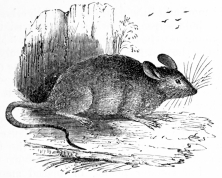
THE MOUSE. (Mus musculus.)
This is a lively, active animal, and the most timid in nature, except the hare, and a few other defenceless species. Although timid, he eats in the trap as soon as he is caught; yet he never can be thoroughly tamed, nor does he betray any affection for his assiduous keeper. He is beset by a number of enemies, among which are the cat, the hawk, and owl, the snake, and weasel, and the rat himself, though not unlike the mouse in his habits and shape. The mouse is one of the most prolific of animals, sometimes producing seventeen at a birth; but it is supposed that the life of this small inmate of our habitations does not extend much further than three years. This creature is known all over the world, and breeds wherever it finds food and tranquillity. There are Mice of various colours, but the most common kind is of a dark, cinereous hue: white mice are not uncommon, particularly in Savoy and some parts of France.
A remarkable instance of sagacity in a long-tailed Field Mouse (Mus sylvaticus) occurred to the Rev. Mr. White, as his people were pulling off the lining of a hotbed, in order to add some fresh dung. From the side of this bed something leaped with great agility, that made a most grotesque appearance, and was not caught without much difficulty. It proved to be a large Field Mouse, with three or four young ones clinging to her teats by their mouths and feet. It was amazing that the various and rapid motions of the dam did not oblige her litter to quit their hold, especially when it appeared that they were so young as to be both naked and blind. Mr. White appears to be the first to describe and accurately examine that diminutive creature the Harvest Mouse (Mus messorius) the least of all the British quadrupeds. He measured some of them, and found that from the nose to the tail they were two inches and a quarter long. Two of them in a scale only weighed down one copper halfpenny, about the third of an ounce avoirdupoise! Their nest is a great curiosity, being made in the form of a ball, and either suspended between the stems of rushes and other tall slender plants, or placed amongst the leaves of some large thistle.
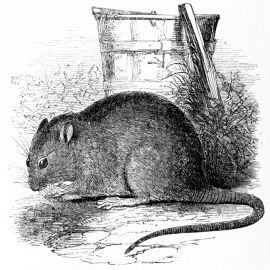
THE RAT. (Mus decumanus.)
The Rat is about four times as large as the mouse, but of a dusky colour, with white under the body; his head is longer, his neck shorter, and his eyes comparatively larger. These animals are so attached to our dwellings, that it is almost impossible to destroy the breed, when they have once taken a liking to any particular place. Their produce is enormous, as they have from ten to twenty young ones at a litter, and this thrice a year. Thus their increase is such, that it is possible for a single pair (supposing food to be sufficiently plentiful, and that they had no enemies to lessen their numbers) to amount at the end of two years to upwards of a million; but an insatiable appetite impels them to destroy each other; the weaker always fall a prey to the stronger; and the large male Rat, which usually lives by itself, is dreaded by those of its own species as their most formidable enemy. The Rat is a bold and fierce little animal, and when closely pursued, will turn and fasten on its assailant. Its bite is keen, and the wound it inflicts is painful and difficult to heal, owing to the form of its teeth, which are long, sharp, and of an irregular form.
It digs with great facility and vigour, making its way with rapidity beneath the floors of our houses, between the stones and bricks of walls, and often excavating the foundations of a dwelling to a dangerous extent. There are many instances of their totally undermining the most solid mason-work, or burrowing through dams which had for ages served to confine the waters of rivers and canals.
A gentleman, some time ago, travelling through Mecklenburgh, was witness to a very singular circumstance respecting one of these animals, in the post-house at New Hargarel. After dinner, the landlord placed on the floor a large dish of soup, and gave a loud whistle. Immediately there came into the room a mastiff, an Angora cat, an old raven, and a large Rat with a bell about its neck. They all four went to the dish, and without disturbing each other, fed together; after which, the dog, cat, and Rat lay before the fire, while the raven hopped about the room. The landlord, after accounting for the familiarity which existed among these animals, informed his guest that the Rat was the most useful of the four; for that the noise he made had completely freed the house from the Rats and mice with which it had been before infested.
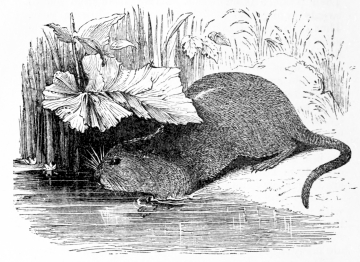
THE WATER RAT, (Arvicola amphibia,)
Inhabits the banks of rivers and ponds, where he digs holes, always above the water-mark, and feeds on roots and aquatic plants.
This animal is nearly as large as the brown Rat, but has a larger head, a blunter nose, and smaller eyes; its ears are very short, and almost hidden in the fur, and the tip of its tail is whitish; the cutting-teeth are of a deep yellow colour in front, very strong, and much resembling those of the beaver. Its head and back are covered with long black hair, and its belly with iron gray. Tail more than half the length of the body, covered with hairs. Fur thick and shining; of a rich reddish brown, mixed with gray above, yellowish gray beneath. The female produces a brood of five or six young ones once (and sometimes twice) a year.
THE LEMMING, (Myodes Lemmus,)
Which is a near relation of the water-rat, and of about the same size, is covered with fur of a yellowish colour variegated with black. This animal resides in the mountains of Norway and Sweden, and is remarkable for performing extraordinary migrations in vast bodies at the approach of a severe winter, and making their appearance so suddenly and unexpectedly that people formerly asserted they had fallen from the clouds. Notwithstanding their supposed celestial origin, they are, however, very unwelcome visitors, as they devour everything eatable that comes in their way, and commit devastations almost as serious as those of the locusts.
THE SHORT-TAILED FIELD-MOUSE, OR FIELD-VOLE.
This little animal has most wonderful powers of reproduction, and, as it is extremely voracious, it often causes an amount of destruction quite out of proportion to its size and insignificant appearance. It burrows in the ground, like the lemming and water-rat; and as it gnaws through the roots of trees that lie in its way, it has been known to cause very serious loss of property. In the year 1813 such immense numbers of these creatures were collected in some of the forests of the South of England, that it was feared all the young trees would be destroyed, and it was found necessary to organise a war of extermination against the invaders. It is said that in New Forest alone not less than eighty or a hundred thousand mice were killed in one season, and the slaughter in other places was quite as great.
The Field-Vole’s favourite food is the bark of trees and roots, but, if pressed by hunger, it will attack and devour its own kind.
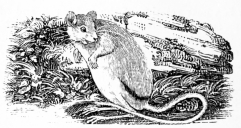
THE JERBOA. (Dipus ægyptius.)
The principal peculiarity of this animal consists in its having very short fore legs, and very long hinder ones: a bird divested of its feathers and wings, and jumping upon its legs, would give us the nearest resemblance to the figure of a Jerboa when pursued. It uses, however, all its four feet upon ordinary occasions, and it is only when pursued that it presses its fore feet close to its body, and leaps on its hind ones. The ancients called it the two-footed rat. This creature is about the size of a rat; the head resembles that of a rabbit, with long whiskers; the tail is ten inches long, and terminated by a tuft of black hair. The fur of the body is tawny, except the breast and throat, and part of the belly, which are white. The Jerboa is very active and lively, and jumps and springs, when pursued, six or seven feet from the ground, with the assistance of its tail; but if this useful member be in any manner injured, the activity of the Jerboa is proportionately diminished; and one which had been accidentally deprived of its tail, was found unable to leap at all. It burrows like the rabbit, and feeds like the squirrel: it is a native of Egypt and the adjacent countries, and is also found in eastern Europe.
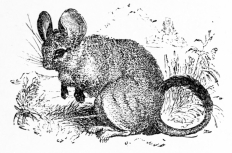
THE CHINCHILLA. (Chinchilla lanigera.)
The Chinchilla is a native of America, and its coat produces the beautiful fur known by its name. The length of the body of this little animal is about nine inches, and its tail nearly five; its limbs are comparatively short, the hind legs being much the longest. The fur is of a remarkably close and fine texture, somewhat crisped, and entangled together; of a grayish or ash colour above, and paler beneath. It is used for muffs, tippets, and linings of cloaks, and is perhaps prettier than the Sable, although less durable, and less valuable in commerce, excepting when fashion rules. The form of the head resembles that of the rabbit; the eyes are full, large, and black; and the ears broad, naked, round at the tips, and nearly as long as the head. The whiskers are plentiful and strong, the longest being twice as long as the head, some of them black, others white. Four short toes, with an appearance of a thumb, terminate the fore feet; the hinder have the same number of toes, but have less the appearance of hands: on all the claws are short, and nearly hidden by tufts of bristly hairs. The tail is about half the length of the body, of equal thickness throughout, and covered with long bushy hairs. It resembles in some degree the jerboa, and takes its food, like that animal, in its fore paws, sitting on its haunches. The temper of the Chinchilla is mild and tractable. It dwells in burrows under ground, and produces young twice a year, bringing forth five or six at a time. It feeds upon the roots of bulbous plants.
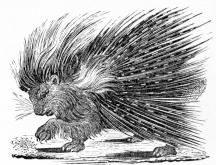
THE PORCUPINE. (Hystrix cristata.)
When full grown this animal measures about two feet in length, and his body is covered with hair and sharp quills, from ten to fourteen inches long, and bent backwards. When he is irritated, they stand erect; but the story that the Porcupine can shoot them at his enemies, is only one of the many fables formerly related as facts in Natural History. The female has only one young one at a time. It is reported to live from twelve to fifteen years. The Porcupine is dull, fretful, and inoffensive; it feeds upon fruits, roots, and vegetables; and inhabits the south of Europe, and almost every part of Africa, particularly Barbary.
THE COUENDOU, (Hystrix, or Synetheres prehensilis,)
Which is also called the Brazilian Porcupine, is chiefly found in Guiana, and differs from the common Porcupine, not only in the shortness of its spines, but also in the great length of its tail. This organ, which is a mere stump in the common species, and only of use to him by producing a rattling of its spines when shaken, in which he seems to take great delight, is nearly as long as the body in the Couendou, and as its extremity is nearly naked, and can be curled up very tightly, the animal makes use of it to cling to the branches of trees, amongst which he is fond of climbing.
§ VI.—Edentata, or Toothless Animals.
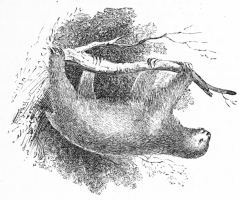
THE SLOTH. (Bradypus tridactylus.)
This animal, which is sometimes also called the Ai, in reference to a noise it makes when caught, and frequently when moving through the forest, is most curiously formed. The arms or fore legs are nearly twice as long as the hind legs: the claws also are larger than the foot, and bent inwardly, so as to prevent the animal from placing the ball of its foot on the ground. From these peculiarities in its construction the progress of the Sloth on land is extremely slow and laborious, for being incapable of supporting himself on his feet, he is compelled to take advantage of every little inequality in the ground to drag himself along; but he is not intended to be a terrestrial animal. He lives in trees, always hanging below the branch, with its back to the ground; and for a life of this kind, its long arms and hooked claws are admirably adapted. Mr. Waterton, whose long residence in the wilds of South America, and whose habits of close observation, render him an excellent authority, observes, that when the Sloth travels from branch to branch of the tree which it inhabits, particularly in windy weather, it moves with such rapidity as to make it quite a misnomer to call it a Sloth. “The Sloth,” says Mr. Waterton, “in its wild state, spends its whole life in the trees, and never leaves them, but through force or accident; and what is more extraordinary, not upon the branches, like the squirrel and monkey, but under them. He moves suspended from the branch, he rests suspended from the branch, and he sleeps suspended from the branch. Hence his seemingly bungled composition is at once accounted for; and in lieu of the Sloth leading a painful life, and entailing a melancholy existence upon its progeny, it is but fair to conclude, that it enjoys life just as much as any other animal, and that its extraordinary formation and singular habits are but further proofs to engage us to admire the wonderful works of Omnipotence.”
The common Sloth has always three toes; but there is another kind, called the Unau, which has only two toes, and much shorter fore legs.
The female Sloth has only one young one at a time, which hangs to her breast, and makes a kind of cradle of her body, during her journeys from branch to branch; in fact, it appears never to quit her, till it is able to provide for itself. When hanging from the branch, she hides her young one in her thick, matted hair, which resembles in texture and appearance dry withered grass, and, indeed, is so like the rough bark and moss on old trees, as to render the animal scarcely distinguishable. It was formerly asserted, when the Sloth has got possession of a tree, it will not descend while a leaf or bud is remaining; and, that in order to obviate the necessity of a slow and laborious descent, it suffers itself to fall to the ground; the toughness of its skin and the thickness of its hair securing it from any unpleasant consequences. This, however, like many other statements regarding this much maligned animal, is erroneous; in the dense tropical forests which he inhabits the Sloth has rarely any occasion to descend to the earth; but he takes advantage of a windy night, when the branches of the trees become interlaced, to make his way with great ease from one place to another.
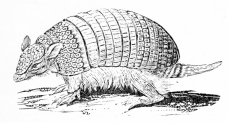
THE ARMADILLO. (Dasypus sexcinctus.)
Nature seems to have been singularly careful in the preservation of this animal, for she has surrounded it with a strong coat of armour to protect it from its enemies. When closely pursued, it assumes the shape of a ball; and, if near a precipice, rolls from one rock to another, and escapes without receiving any injury. The shell, which covers the whole of the body, is composed of numerous bony plates, very hard, and of a square shape, united by a kind of cartilaginous substance, which gives flexibility to the whole. The Armadillo lives principally on roots, carrion, and ants; and in a wild state resides in subterranean burrows, like the rabbit. It is a native of South America. There are several species differing chiefly in the number of their bands. When naturalists wish to obtain a specimen of the Armadillo in its native country, they are obliged to employ an Indian to dig one out of its hole; and as the holes are almost innumerable, only a few of them containing Armadillos, the Indians try them first by putting a stick down, when, if a number of musquitos rise, the Indians know the hole contains an Armadillo, as, if there were none, there would be no musquitos.
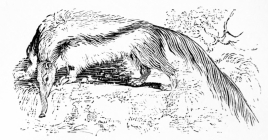
THE GREAT ANT-EATER. (Myrmecophaga jubata.)
The body of the Great Ant-eater is covered with exceedingly coarse and shaggy hair. Its head is very long and slender, and the mouth but just large enough to admit its tongue, which is cylindrical, nearly two feet in length, and lies folded double within it. The tail is of enormous size, and covered with long black hair, somewhat like the tail of a horse. The whole length of the animal, from the end of the snout to the tip of the tail, is sometimes seven or eight feet. Its food consists principally of ants, which it obtains in the following manner:—When it comes to an ant-hill, it scratches it up with its long claws, and then unfolds its slender tongue, which much resembles an enormously long worm. This being covered with a glutinous matter or saliva, the ants adhere to it in great numbers: these it swallows alive, repeating the operation till no more are to be caught.
He also tears up the nests of wood-lice, which it in like manner discovers; but should it meet with little success in its pursuit of food, it is able to fast for a considerable time without inconvenience. The motions of the Ant-eater are in general very slow. It swims, however, over great rivers with ease; and, on these occasions, its tail is always thrown over its back. With this extraordinary member, when asleep, or during heavy showers of rain, the animal is also said to cover its back; but at other times he carries it extended behind him. The Ant-eater is a native of South America.
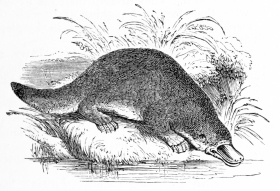
THE DUCK-BILLED PLATYPUS, OR WATER MOLE. (Ornithorhynchus paradoxus.)
This extraordinary creature has the bill and webbed feet of a duck, united to the body of a mole. It is a native of Australia, where it is found on the banks of rivers, in the sides of which it burrows and forms its nest. It feeds on aquatic insects and small molluscous animals, always, however, rejecting the shells of the latter, after crushing them in its mouth, so as to extract the body. A number of these animals are always found together; but it is very difficult to watch their habits, as their sense of hearing is so acute, that they disappear at the slightest noise, plunging into the water, in which they swim so low, that they only look like a mass of weeds floating on the surface.
When the animal feeds, he plunges his beak into the mud, just like a duck; and appears to be equally at home on land and in water. Two young ones that were kept for some time at Sydney, by Mr. Bennet, were very fond of rolling themselves up like a hedgehog, in the form of balls. They often slept in this position, and “awful little growls” issued from them when disturbed. They were fed with worms, and bread and milk; but captivity did not seem to agree with them, and they soon died. They dressed their fur by combing it with their feet, and pecking at it with their beaks, seeming to take great delight in keeping it smooth and clean.
The shape of this animal is so extraordinary, that when a specimen was first sent to Europe, it was supposed to have been manufactured, by fixing the beak of a duck into the head of some small quadruped, with the intention to deceive. Subsequent experience has proved, beyond the possibility of a doubt, the existence of the animal, without in the smallest degree diminishing the wonder excited by its first appearance, as it seems to partake, in almost equal parts, of the nature of quadrupeds, birds, and reptiles.
The Australian Hedgehog (Echidna hystrix), has a long and very slender muzzle, at the end of which is a very small mouth, containing a long tongue, which the creature can extend at pleasure. The body is short and rounded: it is covered with strong sharp spines mixed with hair; and its tail is so short that it was at first doubted whether it had one. The male has a spur upon each hind leg, which was long supposed, but it seems erroneously, to possess venomous properties. Both the Platypus and the Australian Hedgehog, although arranged here with the toothless quadrupeds, are generally considered by zoologists to be most closely related to the Marsupials, or Pouched Mammalia.
§ VII.—Pachydermata, or Thick-skinned Animals.
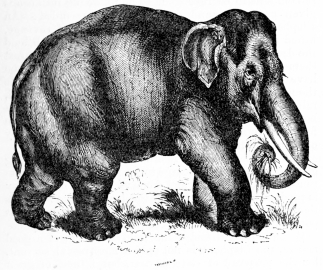
THE ELEPHANT. (Elephas indicus.)
THE ELEPHANT. (Elephas indicus.)
Providence, always impartial in the distribution of its gifts, has given this bulky quadruped a quick instinct nearly approaching to reason, in compensation for the uncouthness of his body. The Ceylon Elephant is about ten or twelve feet high, and is much the largest of all living quadrupeds. His skin is in general a mouse colour, but is sometimes white and sometimes black. His eyes are rather small for the size of his head, and his ears, which are very expanded and of a peculiar shape, have the flaps hanging down, instead of standing up, as in most quadrupeds. The Elephant is a gregarious animal in his wild state, and when domesticated is susceptible of attachment and gratitude, as well as of anger and revenge. Several anecdotes are related of his quick apprehension, and particularly of his vindictive treatment of those who have either scoffed at or abused him. To disappoint him is dangerous, as he seldom fails to be revenged. The following instance is given as a fact, and deserves to be recorded:—An Elephant, disappointed of his reward, out of revenge, killed his governor. The poor man’s wife, who beheld the dreadful scene, took her two children and thrust them towards the enraged animal, saying, “Since you have slain my husband, take my life also, as well as those of my children!” The Elephant instantly stopped, relented, and, as if stung with remorse, took the eldest boy in his trunk, placed him on his neck, adopted him for his governor, and would never afterwards allow any other person to mount him.
The Elephant’s mouth is armed with broad and strong grinding teeth, and two large tusks, which measure sometimes nine or ten feet, and from which the finest ivory is produced. The ivory from the tusks of the female is thought the best, as the tooth, being smaller, admits less porosity in the cellular part of the mass.
Becoming tame under the mild treatment of a good master, the Elephant is not only a most useful servant, for the purposes of state or war, but is also of great assistance in taming the wild ones that have been recently caught. Indian superstition has paid great honours to the white race of this quadruped; and the island of Ceylon is supposed to breed the finest of the kind. This immense beast, by the wisdom of Providence, has not been placed among the carnivorous animals: and vegetable food being much more abundant than animal, he is destined to live on grass and the tender shoots of trees. This noble creature bears in state on his back the potentates of the East, and seems to delight in pompous pageantry: in war he carries a tower filled with archers; and in peace lends his assistance in domestic operations. The female is said to go a year with young, and to bring forth one at a time. The Elephant lives a hundred and twenty or a hundred and thirty years, though they have been known to live to the great age of four hundred. When Alexander the Great had conquered Porus, King of India, he took a large Elephant which had fought very valiantly for the king, and naming him Ajax, dedicated him to the sun, and then let him loose with this inscription:—“Alexander, the son of Jupiter, hath dedicated Ajax to the sun.” This Elephant was found with this inscription 350 years after.
The greatest wonder the Elephant presents to the admiration of the intelligent observer of nature is his proboscis, or trunk, which attains a length of six or eight feet, and is so flexible that he uses it almost as dexterously as a man does his hand. It was erroneously said, that the Elephant could receive nourishment through his trunk; this sort of pipe is nothing but a prolongation of the snout, for the purpose of breathing, into which the animal can by the strength of his lungs draw up a great quantity of water or other liquid, which he spouts out again, or brings back to his mouth by inverting and shortening his proboscis for this purpose.
Captain Marryat, in his very entertaining work called Masterman Ready, relates a curious instance of the sagacity of an Elephant in India, which had fallen into a deep tank. The tank was so deep that it was impossible to hoist the Elephant up, but when the people threw down several bundles of faggots, the sagacious animal laid one bundle above another, always standing on each tier as he arranged it, till at last he raised the pile high enough to allow him to walk out of the tank. But instances of the sagacity of this noble creature might be cited ad infinitum. In the East, where they are made available in the service of man, they will load a boat with singular dexterity, carefully keeping every article dry, and disposing and balancing the cargo with the utmost precision.
Its strength is proportionate to its bulk: it will carry three or four thousand pounds weight on its back, and upwards of a thousand pounds on its tusks.
The African Elephant is a distinct species (E. africanus) readily distinguished from his Asiatic brother, by the enormous size of his flapping ears. He is abundant in the southern part of Africa and is killed annually in great numbers for the sake of his tusks.
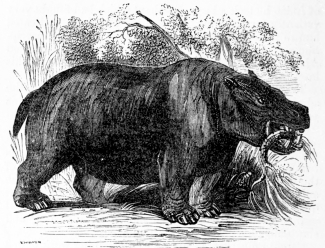
THE HIPPOPOTAMUS, OR RIVER-HORSE. (Hippopotamus amphibius.)
This animal lives as well on land as in water, and yields in size to none but the elephant: he weighs sometimes more than fifteen hundred pounds. His skin is naked, and of a blackish brown colour, tinged with red about the muzzle and on the lower surface of the body. The head is flattish on the top, about four feet long and nine in circumference; the lips are large, the jaws open about two feet wide, and the cutting-teeth, of which it has four in each jaw, are nearly a foot long; he has broad ears, and large eyes, a thick neck, and a short tail, tapering like that of a hog. He grazes and eats the leaves and young branches of trees on shore, but retires to the water if pursued, and will sink down to the bottom, where he can remain five or six minutes at a time. When he rises to the surface and remains with his head out of the water, he makes a bellowing noise which may be heard at a great distance. The female brings forth her young upon land, and it is supposed that she seldom produces more than one at a time. The calf at the instant that it comes into the world, flies to the water for shelter, if pursued; a circumstance which has been noticed as a remarkable instance of pure instinct. Fine specimens of this remarkable animal are to be seen in the Zoological Gardens in London; and in Paris they have been known to breed twice, but on both occasions the mother destroyed her offspring, either intentionally or by accident. The Hippopotamus is supposed to be the Behemoth of the Scripture. See Job, chap. xl.
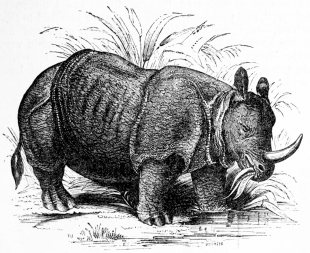
THE INDIAN RHINOCEROS, (Rhinoceros unicornis,)
So called because of the horn on his nose, is bred in India, is of a dark slate-colour, and nearly as large as the elephant, as he measures about twelve feet in length, but has short legs. His skin, which is not penetrable by any ordinary weapon, is folded upon his body, in the manner represented in the figure above; his eyes are small and half closed, and the horn on his nose is attached to the skin only. In confinement he often wears it to a mere stump, by rubbing it against his crib. He is perfectly indocile and untractable; a natural enemy to the elephant, to whom he often gives battle, and is said never to go out of his way, but to endeavour to destroy whatever obstacles present themselves, rather than turn about. He lives on the coarsest vegetables, and frequents the banks of rivers, and marshy grounds; his hoofs are divided into four, and he grunts like a hog, which he resembles in many other particulars. The female produces but one at a time, and during the first month her young are not bigger than a large dog. The Rhinoceros is supposed by some to be the Unicorn of holy writ, and possesses all the properties ascribed to that animal,—rage, untamableness, great swiftness, and immense strength. It was known to the Romans in very early times. Augustus introduced one into the shows, on his triumph over Cleopatra. Some Rhinoceroses have two horns.
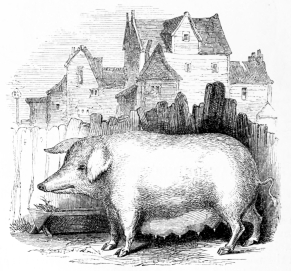
THE COMMON OR DOMESTIC HOG, (Sus scrofa,)
Differs chiefly from the wild animal in having smaller tusks, and large and pendant ears. Of all domestic quadrupeds this is the most filthy and impure. Its form is clumsy and unsightly, and its appetite gluttonous and excessive. Nature, however, has fitted its stomach to receive nutriment from a variety of things that would be otherwise wasted, as the refuse of the field, the garden, and the kitchen, afford it a luxurious repast. The Hog is naturally stupid, inactive, and drowsy; much inclined to increase in fat, which is disposed in a different manner from that of other animals, forming a thick, distinct, and regular layer between the flesh and skin. Their flesh, Linnæus observes, is a wholesome food for those that use much exercise, but improper for such as lead a sedentary life. It is of great importance to this country, as a naval and commercial nation, for it salts better than any other flesh, and is capable of being longer preserved.
The domestic Sow brings forth twice a year, producing from ten to twenty at a litter. She goes four months with young, and brings forth in the fifth. At that time she must be carefully watched, to prevent her from devouring her young. Still greater attention is necessary to keep off the male, as he would destroy the whole litter. Jews and Mahommetans not only abstain from the flesh of swine from a religious principle, but consider themselves defiled by even touching it.
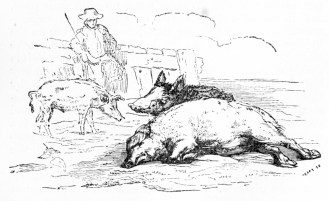
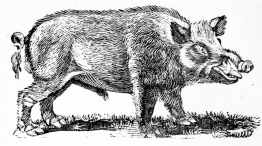
THE WILD BOAR, (Sus scrofa,)
Inhabits, for the most part, marshes and woods, and is of a black or brown colour: his flesh is very tender and good for food. The Wild Boar has tusks, which are sometimes nearly a foot in length, and have often proved dangerous to men, as well as to dogs in the chase. His life is confined to about thirty years; his food consists of vegetables; but when pressed by hunger, he devours animal flesh. This creature is strong and fierce, and undauntedly turns against his pursuers. To hunt him is one of the principal amusements of the grandees in those countries where he is to be found. The dogs provided for this sport are of the slow, heavy kind. Those used for hunting the stag, or the roebuck, would be very improper, as they would too soon come up with their prey, and, instead of a chase, would only furnish an engagement. Small mastiffs are therefore chosen; nor do the hunters much regard the goodness of their nose, as the Wild Boar leaves so strong a scent that it is impossible for them to mistake his course. They never hunt any but the largest and the oldest, which are known by their tusks. When the boar is reared, as is the expression for driving him from his covert, he goes slowly and sullenly forward, without any indication of fear, not very far before his pursuers. At the end of every half-mile, or thereabouts, he turns round, stops till the hounds come up, and offers to attack them. These, on the other hand, knowing their danger, keep off and bay him at a distance. After they have for a while gazed upon each other, with mutual animosity, the Boar again slowly goes on his course, and the dogs renew the pursuit. In this manner the charge is sustained, and the chase continues, till the Boar is quite tired, and refuses to go any further. The dogs then attempt to close in upon him from behind; those which are young, fierce, and unaccustomed to the chase, are generally the foremost, and often lose their lives by their ardour. Those which are older, and better trained, are content to wait until the hunters come up, who despatch him with their spears.
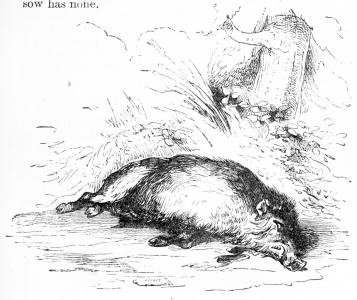
In former times, the Wild Boar was a native of Britain, as appears from the laws of the Welsh prince, Howell the Good, who permitted his grand huntsman to chase that animal from the middle of November to the beginning of December; and in the reign of William the Conqueror, those who were convicted of killing the Wild Boars, in any of the royal forests, were punished with the loss of their eyes. Our domestic pigs are descended from the wild race; but the tame Boar has two tusks, smaller than those of the wild ones, and the sow has none.
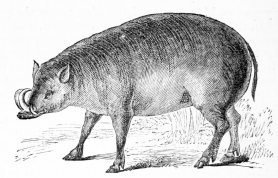
THE BABIROUSSA, (Babirussa alfurus,)
Is a singular species of hog, which dwells in many of the islands of the eastern Archipelago. His four tusks are of enormous size, especially those of the upper jaw, which are turned completely upwards and bent back, like horns, towards the forehead, which they sometimes even touch. These singular tusks are only found in the male; they do not seem, from their construction, to be of much use to him as weapons; and it was formerly supposed that he employed them as hooks to hang himself up to the branch of a tree for his night’s rest.
THE PECCARY. (Dicotyles labiatus.)
This is a little species of pig, of a brown colour, with pale lips, which is found in great troops in the forests of South America. These bands of Peccaries are said to travel from place to place under the guidance of a sort of chief, who places himself at the head of his troop and marches forward in a direct line, swimming boldly over the rivers, and often devastating the plantations. When one of these troops meets with any unusual object, they all stop to examine it, making a dreadful clattering with their teeth, which they are quite ready to use in their own defence, and will soon tear an assailant to pieces, unless he can succeed in climbing up into a tree.
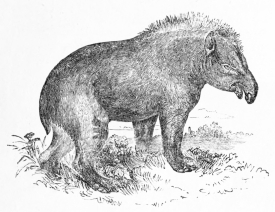
THE TAPIR. (Tapirus americanus.)
This animal bears considerable resemblance to the wild boar, but is without tusks, and has its snout prolonged into a small fleshy proboscis, or trunk. This trunk, however, has not the flexibility of that of the elephant, and is incapable of holding anything. The colour of the Tapir is of a deep brown, and the male has a small mane on the upper part of his neck. It stands about three feet and a half high, and measures nearly six feet in length. It lies in thickets, the thorny branches of which cannot affect it from the thickness of its skin, while they lacerate the skins of its pursuers. Its favourite food is the water-melon. It is generally found alone, and always roams in search of food at night; and it is easily tamed if taken young. It possesses the same power of remaining under water as the hippopotamus, and when it enters a pond, can descend to the bottom, and remain there five or six minutes.
The Malayan Tapir (T. malayanus), is very similar to the American species in form; but is larger and has no mane. It is very remarkable for the distribution of its colours, the anterior part and the legs being deep black, and the rump, back, and sides, white. This animal is found chiefly in Sumatra and Borneo.
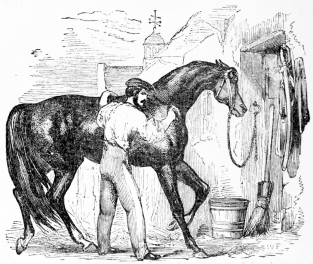
THE HORSE. (Equus caballus.)
The noblest conquest that man ever made over the brute creation was the taming of the Horse, and adapting him to his service. He lessens the labours of man and adds to his pleasures: shares, with equal docility and cheerfulness, the fatigues of hunting or the dangers of war; and draws with appropriate strength, rapidity, or grace, the heavy ploughs and carts of the husbandman, the light vehicles of the fashionable, and the stately carriages of the aristocratic.
The Horse is now bred in most parts of the world: those of Arabia, Turkey, and Persia are accounted better proportioned than many others; but the English Race-Horse may justly claim the precedence over all the other European breeds, and is not inferior to any in strength and symmetry.
The beautiful Horses produced in Arabia are in general of a brown colour; their mane and tail are very short, with the hair black and tufted. The Arabs, for the most part, use the Mares in their ordinary excursions; experience having taught them that they are less vicious than the males, and more capable of sustaining abstinence and fatigue. As the Arabs have no other residence than a tent, this also serves for a stable; the husband, the wife, the child, the mare, and the foal, lie together indiscriminately, and the younger branches of the family may be often seen embracing the neck, or reposing on the body of the Mare, without any idea of fear or danger.
Of the remarkable attachment which the Arabs have to these animals, St. Pierre has given an affecting instance in his Studies of Nature.—“The whole stock of a poor Arabian of the desert consisted of a beautiful Mare: this the French consul at Said offered to purchase, with an intention to send her to Louis XIV. The Arab, pressed by want, hesitated a long time, but at length consented, on condition of receiving a very considerable sum of money, which he named. The consul wrote to France for permission to close the bargain; and having obtained it, sent the information to the Arab. The man, so indigent as to possess only a miserable covering for his body, arrived with his magnificent courser: he dismounted, and first looking at the gold, then steadfastly at his Mare, heaved a sigh, ‘To whom is it,’ exclaimed he, ‘that I am going to yield thee up? To Europeans? who will tie thee close, who will beat thee, who will render thee miserable! Return with me, my beauty, my jewel! and rejoice the hearts of my children:’ as he pronounced the last words, he sprung upon her back, and was out of sight almost in a moment.”
The intelligence of the Horse is next to that of the elephant, and he obeys his rider with so much punctuality and understanding, that the Americans, who had never seen a man on horseback, thought, at first, that the Spaniards were a kind of centaurs, half men and half horses. The Horse, in a domestic state seldom lives longer than twenty years; but it is supposed that in a wild state he attains a much greater age. The Mare is as elegant in her shape as the Horse; and her young is called a foal. The age of the Horse is known from his teeth; and his colour, which varies from black to white, and from the darkest brown to a light hazel tint, has been reckoned a criterion by which to judge of his strength.
The Horse feeds upon grass, either fresh or dry, and corn: he is liable to many diseases, and often dies suddenly. In the state of nature, he is a gregarious animal, and even when domesticated, his debased situation of slavery has not entirely destroyed his love of society and friendship; for Horses have been known to pine at the loss of their masters, their stable fellows, and even at the death of a dog which had been bred near the manger. Virgil, in his beautiful description of this noble animal, seems to have imitated Job:
“The fiery courser, when he hears from far The sprightly trumpets, and the shouts of war, Pricks up his ears, and trembling with delight, Shifts place, and paws, and hopes the promised fight. On his right shoulder his thick mane reclined, Ruffles at speed, and dances in the wind. His horny hoofs are jetty black and round, His chine is double; starting with a bound, He turns the turf and shakes the solid ground. Fire from his eyes, clouds from his nostrils flow; He bears his rider headlong on the foe.”
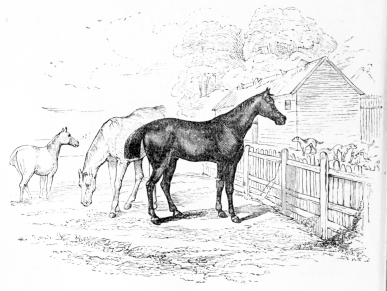
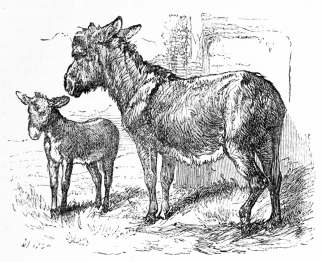
THE ASS. (Equus Asinus.)
The Ass is a beast of burden, and extremely serviceable to man. Of greater strength than most animals of his size, he bears fatigue with patience, and hunger with apparent cheerfulness. A bundle of dried herbs, or a thistle on the road, is sufficient for his daily meal, and he is content with the clear and pure water of a neighbouring brook (in the choice of which he is particularly nice) in the absence of better fare. It is probable that the Ass was originally a native of Arabia, and other parts of the East: the deserts of Libya and Numidia, and many parts of the Archipelago, contain vast herds of wild Asses, which run with such amazing swiftness, that even the fleetest horses of the country can hardly overtake them. At present, perhaps, the best breed in Europe is the Spanish; and very valuable Asses are still to be had in the southern continent of America, where, during the existence of the Spanish dominion, the breed was very carefully attended to. In the time of Elizabeth, we are informed, there were no Asses in this country. Our treatment of this very useful animal is both wanton and cruel, and most ungrateful, considering the great services he renders us at so little expense. The ears of the Ass are of an uncommon length; and he is of a greyish or dun colour, with a black cross on his back and shoulders. When very young, the Ass is sprightly, and even tolerably handsome; but he soon loses these qualifications, either by age or ill-treatment, and becomes slow, sullen, and headstrong. The female is passionately fond of her young one; and it is said she will even cross fire and water to protect or rejoin it. The Ass is also sometimes greatly attached to its owner, whom he scents at a distance, and plainly distinguishes from others in a crowd.
The female goes with young eleven months, and seldom produces more than one foal at a time: the teeth follow the same order of appearance and renewal as those of the horse. Asses’ milk has long been celebrated for its sanative qualities; invalids suffering from debility of the digestive and assimilative functions make use of it with great advantage; and to those also who are consumptive it is very generally recommended.
An old man who, a few years ago, sold vegetables in London, used in his employment an Ass, which conveyed his baskets from door to door. Frequently he gave the poor industrious creature a handful of hay, or some pieces of bread, or greens, by way of refreshment or reward. The old man had no need of any goad for the animal, and seldom, indeed, had he to lift up his hand to drive it on. His kind treatment was one day remarked to him, and he was asked if his beast was apt to be stubborn? “Ah! master,” replied he, “it is of no use to be cruel, and as for stubbornness, I cannot complain; for he is ready to do anything and go anywhere. I bred him myself. He is sometimes skittish and playful, and once ran away from me; you will hardly believe it, but there were more than fifty people after him, attempting in vain to stop him; yet he turned back of himself, and he never stopped till he ran his head kindly into my bosom.”
The ancients had a great regard for this animal. The Romans had a breed which they held in such high estimation, that Pliny mentions one of the males selling for a price greater than three thousand pounds of our money; and he says that in Celtiberia, a province in Spain, a she Ass had colts that were bought for nearly the same sum. The Ass lives nearly to the same age as the horse. From the general resemblance between the Ass and the horse, it might naturally be supposed that they were closely allied, and that one had degenerated; they are, however, perfectly distinct. There is that inseparable barrier placed between them which nature provides for the protection and preservation of her productions; their mutual offspring, the mule, being incapable of reproducing its kind.
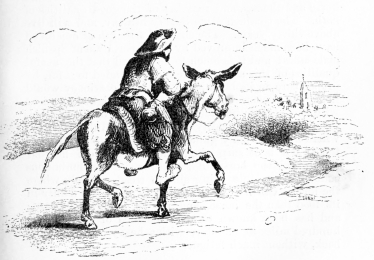
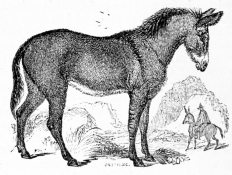
THE MULE.
This useful and hardy animal is the offspring of the horse and the ass, and partakes of the good qualities of both. The common Mule is very healthy, and will live above thirty years. The size and strength of our breed have been much improved by the importation of Spanish male asses; and it is much to be wished that the useful qualities of this animal were more attended to; for, by proper care in its breaking, its natural obstinacy would in a great measure be corrected; and it might be formed with success for the saddle, the draught, or the burden. People of the first quality are drawn by Mules in Spain, where fifty and sixty guineas is no uncommon price for them; nor is it surprising, when we consider how far they excel the horse in travelling in a mountainous country, the Mule being able to tread securely where the former can hardly stand. It is much less dainty in its food than the horse, and not so liable to disease; and has been known to go a distance of eighty or a hundred miles in one day, with a heavy weight on its back, without much fatigue.
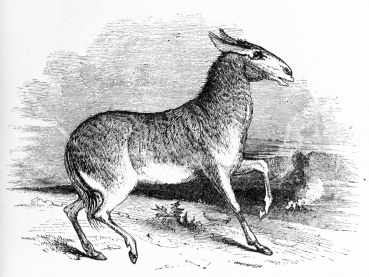
THE KIANG. (Equus Hemionus.)
The Kiang, which is also called the Djiggetai, is a kind of wild ass, found in small herds on the great plains of Central Asia. It is a good deal larger than the common ass, and its fur is of a peculiar pale reddish chestnut tint, except on the legs and muzzle, which are nearly white. The ears are not so long as in the ass, and there is a black streak down the middle of the back.
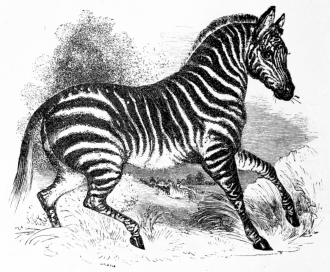
THE ZEBRA. (Equus Zebra.)
This is one of the most elegantly marked quadrupeds in nature. He is striped all over with the most pleasing regularity; in size he resembles the mule, being smaller than the horse, and larger than the ass. The hair of his skin is uncommonly smooth, and he looks at a distance like an animal that some fanciful hand has surrounded with ribbons of white or buff, and jet black. He is a native of Southern Africa—chiefly of the Cape of Good Hope, where he resides amongst the mountains. In these solitudes the Zebra has nothing to restrain his liberty. He is too shy to be caught in traps, and therefore seldom taken alive. Were the Zebra inured to our climate, there is little doubt but he might be soon domesticated. The black cross which the ass bears on his back and shoulders indicates the affinity between these two animals. The Zebra feeds in the same manner as the horse, ass, and mule; and seems to delight in having clean straw and dried leaves to sleep upon. His voice can hardly be described; it is thought by some persons to have a distinct resemblance to the sound of a post-horn, and is more frequently exerted when the animal is alone than at other times. In former times, Zebras were often sent as presents to the oriental princes. A governor of Batavia is said to have given one to the emperor of Japan, for which he received as an equivalent a present to the value of sixty thousand crowns; and Teller informs us, that the Great Mogul gave two thousand ducats for one of these animals. It is usual with the African ambassadors to the court of Constantinople to bring Zebras with them as presents for the Grand Seignior. In a wild state they live in herds, and can only be tamed when taken young, or bred in captivity.
Another kind of Zebra (Equus Burchellii) inhabits the plains of Southern Africa; it is known as the Zebra of the plains, and is also called Burchell’s Zebra, after the distinguished African traveller. This Zebra is less beautifully marked than the mountain species.
Instinct having taught these beautiful animals that in union consists their strength, they combine in a compact body when menaced by an attack either from man or beast; and if overtaken by the foe, they unite for mutual defence, with their heads together in a close circular band, presenting their heels to the enemy, and dealing out kicks in equal force and abundance. Beset on all sides, or partially crippled, they rear on their hinder legs, fly at their adversary with jaws distended, and use both teeth and heels with the greatest freedom.
The Quagga is also a native of Southern Africa. It is more wild than the Zebra, and less beautifully marked; the stripes, indeed, do not extend over the whole body, but only over the head and neck. The colour is a reddish brown above and white beneath. The Quagga is less than the Zebra, and not so elegantly formed, the hind quarters being higher than the shoulders. The ears are also much shorter. The Quagga bears the reputation of being naturally vicious, and so treacherous that it is said that, like a cat, it will bite the hand that feeds and caresses it.