BOOK II. INHABITANTS OF THE AIR. (continued 4)
Reading edition

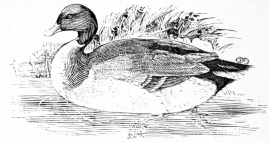
THE DUCK. (Anas boschas.)
The common Duck is of two kinds, the wild and the tame, the latter being but the same species altered by domestication; the difference between them is very trifling, save that the colour of the Mallard, or male wild Duck, is constantly the same in all the individuals, whereas the Drakes, or tame ones, are varied in their plumage. The females do not share with the males in beauty of plumage: the admirable scarf of glossy green and blue, which surrounds the neck of Drakes and Mallards, being an exclusive prerogative of the male sex. There is also a curious and invariable peculiarity belonging to the males, which consists of a few curled feathers rising upon the rump.
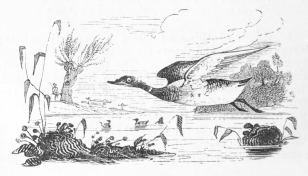
Wild Ducks are caught by decoys in the fen countries, and in such prodigious numbers, that in only ten decoys in the neighbourhood of Wainfleet, as many as thirty-one thousand two hundred have been caught in one season. They do not always build their nests close to the water, but often at a considerable distance from it; in which case the female will take the young ones in her beak, or between her legs, to the water. They have sometimes been known to lay their eggs in a high tree, in a deserted magpie’s or crow’s nest; and an instance has been recorded of one being found at Etchingham, in Sussex, sitting upon nine eggs in an oak, at the height of twenty-five feet from the ground: the eggs were supported by some small twigs laid cross-ways.
The tame Ducks, reared about mills and rivers, or wherever there is a sufficient quantity of water for them to indulge their sports and to search for food, become a branch of trade, which proves very profitable to their owners.
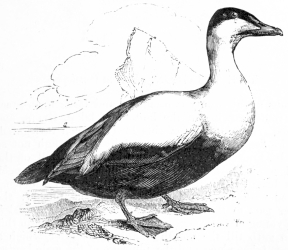
THE EIDER DUCK, (Sornateria mollissima,)
Which is found about the coasts of the north of England and Scotland, becomes more numerous as we go further north, and is most abundant on Iceland and the Arctic shores, both of Europe and America. This bird is particularly valuable for the great quantity of down which it furnishes, as this is so light and elastic that beds and quilts made from it are preferable to any others. The birds line their nests with this beautiful material plucked from their own bodies, and it is chiefly by plundering the nests that the down is obtained. Each nest will furnish about half a pound of down in the season, and it is worth about four dollars a pound.
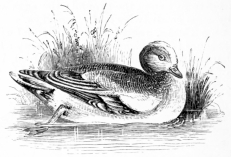
THE WIDGEON, (Mareca Penelope,)
Weighs about twenty-two ounces, and feeds upon grass and roots growing at the bottom of lakes, rivers, and ponds. The plumage of this bird is much variegated, and its flesh esteemed a great delicacy, though not so highly praised as that of the teal. The bill of the Widgeon is black; the head and upper part of the neck of a bright bay; the back and sides under the wing waved with black and white; the breast purple; the lower part of the body white, and the legs are dusky. The young of both sexes are grey, and continue in this plain garb till the month of February; after which a change takes place, and the plumage of the male begins to assume its rich colourings, in which, it is said, he continues till the end of July; and then again the feathers become dark and grey, so that he is hardly to be distinguished from the female.
Widgeons commonly fly in small flocks during the night, and may be known from other birds by their whistling note, while they are on the wing. They quit the desert morasses of the north on the approach of winter, and as they advance towards the ends of their destined southern journey, they spread themselves along the shores, and over the marshes and lakes, in various parts of the continent, as well as those of the British isles; and it is said that some of the flocks advance as far south as Egypt.
The Widgeon is easily domesticated in places where there is plenty of water, and is much admired for its beauty, sprightly look, and busy, frolicsome manners; yet it is generally asserted that they will not breed in confinement, or at least that the female will not make a nest and perform the act of incubation; but that she will lay eggs, which are generally dropped into the water.
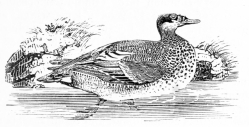
THE TEAL, (Querquedula crecca,)
Is the least of the duck tribe, weighing only twelve ounces. The lower part of the body is of a dingy white, inclining to a grey tint. The back and sides under the wings are curiously varied with lines of white and black; the wings are all over brown, and the tail of the same colour. This bird is common in England during the winter months, and it is still uncertain whether it does not breed here as it does in France. Dr. Heysham says it is known to breed in the neighbourhood of Carlisle. The female makes her nest of reeds interwoven with grass; and, as it is reported, places it among the rushes, in order that it may rise and fall with the water. Their eggs are of the size of those of a pigeon, six or seven in number, and of a dull white colour, marked with small brownish spots; but it appears that they sometimes lay ten or twelve eggs, for Buffon remarks that that number of young are seen in clusters on the pools, feeding on cresses, chervil, and some other weeds, as well as upon seeds and small insects that swarm in the water. The flesh of the Teal is a great delicacy in the winter season, and has less of the fishy flavour than any of the wild duck kind. It is known to breed and remain throughout the year in various temperate climates of the world, and is in the summer met with as far northward as Iceland.
THE COMMON GULL. (Laruscanus.)
The Gulls, of which there are a great many different kinds, are very common birds around our coasts and at the mouths of rivers; they have long wings, and fly with great rapidity and buoyancy. Their plumage is thick, and they float very lightly on the surface of the water, but do not dive. The Gulls are very voracious, and not only devour great quantities of fishes, shell-fish, and other marine animals, but even condescend to feed upon the dead bodies of animals which they find floating on the water or cast up on the shore. Some of the smaller kinds come inland, and catch insects on the wing, in the same way as the Swallows.
The Common Gull is rather a large species, being more than eighteen inches in length when full grown. Its plumage is pearly grey above and white beneath; the largest wing feathers are black, with white tips and white spots near the tip; and the bill and feet are greenish grey. This bird breeds in the salt marshes or on the ledges of cliffs. The female lays two or three eggs, which are olive brown, with dark brown and black spots.
It is a very pretty sight to watch from the top of a lofty cliff the multitudes of these birds that often haunt our coasts; gliding with beautiful ease and swiftness through the air, skimming the surface of the water in pursuit of their prey, or reposing upon its bosom. Even their rather harsh and discordant cry is in harmony with the wild and imposing heights on which they love to dwell. This, however, does not protect them from the frequenters of our seaside towns, with whom seagull shooting is a favourite amusement; an amusement the more to be reprehended as the flesh of the bird is quite useless.
Gulls are frequently caught alive, and, after having their wings clipped to prevent their escape, are kept to satisfy their voracious appetite on snails, slugs, and other garden pests.
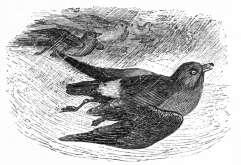
THE STORMY PETREL, OR MOTHER CARY’S CHICKEN. (Thalassidroma pelagica.)
“O’er the deep! o’er the deep! Where the whale, and the shark, and the sword-fish sleep, Outflying the blast and the driving rain, The petrel telleth her tale in vain; For the mariner curseth the warning bird, Who bringeth him news of the storm unheard! Oh! thus does the prophet, of good or ill, Meet hate from creatures he serveth still; Yet he ne’er falters:—So, Petrel! spring Once more o’er the waves on thy stormy wing.” Procter.
The Stormy Petrel is not larger than a swallow; and its colour is entirely black, except the coverts of the tail, the tail itself, and the vent-feathers, which are white: its legs are slender. Ranging over the expanse of the ocean, and frequently at a vast distance from the land, this bird is able to brave the utmost fury of the storms. Even in the most tempestuous weather it is frequently observed by the mariners skimming with almost incredible velocity along the billows, and sometimes over their summits. They often follow vessels in great flocks, to pick up anything that is thrown overboard; but their appearance is looked upon by the sailors as the sure presage of stormy weather in the course of a few hours. It seems to seek protection from the fury of the wind in the wake of the vessels; and it is probable that for the same reason it often flies between two surges. The nest of this bird is found in the Orkney Islands, under loose stones, in the months of June and July. It lives chiefly on small fish; and although mute by day, it is very clamorous by night. The young of this bird are fed with an oily matter or chyle, which is ejected from the stomachs of the parents.
Mudie, in his very entertaining work on British Birds, says that they are called Petrels, or “little Petrels,” because they move along the surface as if they were literally walking on the water. He also informs us that they are at times very full of oil, and that the Faroese, taking advantage of this circumstance, convert them into lamps, by fixing them in an upright position and drawing a wick through their bodies, which they light at the mouth.
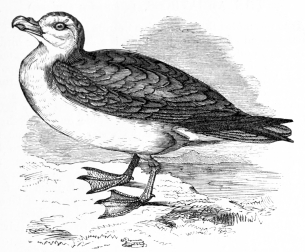
THE FULMAR, (Procellaria glacialis,)
Is a larger kind of Petrel, which is found not uncommonly on the British coasts, and is exceeding abundant in the Arctic seas. Here it is a regular attendant upon the whale-fishers when they are engaged in cutting up a whale. Any fragments of blubber that happen to fall into the water are immediately snapped by these greedy birds, which clamour and squabble over the feast with so little regard to the vicinity of the sailors, that they may be knocked on the head with a boat-hook. They are in high estimation in the countries they inhabit, on account of the large amount of oil they contain. It is only rarely they are seen in England, nor do they regularly frequent any part of Great Britain, except a few of the northernmost islands of Scotland. Like the other Petrels, they feed their young with a sort of oil, which they have the power of exuding at will.
THE ALBATROSS, (Diomedea exulans,)
Also resembles the diminutive Petrels in some respects; but instead of being a pigmy it is a giant among birds. Its wings often measure as much as fifteen feet in extent and are of corresponding power, as they have to support the Albatross by the day together above the stormy waves of the great Southern Ocean. Indeed, so enormous is their strength and endurance, that they have been known to follow ships for whole days together, without once resting upon the water. From time to time the gigantic bird plunges down into the sea to capture the fishes with which he satisfies his hunger; and it is said that where Albatrosses are numerous they will even attack sailors who may happen to fall overboard. From their abundance at the Cape of Good Hope they are often called by mariners Cape sheep.
Albatrosses generally weigh from twenty to thirty pounds. The plumage is white, except some narrow bars upon the back, and some of the long wing feathers, which are black, and of the head, which is a reddish grey. The beak is long and powerful, and curved at the end, and would be a most terrible weapon if the owner were of a pugnacious disposition. It is, however, quite inoffensive, and is even sometimes attacked by much smaller birds, when it invariably takes to flight, and the immense power of its wings generally enables it to distance its pursuers. The Albatross, like most sea birds, has a most insatiable appetite, and devours immense quantities, not only of fish, but of other sea-animals,—such as molluscs. They are so greedy that they are caught by a line baited with a piece of flesh, which the ever-hungry bird swallows at a gulp, paying with his life for the dear repast. They are taken by the natives of the countries they frequent, not for their flesh, which is tough and insipid, but for the sake of their entrails, which are very large and elastic, and are used for a number of useful purposes.
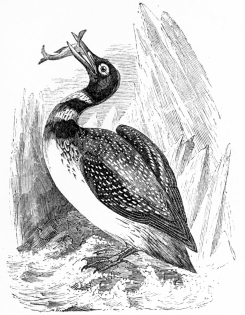
THE GREAT NORTHERN DIVER. (Colymbus glacialis.)
The Great Northern Diver is found most abundantly in the Arctic seas, but a considerable number of them dwell on the shores of Scotland. It has a rather long, strong, and sharply pointed bill; its back and wings are black, ornamented with numerous white spots; its lower surface is greyish-white; and its head and neck are black, with a couple of white collars across the front of the neck. The Great Northern Diver is a large bird, measuring nearly three feet in length; its wings are small in proportion to its size, but yet the bird is able to fly very rapidly. It is, however, in the water that it is most active; it swims and dives with the most remarkable ease, and even under water goes as fast as a four-oared boat. Its food consists of fishes, and it breeds amongst the herbage of the sea-shore, the female laying two or three eggs in a neat nest made of grass.
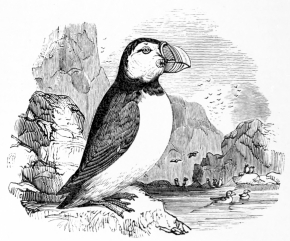
THE PUFFIN, (Fratercula arctica,)
Is another short-winged water bird, but, unlike the Northern Diver, it visits us in the summer, and breeds on our shores. It is about a foot long, and has the back and wings black, the cheeks and all the lower parts of the body, except a band round the neck, white, and the feet orange. Its bill is very curious, and has obtained for it the names of Sea Parrot and Coulterneb in some places. This organ is large and strong, but flattened at the sides; it is of a bluish colour, with three grooves and four ridges of an orange colour. The Puffin flies swiftly, and swims and dives almost as well as the Great Diver; it breeds sometimes in crannies amongst the rocks, and sometimes in a hole which it digs in the turf or in a rabbit-warren.
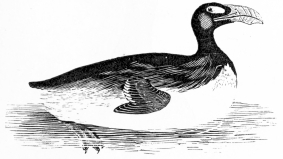
THE GREAT AUK, (Alca impennis,)
Which is sometimes called the Northern Penguin, is a large bird, furnished with very small wings, which, although formed of regular feathers, like those of other birds, are far too weak to raise their owner into the air. They are, however, of use in another way. When the Auk dives, which it frequently does, they serve as fins, and, with its powerful webbed feet, enable it to swim underneath the water with even greater rapidity than on the surface. This bird was formerly seen occasionally on the northern coasts of Britain, and became more plentiful towards the Arctic seas; but no specimens have now been met with for many years, and there is reason to believe that the bird is quite extinct on our coasts. In the water the Great Auk, like the Diver, is wonderfully active, swimming on the surface or beneath the waves with equal ease. Mr. Bullock, when in the Orkneys, pursued a male bird for several hours in a six-oared boat without being able to kill him.
The Great Auk is generally about three feet long, and changes its plumage in summer. The breeding-season is in June and July, when the female lays one large egg, of a yellowish colour, marked with black spots.
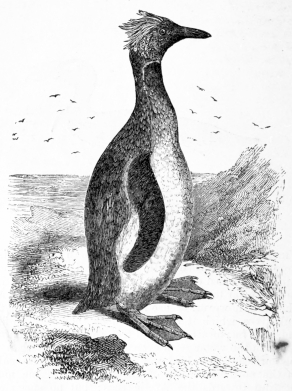
THE PENGUIN, (Speniscus demersus,)
Of which numerous species abound on the shores and islands of the great Southern Ocean, is remarkable for its almost incredible agility in the water; it swims and dives like a fish, and in fact is described as coming to the surface for air, and descending again so suddenly as to give rise to the impression that it is a fish jumping in sport. It is found in vast numbers in hiding places, where the females are seen sitting upright and holding their single egg between their legs.