BOOK II. INHABITANTS OF THE AIR. (continued 2)
Reading edition
Canary-birds live twelve or thirteen years in our climate, and sing well to the end of their life.
The following curious anecdote of one of these birds is related by Dr. Darwin: “On observing a Canary-bird at the house of a gentleman near Tutbury, in Derbyshire, I was told it always fainted away when its cage was cleaned; and I desired to see the experiment. The cage being taken from the ceiling, and the bottom drawn out, the bird began to tremble, and turned quite white about the root of the bill: he then opened his mouth, as if for breath, and respired quick; stood up straighter on his perch, hung his wings, spread his tail, closed his eyes, and appeared quite stiff for half-an-hour; till at length, with much trembling and deep respirations, he came gradually to himself.”
Some years ago, a Frenchman exhibited in London twenty-four Canary-birds, many of which he said were from eighteen to twenty-five years of age. Some of these balanced themselves, head downward, on their shoulders, having their legs and tail in the air. One of them taking a slender stick in its claws, passed its head between its legs, and suffered itself to be turned round, as if in the act of being roasted. Another balanced itself, and was swung backward and forward on a kind of a slack rope. A third was dressed in military uniform, having a cap on its head, wearing a sword and pouch, and carrying a firelock in one claw: after some time sitting upright, this bird, at the word of command, freed itself from its dress, and flew away to the cage. A fourth suffered itself to be shot at, and falling down as if dead, was put into a little wheelbarrow, and wheeled away by one of its comrades!

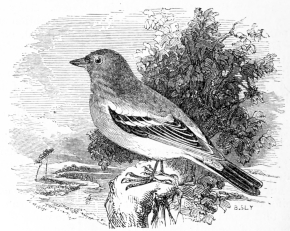
THE CHAFFINCH. (Fringilla cœlebs.)
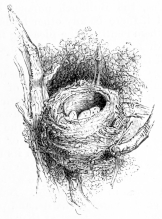
The Chaffinch is of the same dimensions as the sparrow, but more lightly and elegantly formed. Its nest, which is of the most beautiful and elaborate construction, is composed of mosses and lichens, interwoven and lined with wool, hair, and feathers. “Four or five eggs,” says Mr. Waterton, “are the usual number which the Chaffinch’s nest contains, and sometimes only three. The thorn, and most of the evergreen shrubs, the sprouts on the boles of forest trees, the woodbine, the whin, the wild rose, and occasionally the bramble, are this bird’s favourite places for nidification. Like all its congeners, it never covers its eggs on retiring from the nest, for its young are hatched blind. There is something peculiarly pleasing to me in the song of this bird. Perhaps association of ideas may add a trifle to the value of its melody; for when I hear the first note of the Chaffinch, I know that winter is on the eve of its departure, and that sunshine and fine weather are not far off. The Chaffinch never sings when on the wing; but it warbles incessantly on the trees, and on the hedgerows, from the early part of February to the second week in July; and then (if the bird be in a state of freedom) its song entirely ceases.”
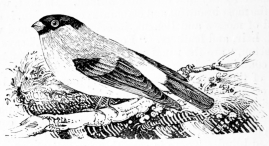
THE BULLFINCH. (Loxia pyrrhula.)
This is a very docile bird, and will nearly imitate the sound of a pipe, or the whistle of man, with its voice, the mellowness of which is really charming. It is, by bird-fanciers, considered to excel all other small birds, except the linnet, in the softness of its tones, and in the variety of its notes. In captivity, its melody seems to be as great a solace to itself, as it is a pleasure to its master. By day, and even when the evening has called for the artificial light of candles, the Bullfinch pursues his melodious exertions, and if there be any other birds in the apartment, awakes them gently to the pleasing task of singing in concert with him. His notes are upon one of the lowest keys of the gamut of birds.
The plumage of the Bullfinch is beautiful, though simple and uniform, consisting only of three or four colours. In the male, a lovely scarlet or crimson colour adorns the breast, throat, and jaws, as far as the eyes; the crown of the head is black; the rump and tail are white; the neck and back grey, or lead-coloured. The name of this bird originates from its head and neck being, like those of the bull, very large in proportion to the body. The female does not share with the male the brightness of colours in the plumage. Bullfinches build their nests in gardens and orchards, and particularly in places that abound in fruit-trees, as they are passionately fond of fruit, which they often destroy before it is ripe.
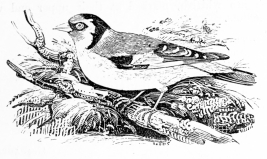
THE GOLDFINCH. (Fringilla carduelis, or Carduelis elegans.)
This bird is also called the Thistlefinch, from his fondness for the seeds of that plant. He is very beautiful, his plumage being elegantly diversified, his form small, but pleasing, and his voice not loud, but sweet. He is easily tamed, and often exhibited as a captive, with a chain round his body, drawing up with trouble, but yet with amazing dexterity, two small buckets, alternately, one containing his meat, the other his drink. If he is old when caught, the Goldfinch, after a few weeks, if well attended to, and gently treated, becomes as familiar as if he had been brought up by the hand of his keeper. Some have been taught to fire a small piece of artillery, and go through the drilling exercise, to the great astonishment of the spectators; but the cruel and severe treatment that animals undergo, when taught performances altogether contrary to their nature, should prevent us from encouraging such exhibitions.
This bird, as if conscious of the beauty of his plumage, likes to view himself in a glass, which is sometimes fixed for this purpose in the back of the cage. The art with which it composes and builds its nest is really worthy of admiration; it is generally interwoven with moss, small twigs, horsehair, and other pliant materials; the inside stuffed most carefully with fine down, and tufts of cotton grass. There the female deposits five or six eggs, which are whitish, marked at their upper end with purple dots.
“The Goldfinch weaves, with willow down inlaid, And cannach tufts, his wonderful abode; And oft suspended at the limber end Of plane-tree spray, among the broad-leaved shoots, The tiny hammock swings to every gale. Sometimes in closest thickets ’tis concealed; Sometimes in hedge luxuriant, where the brier, The bramble, and the plum-tree branch Warp through the thorn, surmounted by the flowers Of climbing vetch, and honeysuckle wild.” Grahame.
The following lines were written by Cowper on a Goldfinch starved to death in his cage. The Goldfinch speaks:—
“Time was when I was free as air, The thistle’s downy seed my fare, My drink the morning dew; I perched at will on every spray, My form genteel, my plumage gay, My strains for ever new. “But gaudy plumage, sprightly strain, And form genteel were all in vain, And of a transient date; For caught and caged, and starved to death, In dying sighs my little breath Soon passed the wiry grate. “Thanks, gentle author of my woes, Thanks for this most effectual close And cure of every ill. Never your cruelty repress! For I, if you had shown me less, Had been your prisoner still.”
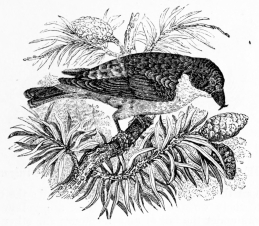
THE CROSSBILL. (Loxia curvirostra.)
The Crossbill is a native of the vast pine forests of northern Europe, and is by no means abundant in England. The bill of this singular bird is of considerable length, and the mandibles towards the point are very sharp and strong, curved in opposite directions, so that when closed the points cross each other, from which the bird derives his name. This curious organization enables them to obtain their food, which chiefly consists of the seeds of the cones of the fir, with the greatest facility. These seeds, for a considerable time after they have ripened, are so firmly enclosed within their ligneous scales, that the bill of no ordinary bird could reach them. Fixing itself across the cone, the Crossbill brings the mandibles of its beak immediately over each other, and insinuates them between the scales, then forcing them laterally, the scales open. The mandibles are again brought in contact, between the scales, and the bird then picks out the seed with their tips. It is very interesting to find that a structure so anomalous as that of the bill of the Crossbill is really beneficial to the creature, and not, as was formerly rather flippantly asserted, a defect or error of nature.
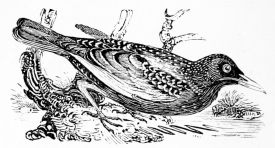
THE STARE, OR STARLING, (Sturnus vulgaris,)
Is about the size and shape of a blackbird; the tips of the feathers on the neck and back are yellow; the feathers under the tail of an ash-colour; the other parts of the plumage are black, with a purple or deep blue gloss, changing as it is variously exposed to the light. In the hen, the tips of the feathers on the breast and belly, to the very throat, are white; which constitutes a material point in the choice of the bird, as the female is no singer. She lays four or five eggs, lightly tinctured with a greenish cast of blue. Starlings build in hollow trees and clefts of rocks and walls, are very easily tamed, and can add to their natural notes any words or modulations which they are taught.
In the winter season Starlings collect in vast flocks, and may be known at a great distance by their whirling mode of flight. The evening is the time when they assemble in the greatest numbers, and betake themselves to fens and marshes. Sterne has immortalized the Starling in his “Sentimental Journey:” “The bird flew to the place where I was attempting his deliverance, and thrusting his head through the trellis, pressed his head against it, as if impatient.—‘I fear, poor creature,’ said I, ‘I can’t set thee at liberty.’—‘No,’ said the Starling, ‘I can’t get out.’ ‘Disguise thyself as thou wilt, still, slavery,’ said I, ‘still thou art a bitter draught!’ ”
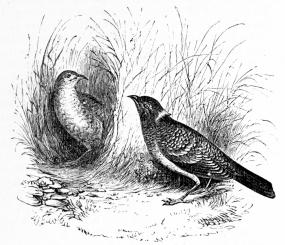
THE SATIN BOWER-BIRD. (Ptilonorhynchus holosericeus.)
This singular bird was first brought before the notice of the public by Mr. Gould, in his splendid work, the “Birds of Australia,” from which the following extracts are given by permission of its author. The most remarkable circumstance relating to this bird, is its construction of a bower-like tenement, the object of which, it should seem, is a sort of playing-ground, or hall of assembly.
“The Satin Bower-bird,” says Mr. Gould, “is not a stationary species, but appears to range from one part of a district to another, either for the purpose of varying the nature, or of obtaining a more abundant supply of food. Judging from the many specimens I dissected, it would seem that it is altogether granivorous and frugivorous; or, if not exclusively so, that insects form but a small portion of its diet. The brushes it inhabits are studded with enormous fig-trees, some of them towering to the height of two hundred feet; among the lofty branches of which the Satin Bower-bird finds, in the small wild fig with which the branches are loaded, an abundant supply of a favourite food: this species also commits considerable depredation on ripening corn. It appears to have particular times in the day for feeding, and when thus engaged among the low shrub-like trees, I have approached within a few feet without creating alarm; but at other times I have found this bird extremely shy, especially the old males, which not unfrequently perch on the topmost branch of the loftiest tree, whence they can survey all around, and watch the movements of the females and their young in the brush below. Besides the loud liquid call peculiar to the male, both sexes frequently utter a harsh, unpleasant, guttural note, indicative of surprise or displeasure. The old black males are exceedingly few in number, as compared with the females and young male birds in the green dress, from which, and other circumstances, I am led to believe that at least two, if not three years, elapse before they attain the rich satin-like plumage, which, when once perfectly assumed, is, I believe, never again thrown off. The extraordinary bower-like structures alluded to above, are usually placed under the shelter of the branches of some overhanging tree in the most retired part of the forest, and differ considerably in size. The base consists of an extensive and rather convex platform of stick, firmly interwoven, on the centre of which the bower itself is built: this, like the platform on which it is placed, and with which it is interwoven, is formed of sticks and twigs, but of a more slender and flexible description, the tips of the twigs being so arranged as to curve inwards and nearly meet at the top: in the interior of the bower the materials are so placed, that the forks of the twigs are always presented outwards, by which arrangement not the slightest obstruction is offered to the passage of the birds. The interest of this curious bower is much enhanced by the manner in which it is decorated at and near the entrance with the most gaily-coloured articles that can be collected, such as the blue tail-feathers of the Rose-bill and Pennantian parrots, bleached bones, the shells of snails, &c.; some of the feathers are stuck in among the twigs, while others with the bones and shells are strewed about near the entrances. The propensity of these birds to pick up and fly off with any attractive object, is so well known to the natives, that they always search the runs for any small missing article, as the bowl of a pipe, &c., that may have been accidentally dropped in the brush. I myself found at the entrance of one of them a small neatly-worked stone tomahawk, of an inch and a half in length, together with some slips of blue cotton rags, which the birds had doubtless picked up at a deserted encampment of the natives. For what purpose these curious bowers are made is not yet, perhaps, fully understood; they are certainly not used as a nest, but as a place of resort for many individuals of both sexes, which, when there assembled, run through and around the bower in a sportive and playful manner, and that so frequently, that it is seldom entirely deserted.”
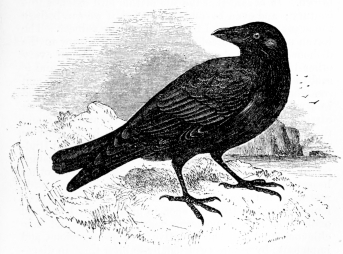
THE RAVEN. (Corvus Corax.)
“The Raven sits On the raven-stone, And his black wing flits O’er the milk-white bone; To and fro, as the night-winds blow, The carcass of the assassin swings: And there alone, on the raven-stone, The Raven flaps his dusky wings. The fetters creak—and his ebon beak Creaks to the close of the hollow sound: And this is the tune by the light of the moon, To which the witches dance their round.” Byron’s Manfred.
The Raven is about twenty-six inches in length, and his weight about three pounds. The bill is strong, black, and hooked at the tip. The plumage of the whole body of a shining black, glossed with deep blue; the back of the lower part inclining to a dusky colour. He is of a strong and hardy disposition, and inhabits all climates of the globe. He builds his nest in trees; and the female lays five or six eggs of a palish green colour, spotted with brown. It is said that the life of this bird extends to a century; and even beyond that period, if we can believe the accounts of several naturalists on the subject. The Raven unites the voracious appetite of the crow to the dishonesty of the daw and the docility of almost every other bird. He feeds chiefly on small animals; and is said to destroy rabbits, young ducks, and chickens, and sometimes even lambs, when they happen to be dropped in a weak state. In the northern regions, he preys on carrion, in concert with the white bear, the arctic fox, and the eagle. The faculty of scent in these birds must be very acute; for in the coldest of the winter days, at Hudson’s Bay, when every kind of effluvium is almost instantaneously destroyed by the frost, buffaloes and other beasts have been killed, where not one of these birds was seen; but in a few hours scores of them have been found collected about the spot, to pick up the blood and offal. The Raven possesses many diverting and mischievous qualities; he is active, curious, sagacious, and impudent; by nature a glutton, by habit a thief, in disposition a miser, and in practice a rogue. He is fond of picking up any small piece of money, bits of glass or any thing that shines, which he carefully conceals under the eaves of roofs, or in any other inaccessible place. He is easily tamed; and, like the parrot and starling, can imitate the human voice, in articulating words. At the seat of the Marquis of Aylesbury, in Wiltshire, a tame Raven, that had been taught to speak, used to ramble about in the park, where he was commonly attended and beset with crows, rooks, and others of his inquisitive tribe. When a considerable number of these were collected round him, he would lift up his head, and with a hoarse and hollow voice shout out Holloa! This would instantly put to flight and disperse his sable brethren; while the Raven seemed to enjoy the fright he had occasioned. When domesticated, the Raven is of great service, both as a scavenger and in keeping watch, in the last of which he is more alert and vigilant than almost any other animal. The Raven was the ensign of the invading Danes, and the prejudice thereby engendered against the bird is not yet quite extinct. Of its perseverance in the act of incubation, Mr. White relates the following singular anecdote:
“In the centre of a grove near Selborne, there stood an oak, which, though on the whole shapely and tall, bulged out into a large excrescence near the middle of the stem. On this tree a pair of Ravens had fixed their residence for such a series of years, that the oak was distinguished by the title of ‘The Raven-tree.’ Many were the attempts of the neighbouring youths to get at this nest: the difficulty whetted their inclinations, and each was ambitious of surmounting the arduous task; but when they arrived at the swelling, it jutted out so in their way, and was so far beyond their grasp, that the boldest lads were deterred and acknowledged the undertaking to be too hazardous. Thus the Ravens continued to build, nest upon nest, in perfect security, till the fatal day on which the wood was to be levelled. This was in the month of February, when those birds usually sit. The saw was applied to the trunk, the wedges were inserted into the opening, the wood echoed to the heavy blows of the mallet, the tree nodded to its fall; but still the dam persisted in sitting. At last, when it gave way, the bird was flung from her nest; and though her parental affection deserved a better fate, was whipped down by the twigs, which brought her dead to the ground!”
The croaking of the Raven was formerly considered a note of ill omen:
“The Raven croaked as she sat at her meal, And the old woman knew what he said; And she grew pale at the Raven’s tale, And sickened and went to her bed.”
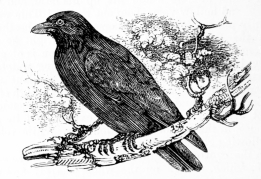
THE CARRION CROW. (Corvus corone.)
This bird is less in size than the raven. The bill is strong, thick, and straight. The general colour is black, except the extremities of the feathers, which are of a greyish tint. His delight is to feed upon carcasses and dead animals, or malefactors exposed on the gibbet. He roosts upon trees, and takes both animal and vegetable food. Crows, like rooks, are gregarious, and often fly in large companies in the fields or in the woods. On the upland moors, Crows occupy the place which rooks fill in the low country; and as the Crow has a very coarse and uncouth voice, the Lowlanders of Scotland are in the habit of saying that the Highland rooks “speak Gaelic.” They are great destroyers of partridges’ eggs, as they often pierce them with their bills, and carry them in that manner through the air to a great distance to feed their young. The female lays five or six eggs.
Mr. Montagu states that he once saw a Crow in pursuit of a pigeon, at which it made several pounces, like a hawk; but the pigeon escaped by flying in at the door of a house. He saw another strike a pigeon dead from the top of a barn. The Crow is so bold a bird that neither the kite, the buzzard, nor the raven, can approach its nest without being driven away. When it has young ones, it will even attack the peregrine falcon, and at a single pounce sometimes bring that bird to the ground.
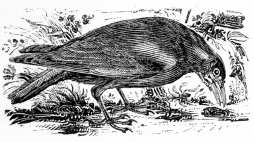
THE ROOK. (Corvus frugilegus.)
The cawing of these birds, on the tops of high trees near gentlemen’s houses, and in the middle of cities, is not very pleasing; yet old habits, to which we are reconciled, have as much influence upon us as if they were productive of amusement. Hence it has been seldom attempted to destroy a rookery; although the noise and other inconveniences that accompany these birds render their vicinity often troublesome. They feed entirely on corn and insects, and are little bigger than the common crows. In Suffolk, and in some parts of Norfolk, the farmers find it their interest to encourage the breed of Rooks, as the only means of freeing their grounds from the grub, which produces the cockchafer, and which in this state destroys the roots of corn and grass to such a degree, that instances have been known where the turf of pasture land might be turned up with the foot. The farmers in a northern county, a good many years ago, waged a war of extermination against the Rooks, but the very next year the crops were so completely cut up by grubs, that the same proprietors were at considerable expense in getting Rooks back again. Young Rooks are good eating, but should be skinned before they are dressed. The colour is black, but brighter than that of the crow, which the Rook resembles in shape. The female lays the same number of eggs; and the male shares with her the trouble of fetching sticks, and interweaving them to make the nest, an operation which is attended with a great deal of fighting and disputing with the other Rooks.
New comers are often severely beaten by the old inhabitants, and are even frequently driven quite away; of this an instance occurred near Newcastle, in the year 1783. A pair of Rooks, after an unsuccessful attempt to establish themselves in a rookery at no great distance from the Exchange, were compelled to abandon the attempt, and take refuge on the spire of that building; and, though constantly interrupted by other Rooks, they built their nest on the top of the vane, and reared their young ones, undisturbed by the noise of the populace below. The nest and its inhabitants were of course turned about by every change of the wind! They returned and built their nest every year on the same place, till 1793, soon after which year the spire was taken down. A small copperplate was engraved, of the size of a watchpaper, with a representation of the spire and the nest; and so much pleased were the inhabitants and other persons with it, that as many copies were sold as produced to the engraver a profit of ten pounds. The woodcut by Bewick, in the title-page to his Select Fable gives, a view of the old Exchange, with the Rook’s nest on the vane.
It is amusing to see Rooks coming at sunset as thick as a cloud hovering over a grove, and, after several eddies described in the air, and incessant cawings, each repairing to its own nest, and settling in a few minutes to rest, till the dawn calls them up again to their pasture in the neighbouring fields.
Dr. Darwin has remarked, that an instinctive feeling of danger from mankind is much more apparent in Rooks than in most other birds. Any one who has in the least observed them will see that they evidently distinguish that the danger is greater when a man is armed with a gun, than when he has no weapon with him. In the spring of the year, if a person happened to walk under a rookery with a gun in his hand, the inhabitants of the trees rise on their wings, and scream to the unfledged young to shrink into their nests from the sight of the enemy. The country people observing this circumstance so uniformly to occur, assert that Rooks can smell gunpowder.
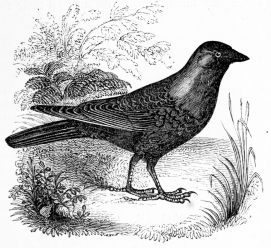
THE JACKDAW. (Corvus monedula.)
This bird is much less than the crow. He has a large head and long bill, in proportion to the size of his body. The colour of the plumage is black, but on some parts inclining to a bluish hue; the fore part of the head is of a deeper black. The Jackdaw feeds upon nuts, fruits, seeds, and insects; and builds in ancient castles, towers, cliffs, and all desolate and ruinous places. The female lays five or six eggs, smaller, paler, and marked with fewer spots than those of the crow.
Jackdaws are easily tamed, and may with little difficulty be taught to pronounce several words. They conceal such parts of their food as they cannot eat, and often, along with it, small pieces of money or toys, frequently occasioning, for the moment, suspicions of theft in persons who are innocent. In Switzerland there is found a variety of the Jackdaw, which has a white ring round its neck. In Norway, and other cold countries, they have been seen entirely white. In a state of nature, jackdaws and rooks frequently feed together, and the Jackdaws come to meet the rooks in the morning, and also accompany them for some distance on their retreat at night.
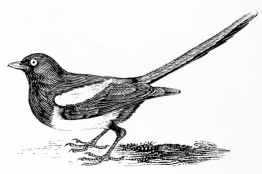
THE MAGPIE. (Pica caudata.)
“From bough to bough the restless Magpie roves, And chatters as he flies.” Gisborne.
This bird resembles the daw, except in the whiteness of the breast and wings, and the length of the tail. The black of the feathers is accompanied with a changing gloss of green and purple. It is a very loquacious creature, and can be taught to imitate the human voice as well as any of the feathered creation.
Plutarch relates a singular story of a Magpie belonging to a barber at Rome, which could imitate, to a wonderful extent, almost every noise that it heard. Some trumpets happened one day to be sounded before the shop; and for a day or two afterwards the Magpie was quite mute, and seemed pensive and melancholy. This surprised all who knew it; and they supposed the sound of the trumpets had so stunned the bird as to deprive it at the same time of voice and hearing. This, however, was not the case; for, says the writer, the bird had been all the time occupied in profound meditation, and was studying how to imitate the sound of the trumpets; accordingly, in the first attempt, it perfectly imitated all their repetitions, stops, and changes. This new lesson, however, made it entirely forget everything that it had learned before.
The Magpie feeds on everything; worms, insects, meat, cheese, bread, milk, and all kinds of seeds, and also on small birds, when they come in its way: the young of the blackbird and of the thrush, and even a strayed chicken, often fall a prey to its rapacity. It is fond of hiding pieces of money or wearing apparel, which it carries away by stealth, and with much dexterity, to its hole. Its cunning is also remarked in the manner of making its nest, which it covers all over with hawthorn branches, the thorns sticking outward; within, it is lined with fibrous roots, wool, and long grass, and then plastered all round with mud and clay. The canopy above is composed of the sharpest thorns, woven together in such a manner as to deny all entrance except at the door, which is just large enough to permit egress and regress to the owners. In this fortress the birds bring up their brood with security, safe from all attacks, but those of the climbing schoolboy, who often finds his torn and bloody hands too dear a price for the eggs or the young ones.
There are many superstitions respecting Magpies; and it is singular that in all the southern and middle districts of England, two Magpies together are thought to betoken luck; while in Lancashire, and other northern counties, they are thought to betoken misfortune. The chattering of Magpies was formerly supposed to foretell the arrival of strangers.
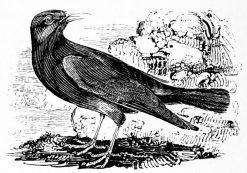
THE CORNISH CHOUGH, (Pyrrhcorax graculus,)
Is like the jackdaw in shape and colour, but somewhat larger. The bill and legs are of a red colour, and hence the bird is frequently called the red-legged Crow. It is an inhabitant of Cornwall, Wales, and all the western coasts of England, and is generally to be found among rocks near the sea, where it builds, as well as in old ruinous castles and churches on the sea-side. The voice of the Chough resembles that of the jackdaw, except that it exceeds it in hoarseness and strength.
Mr. Montagu describing a Chough in the possession of a friend, says, “his curiosity is beyond bounds, never failing to examine everything new to him: if the gardener be pruning, he examines the nail-box, carries off the nails, and scatters the shreds about. Should a ladder be left against the wall, he instantly mounts, and goes all round the top of the wall: and if hungry descends at a convenient place, and immediately travels to the kitchen window, where he makes an incessant knocking with his bill, until he is fed or let in. If allowed to enter, his first endeavour is to get up-stairs; and if not interrupted, goes as high as he can, and gets into any room on the attic story; but his intention is to get upon the top of the house. He is excessively fond of being caressed, and would stand quietly by the hour to be smoothed; but resents an affront with violence and effect, by both bill and claws, and will hold so fast by the latter, that he is with difficulty disengaged.”
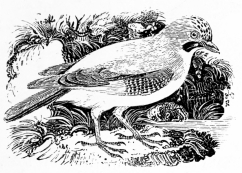
THE JAY, (Garrulus glandarius,)
Is less than the magpie, and resembles him more in the habits of his life than in the shape and colour of his body. Like him he is talkative, and ready to imitate all sounds, but boasts of ornamental colours, which the magpie is deprived of. The ablest painter can produce no colour to equal the brightness of the chequered tablets of white, black, and blue, which adorn the sides of his wings. His head is covered with feathers, which are moveable at will, and the motion of which is expressive of the internal affections of the bird, whether he is stimulated by fear, anger, or desire.
A Jay, kept by a person in the north of England, had learned at the approach of cattle to set a cur dog upon them, by whistling and calling him by his name. One winter, during a severe frost, the dog was by this means excited to attack a cow that was big with calf, when the poor thing fell on the ice, and was much hurt. The Jay was complained of as a nuisance, and its owner was obliged to destroy it.
The hen lays five or six eggs, of a dull white colour, mottled with brown.
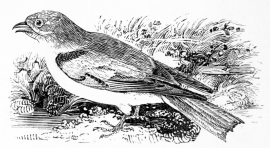
THE ROLLER, (Coracias garrula,)
Is about the size of the jay. Its bill is black, sharp, and somewhat hooked. The head is of a dirty green, mingled with blue; of which colour is also the throat, with white lines in the middle of each feather; the breast is of a pale blue, like that of the pigeon; the middle of the back, between the shoulders, is red; the rump and lesser coverts of the wings are dark blue; the feet are short, and, like those of a dove, of a dirty yellow colour.
The Roller is wilder than the jay, and frequents the thickest woods; it builds its nest chiefly on birch-trees. It is a bird of passage, and migrates in the months of May and September. In Africa, it is said to fly in large flocks in the autumn, and is frequently seen on cultivated grounds, with rooks and other birds, searching for worms, insects, seeds, berries, roots, and in cases of necessity, small frogs.
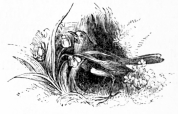
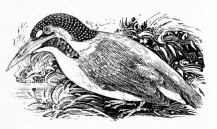
THE KINGFISHER, (Alcedo ispida,)
Is the Halcyon of the ancients, and his name recalls to our mind the most lively ideas. It was believed, that, as long as the female sat upon her eggs, the god of storms and tempests refrained from disturbing the calmness of the waves, and Halcyon days were, for navigators of old, the most secure times to perform their voyages:
“As firm as the rock, and as calm as the flood, Where the peace-loving Halcyon deposits her brood.”
But although this bears analogy to a natural coincidence between the time of breeding assigned to the Kingfishers and a part of the year when the ocean is less tempestuous, yet Mythology would exercise her fancy, and turn into wonders that which was nothing else than the common course of nature.
This bird is nearly as small as a common sparrow, but the head and beak appear proportionally too big for the body. The bright blue of the back and wings claims our admiration, as it changes into deep purple or lively green, according to the angles of light under which the bird presents itself to the eye. It generally haunts the banks of rivers, for the purpose of seizing small fish, on which it subsists, and which it takes in amazing quantities, by balancing itself at a distance above the water for a certain time, and then darting on the fish with unerring aim. It dives perpendicularly into the water, where it continues several seconds, and then brings up the fish, which it carries to land, beats to death, and afterwards swallows. When it cannot find a projecting bough, it sits on some stone near the brink, or even on the gravel; but the moment it perceives the fish, it takes a spring upwards of twelve or fifteen feet, and drops from that height upon its prey.
The Kingfisher lays its eggs, to the number of seven or more, in a hole in the bank of the river or stream that it frequents. Dr. Heysham had a female brought alive to him at Carlisle by a boy, who said he had taken it the preceding night when sitting on its eggs. His information on the subject was, that “having often observed these birds frequent a bank upon the river Peteril, he had watched them carefully, and at last he saw them go into a small hole in the bank. The hole was too narrow to admit his hand; but, as it was made in soft mould, he easily enlarged it. It was upwards of half a yard long; at the end of it the eggs, which were six in number, were placed upon the bare mould, without the smallest appearance of a nest.” The eggs were considerably larger than those of the yellow-hammer, and of a transparent white colour. It appears, from a still later account, that the direction of the holes is always upward; that they are enlarged at the end, and have there a kind of bedding formed of the bones of small fish, and some other substances, evidently the castings of the parent animals. This bedding is generally half an inch thick, and mixed with earth; and on it the female deposits and hatches her eggs. When the young ones are nearly full-feathered they are extremely voracious; and as the old birds do not supply them with all the food they can devour, they are continually chirping, and may be discovered by their noise.
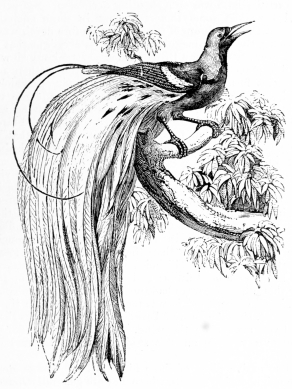
THE BIRD OF PARADISE. (Paradisea apoda.)
There are several distinct species of these birds, of which the best known are the large and small Emerald Birds of Paradise, which are very similar in appearance, and are both imported into Europe as ornaments for ladies’ dress. Their appearance when flying in their native forests is said to be most beautiful. M. Lesson, a French naturalist, gives the following account:—“Soon after our arrival on this land of promise (New Guinea) for the naturalist, I was on a shooting excursion. Scarcely had I walked some hundred paces in those ancient forests, the daughters of time, whose sombre depth was, perhaps, the most magnificent and stately sight that I had ever seen, when a Bird of Paradise struck my view: it flew gracefully and in undulations; the feathers of its sides formed an elegant and aërial plume, which, without exaggeration, bore no remote resemblance to a brilliant meteor. Surprised, astounded, enjoying an inexpressible gratification, I devoured this splendid bird with my eyes; but my emotion was so great that I forgot to shoot at it, and did not recollect that I had a gun in my hand till it was far away.”
The head is small, but adorned with colours which vie with the brightest hues of the feathered tribe; the neck is a beautiful fawn, and the body very small, but covered with long feathers of a browner hue, tinged with gold: the two middle feathers of the tail are little more than filaments, except at the point and near the base. Although the body is no larger than that of a thrush, the total length is two feet. This bird has long been esteemed by ladies as a head-dress; and as those sent to Europe for this purpose always had the legs cut off for the convenience of packing, it was reported, and at one time believed, that the Bird of Paradise had no legs, but that it lived always on the wing. Indeed, a very fierce controversy arose on this subject among the earlier naturalists.
The native place of these birds is New Guinea and the neighbouring islands, where they are generally found in flocks of thirty and forty, roosting on fig or teak trees. They always fly against the wind, that it may not ruffle their light and spreading plumage, as, if the wind came from behind, it would blow their long tails over their back. They take shelter from storms in the most dense thickets, and feed principally on figs, the berries of the teak, and insects. The note of the Bird of Paradise is very unpleasant, and resembles the cawing of a raven; it is chiefly heard in windy weather, when they dread being thrown on the ground.
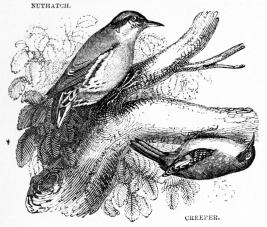
THE NUTHATCH, OR NUTJOBBER, (Sitta Europæa,) AND THE CREEPER, (Certhia familiaris,)
Is less than the chaffinch. The head, neck, and beak are of an ash-colour; the sides under the wings red; the throat and breast of a pale yellow; the chin white, and the feathers under the tail red, with white tips. The Nuthatch feeds upon insects and also upon nuts, which he hoards in the hollow part of a tree; and it is pleasing to see him fetch a nut out of the hole, place it first in a chink, and standing above it with his head downwards, striking it with all his might, break the shell, and catch up the kernel. The hen is so attached to her brood, that, when disturbed from her nest, she flutters about the head of the depredator, and hisses like a snake. The Nuthatches are shy and solitary birds, and like the woodpeckers frequent woods, and run up and down the trees with surprising facility. They often move their tails in the manner of the wagtail. They do not migrate, but during the winter approach nearer to inhabited places, and are sometimes seen in orchards and gardens. The female lays her eggs in holes of trees.
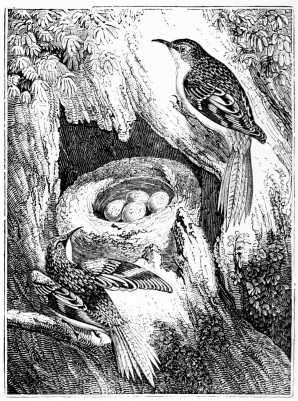
THE CREEPER. (Certhia familiaris.)
The Creepers are dispersed through most countries of the globe, and feed chiefly on insects, in search of which they run in a spiral direction round the stems and branches of trees, with great agility.
The Common Creeper is about five inches in length; its colour is tawny, the quills being tipped with white or light brown. Its nest is formed of dry grass and bark, and is placed in the hollow of some decayed tree.
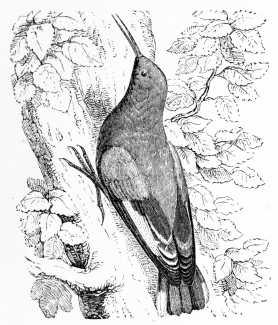
THE WALL CREEPER, OR SPIDER-CATCHER, (Tichodroma muraria,)
Is larger than a house-sparrow. It has a long, slender, black bill; the head, neck, and back are of an ash-colour, the front of the neck and throat being a deep black; the breast is white; the wings a compound of lead-colour and red. It is a brisk and cheerful bird, and has a pleasant note. Clefts and crevices of rocks and the walls of old edifices are its favourite haunts, and sometimes, but very rarely, the trunks of trees. It feeds on insects, and is especially fond of spiders and their eggs. The nest is made in clefts of the most inaccessible rocks, and in the crevices of ruins, at a great height.
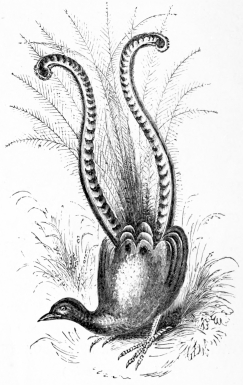
THE LYRE-BIRD OF AUSTRALIA. (Menura superba.)
This bird is found in New South Wales, near Port Philip, but it is the male only that possesses the splendid tail whence it derives its name. It feeds on snails, and builds a nest like a magpie.
“Of all the birds I have ever met with,” says Mr. Gould, “the Menura is by far the most shy and difficult to procure. While among the brushes, I have been surrounded by these birds, pouring forth their loud and liquid calls, for days together, without being able to get a sight of them; and it was only by the most determined perseverance and extreme caution that I was enabled to effect this desirable object; which was rendered the more difficult by their often frequenting the almost inaccessible and precipitous sides of gullies and ravines, covered with tangled masses of creepers, and umbrageous trees: the cracking of a stick, the rolling down of a small stone, or any other noise, however slight, is sufficient to alarm it; and none but those who have traversed these rugged, hot, and suffocating brushes, can fully understand the excessive labour attendant on the pursuit of the Menura. Independently of climbing over rocks and fallen trunks of trees, the sportsman has to creep and crawl beneath and among the branches with the utmost caution, taking care only to advance when the bird’s attention is occupied in singing, or in scratching up the leaves in search of food: to watch its actions, it is necessary to remain perfectly motionless, not venturing to move even in the slightest degree, or it vanishes from sight, as if by magic. Although I have said thus much on the cautiousness of the Menura, it is not always so alert: in some of the more accessible brushes through which roads have been cut, it may frequently be seen, and even on horseback closely approached, the bird apparently evincing less fear of those animals than of man. At Illawarra it is sometimes successfully pursued by dogs trained to rush suddenly upon it, when it immediately leaps upon the branch of a tree, and its attention being attracted by the dog which stands barking below, it is easily approached and shot. Another successful mode of procuring specimens is, by wearing a tail of a full-plumaged male in the hat, keeping it constantly in motion, and concealing the person among the bushes, when the attention of the bird being arrested by the apparent intrusion of another of its own sex, it will be attracted within the range of the gun: if the bird be hidden from view by the surrounding objects, any unusual sound, as a shrill whistle, will generally induce him to show himself for an instant, by causing him to leap with a gay and sprightly air upon some neighbouring branch to ascertain the cause of the disturbance: immediate advantage must be taken of this circumstance, or the next moment it may be half-way down the gully. So totally different is the shooting of this bird to anything practised in Europe, that the most expert shot would have but little chance, until well experienced in the peculiar nature of the country, and the habits of the bird. The Menura seldom, if ever, attempts to escape by flying; it easily eludes pursuit by its extraordinary power of running. None are so efficient in obtaining specimens as the naked black, whose noiseless and gliding steps enable him to steal upon it unheard and unperceived, and with the gun in his hand, he rarely allows it to escape, and in many instances he will even kill it with his own weapons.
“The Lyre-bird is of a wandering disposition, and although it probably keeps to the same brush, it is constantly engaged in traversing it from one end to the other, from mountain-top to the bottom of the gullies, whose steep and rugged sides present no obstacle to its long legs and powerful muscular thighs: it is also capable of performing extraordinary leaps; and I have heard it stated, that it will spring ten feet perpendicularly from the ground. It appears to be of solitary habits, as I have never seen more than a pair together, and these only in a single instance; they were both males, and were chasing each other round and round with extreme rapidity, apparently in play, pausing every now and then to utter their loud shrill calls; while thus employed they carried the tail horizontally, as they always do when running quickly through the bush, that being the only position in which this great organ could be conveniently borne at such times. Among its many curious habits, the only one at all approaching to those of the Gallinacæa, is that of forming small round hillocks, which are constantly visited during the day, and upon which the male is constantly trampling, at the same time erecting and spreading out his tail in the most graceful manner, and uttering his various cries, sometimes pouring forth his natural notes, at others mocking those of other birds, and even the howling of the native dog, or dingo. The early morning and the evening are the periods when it is most animated and active.”
There is another kind of Lyre-Bird, also found in New South Wales, to which Mr. Gould has given the name of Menura Alberti, in honour of the late Prince Consort.
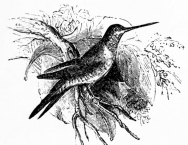
THE HUMMING-BIRD. (Trochilus colubris.)
There are numerous species of Humming-Birds, but that represented above, is one of the most common. They are abundant in South America, particularly in Brazil; and are so small and so brilliant in their colours, that when seen fluttering about in the brilliant rays of a tropical sun, they look like flying gems. They are extremely active, darting about, and thrusting their long beaks and flexible tongues into every flower they see, in search of food. Sometimes they will remain suspended in the air for a long time together, vibrating their wings with such velocity, that they cannot be seen distinctly, but appear like a mist round the body of the bird, while they make that curious humming noise from which the bird takes its name. Sometimes they quarrel, when their little throats become distended, their crest, tails, and wings expand, and they fight with inconceivable fury, till one of them falls exhausted on the ground. The most common species is Trochilus colubris, the Ruby-throated Humming-Bird, and one of them has been kept alive in a cage for more than three months, by feeding it with sugar and water. This species is found in North America, where it migrates to the north in summer, and is there seen even in Canada and the country of Hudson’s Bay.
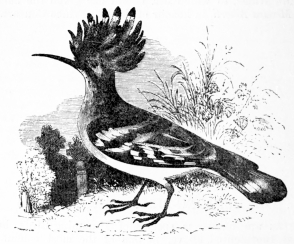
THE HOOPOE. (Upupa epops.)
This is a small bird, measuring no more than twelve inches from the point of the bill to the end of the tail. The bill is sharp, black, and somewhat bending. The head is adorned with a very beautiful, large moveable crest, a kind of bright halo, the radiation of which places the head nearly in the centre of a golden circle. This pleasing ornament, which the bird sets up or lets fall at pleasure, is composed of a double row of feathers, reaching from the bill to the nape of the neck, which is of a pale red. The breast is white, with black streaks tending downwards; the wings and back are varied with white and black cross-lines. The food of the Hoopoe consists chiefly of insects, with the remains of which its nest is sometimes so filled as to become extremely offensive. This beautifully-crested bird is not at all common in this country, and is solitary, two of them being seldom seen together, while in Egypt, where Hoopoes are very common, they are often seen in small flocks. The female generally constructs her nest in a hollow tree, the materials employed, in addition to the remains of their food, being very scanty, consisting in fact of a few dried grass stalks and feathers. She lays from four to seven eggs at a time, of a pale lavender grey, about an inch and a half long. The young are generally hatched in June; it is said, however, that two or three broods are produced in the course of the year. The name alludes to the note of the bird, which resembles the word “hoop” repeated several times in a low voice.
Though this bird is found occasionally both in England and Scotland, it rarely breeds with us. It is common in Italy, where its strange startling cry is often heard, without the bird being seen, as it keeps itself concealed among trees. It is also not uncommon on the banks of the Garonne in France, where it may be seen skimming along the ground amongst the willows in search of the insects upon which it feeds.
There are several species of this magnificent family. The most brilliant is undoubtedly the Upupa Superba, or Grand Promerops of New Guinea. “There does not perhaps exist,” says Sonnerat, “a more extraordinary bird. Its body is delicate and slender, and, although it is of an elongated form, appears excessively small in comparison with the tail. Nature seems to have pleased herself in painting this being, already so singular, with her most brilliant colours. The head, the neck, and the belly are a glittering green; the feathers which cover these parts have the lustre and softness of velvet to the eye and to the touch; the back is changeable violet; the wings are of the same colour, and appear, according to the lights in which they are held, blue, violet, or deep black, always however imitating velvet.” This bird is rare, and a specimen is seldom seen even in the most complete collections.
§ IV.—Scansores, or Climbers.
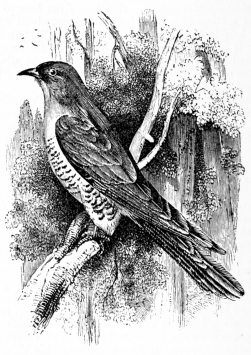
THE CUCKOO. (Cuculus canorus.)
“Hail, beauteous stranger of the wood, Attendant on the spring! Now Heaven repairs thy rural seat, And woods thy welcome sing. “Soon as the daisy decks the green, Thy certain voice we hear; Hast thou a star to guide thy path, Or mark the rolling year? “Delightful visitant! with thee I hail the time of flowers, When heav’n is fill’d with music sweet, Of birds among the bowers.” Logan.
The well-known notes of this bird, in spite of their monotony, are heard with pleasure in spring, as a sure prognostic of fine weather. The Cuckoo is generally first heard about the middle of April, and ceases towards the end of June. This bird is so shy that he is seldom seen when uttering his singular note. The female does not build a nest, but lays her eggs in that of some other bird.
The Cuckoo is somewhat less than the magpie, his length being about twelve inches from the tip of the bill to the end of the tail. He is remarkable for his round prominent nostrils; the lower part of the body is of a yellowish colour, with black transverse lines on the throat and across the breast; the head and upper part of the body and wings are beautifully marked with black and tawny stripes, and on the top of the head there are a few white spots. The tail is long, and on the exterior part, or edges of the feathers, there are several white marks; the ground colour of the body is a sort of grey. The legs are short, and covered with feathers, and the feet are composed of four toes, two before and two behind.
We are indebted to the observations of Dr. Jenner for the following account of the habits and economy of this singular bird in the disposal of its eggs. He states that, during the time the hedge-sparrow is laying her eggs, which generally occupies four or five days, the Cuckoo contrives to deposit her egg among the rest, leaving the future care of it entirely to the hedge-sparrow. This intrusion often occasions some disorder; for the old hedge-sparrow, at intervals while she is sitting, not only throws out some of her own eggs but sometimes injures them in such a way that they become addled, so that it frequently happens that not more than two or three of the parent bird’s eggs are hatched: but, what is very remarkable, it has never been observed that she has either thrown out or injured the egg of the Cuckoo. When the hedge-sparrow has set her usual time, and has disengaged the young Cuckoo and some of her own offspring from the shell, her own young ones and any of her eggs that remain unhatched are soon turned out: the young Cuckoo then remains in full possession of the nest, and is the sole object of the future care of the foster parent. The young birds are not previously killed, nor are the eggs demolished; but they are left to perish together, either entangled in the bush that contains the nest, or lying on the ground beneath it. On the 18th June, 1787, Dr. Jenner examined a nest of a hedge-sparrow, which then contained a Cuckoo’s and three hedge-sparrow’s eggs. On inspecting it the day following, the bird had hatched: but the nest then contained only a young Cuckoo and one hedge-sparrow. The nest was placed so near the extremity of a hedge, that he could distinctly see what was going forward in it; and, to his great astonishment, he saw the young Cuckoo, though so lately hatched, in the act of turning out the young hedge-sparrow. The mode of accomplishing this was curious; the little animal, with the assistance of its rump and wings, contrived to get the bird upon its back, and making a lodgment for its burden by elevating its elbows, climbed backward with it up the side of the nest, till it reached the top; where, resting for a moment, it threw off its load with a jerk, and quite disengaged it from the nest. After remaining a short time in this situation, and feeling about with the extremities of its wings, as if to be convinced that the business was properly executed, it dropped into the nest again. Dr. Jenner made several experiments in different nests, by repeatedly putting in an egg to the young Cuckoo, which he always found to be disposed of in the same manner. It is very remarkable that nature seems to have provided for the singular disposition of the Cuckoo in its formation at this period; for, different from other newly-hatched birds, its back, from the scapulae downward, is very broad, with a considerable depression in the middle, which seems intended for the express purpose of giving a more secure lodgment to the egg of the hedge-sparrow or its young one, while the young Cuckoo is employed in removing either of them from the nest. When it is about twelve days old, this cavity is quite filled up, the back assumes the shape of that of nestling birds in general, and at that time the disposition of turning out its companion entirely ceases. The smallness of the Cuckoo’s egg, which in general is less than that of the hedge-sparrow, is another circumstance to be attended to in this surprising transaction, and seems to account for the parent Cuckoo’s depositing it in the nest of such small birds only as these. If she were to do this in the nest of a bird that produced a larger egg, and consequently a larger nestling, the design would probably be frustrated, the young Cuckoo would be unequal to the task of becoming sole possessor of the nest, and might fall a sacrifice to the superior strength of its partners. Dr. Jenner observes, that the egg of two Cuckoos are sometimes deposited in the same nest; and gives the following instance which fell under his observation. Two Cuckoos and a hedge-sparrow were hatched in the same nest; one hedge-sparrow’s egg remained unhatched. In a few hours a contest began between the Cuckoos for possession of the nest; and this continued undetermined till the afternoon of the following day, when the one which was somewhat superior in size, turned out the other, together with the young hedge-sparrow and the unhatched egg. The contest, he adds, was very remarkable; the combatants alternately appeared to have the advantage, as each carried the other several times nearly to the top of the nest, and again sank down oppressed by the weight of its burden; till at length, after various efforts, the strongest of the two prevailed, and was afterwards brought up by the hedge-sparrow.
The American Cuckoo, or Cow bird, is quite different in its habits to the European Cuckoo, as it builds a nest for its eggs, and hatches its young itself like other birds.
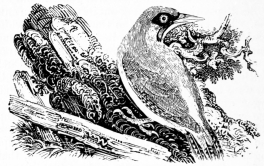
THE COMMON GREEN WOODPECKER, (Picus viridis,)
Receives his name from his habit of pecking the insects from the chinks of trees and holes in the bark. The bill is straight, strong, and angular at the end; and in most of the species is formed like a wedge, for the purpose of piercing the trees. The nostrils are covered with bristles. The tongue is slender, and cylindrical in shape, and to the touch is hard and bony. The Woodpecker, in common with the Humming Bird, though for a different object, possesses the remarkable property of being able to dart out its tongue and secure insects at a considerable distance from its beak. For the purpose of effectually capturing the stronger insects, the tongue is barbed at the end, and provided with glutinous secretion. The toes of this bird are placed two forward and two backward; and the tail consists of ten hard, stiff, and sharp-pointed feathers. A Woodpecker is often seen hanging by his claws, and resting upon his breast against the stem of a tree; when, after darting his beak against the bark, with great strength and noise, he runs round the tree with much alacrity, which manœuvre has made the country people suppose that he goes round to see whether he has not pierced the tree through, though the fact is, the bird is in search of the insects, which he hopes to have driven out by his blow.
The following lines, from Moore’s beautiful song, allude to the noise which the Woodpecker makes in searching for its food:
“I knew by the smoke that so gracefully curl’d Above the green elms, that a cottage was near, And I said, if there’s peace to be found in the world, A heart that was humble might hope for it here. Every leaf was at rest, and I heard not a sound, But the Woodpecker tapping the hollow beech-tree.”
The fact is, that this beating against the bark is for no other purpose than to rouse the insects which the chink contains, and to force them to come out, which they do from their alarm at the noise, when the Woodpecker turning round takes them unawares, and feeds upon them: if the insects do not answer the delusive call, he darts his long tongue into the hole, and brings out, by this means, his reluctant prey. The plumage of this bird is a compound of red and green, two colours, the approximation of which is always productive of harmony in the works of nature. They nestle in the hollows of trees, where the female lays five or six whitish eggs, without making any nest, trusting to the natural heat of her body to hatch them.
The Green Woodpecker is seen more frequently on the ground than the other kinds, particularly where there are ant-hills. It inserts its long tongue into the holes through which the ants issue, and draws them out in abundance. Sometimes with its feet and bill it makes a breach in the nest, and devours the ants and their eggs at its ease. The young ones climb up and down the trees before they are able to fly; they roost very early, and repose in their holes till day. There are many different kinds of Woodpecker, five of which are common to this country.
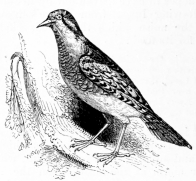
THE WRYNECK. (Yunx torquilla.)
This bird, Mr. Gould tells us, has received its English name from its habit of moving its head and neck in various directions, and with an undulating motion, like that of a snake; indeed, in some parts of England it is called the snake-bird. When found in its usual retreat in the hole of a tree, it makes a loud hissing noise, raises the feathers of the crown, and writhing its head and neck towards each shoulder alternately, with grotesque contortions, becomes an object of terror to a timid intruder; and the bird, taking advantage of a moment of indecision, darts with the rapidity of lightning from a situation where escape appeared impossible.
The Wryneck deposits its eggs on fragments of decayed wood within a hollow tree, and makes scarcely any nest. The birds when caught young are easily tamed.
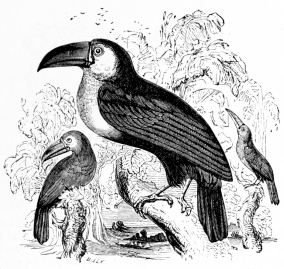
THE TOUCAN, (Rhamphastos tucanus,)
Is a native of South America, very conspicuous for the magnitude and shape of its bill; which, in some of the species, is nearly as long and as large as the body itself. The length of its body is about eighteen inches (the size of the magpie); the head is large and strong, and the neck short, in order the more easily to support the bulk of such a beak. The head, neck, and wings are black; the breast of a most lovely orange saffron colour; the lower part of the body and the thighs are vermilion; the tail black. Mr. Gould’s specimen represents a narrow straw-coloured belt across the centre of the breast, dividing the orange tint from the vermilion. One of these birds that was kept in a cage was very fond of fruit, which it held for some time in its beak, touching it with great delight with the tip of its feathery tongue, and then tossing it into its throat by a sudden upright jerk; it also fed on small birds, insects, caterpillars, &c.
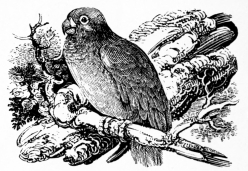
THE GREY PARROT. (Psittacus erythacus.)
The tongue of the Parrot is not unlike a black soft bean, and fills so completely the capacity of its beak, that the bird can easily modulate sounds and articulate words; the beak is composed of two pieces, both moveable, which is a peculiarity belonging almost exclusively to this tribe of birds. The bill of the Parrot is strongly hooked, and assists it in climbing, catching hold of the boughs of the trees with it, and then drawing its legs upwards; then again advancing the beak, and afterwards the feet, for its legs are not adapted for hopping from bough to bough, as other birds do. Several stories are told of the sagacity of these birds, and of the aptitude of their interrogatories and answers, but they have been no doubt the effect of chance.
Dr. Goldsmith says that a Parrot, belonging to King Henry the Seventh, having been kept in a room next the Thames, in his palace of Westminster, had learned to repeat many sentences from the boatmen and passengers. One day, sporting on its perch, it unluckily fell into the water. The bird had no sooner discovered its situation, than it called out aloud, “A boat! twenty pounds for a boat!” A waterman, happening to be near the place where the Parrot was floating, immediately took it up, and restored it to the king; demanding, as the bird was a favourite, that he should be paid the reward the bird had called out. This was refused; but it was agreed that, as the Parrot had offered a reward, the man should again refer to its determination for the sum he was to receive. “Give the knave a groat,” screamed the bird the instant the reference was made.
The memory of Parrots is very astonishing, and they can not only imitate discourse, but can sing verses of songs, and mimic gestures and actions. Scaliger saw one that performed the dance of the Savoyards at the same time that it repeated their song. The song was well imitated, but when the bird tried to caper, it was with the worst grace imaginable, as he turned in his toes, and kept tumbling back in a most clumsy manner.
Willoughby tells us of a Parrot, which, when a person said to it, “Laugh, Poll, laugh,” laughed accordingly, and the instant after screamed out, “What a fool to make me laugh!” Another, which had grown old with its master, shared with him the infirmities of age. Being accustomed to hear scarcely anything but the words “I am sick;” when a person asked it, “How do you do, Poll?” “I am sick,” it replied in a doleful tone, stretching itself out, “I am sick.”
Parrots are very numerous in the East and West Indies, where they assemble in companies, like rooks, and build in the hollows of trees. The female lays two or three eggs, marked with little specks, like those of the partridge. They never breed in our climate, though they live here to a great age. They feed entirely upon vegetables, but, when tame, will take from the mouth of their master or mistress any kind of chewed meat, and chiefly eggs, of which they seem particularly fond. They bite or pinch very hard, and some of them possess so much strength in their beak, that they could easily break a man’s finger. The Parrot is sensible of attachment, as well as of revenge; and if in their mimic attitudes they show great pleasure at the sight of their feeders, they also fly up with anger to the face of those who once have affronted or injured them.
THE GREEN PARROT, (Psittacus amazonicus,)
Which is perhaps more commonly seen in England than the African Grey Parrot, is a native of South America, and receives its name from the great river Amazon, on the banks of which it is common. In its native country it does much damage to the plantations, and indeed many of the Parrots are as injurious in this respect as they are beautiful in their plumage. The Green Parrot resembles the Grey species in its habits, and may likewise be taught to speak with much distinctness.
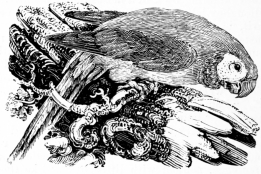
THE BLUE AND YELLOW MACAW, (Psittacus, or Macrocercus aracanga,)
Is one of the largest of the parrot tribe, and painted with the finest colours Nature can bestow. The beak is uncommonly strong; and the tail proportionally longer than that of any of the parrot tribe. Its voice is fierce and tremulous, sometimes sounding like the laugh of an old man; and it seems to utter the word “Arara,” which occasions its bearing that name in its native country.
When tame, it eats almost every article of human food, and is particularly fond of bread, beef, fried fish, pastry, and sugar. It cracks nuts with its bill, and dexterously picks out the kernels with its claws. It does not chew the soft fruits, but sucks them by pressing its tongue against the upper part of its beak: and the harder sort of food, such as bread and pastry, it bruises, or chews, by pressing the tip of the lower upon the most hollow part of the upper mandible.
The Scarlet Macaw (M. Macao) is another large species, of a bright red colour, with some blue and yellow feathers on the wings, and blue ones about the base of the tail. It was formerly common in the West Indian Islands, but has now become rare there. Its voice is very loud and harsh.
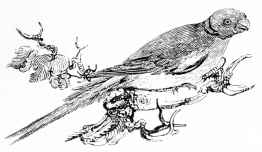
THE RING PAROQUET. (Palæornis Alexandri.)
This beautiful species, no less remarkable for the elegance of its form than for its docility and imitative powers, is supposed to have been the first of the parrot species known to the ancients, from the time of Alexander the Great down to the age of Nero. It is about fifteen inches long; its bill is thick and red; the head and the body a bright green; the neck, breast, and the whole of the under side of a paler tint. It has a red circle, or ring, which encompasses the neck, and is about the breadth of a little finger at the back; but grows narrower by degrees towards the sides, and ends under the lower bill. The lower part of the body is of so faint a green, that it seems almost yellow. The tail also is of a yellowish green, and the legs and feet ash-coloured.
THE WARBLING GRASS PAROQUET. (Melopsittacus undulatus.)
Great numbers of Paroquets of different species are found in Australia, and most of these live and seek their food upon the ground rather than in trees. One of them is called the Ground Paroquet, as it is never seen to perch upon trees, but is always running about among the grass and herbage. The Warbling Grass Paroquet is a well known and beautiful little Australian bird, of which considerable numbers have been imported into this country of late years; it is deservedly a favourite, both on account of its elegance, and from its possessing a gentle warbling note very different from the harsh screaming of many species of its tribe. It can, however, scream vigorously for its size. In the interior of Australia these charming little birds occur in countless multitudes. They feed chiefly on the seeds of grasses, which they pick up whilst running upon the ground, but they perch in crowds upon the gum-trees for shelter from the noon-day heat, and also before starting on an expedition in search of water.
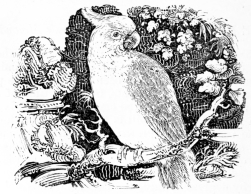
THE COCKATOO. (Plyctolophus galeritus.)
This bird is distinguished from the parrots, by a beautiful crest, composed of a tuft of elegant feathers, which he can raise or depress at pleasure. We meet with some of a beautiful white plumage, and the inside feathers of the crest of a pleasing yellow, with a spot of the same colour under each eye, and one upon the breast. The Cockatoos are natives of the Indian Islands and Australia, where they are found in great abundance. Their food consists of seeds and soft and stony fruits, which last their powerful bill enables them to break with ease. They are easily tamed when taken at an early age, after which they become familiar and even attached, but their imitative powers seldom go beyond a very few words added to their own cry of Cockatoo.
In a wild state they are shy, and cannot easily be approached. The flesh of the young birds is accounted very good eating. The female is said to make her nest in the rotten limbs of trees, using nothing more than the accumulation of vegetable mould formed by the decayed parts of the bough. The eggs are white, without spots; there are no more than two young at a time. The natives first find the nest by the pieces of bark and twigs which the old birds strip off the trees adjoining that in which the nest is situated. It is a remarkable fact that the bark is never stripped off the tree which contains the nest.
Mr. Bennet, in speaking of the large black Cockatoo of New Holland, says, that if this bird observes on the trunk of a tree indications of a larva being within, it diligently labours to get at it with its powerful beak, and should the object of its pursuit be deep within the wood, as often happens, the trunk becomes so extensively hacked, that a slight gust of wind will lay the tree prostrate.
§ V.—Gallinaceous Birds.
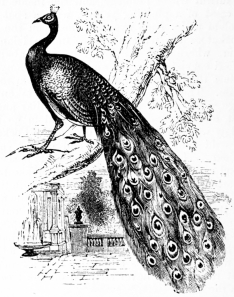
THE PEACOCK. (Pavo cristatus.)
Astonished at the unparalleled beauty of this bird, the ancients could not help indulging their lively and creative fancy, in accounting for the magnificence of his plumage. They made him the favourite of imperial Juno, sister and wife to Jupiter; and not less than the hundred eyes of Argus were pulled out to ornament his tail; indeed, there is scarcely anything in nature that can vie with the transcendent lustre of the Peacock’s feathers. The changing glory of his neck eclipses the deep azure of ultramarine; and at the least evolution, it assumes the green tint of the emerald, and the purple hue of the amethyst. His head, which is small and finely shaped, has several curious stripes of white and black round the eyes, and is surmounted by an elegant plume, or tuft of feathers, each of which is composed of a slender stem and a small tuft at the top. Displayed with conscious pride, and exposed under a variety of angles to the reflections of light, the broad and variegated disks of his train, of which the neck, head, and breast of the bird become the centre, claim our admiration. By an extraordinary mixture of the brightest colours, it displays at once the richness of gold, and the paler tints of silver, fringed with bronze-coloured edges, and surrounding eye-like spots of dark brown and sapphire. The hen does not share in the beauty of the cock, and her feathers are generally of a light brown. She lays only a few eggs at a time, generally at an interval of three or four days; they are white and spotted, like the eggs of the turkey. She sits from twenty-seven to thirty days.
The loud screamings of the Peacock are worse than the harsh croakings of the raven, and a sure prognostic of bad weather; and his feet, more clumsy than those of the turkey, make a sad contrast with the elegance of his plumage:
“Though richest hues the Peacock’s plumes adorn, Yet horror screams from his discordant throat.”
The spreading of the train, the swelling of the throat, neck, and breast, and the puffing noise which they emit at certain times, are proofs that the Turkey and the Peacock stand nearly allied in the family chain of animated beings.
The flesh of the Peacock was anciently esteemed a princely dish; and the whole bird used to be served on the table with the feathers of the neck and tail preserved; but few people could now relish such food, as it is much coarser than the flesh of the turkey. The Italians have given this laconic description of the Peacock: “He has the plumage of an angel, the voice of a devil, and the stomach of a thief.”
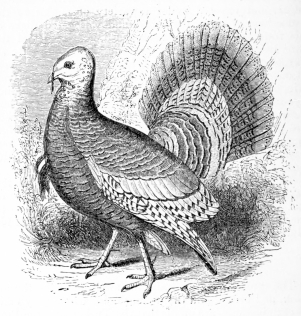
THE TURKEY, (Meleagris Gallo-Pavo,)
Was originally an inhabitant of America, whence he was brought to Europe by some Jesuit missionaries, which accounts for his being called a Jesuit in some parts of the continent. The general colour of the feathers is buff and black; and turkeys have about the head, especially the cock, naked and tuberous lumps of flesh of a bright red colour. A long fleshy appendage hangs from the base of the upper mandible, and seems to be lengthened and shortened at pleasure. The hen lays from fifteen to twenty eggs, which are whitish and freckled. The chicks are very tender, and require great care and attentive nursing, until they are able to seek their food. In the county of Norfolk the breeding of Turkeys, which is there a considerable branch of trade, is brought to great perfection; and some weighing upwards of twenty pounds each have been raised there. They appear to have a natural antipathy to everything of a red colour.
Though extremely prone to quarrel among themselves, they are, in general, weak and cowardly against other animals, and fly from almost every creature that ventures to oppose them. On the contrary, they pursue everything that appears to dread them, particularly small dogs and children; and after having made these objects of their aversion scamper, they evince their pride and satisfaction by displaying their plumage, strutting about among their female train, and uttering their peculiar note of self-approbation. Some instances, however, have occurred, in which the Turkey-cock has exhibited a considerable share of courage and prowess; as will appear from the following anecdote:—A gentleman of New York received from a distant part a Turkey-cock and hen, and with them a pair of bantams; which were put all together into the yard with his other poultry. Some time afterwards, as he was feeding them from the barn-door, a large hawk suddenly turned the corner of the barn, and made a pounce at the bantam hen: she immediately gave the alarm, by a noise which is natural to her on such occasions; when the Turkey-cock, who was at the distance of about two yards, and without doubt understood the hawk’s intention, flew at the tyrant, with such violence, and gave him so severe a stroke with his spurs, as to knock him from the hen to a considerable distance; by which means the bantam was rescued from destruction.
The wild Turkey-cock is, in the American forests, an object of considerable interest. It perches on the tops of the deciduous cypress and magnolia:
“On the top Of yon magnolia, the loud Turkey’s voice Is heralding the dawn: from tree to tree Extends the wakening watch-note far and wide, Till the whole woodlands echo with the cry.” Southey.
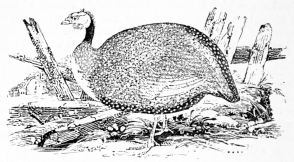
THE GUINEA FOWL, OR PINTADO. (Numida Meleagris.)
This bird, which is also called the Pearled Hen, was originally brought from Africa, where the breed is common, and seems to have been well known to the Romans, who used to esteem the flesh of this fowl as a delicacy, and admit it at their banquets. It went then by the name of Numidian Hen, or Meleagris, because it was fabled that the sisters of Meleager, who unceasingly deplored his death, were metamorphosed into Guinea Hens by Diana. In fact, although they are now domesticated with us, they still retain a great deal of their original freedom, and have a stupid look. Their noise is very disagreeable: it is a creaking note, which, incessantly repeated, grates upon the ear, and becomes very teasing and unpleasant. They belong to the class of birds called pulveratores; as they scrape the ground and roll themselves in the dust like common hens, in order to get rid of small insects which lodge in their feathers.
The Pintado is somewhat larger than the common hen; the head is bare of feathers, and covered with a naked skin of a bluish colour; on the top is a callous protuberance of a conical form. At the base of the bill on each side hangs a loose wattle, red in the female and bluish in the male. The general colour of the plumage is a dark bluish grey, sprinkled with round white spots of different sizes, resembling pearls, from which circumstance the epithet of pearled has been applied to this bird; which at first sight appears as if it had been pelted by a strong shower of hail.
If trained when young, these birds may easily be rendered tame. M. Bruë informs us, that when he was on the coast of Senegal he received as a present from an African princess two Guinea fowls. Both these birds were so familiar that they would approach the table and eat out of his plate; and, when they had liberty to fly about upon the beach, they always returned to the ship when the dinner or supper bell rang.
In a wild state, it is asserted that the Pintado associates in large flocks. Dampier speaks of having seen between two and three hundred of them together in the Cape de Verd Islands. They were originally introduced into our country from the coast of Africa somewhat earlier than the year 1260.
In Jamaica, where they have run wild, and become very destructive to the plantations, they are sometimes caught, Mr. Gosse tells us, by the following stratagem:—A small quantity of corn is steeped for a night in proof rum and is then placed in a shallow vessel, with a little fresh rum, and the water expressed from a bitter cassava grated. This is deposited within an enclosed ground to which the depredators resort. A small quantity of the grated cassava is then strewed over it, and it is left. The fowls eat the medicated food greedily, and are soon found reeling about intoxicated, unable to escape, and content with thrusting their heads into a corner. It is almost unnecessary to observe that in this state they become an easy prey. Pigeons are sometimes caught in this manner in Germany by the poachers.
This bird has, of late years, greatly increased in this country, and is often seen hanging at the poultry shops and in the markets; the great abundance of them has considerably reduced their value, and they now sell, proportionally, like other fowls. The eggs are smaller and rounder than those of the common hen, and of a speckled reddish-brown colour. They are esteemed a very delicate food.
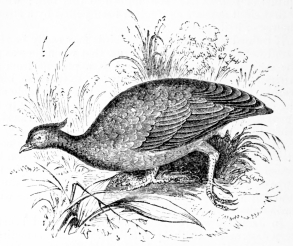
THE MOUND-BIRD OF AUSTRALIA. (Megapodius tumulus.)
It is remarkable that this bird does not hatch its eggs by incubation. It collects together a great heap of decaying vegetables as the place of deposit of its eggs, thus making a hotbed, arising from the decomposition of the collected matter, by the heat of which the young are hatched. This mound varies in quantity from two to four cart-loads, and is not the work of a single pair of birds, but is the result of the united labour of many.
Mr. Gould, in his Birds of Australia, gives the following account of the discovery of one of these nests by Mr. Gilbert:—
“I landed beside a thicket, and had not proceeded far from the shore, ere I came to a mound of sand and shells, with a slight mixture of black soil, the base resting on a sandy beach, only a few feet above high-water mark; it was enveloped in the large yellow-blossomed Hibiscus, and was of a conical form, twenty feet in circumference at the base, and about five feet in height. On pointing it out to the native, and asking him what it was, he replied, ‘Oooregoorga Rambal,’ Jungle-fowls’ house or nest. I then scrambled up the sides of it, and, to my extreme delight, found a young bird in a hole about two feet deep; it was lying on a few dry withered leaves, and appeared only a few days old. So far I was satisfied that these mounds had some connection with the bird’s mode of incubation; but I was still sceptical as to the probability of these young birds ascending from so great a depth as the natives represented, and my suspicions were confirmed by my being unable to induce the native, in this instance, to search for the eggs, his excuse being that he knew it would be no use, as he saw no traces of the old birds having recently been there. I took the utmost care of the young bird, intending to rear it if possible; I therefore obtained a moderate-sized box, and placed in it a large portion of sand. As it fed rather freely on bruised Indian corn, I was in full hopes of succeeding; but it proved of so wild and intractable a disposition, that it would not reconcile itself to such close confinement, and effected its escape on the third day. During the period it remained in captivity, it was incessantly occupied in scratching up the sand into heaps, and the rapidity with which it threw the sand from one end of the box to the other was quite surprising for so young and small a bird, its size not being larger than that of a small quail.
“At night it was so restless, that I was constantly kept awake by the noise it made in its endeavours to escape. In scratching up the sand it only used one foot, and having grasped a handful, as it were, the sand was thrown behind it, with but little apparent exertion, and without shifting its standing position on the other leg: this habit seemed to be the result of an innate restless disposition, and a desire to use its powerful feet, and to have but little connection with its feeding; for although Indian corn was mixed with the sand, I never detected the bird in picking any of it up while thus employed.
“I continued to receive the eggs without having any opportunity of seeing them taken from the mound until the 6th of February; when, on again visiting Knocker’s Bay, I had the gratification of seeing two taken from a depth of six feet, in one of the largest mounds I had then seen. In this instance the holes ran down in an oblique direction from the centre towards the outer slope of the hillock, so that, although the eggs were six feet deep from the summit, they were only two or three feet from the side. The birds are said to lay but a single egg in each hole, and after the egg is deposited the earth is immediately thrown down lightly, until the hole is filled up; the upper part of the mound is then smoothed and rounded over. It is easily known when a Jungle-fowl has been recently excavating, from the distinct impression of its feet on the top and sides of the mound, and from the earth being so lightly thrown over, that with a slender stick the direction of the hole may readily be detected; the ease or difficulty of thrusting the stick down indicating the length of time that has elapsed since the birds’ operations. Thus far it is easy enough; but to reach the eggs requires no little exertion and perseverance. The natives dig them up with their hands alone, and only make sufficient room to admit their bodies, and to throw out the earth between their legs: by grubbing with their fingers alone, they are enabled to fellow the direction of the hole with greater certainty, which will sometimes, at a depth of several feet, turn off abruptly at right angles, its direct course being obstructed by a clump of wood, or some other impediment.”
In all probability, as Nature has adopted this mode of reproduction, she has also furnished the tender birds with the power of sustaining themselves from the earliest period; and the great size of the egg would equally lead to this conclusion, since in so large a space it is reasonable to suppose that the bird would be much more developed than is usually found in eggs of smaller dimensions. The eggs are perfectly white, of a long, oval form, three inches and three quarters long by two inches and a half in diameter.
There are several other Australian birds which adopt the same singular mode of hatching their eggs; one of these is called the Native Pheasant (Leipoa ocellata), and another the Brush Turkey (Talegalla Lathami). The latter has its head and neck covered with a naked skin, like the turkey, but the lower part of this is much thickened, warty, and bright yellow.
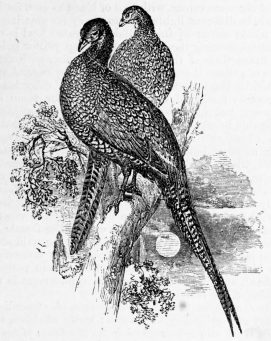
THE PHEASANT. (Phasianus colchicus.)
The name of this bird implies that he was originally a native of the banks of the river Phasis, in Armenia; how and when he emigrated, and began to frequent our groves, is unknown. He is of the size of the common cock; the bill is of a pale horn colour; the nostrils arched; the eyes yellow, and surrounded by a naked warty skin, of a beautiful scarlet, finely spotted with black; immediately under each eye there is a small patch of short feathers, of a dark glossy purple; the upper parts of the head and neck are of a deep purple, varying to glossy green and blue; the lower parts of the neck and breast are of a reddish chesnut, with black indented edges; the sides and lower part of the breast are of the same colour, with tips of black to each feather, which, in different lights, vary to glossy purple; indeed, the whole colour of this half-domesticated fowl is very beautiful, uniting the brightness of deep yellow gold to the finest tints of the ruby and turquoise, with reflections of green; the whole being set off by several spots of shining black; but in this, as in every other kind of gorgeously-feathered birds, Nature has for some wise purposes, yet unknown to us, denied the female that admirable beauty of plumage which belongs to the male. The Pheasant lives in the woods, which he leaves at dusk to perambulate corn-fields and other sequestered places, where he feeds with his females, upon acorns, berries, grain, and seeds of plants, but chiefly on ants’ eggs, of which he is particularly fond. His flesh is justly accounted better meat than any of the domestic or wild fowls, as it unites the delicacy of the common chicken to a peculiar taste of its own. The female lays eighteen or twenty eggs once a year, in the wild state; but it is in vain that we have attempted to domesticate this bird entirely, as she never will remain patiently confined, and if she ever breeds in confinement is very careless of her brood.
There are great varieties of Pheasants, of extraordinary beauty and brilliancy of colours: many of these, such as the Gold and Silver Pheasants (Phasianus pictus and P. Nycthemerus), brought from the rich provinces of China, are kept in aviaries in this kingdom.
This beautiful bird is elegantly described in the following passage:—
“See! from the brake the whirring Pheasant springs, And mounts exulting on triumphant wings; Short is his joy; he feels the fiery wound, Flutters in blood, and panting beats the ground: Ah! what avails his glossy, varying dyes, His purple crest, his scarlet-circled eyes, The vivid green his shining plumes unfold, His painted wings, and breast that flames with gold!” Pope’s Windsor Forest.
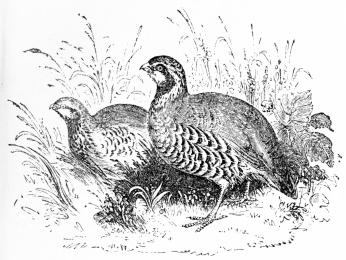
THE RED-LEGGED PARTRIDGE. (Perdix rufus.)
These Partridges are natives of Guernsey and Jersey; but are also very frequently found on the adjoining coasts of France. Of late years they have spread very rapidly in England; and as they are stronger and fiercer than the common partridge, the latter becomes scarce wherever the Red-legged Partridges are abundant. In the Western districts of France they are very abundant, and their flesh is plump and juicy. In England it is as white as in France, but more dry. The side-feathers are very handsomely speckled, and there is a rich black mark beginning behind the eye and forming a kind of gorget on the breast. The eyelids are of a bright red, as are the bill and feet, and the claws are brown. They build their nests on the ground; but are sometimes found perched on trees, or on a fence or paling.
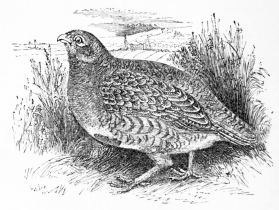
THE COMMON PARTRIDGE, (Perdix cinerea,)
Is in weight about fourteen ounces. The plumage, although it cannot boast of gaudiness, is very pleasing to the eye, being a mixture of brown and fawn-colour, interspersed with grey and ash-colour tints. The head is small and pretty; the beak strong, but short, and resembling that of all other granivorous birds. The female lays fifteen or eighteen eggs, and leads her brood in the corn-fields with the utmost care. Young Partridges are among the birds which run fleetly the moment they come out of the shell, and may sometimes be found running with a piece of the shell still remaining on their heads. The affection of Partridges for their offspring is peculiarly interesting. Both the parents lead them out to feed: they point out to them the proper places for their food, and assist them in finding it by scratching the ground with their feet. They frequently sit close together, covering the young ones with their wings; and from this position they are not easily roused. If, however, they are disturbed, most people acquainted with rural affairs know the confusion that ensues. The male gives the first signal of alarm, by a peculiar cry of distress; throwing himself at the same moment more immediately into the way of danger, in order to mislead the enemy. He flutters along the ground, hanging his wings, and exhibiting every symptom of debility. By this stratagem he seldom fails of so far attracting the attention of the intruder as to allow the female to conduct the helpless unfledged brood into some place of security.
The nest is usually on the ground; but on the farm of Lion Hall, in Essex, belonging to Colonel Hawker, a Partridge, in the year 1788, formed her nest, and hatched sixteen eggs, on the top of a pollard oak-tree! What renders this circumstance the more remarkable is, that the tree had fastened to it the bars of a stile, where there was a footpath; and the passengers, in going over, discovered and disturbed her before she sat close. When the brood was hatched, the birds scrambled down the short and rough boughs, which grew out all around the trunk of the tree, and reached the ground in safety. It has long been a received opinion among sportsmen, as well as among naturalists, that the female Partridge has none of the bay feathers of the breast like the male. This, however, is a mistake; for Mr. Montague happening to kill nine birds in one day, with very little variation as to the bay mark on the breast, he was led to open them all, and discovered five of them were females. On carefully examining the plumage, he found that the males could only be known by the superior brightness of colour about the head; which alone, after the first or second year, seems to be the true mark of distinction. They fly in coveys till about the third week in February, when they separate and pair; but if the weather be very severe, it is not unusual to see them collect together again. We are told that a gamekeeper, in Dorsetshire, hearing a Partridge utter a cry of distress, was attracted by the sound into a field of oats, when the bird ran round him very much agitated; upon his looking among the corn, he saw in the midst of her infant brood a large snake, which he killed; and perceiving its body much distended, he opened it, when to his astonishment two young Partridges ran from their prison, and joined their mother; two others were found dead in its stomach. Partridges have ever held a distinguished place at the tables of the luxurious: we have an old distich: